- The paper demonstrates that structure-preserving discretization via similarity transform secures the positive semi-definite Hermitian property essential for LCHS-based quantum simulation.
- It integrates boundary lifting, midpoint finite difference schemes, and state lifting to seamlessly handle mixed Dirichlet, Neumann, and periodic conditions in both parabolic and hyperbolic PDEs.
- A complete complexity analysis is provided, detailing explicit gate count, spatial discretization, and qubit resource bounds to facilitate practical hardware implementation.
Structure-Preserving Quantum Method of Lines for Evolutionary PDEs with Mixed Boundary Conditions
The paper "Structure-Preserving Quantum Method of Lines for Evolutionary PDEs with Mixed Boundary Conditions" (2606.03407) presents an explicit pipeline for developing quantum algorithms for the simulation of second-order linear evolutionary PDEs—both parabolic (e.g., convection-diffusion) and hyperbolic (e.g., wave, Klein-Gordon)—on rectangular domains with mixed Dirichlet, Neumann, and periodic boundary conditions. The primary technical focus is to ensure post-spatial-discretization compatibility between semi-discrete operator structure and quantum ODE-solving primitives, specifically, the Linear Combination of Hamiltonian Simulation (LCHS) framework for non-unitary parabolic dynamics and Hamiltonian simulation for (suitably formulated) hyperbolic dynamics.
Classical quantum linear systems algorithms (QLSAs) have been successful for elliptic and steady-state PDEs but encounter practical obstacles for evolutionary PDEs with nontrivial boundary or source terms owing to repeated initial/boundary state preparations. The method of lines approach—discretization in space, yielding an ODE system for the time variable—enables direct exploitation of quantum ODE solvers. However, quantum advantage hinges crucially on the structural properties of the resulting semi-discrete operator, which must satisfy stricter positivity or anti-Hermitian conditions than classically necessary due to error amplification under quantum simulation.
Methodology
For parabolic PDEs,
ut=Δu+∑l=1dcluxl+f(x,t)
with general mixed boundaries, the method systematically employs:
- Boundary Lifting by Coons Interpolation: All (possibly inhomogeneous) Dirichlet/Neumann/periodic constraints are homogenized, with induced modifications to f and u0.
- Finite Difference Discretization: A boundary/condition-aware spatial discretization is constructed. For Neumann boundaries, mid-point (staggered) finite difference stencils for second derivatives are used, combined with appropriate first-order closure to avoid negative eigenvalues.
- Diagonal Similarity Transform: To guarantee that the real part of the semi-discrete matrix A is positive semi-definite, a coordinate-wise similarity transform P−1AP is applied, yielding a Hermitian part L⪰0 essential for the LCHS quantum subroutine. This step corrects the failure of classical discretizations (especially with ghost points) to satisfy quantum algorithmic stability constraints.
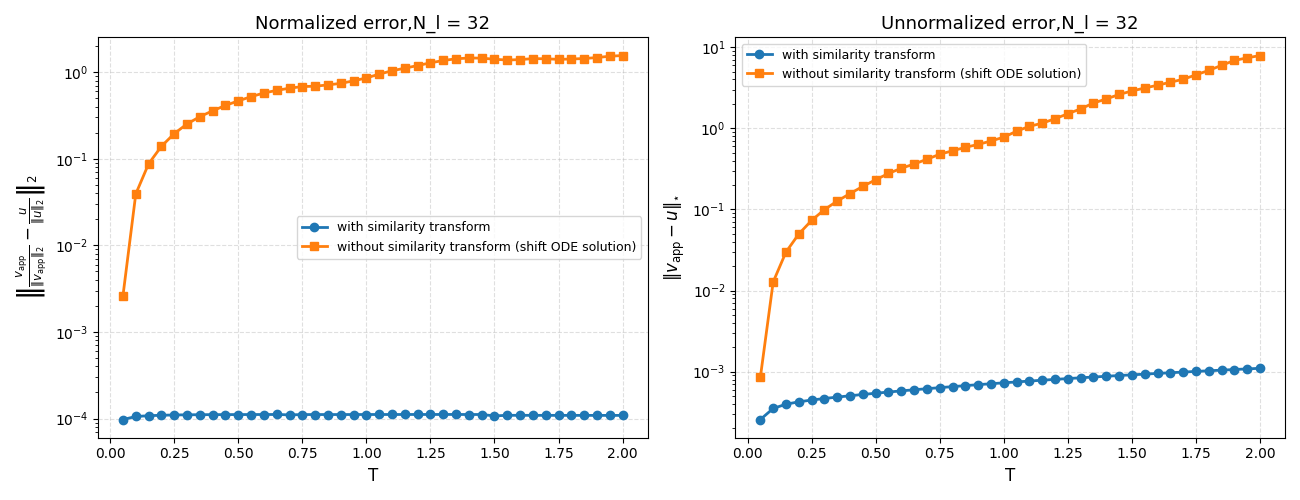
Figure 1: Validity of the similarity transform for Nl=32, demonstrating stable error behavior for long simulation times under the structure-preserving method.
After this pipeline, the quantum LCHS method (recently attaining optimality in [lchs3]) can be invoked, resulting in a block-encoded propagator implemented via optimal quantum signal processing, block-encoding, and linear combination of unitaries.
Hyperbolic PDE: Hamiltonian Simulation via State Lifting
For hyperbolic PDEs with mixed boundaries, e.g.,
utt=Δu+l=1∑dcluxl−c02u+f(x,t)
—subject to vanishing cl for periodic directions to avoid exponential time instabilities—the approach is:
- Spatial Discretization: As above, a structure-preserving (mid-point for Neumann) spatial finite-difference discretization yields a second-order ODE.
- Lifting to First-Order System: The semi-discrete system is mapped to a first-order Hamiltonian system in an extended space via auxiliary variables, and a corresponding block-encoded Hamiltonian matrix H is constructed explicitly. This matrix is Hermitian by construction.
- Quantum Simulation: Propagation under this effective Hamiltonian is implemented via standard QSVT-based Hamiltonian simulation subroutines.
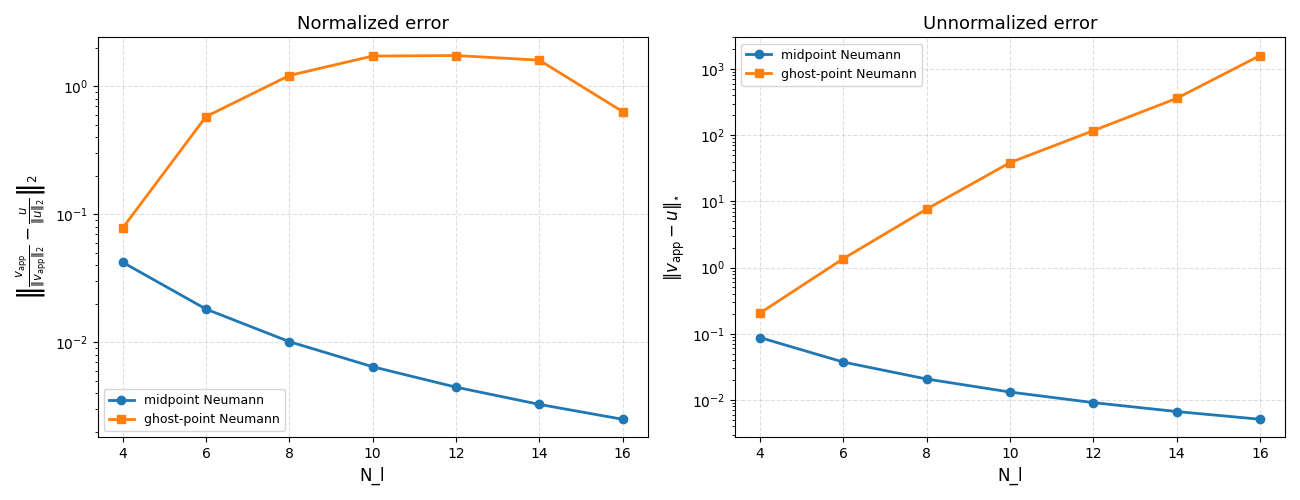
Figure 2: Comparison of midpoint discretization (structure-preserving) and ghost-point (unstable) methods for Neumann boundaries.
Classical Error and Stability Analysis
Despite first-order local errors for Neumann boundaries (due to endpoints), the overall scheme attains second-order accuracy, owing to global error cancellation properties verified both analytically and experimentally.
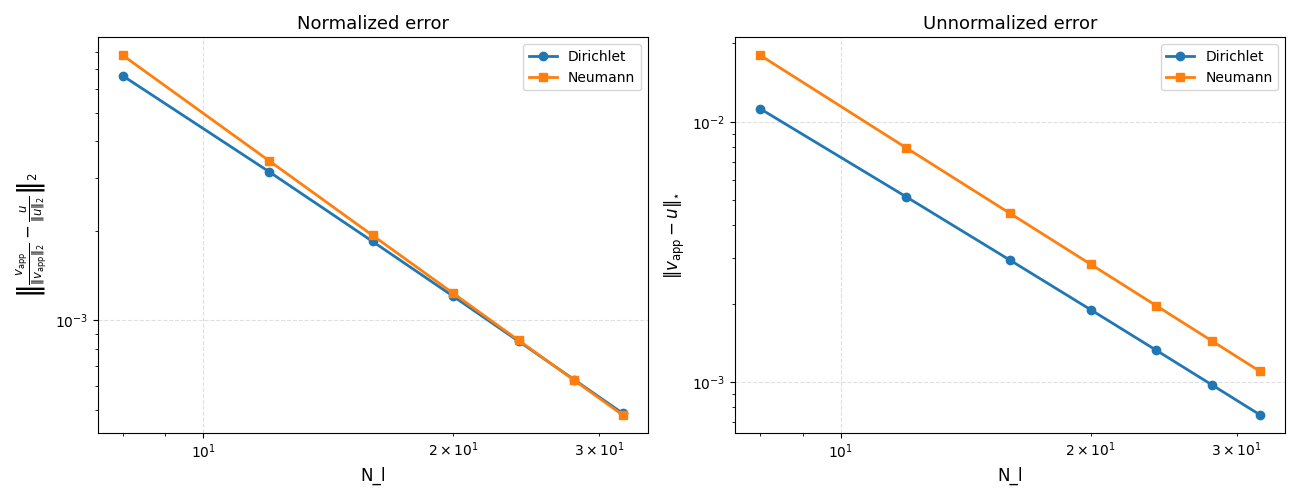
Figure 3: Empirically observed second-order scaling of the global error with respect to the number of spatial grid points for both Dirichlet and Neumann cases.
Strong Claims and Numerical Validation
1. The scheme’s semi-discrete generator always satisfies the required quantum-algorithmic structure: This claim is nontrivial, as almost all conventional finite-difference schemes for Neumann or mixed boundaries fail to produce a positive semi-definite Hermitian part, a requirement much stronger than classical stability. The necessity of the specific mid-point discretization strategy is quantified, with explicit demonstration of the exponential error amplification when this property is violated, e.g., when ghost-point methods are used.
2. End-to-end complexity is fully transparent: The main theorems provide complete upper bounds—including gate complexity, qubit counts, and oracle query complexity—explicitly in terms of the spatial mesh, simulation time, PDE coefficients, problem dimension, and norm properties of the solution and inhomogeneities. The entire error budget (discretization, quadrature, LCHS/simulation) is balanced in the proofs.
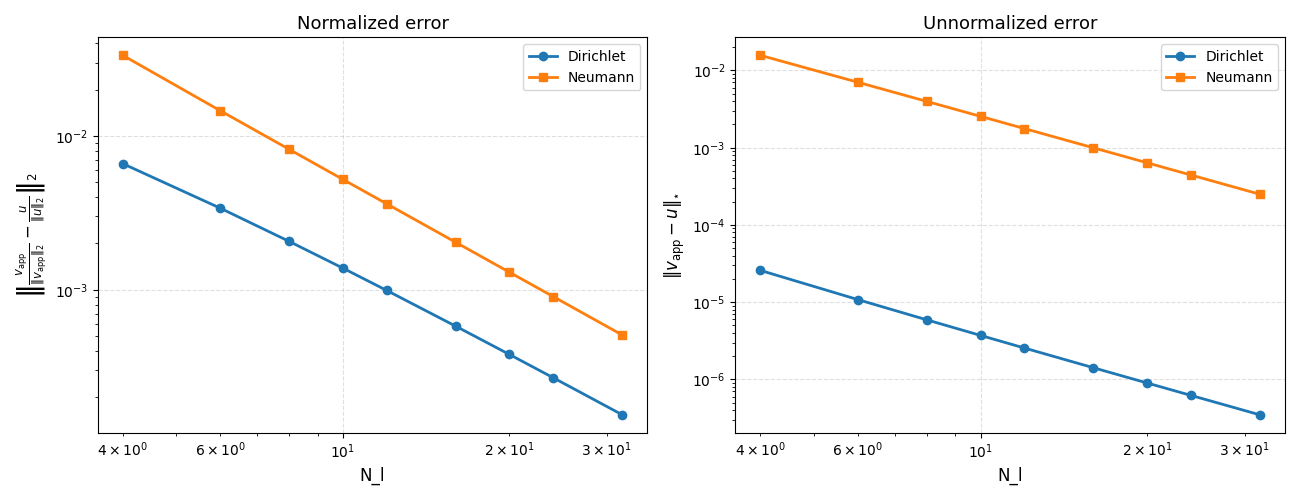
Figure 4: Empirical demonstration of validity and second-order accuracy for high-dimensional hyperbolic equations using the proposed pipeline.
3. Second-order global accuracy is maintained despite boundary-induced first-order terms: This is established for both parabolic and hyperbolic equations with rigorous analysis and direct numerical experiments.
4. Quantitative comparison of LCHS kernel choices influences circuit depth: The impact of kernel selection for the LCHS method on convergence and practical performance is digested by comparing various proposals in the literature.
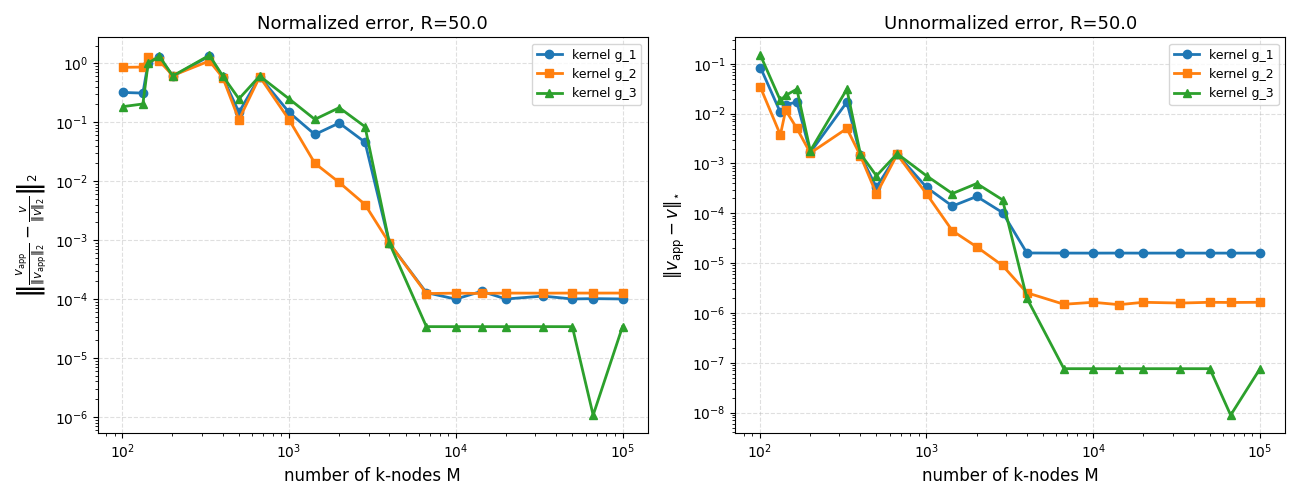
Figure 5: Comparison of LCHS kernel function performance (f0). Kernel 3 (from [lchs3]) yields minimal error across a range of quadrature nodes.
Implications
The primary theoretical implication is a rigorous separation between stability requirements for quantum and classical solvers of differential equations, and the necessity of redesigning discretization schemes for quantum compatibility. The explicit construction and block-encoding formulas provided facilitate direct implementation or hardware synthesis of quantum PDE solvers in arbitrary mixture of Dirichlet/Neumann/periodic boundaries.
On the practical side, for parabolic problems, the overall computational cost scales as f1, where f2 is a uniform bound on third and fourth derivatives of the solution. For the hyperbolic setting, the corresponding cost is milder in f3 and f4, reflecting advantages of structure-compatible Hamiltonian simulation. Gate count and qubit resource bounds include all algorithmic and oracle-preparation costs, establishing concrete roadmap benchmarks for future quantum PDE algorithm implementations.
Future Directions
Several open avenues are discussed:
- Extending to Robin boundary conditions, which are significantly more subtle in quantum settings due to their mixture of Dirichlet/Neumann and their impact on Hermiticity.
- Allowing for variable coefficients and non-rectangular domains, where tensor product structure and block-encoding simplifications no longer hold.
- Improving accuracy dependence from polynomial (due to finite differences) to polylogarithmic, achievable via spectral spatial discretization.
- Applications to physically relevant models in transport, thermal, and wave phenomena, wherever the PDE class and boundary structures match the considered setting.
Conclusion
This work systematically closes the gap between method-of-lines-inspired quantum PDE solution strategies and the structure-preserving discretization required for compatibility with contemporary quantum linear ODE solvers (LCHS/Hamiltonian simulation). All aspects—boundary discretization, similarity transforms, error estimation, block-encoding, and circuit synthesis—are treated with explicit constructions. Numerical experiments spanning parabolic and hyperbolic representatives in low to high space dimensions robustly validate the theoretical design, promoting the framework to a reproducible and hardware-implementable prescription for quantum numerical PDE solution under arbitrary linear boundary mixes.

