- The paper presents a perturbative mechanism for SFSE by analyzing how boundary-induced spectral modifications in periodic systems lead to scale-free localization.
- It employs analytic perturbation theory and the Hatano-Nelson model to derive explicit expressions demonstrating that localization length scales with the system size.
- The study validates theoretical predictions using numerical simulations and highlights limitations in cases of band degeneracies and Hermitian chains.
Mechanism for Scale-Free Skin Effect in One-Dimensional Systems
Introduction
Non-Hermitian physics in condensed matter and synthetic platforms has revealed a plethora of unconventional boundary phenomena, most notably the non-Hermitian skin effect (NHSE), in which a macroscopic fraction of eigenstates exponentially localizes at system boundaries under open boundary conditions (OBC). In the standard NHSE, the localization length is a bulk-defined, system-size-independent quantity, and is now understood via a non-Bloch band theory formalism that generalizes the Brillouin zone (β=eik→β~) and reinterprets bulk-boundary correspondence in non-Hermitian lattices.
Recent work has identified and characterized a variant—termed the scale-free skin effect (SFSE)—in which the localization length itself scales proportionally with the system size under generalized boundary conditions (GBC). This paper presents a model-independent, perturbative mechanism for SFSE, relating it generically to boundary-induced spectral modifications of the periodic system. By using analytic perturbation theory and explicit Hatano-Nelson model calculations, the authors establish the generality of scale-free localization under GBC and delineate its theoretical regime of validity.
General Theoretical Framework
The foundational observation is that non-Hermitian lattices exhibit non-normality, resulting in extreme sensitivity to boundary perturbations. While OBC generically induce exponential skin modes, GBC can produce states with localization lengths that diverge in the thermodynamic limit, i.e., scaling as the system size L.
The approach taken in the paper treats the GBC Hamiltonian as a periodic boundary condition (PBC) system perturbed by finite (boundary) impurities. The unperturbed PBC eigenstates are always extended, with well-defined band structure, and eigenfunctions labeled by k with βk=eik.
Introducing a local (boundary) impurity Hamiltonian Himp, standard non-degenerate perturbation theory yields an eigenenergy correction scaling as $1/L$:
E~p(k)≈Ep(βk)+Cp,k/L,
where Cp,k is independent of L.
Since the functional form Ep(β) is defined independently of the boundary, the associated eigenfunction's (decay) parameter L0 solves
L1
yielding a correction
L2
Consequently, the new "decay factor" for the eigenstate,
L3
where L4 is determined by microscopic details, leads to a localization profile that is not fixed but rather scale-free: the decay length is of order L5. In the thermodynamic limit, the state becomes extended, manifesting qualitative equivalence to the PBC scenario.
The general perturbative expansion is rigorously controlled when L6 (with L7 the imaginary part), ensuring corrections converge and SFSE emerges. Critical or Hermitian points (with degenerate unperturbed bands) necessarily fall outside this regime.
Explicit Models: The Hatano-Nelson Lattice
The Hatano-Nelson (HN) model provides a tractable platform to demonstrate the perturbation mechanism for SFSE. The non-Hermitian tight-binding lattice with asymmetric hopping, under PBC and various impurity configurations, is analyzed.
Boundary Coupling Impurity
For a Hamiltonian with boundary hopping impurities
L8
the analytic expressions for SFSE parameters become
L9
where k0. The scale-free localization direction (left/right) depends on the sign of k1.
The regime of validity for the perturbative framework is dictated by the bound
k2
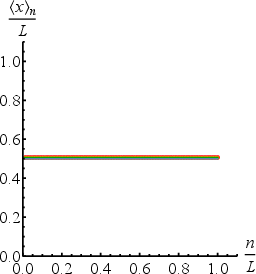
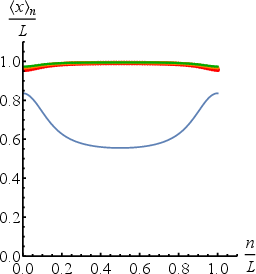
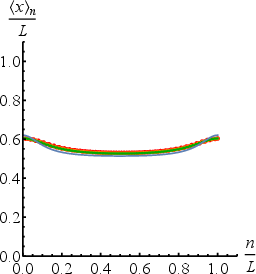
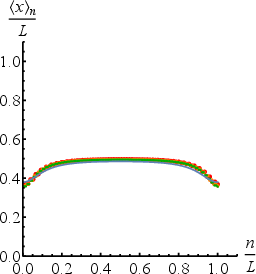
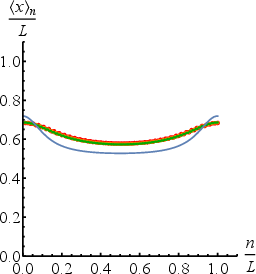
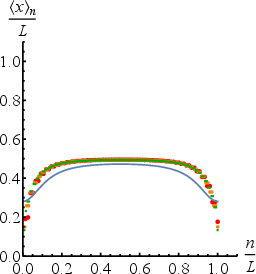
Figure 1: Mean positions for eigenstates of HN model with boundary impurity couplings for various values of k3, confirming SFSE and the theoretical predictions for several system sizes.
These results agree quantitatively with exact diagonalization over a broad parameter regime, as shown by the collapse of mean position data for different k4 and the theoretical scaling predictions. Notably, the theory fails at the OBC limit, where the transition into conventional NHSE occurs.
Onsite Boundary Impurity
The model with a local boundary potential,
k5
yields
k6
with validity constraint k7.
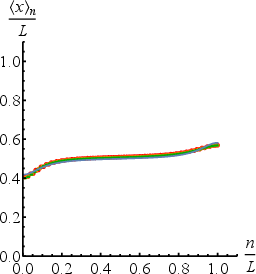
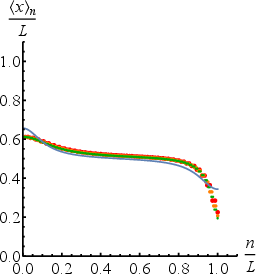
Figure 2: Mean positions for eigenstates under onsite boundary impurity k8, demonstrating excellent agreement with the scale-free analytical results for k9.
In the Hermitian case (βk=eik0), the theory ceases to be valid as band degeneracies break the assumptions of the analysis.
Numerical Verification and Physical Interpretation
The mean position of the eigenstates, as a function of eigenstate index and system size, corroborates the analytic form for the scale-free localization. Specifically, the mean position takes non-trivial values between the extremes of 0 and 1, confirming the states' scale-free, delocalized character in the thermodynamic limit.
The framework establishes that scale-free skin modes generically result from finite (boundary) perturbations to extended states under PBC, provided non-degeneracy and smallness conditions are met. Unlike exponential skin modes (NHSE), whose localization is fixed by bulk parameters, scale-free localization is inherently tied to system size, and is reversible by tuning impurity/boundary couplings.
Implications and Perspectives
This theoretical development generalizes the emergence of SFSE to all 1D non-Hermitian lattices fitting the outlined spectral structure, and clarifies the underlying physical mechanism as the result of a boundary impurity in an extended PBC system. This unifies previously model-specific approaches and provides a readily computable criterion for the presence of SFSE via perturbation theory.
Limitations: The framework does not encompass cases with degenerate bands, such as Hermitian chains with purely imaginary boundary impurity or critical scale-free localization regimes, where breakdown of non-degenerate perturbation theory is expected. Extension of the approach to higher-dimensional systems and interacting models remains non-trivial.
From an experimental perspective, the results inform the design and interpretation of SFSE observations in photonic, electrical, and cold atom platforms where boundary condition control is available.
Conclusion
The paper provides a general, model-independent mechanism for the scale-free skin effect in one-dimensional non-Hermitian systems, deriving analytic expressions for SFSE parameters and verifying predictions in representative lattice models. The work elucidates the profound role of boundary perturbations in non-Hermitian lattice spectra and localization profiles, offering new theoretical tools for predicting and controlling scale-free modes. Future studies should address the breakdown regimes, multi-band degenerate cases, and the extension to higher-dimensional scenarios.

