CalVerT: Augmenting Agents with Calibrated Verifier Telemetry Improves Action and Learning in Knowledge-Intensive Tasks
Abstract: LLM agents in knowledge intensive question answering take retrieval and reasoning actions with incomplete knowledge about whether their current answer is uncertain, unsupported, or already complete. This produces two failure modes: committing to confident but unsupported answers, which hurts accuracy, and over-retrieving when the evidence in hand already suffices, resulting in wasted compute. To give agents a more complete picture of the state space they are operating in, we introduce calibrated verifier telemetry (CalVerT), which augments the agent's state with additional telemetry: a calibrated self-confidence score and a grounding verifier score. We show that CalVerT can improve agents in both training-free and training-based settings. On four QA benchmarks, we find that CalVerT raises F1 by triggering retrieval in cases where agents over-rely on parametric knowledge, while cutting redundant retrieval in cases where agents have sufficient context to answer. We show that CalVerT can augment existing QA frameworks without training. Moreover, CalVerT also improves trained systems: by simply augmenting an agent's state with telemetry, we observe improvements after reinforcement learning, as compared to an agent with identical training but no CalVerT telemetry.
Paper Prompts
Sign up for free to create and run prompts on this paper using GPT-5.
Top Community Prompts
Explain it Like I'm 14
Overview: What this paper is about
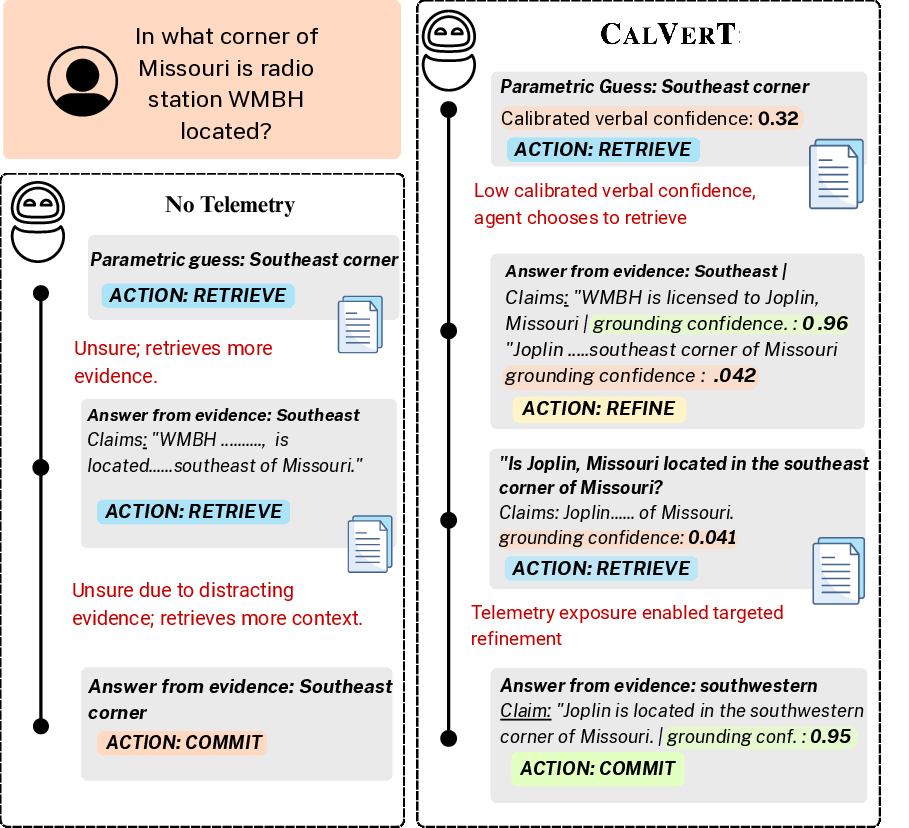
This paper introduces a simple idea to help AI “agents” answer tough questions more accurately and efficiently. The idea is called CalVerT (Calibrated Verifier Telemetry). Think of it like adding a small dashboard to the AI that shows two helpful gauges every time it thinks about an answer:
- How confident it feels about its current answer.
- Whether that answer is actually supported by the evidence it has retrieved.
By giving the agent these two signals at each step, it can choose smarter actions—like searching for more information, fixing its answer, breaking the problem into smaller parts, or stopping when it’s confident and well-supported.
Key questions the paper asks
- Can showing an AI both its confidence level and how well its answer is backed by evidence help it avoid common mistakes?
- Will this “dashboard” make the AI stop guessing when it doesn’t have proof, and stop over-searching when it already has enough information?
- Does this approach work even without retraining the AI, and can it also improve AIs that are trained with reinforcement learning?
Methods and approach, explained simply
Imagine the AI as a detective solving a case. At every step, it can choose one of four actions:
- Commit: “I’m done—this is my answer.”
- Retrieve: “I need to search for more clues.”
- Refine: “I’ll rewrite my answer using the clues I already have.”
- Decompose: “This is too big—let’s split it into smaller questions.”
The paper adds two kinds of telemetry (dashboard signals) to guide these choices:
- Confidence signal: A calibrated score that says how sure the AI is about its answer. It’s like the detective’s gut feeling, but measured carefully so it’s more reliable than just “sounds confident.”
- Grounding signal: A score that checks whether each part of the answer is truly supported by the passages the AI found. It’s like asking, “Do my clues really back this claim?” The system looks at all the claims in the answer, calculates an average support score, and also highlights the weakest claim.
Why both signals? Confidence alone can be dangerously wrong (you can be very sure and still be wrong), and grounding alone can’t tell whether you need more evidence or whether your answer disagrees with the evidence. Together, they tell the agent when to search, when to fix, and when to stop.
The authors test two ways of using this telemetry:
- Training-free: They simply add the two scores into the agent’s prompt (its instructions) so it “sees” the dashboard while thinking.
- Training-based: They train the agent with reinforcement learning (a way of learning from trial and error) while showing it the telemetry, so it learns when it’s smart to retrieve, refine, decompose, or commit.
They evaluate on several question-answering benchmarks (like HotpotQA and 2WikiMultihopQA), which require reading multiple documents and linking facts across them.
Main findings and why they matter
- Better accuracy and smarter actions without retraining: Just showing the telemetry in the prompt often boosted performance. For example, across different systems, F1 scores rose, sometimes by a lot (up to about +15 percentage points in one framework). The agent also cut down on wasteful steps when it already had enough evidence, saving time and compute.
- Fixing two big failure modes:
- Parametric over-trust: When the AI trusts its “memory” too much and commits without proof. Telemetry helped catch these cases and triggered retrieval.
- Over-retrieval: When the AI keeps searching even after it has enough. Telemetry helped it stop sooner.
- Portable across many agent designs: The telemetry worked when plugged into several existing systems (like Self-Ask, TARG, SeaKR) without changing their core logic, improving accuracy in most of them.
- Training makes it even better: When the agent was trained with reinforcement learning while seeing the telemetry, it outperformed identical agents trained without telemetry (for example, gains of roughly +6% F1 on a smaller model and +3% on a larger model). This shows the signals help the agent learn good habits.
In short, the “confidence meter” plus “evidence check” helps the agent:
- Retrieve when it should.
- Avoid retrieving when it doesn’t need to.
- Commit only when the answer is both confident and well-supported.
Implications and potential impact
This approach is simple but powerful:
- It can be added to many question-answering systems right away.
- It tends to make answers more trustworthy (less guessing) and systems more efficient (less wasted searching).
- It helps smaller models too—especially when combined with training—by teaching them to act based on evidence, not just hunches.
A couple of notes:
- The current setup is “commit-centric,” meaning it stops once it has a good single answer. For tasks where you must list all correct items (like “name every country that…”), the agent will need a variant that keeps collecting until the set is complete.
- Very small models may not benefit as much from prompt-only telemetry unless they get trained to use the signals.
Overall, CalVerT is like giving an AI a clear, calibrated dashboard. With better awareness of both its certainty and its proof, it makes better choices—leading to more accurate answers at lower cost.
Knowledge Gaps
Knowledge gaps, limitations, and open questions
The following list captures what remains missing, uncertain, or unexplored in the paper and can guide future research:
- Telemetry source coupling and circularity: DiNCo confidence is obtained by prompting the same generator that makes decisions, especially during RL fine-tuning. How robust is CalVerT when confidence comes from a decoupled, frozen model or a different backbone? Could the policy learn to “game” its own confidence signal?
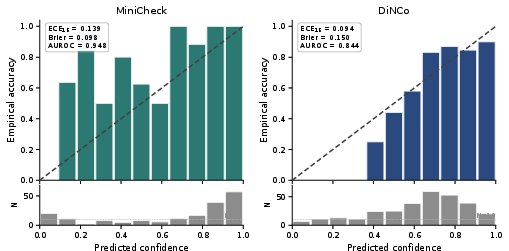
- Calibration quality and drift: The paper assumes DiNCo provides calibrated confidence, but does not report calibration metrics (e.g., ECE, reliability curves) across datasets or after RL fine-tuning. How does calibration degrade or drift with training, and how can it be maintained or re-calibrated online?
- Grounding verifier reliability: MiniCheck-7B’s claim decomposition and entailment scoring are treated as ground truth signals. What is the verifier’s error profile, how does it vary by claim type, and how do verifier misclassifications propagate to action choices and final answers?
- Telemetry update policy: Confidence is cached per subgoal and not recomputed after new evidence is retrieved or the answer is refined. Under what conditions should confidence be recomputed, and how does recomputation vs caching affect performance and cost?
- Aggregation choices for grounding: Only and are used. Do other aggregations (e.g., variance, quantiles, per-claim weights by importance) yield better action decisions? How does claim-number scaling affect telemetry stability?
- Prompt design sensitivity: The telemetry is injected as four scalars with a brief natural-language framing. What is the sensitivity to prompt wording, scalar formatting, scaling (e.g., percentages vs decimals), and placement? Is there a more robust representation (e.g., structured tokens, special control tokens)?
- Confidence-only portability: The framework portability study replaces each framework’s uncertainty gate with DiNCo confidence but does not integrate grounding. Does adding grounding telemetry to these frameworks yield larger gains, and what integration schemes work best?
- Thresholdless vs thresholded policies: The paper avoids hard-coded thresholds, relying on the LLM to reason over telemetry. How do explicit thresholds or learned gates (e.g., small controllers) compare in stability, interpretability, and efficiency?
- Failure analysis depth: Aside from correlation summaries, there is no detailed error analysis (e.g., confident-but-unsupported vs low-confidence-and-wrong). Which specific failure modes are reduced by each telemetry channel, and where does telemetry induce new errors?
- Scale dependence: Prompt-only telemetry degrades with smaller models (e.g., Qwen3-8B). What is the minimal model capacity needed to reliably use telemetry without training? Can lightweight adapters or instruction tuning close this gap?
- Generalization beyond English Wikipedia QA: All evaluations are on English, Wikipedia-style QA. How does CalVerT perform on non-English, multi-domain corpora, dynamic web environments, or tasks with noisy/heterogeneous evidence?
- Beyond QA to broader tool-use: The introduction motivates general agents, but experiments focus on QA. Can telemetry generalize to web agents, code agents, and multi-tool workflows where “grounding” is procedural rather than textual?
- Cost and latency accounting: The paper reports turns/ex but not wall-clock latency, GPU/CPU costs, or telemetry-specific overhead (MiniCheck and DiNCo queries). What are the true compute/latency trade-offs and Pareto frontiers (accuracy vs cost) under different hardware and batching regimes?
- Retriever strength confound: Experiments primarily use BM25 (with reranking only on WiTQA). How does CalVerT interact with dense retrievers (e.g., DPR, ColBERT), web search, or hybrid pipelines? Do gains persist or change under stronger retrieval?
- Planner and composer robustness: The planner and composer are fixed across conditions. How sensitive are telemetry gains to planner errors, decomposition quality, and the final composition step? Can telemetry help detect or correct flawed decompositions?
- Dataset coverage and significance: Results are on small dev slices (e.g., N=300; portability N=100) without statistical tests. Are improvements statistically significant across larger, more diverse sets and different random seeds?
- Portability conditions clarity: The description of “replacing gates” vs “keeping original gates” is ambiguous. Precisely how were DiNCo scores integrated within each framework’s decision logic, and does the method generalize across different gating architectures?
- Telemetry noise and uncertainty: Telemetry itself is uncertain. Can the agent model uncertainty over telemetry (e.g., confidence intervals, meta-calibration) and act robustly when telemetry is noisy, missing, or conflicting?
- RL training stability and rewards: GRPO is applied to small Hotpot slices with LoRA and a specific reward design. How do different RL algorithms, reward weightings, and longer training horizons affect learning, stability, and generalization?
- Action vocabulary limitation (acknowledged): The commit-centric loop is ill-suited for answer set recall tasks (e.g., FANOutQA, QAMPARI). How should telemetry be extended to support accumulate-then-commit policies and stopping conditions that ensure completeness?
- Signal ablation and synergy: The paper claims both signals are essential but provides only correlational evidence. What is the causal contribution of confidence-only, grounding-only, and both signals across tasks and models?
- Adversarial and conflicting evidence: How does the system behave when retrieved evidence is adversarial, contradictory, or off-topic? Can telemetry detect and mitigate such cases, and should conflict-resolution actions be added to the vocabulary?
- Beam and candidate-answer generation: Telemetry is computed over a candidate-answer beam , but beam size and generation settings are not analyzed. How do beam settings influence telemetry stability and action decisions?
- Hallucination and factuality metrics: Improvements are measured via EM/F1; claim-level factuality, faithfulness, or hallucination metrics are not reported. Does grounding telemetry measurably reduce hallucinations under claim-level evaluation?
- Multi-turn calibration drift: Over long trajectories, telemetry may accumulate biases (e.g., early mis-grounding shaping later choices). How do such feedback loops impact outcomes, and can periodic recalibration or verifier ensembles mitigate drift?
- Safety and bias: No analysis of whether telemetry changes the kinds of errors made (e.g., amplifying biases, under-retrieving for certain topics). What are the safety implications of telemetry-driven action policies?
- Robustness to telemetry format changes: If future verifiers output different scales or categorical labels, how robust is the learned or prompted policy? Is normalization/adaptation required to preserve behavior?
- Reproducibility of external components: MiniCheck-7B and DiNCo are external dependencies. How sensitive are results to different verifiers/calibrators, and can community-standard telemetry suites be established for reproducible benchmarking?
Practical Applications
Immediate Applications
The following applications can be deployed now by adapting existing RAG/agent pipelines to include calibrated self-confidence and grounding verification telemetry in the agent state. They leverage CalVerT’s training-free prompt integration, portability across agent frameworks, and demonstrated accuracy–cost gains.
- Calibrated RAG chatbots for enterprise knowledge bases (software, customer support, IT/HR helpdesk)
- What: Add telemetry-aware gates to decide when to answer from parametric knowledge vs. retrieve internal docs, and when to stop retrieving. Surface per-answer confidence and grounding to users, and always attach supporting passages on commit.
- Why now: Paper shows consistent F1 gains and fewer redundant actions across benchmarks and frameworks (e.g., +7.8% F1 in SeaKR with reduced extra retrieval).
- Tools/workflows: “Verifier Telemetry” middleware for LangChain/LlamaIndex; plugin that computes DiNCo confidence and MiniCheck grounding after each draft answer; logs per-turn telemetry for observability; cost-aware policies to reduce retrieval API calls.
- Assumptions/Dependencies: Access to internal search index (BM25/vector); verifier models (MiniCheck or equivalent) generalize to the domain; acceptable latency overhead from verifying claims; larger LLMs benefit most in prompt-only mode or use light RL fine-tuning for smaller bases.
- Research and legal assistants with citation guarantees (academia, legal, policy analysis)
- What: Force retrieval/refinement when confidence is low or grounding is weak; prevent “confident but unsupported” answers; highlight weakest-grounded claim; attach citations by default.
- Tools/workflows: Draft answer → telemetry → retrieve/refine until min-claim grounding passes → commit with citations; risk flags when confidence is high but grounding is low (human review queue).
- Assumptions/Dependencies: Domain-tuned retrievers; claim verifier coverage for legal/scientific language; human-in-the-loop sign-off.
- Clinical literature lookup and guideline summarization assistants (healthcare, non-diagnostic)
- What: Telemetry-gated retrieval for questions about clinical trials and guidelines; refuse to commit without strong grounding; expose confidence and evidence to clinicians.
- Tools/workflows: Integrate with PubMed/Guideline repositories; show “commit only when grounded” behavior; route low-grounding, high-confidence cases to clinician review.
- Assumptions/Dependencies: Not for diagnosis/triage; domain-specific verifiers preferable; strict compliance, auditing, and PHI handling.
- Finance and compliance research copilots (finance, risk, compliance)
- What: Tie answers to filings, disclosures, and regulations; gate “closed-book” answers on long-tail entities/relations; reduce retrieval spam on common facts.
- Tools/workflows: Index SEC/ESMA filings; telemetry dashboards to audit unsupported commits; auto-citations in memos.
- Assumptions/Dependencies: Up-to-date document stores; verifier generalization to numerical/procedural claims; human verification for material decisions.
- Educational tutors and writing assistants with fact-check feedback (education, consumer productivity)
- What: Show learners confidence/grounding meters; automatically retrieve when composing fact-heavy content; prompt to refine unsupported claims.
- Tools/workflows: “Explain your evidence” buttons; weakest-claim highlighting to encourage revision; structured citing requirements in assignments.
- Assumptions/Dependencies: Age-appropriate UX; verifier robustness for varied reading levels; latency acceptable in classroom settings.
- Software engineering agents that retrieve documentation and code context intelligently (software)
- What: Use telemetry to decide when to search repositories/docs before proposing edits; prevent commits when weakest claim (e.g., API assumption) is ungrounded.
- Tools/workflows: Repo/DOC RAG → propose patch → telemetry check → retrieve/refine if weak grounding → test → commit.
- Assumptions/Dependencies: Indexing of repos/issues/docs; verifier coverage for code/text claims (MiniCheck works on text; code-sensitive verifiers are a plus).
- Web and browsing agents with fewer redundant page loads (web automation, e-commerce)
- What: Telemetry-based decision to keep browsing vs. finalize; reduce unnecessary retrieval/API calls while avoiding premature stopping.
- Tools/workflows: Integrate into ReAct-style loops used in web arenas; log per-turn telemetry for performance tuning.
- Assumptions/Dependencies: Site access constraints; verifier operating on scraped text; policy limits for automation.
- AgentOps observability and risk triage (platform/ops, safety)
- What: Track per-turn calibrated confidence and grounding distributions in production; alert on patterns like “high confidence + low grounding” (hallucination risk).
- Tools/workflows: Telemetry dashboards; offline A/B testing of prompt thresholds; SLA and cost governance using action-cost penalties.
- Assumptions/Dependencies: Telemetry logging and storage; privacy-compliant analytics; organizational processes to act on alerts.
- Human review prioritization in labeling and editorial pipelines (media, marketing, data ops)
- What: Route low-grounding responses or high-confidence-but-ungrounded outputs to senior review; auto-approve well-grounded, high-confidence items.
- Tools/workflows: Queue scoring/ranking by telemetry; weakest-claim drill-down for editors.
- Assumptions/Dependencies: Calibrated thresholds validated against domain QA; editor capacity and SOPs.
- Training efficiency upgrades for internal models (ML platforms)
- What: Adopt telemetry-aware RL (e.g., GRPO) to learn better action policies without changing other components; reduce turns and retrieval cost.
- Tools/workflows: Drop-in LoRA adapters trained with telemetry-augmented state and cost-aware rewards; deploy alongside existing retrievers/verifiers.
- Assumptions/Dependencies: Small RL budgets; curated training pool; reproducible reward shaping; monitoring for regressions.
- Search and answer snippet generation with self-checks (search, content platforms)
- What: Use telemetry to decide when to show an answer vs. “see sources” prompt; ensure snippets cite grounded claims.
- Tools/workflows: Inline confidence/grounding badges; auto-retrieve for long-tail queries.
- Assumptions/Dependencies: UX acceptance of confidence displays; re-ranking and snippet selection pipelines.
- Cost and energy savings across RAG fleets (energy, infra)
- What: Reduce redundant retrieval/refinement turns without hurting F1; schedule expensive actions only when telemetry indicates need.
- Tools/workflows: Policy rules that price actions; carbon-aware scheduling using telemetry as a compute budget signal.
- Assumptions/Dependencies: Accurate action cost models; telemetry correlation with outcome maintained in-domain.
Long-Term Applications
These require further research, domain-specific verifiers, scaling, or new action vocabularies, but are natural extensions of CalVerT’s telemetry paradigm.
- High-stakes decision support with domain-calibrated verifiers (healthcare diagnosis, legal advice, public policy)
- What: Deploy domain-specific claim verifiers and calibration schemes; mandate grounded commitments and human escalation for residual uncertainty.
- Dependencies: Robust medical/legal/scientific verifiers; rigorous calibration audits; regulatory approvals; comprehensive safety cases.
- Telemetry standards and audit trails for AI governance (policy, compliance)
- What: Standardize “agent telemetry schema” (confidence, grounding, weakest-claim, action costs) for compliance reporting and incident forensics.
- Dependencies: Cross-vendor interoperability; logging standards; privacy-preserving telemetry collection; policy frameworks recognizing calibrated telemetry.
- Exhaustive recall and set-building agents (systematic reviews, e-discovery, procurement)
- What: Extend action vocabulary beyond “commit” to support “enumerate until coverage,” with telemetry guiding completeness and stopping criteria.
- Dependencies: Coverage estimators, recall-aware rewards, and verifiers that detect missing-but-relevant claims; dataset curation for training.
- Cross-modal and structured-data grounding (multimodal AI, data analytics)
- What: Claim verification over tables, charts, code, and images; telemetry-aware retrieval from data lakes and BI systems.
- Dependencies: Verifiers for numerical consistency, table reasoning, and code semantics; connectors to analytical backends.
- Privacy-preserving and on-device telemetry (edge AI, regulated data)
- What: Lightweight, private verifiers and calibrators running on-prem/edge; zero-retention pipelines for sensitive queries.
- Dependencies: Efficient verifier architectures; hardware acceleration; privacy guarantees (e.g., differential privacy, federated evaluation).
- Multi-agent collaboration via telemetry negotiation (autonomous systems, Ops)
- What: Agents expose telemetry to coordinate—specialists take over when others show low grounding; arbitration based on calibrated signals and action costs.
- Dependencies: Protocols for telemetry exchange; task routing frameworks; stability under adversarial or noisy telemetry.
- Carbon- and cost-aware orchestration at scale (energy, cloud)
- What: Global schedulers allocate retrieval/refinement budgets according to telemetry-driven uncertainty and current carbon intensity/pricing.
- Dependencies: Real-time carbon signals; cost models; policy engines that integrate per-turn telemetry and SLAs.
- Sector-specific productization
- Healthcare: EHR-integrated literature copilot enforcing grounding to guidelines; clinician-in-the-loop dashboards.
- Law: Research stack with authoritative-source prioritization and weakest-claim cross-checks across jurisdictions.
- Finance: Risk/compliance assistants that refuse to commit on ungrounded interpretations of regulations.
- Dependencies: Deep domain verifiers, curated corpora, governance integration, vendor certifications.
- Unified observability and safety scoring for agent platforms (platform ecosystems)
- What: Make telemetry first-class: exposure in SDKs, auto-instrumentation, aggregated “unsupported-commit rate,” and safety scores for model/agent versions.
- Dependencies: Ecosystem buy-in (frameworks, vendors), benchmarking corpora that measure grounding and calibration longitudinally.
- Training paradigms with telemetry-informed rewards across tasks (ML research)
- What: Generalize GRPO-style training to many tools and domains, shaping policies with outcome + cost + telemetry-aligned rewards.
- Dependencies: Stable reward designs; scalable RL infra; negative side-effect analysis (e.g., avoiding over-cautiousness).
Notes on Feasibility Assumptions (cross-cutting)
- Calibration and verification quality: The utility of telemetry hinges on well-calibrated confidence estimates (e.g., DiNCo) and reliable claim verifiers (e.g., MiniCheck). Domain shift may degrade both; domain-specific tuning may be required.
- Model scale and training: Prompt-only telemetry works best with sufficiently capable LLMs; smaller models may need light RL fine-tuning to exploit telemetry effectively.
- Latency/cost trade-offs: Running verifiers per turn adds overhead; benefits depend on retrieval/tool-call costs and latency budgets.
- Data access and privacy: Effective grounding requires access to trustworthy, up-to-date sources; sensitive domains need on-prem or privacy-preserving setups.
- Task fit: The current commit-centric loop suits single-answer QA; tasks requiring exhaustive recall need extended action vocabularies and stopping rules.
Glossary
- 2WikiMultihopQA: A multi-hop question answering dataset requiring reasoning across multiple documents. "2WikiMultihopQA"
- Agent loop: The iterative control process where an agent selects actions (e.g., retrieve, refine, commit) over turns. "a ReAct-style agent loop."
- Bespoke-MiniCheck-7B: An external verifier model used to assess whether claims are supported by evidence. "Bespoke-MiniCheck-7B"
- BM25: A probabilistic information retrieval ranking function used to retrieve relevant passages. "Retrieval uses BM25"
- Calibrated verbal self-confidence: A method for eliciting and calibrating a model’s own stated confidence about an answer. "calibrated verbal self-confidence score"
- Calibrated verifier telemetry (CalVerT): The paper’s framework exposing calibrated confidence and grounding signals to guide agent actions. "calibrated verifier telemetry (CalVerT)"
- Composer: A component that assembles the final answer from the question and evidence after the agent loop. "a composer pass produces the final answer "
- Cross-encoder reranking: A reranking strategy where a model jointly encodes query and passage to refine retrieval results. "cross-encoder reranking"
- Directed acyclic graph (DAG): A graph with directed edges and no cycles; here, it encodes dependencies among subgoals. "directed acyclic graph (DAG)"
- DiNCo: A technique/model that produces normalized verbal confidence and self-consistency signals for answers. "produced by DiNCo"
- Entailment: The relation where evidence supports or implies a claim. "scores each claim's entailment against the current evidence pool "
- Exact match (EM): A metric that checks if the predicted answer exactly matches the gold answer after normalization. "normalized exact match (EM)"
- F1 (token-level F1): The harmonic mean of precision and recall computed over tokens comparing predicted and gold answers. "token-level F1"
- Grounding verifier: A model that evaluates whether answer claims are supported (grounded) by retrieved evidence. "per-claim grounding verifier"
- GRPO: Group-relative policy optimization; an RL algorithm used to train the agent policy from outcome feedback. "we use GRPO"
- HotpotQA-distractor: A multi-hop QA benchmark with distractor paragraphs that requires multi-document reasoning. "HotpotQA-distractor"
- LoRA: A parameter-efficient fine-tuning technique that inserts low-rank adapters into a base model. "a LoRA adapter (rank $16$)"
- Mixture-of-Experts (MoE): A neural architecture where multiple expert subnetworks are selectively activated by a router. "Mixture-of-Experts model"
- MuSiQue: A multihop QA dataset created by composing single-hop questions to require connected reasoning. "MuSiQue"
- Normalized verbal confidence (nvc): A calibrated scalar capturing the model’s elicited yes/no confidence about its answer. "nvc is the normalized verbal confidence"
- Over-retrieval: A failure mode where the agent keeps retrieving despite having sufficient evidence. "over-retrieval"
- Parametric knowledge: Knowledge stored in the model’s parameters rather than obtained via external retrieval. "parametric knowledge"
- Planner: The component that decomposes a question into a subgoal structure before the agent acts. "A planner first decomposes the question "
- ReAct: A prompting framework that interleaves reasoning steps with actions like retrieval. "ReAct-style"
- Reinforcement learning (RL): A learning paradigm optimizing policies via rewards, used here to train agent decisions. "reinforcement learning (RL)"
- Rollouts: Sampled trajectories of agent actions and outputs used for training/evaluation under RL. "we sample four rollouts per question"
- SeaKR: An adaptive retrieval framework that triggers retrieval based on uncertainty signals. "SeaKR"
- Self-Ask: An iterative decomposition framework where a model asks follow-up subquestions to solve complex queries. "Self-Ask"
- Self-consistency rate: The proportion of sampled answers that agree, serving as a confidence proxy. "sc is the self-consistency rate of the generator."
- SUGAR: A method that leverages contextual confidence to adaptively control retrieval. "SUGAR"
- Subgoal: A decomposed intermediate objective the agent must resolve en route to answering the main question. "current subgoal"
- TARG: A training-free adaptive gating approach that decides when to retrieve for efficiency. "TARG"
- Telemetry signal: The per-turn numerical signals (confidence and grounding) injected into the agent’s state. "telemetry signal"
- Turn budget: A fixed limit on the number of agent turns allowed per question. "per-question turn budget is exhausted"
- Verify-and-Edit: A framework that verifies intermediate answers and edits them based on uncertainty signals. "Verify-and-Edit"
- WiTQA: A fact-centric QA dataset with questions tied to supporting passages and popularity analyses. "WiTQA"
Collections
Sign up for free to add this paper to one or more collections.

