EvoEmbedding: Evolvable Representations for Long-Context Retrieval and Agentic Memory
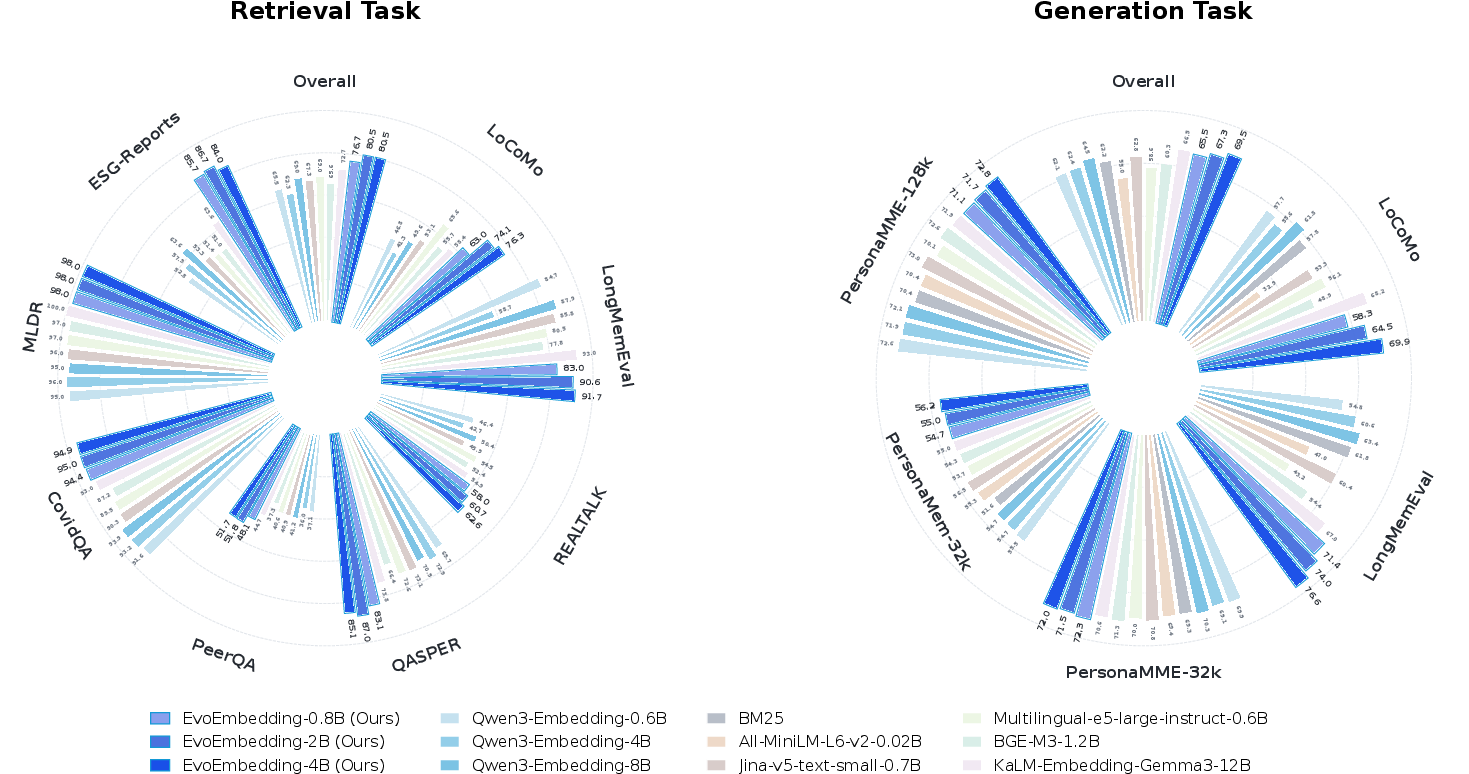
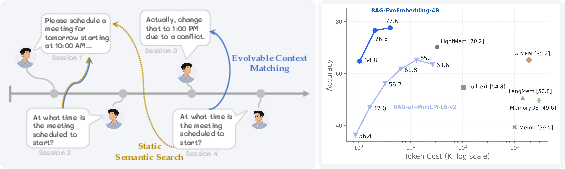
Abstract: Existing embedding models are inherently static: they encode text segments in isolation, ignoring their surrounding context and temporal order. This paper introduces EvoEmbedding, a novel embedding model that generates evolvable representations for retrieval. It is tailored for long-context scenarios, where information is dynamic, sequential, and requires continuous state tracking. Our design is simple: EvoEmbedding maintains a continuously updated latent memory as it sequentially processes inputs, and uses it alongside the raw content to jointly generate evolvable embeddings. Consequently, for the same query, our model adapts its representation to retrieve distinct targets based on the evolving context, going beyond static semantic search. To equip the model with this capability, we construct EvoTrain-180K, a diverse dataset for the joint optimization of latent memory and retrieval. Furthermore, we introduce a memory queue to prevent representation collapse during recurrent encoding, alongside segment-batching techniques that tackle significant length variance and accelerate training by 3.8$\times$. Extensive experiments show that our model not only outperforms larger-scale specialists (e.g., Qwen3-Embedding-8B and KaLM-Embedding-Gemma3-12B) across a range of long-context retrieval benchmarks, but also generalizes well to downstream tasks (e.g., personalization) with contexts 10$\times$ longer than its training window. Notably, EvoEmbedding seamlessly integrates into agentic workflows to boost performance. For instance, a naive RAG pipeline equipped with our model surpasses dedicated agentic memory systems. Project Page: https://clare-nie.github.io/EvoEmbedding.
Paper Prompts
Sign up for free to create and run prompts on this paper using GPT-5.
Top Community Prompts
Explain it Like I'm 14
What is this paper about?
This paper introduces EvoEmbedding, a new way for computers to remember and find information in very long texts or conversations. Unlike most current systems that treat each paragraph or message separately, EvoEmbedding keeps a small, constantly updated “memory” of what happened before. That way, when you ask a question, it can find the right information based on what has changed over time, not just on similar wording.
What questions are the researchers trying to answer?
They focus on simple but important questions:
- Can we build embeddings (think: compact “fingerprints” of text) that change as the conversation or document evolves, instead of staying the same forever?
- Will this help computers find more accurate, up-to-date information when the situation changes (like rescheduling a meeting)?
- Can this approach work on very long contexts (tens of thousands of words) and still be fast and reliable?
- Can it plug into existing tools (like chatbots and memory systems) to make them better without making them slower and more complicated?
How does EvoEmbedding work? (In everyday language)
Think of reading a long chat or article. If you only remember one paragraph at a time, you’ll miss how things change from start to finish. EvoEmbedding fixes that by combining two ideas:
- A small, evolving memory
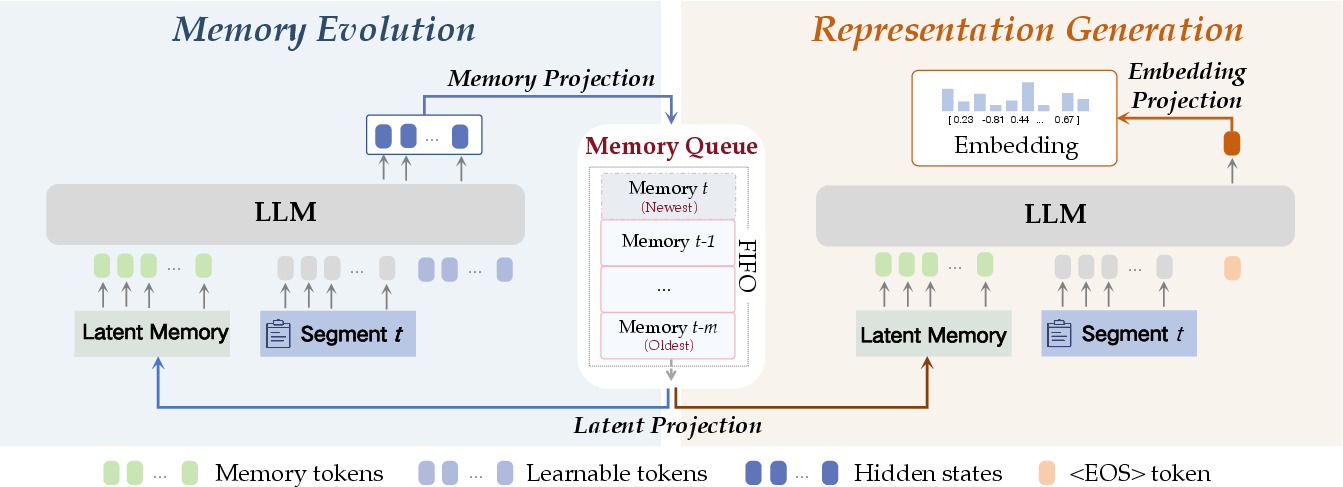
- Analogy: It keeps a tiny notepad where it writes down the most important points as it reads each new chunk of text.
- This notepad is a “queue” (First-In-First-Out): the oldest notes get removed when new ones come in, so the memory stays small and focused. This avoids the model “looping” on its own thoughts and losing accuracy.
- Context-aware embeddings
- Analogy: For every chunk of text, it creates a fingerprint that mixes the current text with what’s in the notepad.
- Because the fingerprint depends on the current state of the notepad, the same question can retrieve different answers if the context changed (like a meeting being moved from Tuesday to Friday).
To make this fast and stable:
- Segment-batching: Instead of reading one chunk at a time, it reads several in a batch (like skimming a few paragraphs together) to speed things up.
- Two training goals:
- Memory goal: The notepad must be good enough to help answer questions about the text (the model practices using only its tiny memory + question to produce the right answer).
- Retrieval goal: It learns to match questions to the right chunks (positives) and ignore wrong ones (negatives), even when there are many distractors.
- Lightweight adaptation (LoRA): They add small adapters to a base LLM so it learns this new behavior without forgetting how to understand language.
They also built a training dataset called EvoTrain-180K:
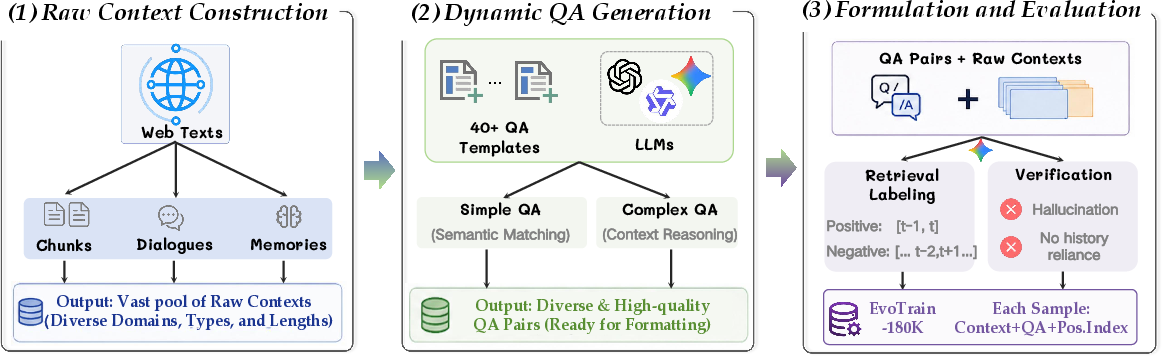
- They gathered long texts and multi-turn dialogues, created many question types (including time- and reasoning-based questions), and carefully labeled which chunks contain the right answers.
- This trains the model to handle dynamic, real-life situations (like “What did I say first?” vs. “What did I say last?”).
What did they find, and why is it important?
Across 10 benchmarks (tests on long documents and conversations), EvoEmbedding:
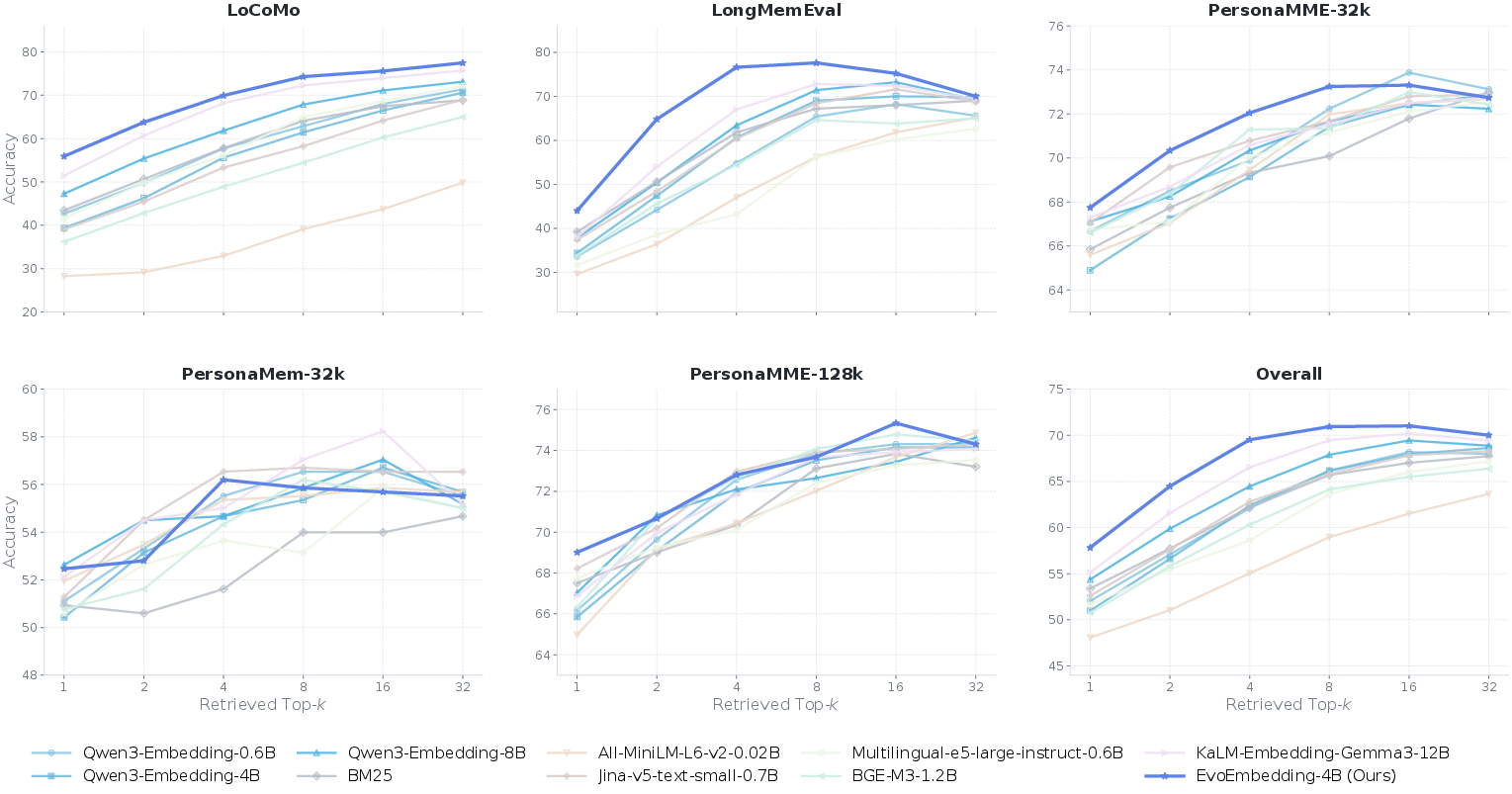
- Finds information better than bigger, well-known models (like Qwen3-Embedding-8B and KaLM-Embedding-12B), even though EvoEmbedding is smaller (0.8B–4B parameters).
- Handles much longer contexts at test time (up to 128K tokens), even though it was trained on much shorter ones—showing strong generalization.
- Works great in RAG (Retrieval-Augmented Generation): a simple RAG pipeline using EvoEmbedding beat dedicated “agentic memory” systems on a popular benchmark (LongMemEval). For example, it scored about 77.6% vs. 65.2% (A-MEM) and 70.2% (LightMem).
- Improves existing memory systems as a drop-in component, giving large gains (like +19.2% for A-MEM) without needing complicated extra steps.
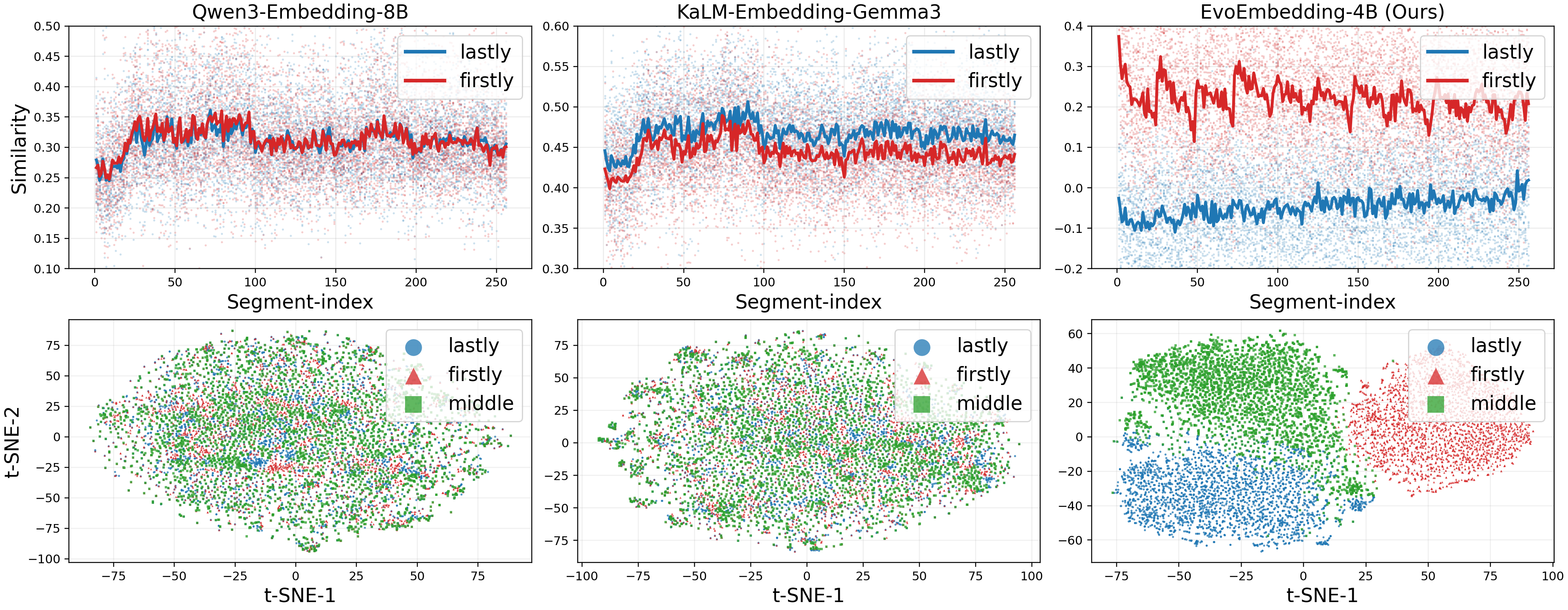
- Understands time-sensitive questions: if you ask “What did I say firstly?” it focuses on the beginning; if you ask “lastly,” it focuses on the end. Most static models can’t do this well.
In short, EvoEmbedding’s “evolving memory + context-aware fingerprints” help it find the right information at the right time, especially when things change.
Why does this matter?
- Better assistants and chatbots: It can remember how things changed over time and fetch the latest, most relevant info (like your most recent preference or schedule).
- Simpler, faster pipelines: You can get top results with a basic RAG setup—no need for expensive, slow, multi-step agent workflows.
- Plug-and-play upgrades: You can add EvoEmbedding to existing systems to boost accuracy without rewriting everything.
- Scales to long contexts: It stays reliable even when conversations or documents become very long.
- Efficient memory use: The tiny “notepad” keeps costs predictable and makes the system more stable.
Overall, this research shows a practical way to make retrieval smarter by teaching embeddings to evolve with the story, not just match words.
Knowledge Gaps
Knowledge gaps, limitations, and open questions
Below is a concise, actionable list of what remains uncertain or unexplored in the paper.
- Large-scale indexing in open-world corpora: How to build and maintain indices when segment embeddings depend on document-internal temporal order (sequential encoding), especially across millions of documents where “position-dependent” segment vectors may complicate sharding, merging, and global retrieval.
- Incremental updates and index maintenance: When earlier parts of a document change, subsequent segment embeddings (which depend on prior memory states) must be recomputed; the paper does not quantify update costs or propose incremental refresh strategies.
- Cross-document retrieval at web scale: Training contrasts only within-sample negatives (segments from the same long context). The impact on retrieval quality in settings with cross-document/global negatives and very large candidate pools is untested.
- Heterogeneous structures beyond linear sequences: The approach assumes a FIFO temporal order; applicability to non-linear sources (e.g., wikis with hyperlinks, graphs, tables, codebases, hierarchical docs) is unexamined.
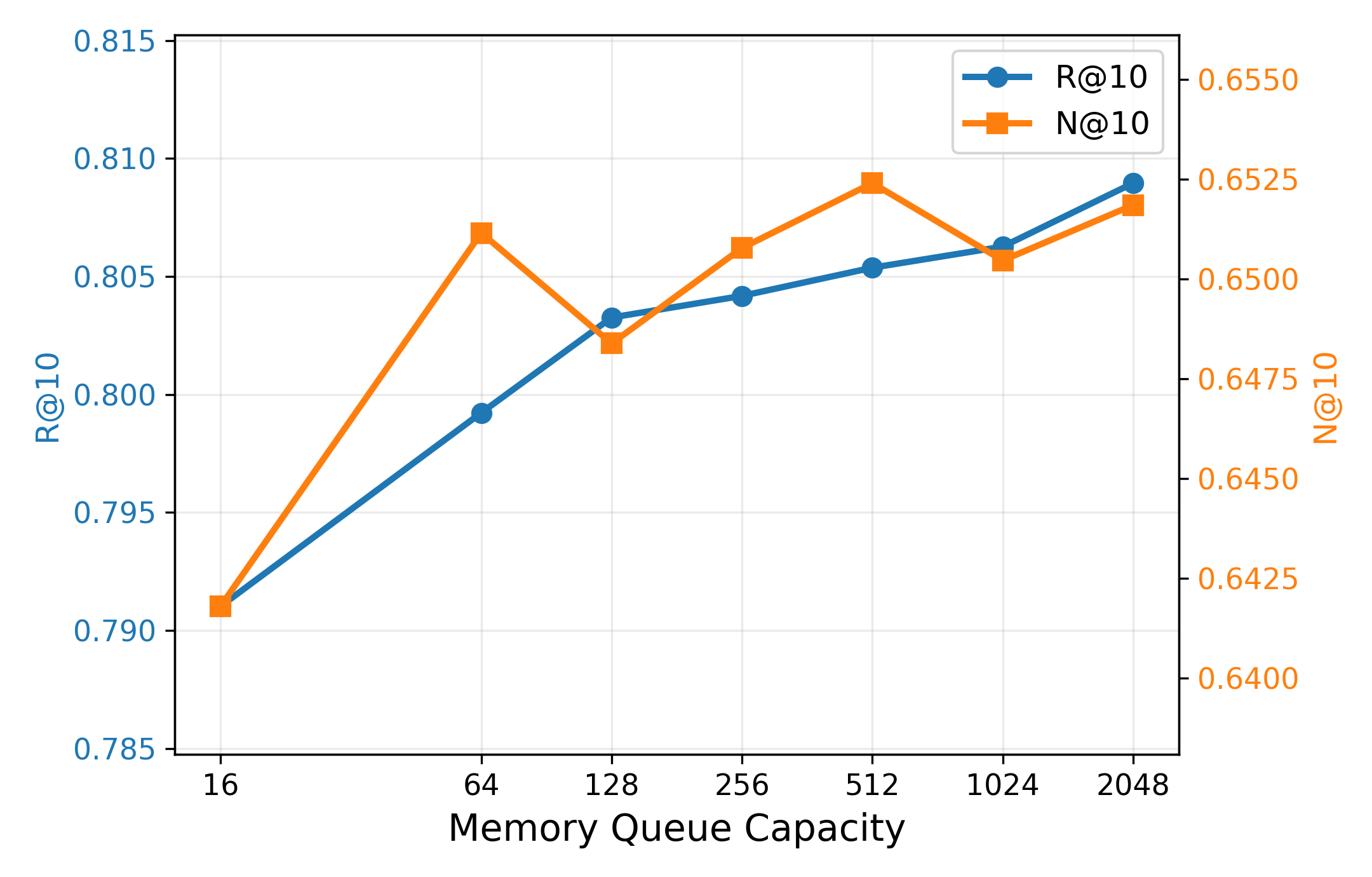
- Memory capacity vs. performance trade-off: Only a fixed memory capacity is evaluated (C=512, K=16). There is no sensitivity analysis of capacity, token budget per step, or adaptive scheduling (e.g., content-based vs. FIFO eviction) under varying task demands.
- Stability for ultra-long horizons: Although the model generalizes to 128K tokens, behavior beyond that (e.g., multi-hundred-thousand or million-token contexts), and robustness of the queue mechanism at extreme lengths, remains unexplored.
- Retention of distant events: FIFO queue discards older states after L steps. The failure modes when queries hinge on long-range, low-frequency facts beyond the memory horizon are not characterized; adaptive retention or recall is not studied.
- Temporal reasoning depth: The temporal analysis focuses on keyword-based “first/last/middle” sensitivity. More complex temporal reasoning (e.g., durations, overlapping intervals, causal order, updates with contradictions) is not assessed.
- Cross-model alignment and portability: The memory loss aligns latent memory to a frozen base LLM’s semantic space. How well the learned embeddings transfer to different generator LLMs (or across families) is not quantified.
- Dependence on base model choice: The impact of different backbones (beyond Qwen-based variants) on retrieval quality, stability, and compute/latency is not systematically studied.
- Training data realism and bias: EvoTrain-180K is predominantly synthetic (LLM-authored templates/dialogues). Generalization to noisy, real-world conversational logs and enterprise documents, and the risk of template/LLM bias, are not evaluated.
- Domain and task breadth: Benchmarks emphasize long-context QA and personalization. Performance on standard general-purpose retrieval suites (e.g., MTEB) and domain-specific tasks (e.g., code, legal, financial compliance) is not reported.
- Multilingual and cross-lingual capability: Despite multilingual baselines in comparisons, EvoEmbedding’s performance outside English (both training and evaluation) is not tested.
- Multimodal contexts: The method is text-only; how latent memory and evolvable embeddings extend to multimodal inputs (images, audio transcripts) is unaddressed.
- Efficiency and latency at inference: The paper acknowledges extra encoding time for memory construction but does not fully quantify latency/throughput across context lengths, batch sizes, and deployment settings (e.g., CPU, edge devices).
- Online/streaming deployment: How to persist, reuse, or reset latent memory across sessions, users, or long-running agents is unspecified; strategies for memory sharing, isolation, and eviction in multi-session, multi-user settings are open.
- Privacy and data isolation: When used for agentic memory, how to avoid cross-user leakage via latent memory states is not discussed; mechanisms for secure compartmentalization and auditable memory are unaddressed.
- Robustness to adversarial or poisoned context: Susceptibility to prompt injection, contradictory updates, or malicious segments that steer the latent memory is not evaluated.
- Catastrophic collapse theory: The queue is shown empirically to prevent representation collapse, but there is no theoretical analysis of stability (e.g., bounds on repeated re-encoding, effect of L, K, and τ).
- Negative sampling strategy: Only within-context negatives are used; the effect of mixing in hard negatives from other documents/domains (or mined adversarial negatives) on generalization is unknown.
- Segmenting policy sensitivity: The model assumes a given segmentation; the effect of segmentation granularity, overlapping windows, or adaptive segmentation on retrieval quality and compute is not analyzed.
- Combination with reranking/reasoning: While EvoEmbedding outperforms reranking/reasoning baselines independently, potential complementary gains from stacking a reranker or lightweight reasoning on top of EvoEmbedding are not reported.
- Fairness and reproducibility: Reliance on closed LLMs (Gemini-3.1-Pro for labeling and GPT-4o-mini for judging) may limit reproducibility; human evaluation, inter-annotator agreement, and statistical significance testing are not provided.
- Data contamination checks: Possible overlap between training sources (e.g., FineWeb) and evaluation corpora is not examined; no decontamination procedures are described.
- Continual and lifelong learning: The approach is trained offline; mechanisms for online adaptation (without full retraining), avoiding drift, and handling evolving user preferences are open.
- Storage footprint and operational costs: Although memory tokens are compact, the operational storage/compute costs for building and refreshing embeddings over large corpora are not benchmarked against strong static baselines.
- Failure cases: The paper notes slight underperformance on certain LoCoMo subtasks (temporal/open-domain) but does not provide error analyses to guide targeted improvements.
Practical Applications
Immediate Applications
Below are concrete, deployable use cases that leverage EvoEmbedding’s evolvable, temporally aware representations, memory queue, and segment-batching, along with the reported performance gains in long-context retrieval and agentic workflows.
- Enterprise knowledge assistants with timeline awareness (Sector: software/enterprise)
- Use case: Internal copilots that answer “latest vs. original” policy questions, track evolving SOPs, and surface the most up-to-date ESG, HR, or compliance guidance from long documents and change logs.
- Tools/workflows:
- EvoEmbedding-powered RAG that encodes policies sequentially and indexes per-segment embeddings with FIFO latent memory.
- Temporal cues in prompts (e.g., “firstly,” “lastly,” “as of this quarter”) to exploit temporal sensitivity.
- Integrate with vector DBs (FAISS/Milvus/Pinecone) and existing RAG stacks.
- Assumptions/dependencies: Sequential indexing per document is feasible; version history is accessible; moderate encoding overhead vs. static embeddings is acceptable.
- Customer support and CRM memory (Sector: software/customer experience)
- Use case: Retrieve multi-session history (preferences, commitments, escalations) to reduce repetition and resolve conflicts when customers change requests over time.
- Tools/workflows:
- Session-level memory construction (per customer thread) and Top-k retrieval feeding to a generator.
- Plug-and-play replacement for rerankers in existing support bots (demonstrated gains over Qwen3-Reranker-4B).
- Assumptions/dependencies: Clear per-thread ordering; conversation logs stored with timestamps; privacy/PII safeguards.
- Document AI for long reports (ESG, research, regulatory filings) (Sector: finance, sustainability, public companies)
- Use case: Precisely answer “what changed last update,” “compare first vs. latest targets,” and “retrieve the final approved figures” from lengthy reports with revisions.
- Tools/workflows:
- Batch sequential encoding of filings; EvoEmbedding Recall@10/NDCG@10 leads to better evidence retrieval.
- “Latest-first” retrieval option using temporal cues.
- Assumptions/dependencies: Each query is tied to a specific report or filing set; re-indexing on major updates is acceptable.
- Legal case and contract lifecycle search (Sector: legal)
- Use case: Retrieve the binding clause version after amendments, identify superseded terms, and track case developments across filings.
- Tools/workflows:
- Per-matter sequential index; temporal-aware retrieval UI (“at signing,” “after second amendment”).
- Assumptions/dependencies: Version control and chronology preserved; validation by counsel for critical responses.
- Clinical timeline retrieval for longitudinal care (Sector: healthcare)
- Use case: Answer timeline-specific questions across EHRs (“latest HbA1c,” “first recorded adverse reaction,” “most recent care plan change”).
- Tools/workflows:
- Patient-level sequential encoding of notes and labs; Top-k retrieval to a compliant generation model.
- Assumptions/dependencies: PHI handling and compliance (HIPAA/GDPR); domain adaptation likely needed; human-in-the-loop.
- Engineering knowledge and codebase evolution (Sector: software engineering)
- Use case: Retrieve “current spec vs. original ADR,” “refactor rationale,” and “latest API contract” from long-running repositories and design docs.
- Tools/workflows:
- Sequential indexing of ADRs/PRs/releases; integrate into IDE copilots; temporal prompts (“prior to v2.0”).
- Assumptions/dependencies: Repo chronology is available; indexing pipelines can handle large histories.
- Education copilots with student memory (Sector: education)
- Use case: Personalize help using long-term learning histories—retrieve “last misconception,” “earliest mastery evidence,” or “recent performance changes.”
- Tools/workflows:
- Per-student sequential memory; retrieval-constrained context to keep token costs low.
- Assumptions/dependencies: Consent and privacy; alignment with institutional data policies.
- Contact center analytics and coaching (Sector: operations/analytics)
- Use case: Retrieve multi-call patterns, last commitments, or unresolved issues across agent/customer histories for QA and coaching.
- Tools/workflows:
- Temporal queries across call transcripts; plug-and-play integration atop existing analytics pipelines.
- Assumptions/dependencies: Clean session stitching; acceptable latency for batch analytics.
- Security and incident response timeline retrieval (Sector: cybersecurity)
- Use case: Retrieve “first indicator,” “latest TTP,” and “sequence of actions” from multi-stream logs and tickets.
- Tools/workflows:
- Sequential encoding of incidents and logs; temporal disambiguation to avoid outdated IOCs.
- Assumptions/dependencies: Log order fidelity; high-precision requirements may need domain fine-tuning.
- Government records and policy assistants (Sector: public sector/policy)
- Use case: Surface latest statute language, compare amendments, and retrieve “in-force vs. superseded” guidance across legislative histories.
- Tools/workflows:
- Temporal-aware RAG for legislative archives; per-bill/act sequential memory construction.
- Assumptions/dependencies: Trusted canonical sources; auditability and provenance logging.
- Media and content continuity (Sector: media/entertainment)
- Use case: Writers’ rooms and editors retrieve “first mention,” “latest canon,” or “continuity overrides” across season bibles and scripts.
- Tools/workflows:
- Sequential indexing of scripts/notes; temporal filters in creative assistants.
- Assumptions/dependencies: Versioned assets; creative oversight to resolve conflicts.
- Plug-and-play upgrade for agentic memory systems (Sector: AI platforms)
- Use case: Replace rerankers or complex reasoning retrieval with EvoEmbedding to lift overall accuracy while lowering token overhead.
- Tools/workflows:
- Drop-in component for Mem0, LightMem, A-MEM, MemoryOS; maintain same Top-k budget; batch inference support.
- Assumptions/dependencies: GPU memory budget (comparable to 4B rerankers); sequential pre-encoding available.
- On-device or edge personalization (Sector: consumer/daily life)
- Use case: Personal journals, email, calendar assistants that can answer “what did I say last about X?” with strong temporal awareness.
- Tools/workflows:
- 0.8B/2B variants with quantization; per-user sequential index built locally; private RAG.
- Assumptions/dependencies: Device-class hardware and storage; user consent; acceptable latency for local encoding.
- Training pipeline acceleration for embedding teams (Sector: AI/ML tooling, academia)
- Use case: Adopt segment-batching (3.8× speedup) and memory queue to prevent collapse during training of new temporal/long-context retrievers.
- Tools/workflows:
- Multi-LoRA setup decoupling memory evolution and representation generation; length-weighted multi-positive contrastive loss.
- Assumptions/dependencies: Access to base LLMs and LoRA infra; mixed-length datasets.
- Benchmarking and evaluation for long-context retrieval (Sector: academia/industry evaluation)
- Use case: Evaluate temporal and personalization capabilities using LongMemEval, LoCoMo, PersonaMem/MME; reproduce state-of-the-art baselines.
- Tools/workflows:
- EvoTrain-like data synthesis pipeline for internal eval; temporal query probes (first/last/middle).
- Assumptions/dependencies: Availability of datasets and license-compliant judges; controlled evaluation harness.
Long-Term Applications
These use cases are promising but need further research, scale-up, domain adaptation, or ecosystem support.
- Temporal-native vector databases and APIs (Sector: software/data infra)
- Vision: Vector DBs that natively manage latent memory states, versioned embeddings, and temporal filters, reducing re-encoding and simplifying per-session indexing.
- Dependencies: New index formats for memory-aware embeddings; routing/query-time memory selection.
- Cross-modal evolvable embeddings (Sector: multimodal AI)
- Vision: Extend EvoEmbedding to video/audio/IoT streams for timeline-sensitive retrieval (“first malfunction sound,” “final scene reference,” “latest sensor anomaly”).
- Dependencies: Multimodal pretraining, synchronized temporal labeling; memory-augmented encoders for non-text.
- Real-time streaming assistants with continuous memory (Sector: AI assistants/robotics)
- Vision: Always-on assistants that update latent memory on-device as events unfold, enabling low-latency, temporal RAG during live operations.
- Dependencies: Efficient streaming encoders; memory compaction policies; edge deployment and privacy-preserving learning.
- Domain-certified retrieval in high-stakes settings (Sector: healthcare, legal, finance)
- Vision: Safety-assured retrieval where “latest supersedes prior” is guaranteed, with provenance and version traceability.
- Dependencies: Formal verification, audit logs, regulatory approvals, robust domain fine-tuning, and risk controls.
- Federated and privacy-preserving personalization (Sector: consumer/enterprise privacy)
- Vision: On-device memory with secure aggregation to improve models without sharing raw histories.
- Dependencies: Federated optimization for memory modules; secure enclaves; consent management.
- Knowledge graph + evolvable embedding hybrids (Sector: knowledge management)
- Vision: Temporal KG edges aligned with memory-aware embeddings to combine symbolic revision tracking with latent semantic retrieval.
- Dependencies: Co-training and alignment methods; scalable temporal KG tooling.
- Temporal-aware search engines (Sector: web search)
- Vision: Web-scale retrieval that respects time and updates, answering “as of date X” with high fidelity across evolving pages and versions.
- Dependencies: Efficient global re-index strategies; document-version catalogs; scalable memory queues.
- Incident forensics and digital twins with lifelong memory (Sector: industrial/energy/IoT)
- Vision: Plant/digital twin assistants that retrieve events along a machine’s lifetime to explain failures and decisions.
- Dependencies: Long-horizon storage, stream alignment, domain-specific adaptation; reliability guarantees.
- Standardization and benchmarks for temporal RAG (Sector: academia/standards)
- Vision: Shared tasks/datasets for temporal reasoning in retrieval (beyond short, static samples), focusing on collapse prevention, memory efficiency, and fairness.
- Dependencies: Community curation, legal data sharing, evaluation frameworks.
- Tooling ecosystem: EvoRAG SDK and trainers (Sector: developer tools)
- Vision: SDKs that automate sequential encoding, memory queue management, temporal prompts, and segment-batching; trainers with length-weighted contrastive objectives.
- Dependencies: Broad community adoption; integration guides for popular LLM stacks.
- Latent memory interchange format (Sector: interoperability)
- Vision: A standard for exporting/importing compact latent memories so different components (retrievers, agents, generators) can share state without exposing raw data.
- Dependencies: Security model, schema design, and buy-in from model providers.
- Policy and records management modernization (Sector: public sector/policy)
- Vision: FOIA/e-discovery systems that default to temporal-aware retrieval (e.g., “final determination,” “first official notice”), improving transparency and response quality.
- Dependencies: Records normalization, legal process integration, provenance preservation.
Cross-cutting assumptions and dependencies to consider
- Sequential encoding is required to construct memory-aware per-segment embeddings; pipelines must preserve order and versioning.
- Query-time memory: best performance occurs when a session-specific or document-specific memory state is available (e.g., per conversation or per document). For global multi-document search, routing to a candidate memory or using a memory-agnostic query variant may be necessary.
- Encoding overhead is higher than static embeddings, though mitigated by segment-batching (3.8× training speedup reported). Plan for indexing latency and GPU budgets.
- Domain adaptation may be required in specialized sectors (healthcare, legal, finance). Safety, compliance, and auditability are essential for high-stakes deployments.
- Privacy and data governance must be designed in (PII handling, consent, retention policies, on-device options).
- Tooling readiness: success depends on integration with existing RAG stacks, vector stores, schedulers, and observability for retrieval quality.
Glossary
- Agentic RAG: A retrieval paradigm that uses autonomous agents to orchestrate dynamic, multi-step retrieval workflows. "the emerging paradigm of agentic RAG~\citep{singh2025agentic} integrates autonomous agents to orchestrate dynamic query routing and multi-step iterative retrieval"
- Autoregressive generation: A token-by-token text generation process where each output depends on previously generated tokens. "existing mechanisms remain deeply coupled with the autoregressive generation process of LLMs"
- BM25: A classical lexical information retrieval algorithm that ranks documents based on keyword occurrences and term statistics. "as well as the traditional keyword-based retriever, BM25"
- Catastrophic forgetting: A phenomenon where a model forgets previously learned knowledge when trained on new tasks. "we employ lightweight LoRA adaptation to equip general-purpose LLMs with strong representation capabilities while avoiding catastrophic forgetting"
- Contrastive learning: A representation learning approach that pulls semantically similar pairs together and pushes dissimilar pairs apart. "current embedding models are optimized via contrastive learning primarily on short, static samples"
- Contrastive loss: A loss function that aligns query representations with relevant contexts by contrasting positives against negatives. "The second term is the contrastive loss designed to align the query representation with the relevant contexts."
- Coreference resolution: The task of identifying when different expressions refer to the same entity across text segments. "such as coreference resolution and temporal reasoning"
- Cross-entropy: A standard loss function for classification and sequence prediction measuring divergence between predicted and true distributions. "The first term is measured using standard cross-entropy."
- Curriculum learning: A training strategy that organizes data from easy to hard to stabilize learning. "without curriculum learning~\citep{bulatov2023scaling}"
- Evolvable embeddings: Context-aware representations that adapt to changing, sequential information rather than remaining static. "and uses it alongside the raw content to jointly generate evolvable embeddings"
- First-In-First-Out (FIFO): A queue mechanism where the oldest entries are removed first as new ones arrive. "is a First-In-First-Out (FIFO) queue matrix."
- Hadamard product: Element-wise multiplication of vectors (or matrices), often used to combine representations. "query-conditioned segment representations (Hadamard product)."
- Knowledge graphs: Structured representations of entities and relationships used to augment retrieval and reasoning. "introduce auxiliary storage structures such as knowledge graphs"
- LLMs: High-capacity neural models trained on large text corpora to understand and generate language. "Retrieval-Augmented Generation (RAG) has emerged as a dominant paradigm for augmenting LLMs with external knowledge"
- Latent memory: A compact, internal representation that accumulates and preserves evolving contextual state across segments. "EvoEmbedding maintains a continuously updated latent memory as it sequentially processes inputs"
- Latent Memory Queue: A bounded FIFO structure that stores recent latent tokens to stabilize recurrent updates and prevent collapse. "Latent Memory Queue."
- Latent space: The internal representation space where models encode semantic structure for reasoning and retrieval. "jointly performing reasoning, retrieval, and generation within the model's latent space"
- Latent tokens: Compact learned tokens that summarize segment information for storage in latent memory. "represents the newly generated latent tokens"
- Length-weighted multi-positive contrastive loss: A contrastive objective that scales with the number of negatives and supports multiple positives per query. "we formulate a length-weighted multi-positive contrastive loss:"
- LoRA (Low-Rank Adaptation): A parameter-efficient fine-tuning method that injects low-rank adapters into a frozen backbone. "we employ lightweight LoRA adaptation to equip general-purpose LLMs with strong representation capabilities"
- Memory capacity: The fixed size allocated to latent memory, constraining complexity and enforcing fusion of new and historical states. "The memory capacity is defined as "
- Multi-agent collaboration: Coordinated workflows where multiple agents contribute to query routing, reasoning, and retrieval. "and multi-agent collaboration~\citep{nguyen2025ma} to balance computational overhead and retrieval precision"
- Multi-LoRA: Using multiple LoRA adapters to decouple different capabilities (e.g., memory evolution vs. representation generation). "We employ a multi-LoRA~\citep{hu2022lora} design to decouple the memory evolution and representation generation capabilities"
- Normalized Discounted Cumulative Gain (NDCG@k): A ranking metric that evaluates the quality of ordered retrieval results up to k items, discounted by position. "Normalized Discounted Cumulative Gain (NDCG@)"
- Projector: A learned mapping that transforms newly generated latent tokens into the shared memory space. "f_m(\cdot) is a projector to map the newly generated tokens"
- Plug-and-play module: A component that can be integrated into existing systems without major architectural changes. "Comparison of EvoEmbedding as a plug-and-play module against other strategies"
- Query rewriting: Reformulating the original query to improve retrieval relevance and bridge semantic gaps. "optimizing query representations through rewriting"
- Recall@k: The fraction of relevant items found within the top-k retrieved results. "Recall@"
- Recurrent encoding: Iteratively processing segments while feeding updated memory back into the model over time. "This avoids the collapse caused by recurrent encoding of memory"
- Recurrent Memory Transformer (RMT): An architecture that maintains and updates latent memory to handle very long sequences with linear complexity. "the Recurrent Memory Transformer (RMT)\citep{bulatov2022recurrent,bulatov2023scaling} extends the context window to over 1M tokens"
- Reranker: A model that reorders initial retrieval candidates to refine the final list of relevant segments. "frequently introduce additional reranker models to refine the candidate list"
- Representation collapse: Degeneration of embeddings to indistinguishable vectors, often due to unstable recurrent updates. "we introduce a memory queue to prevent representation collapse during recurrent encoding"
- Retrieval-Augmented Generation (RAG): A paradigm that augments generation with retrieved external knowledge to extend context and improve accuracy. "Retrieval-Augmented Generation (RAG) has emerged as a dominant paradigm"
- Segment-Batching: A technique to process multiple consecutive segments in parallel to speed up training and inference. "We introduce a dynamic Segment-Batching technique"
- Sliding window approach: Partitioning long text into overlapping segments by moving a fixed-size window over the sequence. "process them into sequential segments using a sliding window approach"
- t-SNE visualization: A dimensionality reduction method used to visualize high-dimensional representations in 2D. "t-SNE visualization of query-conditioned segment representations"
- Temperature hyperparameter: A scaling factor in softmax similarities that controls the sharpness of distribution. "and is a temperature hyperparameter"
- Temporal reasoning: Understanding and reasoning about time-dependent relationships and order in context. "such as coreference resolution and temporal reasoning"
- Temporal RAG: Retrieval-augmented generation explicitly sensitive to temporal cues and ordering. "we show our model is inherently suited for temporal RAG"
- White-box access: Direct access to internal model states and parameters, enabling tight integration but limiting API compatibility. "as they require full white-box access to internal hidden states"
Collections
Sign up for free to add this paper to one or more collections.

