- The paper introduces a scaling axis through learned coordination of specialized LLMs, enabling collective intelligence that surpasses individual models.
- The methodology combines supervised fine-tuning, evolutionary optimization, and RL-based prompt engineering to dynamically optimize multi-agent workflows.
- Empirical results show state-of-the-art performance across coding, reasoning, and agentic tasks, outperforming leading frontier LLMs.
Sakana Fugu: Collective Intelligence via LLM Orchestration
Motivation & Theoretical Foundations
Recent advances in frontier LLMs demonstrate increasing domain specialization and complementary strengths across models. The Sakana Fugu technical report (2606.21228) formalizes a new scaling axis: orchestrating a pool of specialized LLMs through learned model coordination, rather than raw parameter scaling. Sakana Fugu models are trained to understand queries, devise agentic scaffolds, and dynamically select and combine agents (frontier LLMs) for each task. The orchestrator paradigm posits intelligence and capability as emergent from optimal agent selection, dynamic communication, and behavioral composition, transcending individual model limitations and harnessing collective intelligence.
System Architecture
Orchestrator Variants: Fugu & Fugu-Ultra
Fugu exposes two orchestrator variants:
- Fugu: Targeted for low-latency, everyday workloads, employing efficient model selection via a lightweight head and parallel singular-value fine-tuning. Each input is dispatched to a single agent, using hidden-state driven selection rather than full decoding.
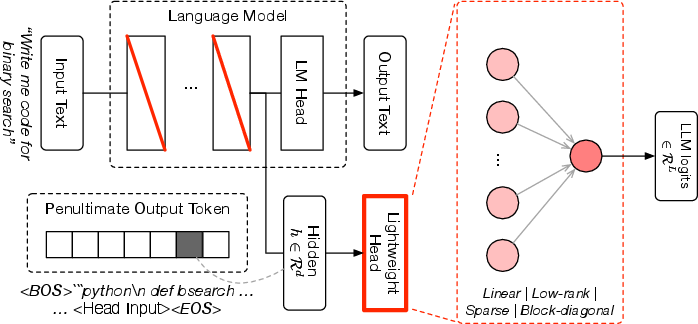
Figure 1: Fugu parametrization—lightweight head selects worker; internal hidden states serve as input for efficient orchestration.
- Fugu-Ultra: Prioritizes maximal answer quality, constructing multi-agent workflows with higher orchestration depth. Built atop the Conductor framework, it leverages RL-based prompt engineering, adaptive agent memory, and multi-step decomposition. Workflows encapsulate arbitrary topologies (debate, aggregation, builder–debugger cycles), exploiting fine-grained specialization and cross-agent communication.
Training Methodology
Fugu
Fugu utilizes a two-stage process:
- Supervised Fine-tuning (SFT): Trained on single-step verifiable tasks, with reward distributions based on worker agent performance, providing robust supervision via softmax targets conditioned on measured reward vectors. The lightweight head and singular-value scales are optimized via KL-divergence minimization.
- Evolutionary Optimization: sep-CMA-ES directly maximizes terminal reward on multi-turn end-to-end agentic tasks (e.g., repository management, iterative code editing, tool usage, feedback loops). SFT initialization guarantees stability; ES discovers granular task-specific routing, adapting to real-world agentic workflows.
Fugu-Ultra
Fugu-Ultra extends the Conductor RL paradigm:
- RL via GRPO on agentic workflow outputs, rewarding solutions that match ground truth while penalizing malformed workflows.
- Training incorporates adaptive memory strategies for function call ordering and intra-/inter-workflow agent isolation, allowing persistent context retention without orchestration collapse.
- Large-scale agentic data exposes real-world skill requirements and enables specialization recognition and optimal workflow construction.
Aggregate Benchmarking
Fugu models set new SOTA performance standards over diverse coding, reasoning, scientific, and agentic benchmarks, consistently outperforming leading individual frontier LLMs (Gemini-3.1-Pro, Claude-Opus-4.8, GPT-5.5) and even the Mythos Preview and Fable 5 model class.
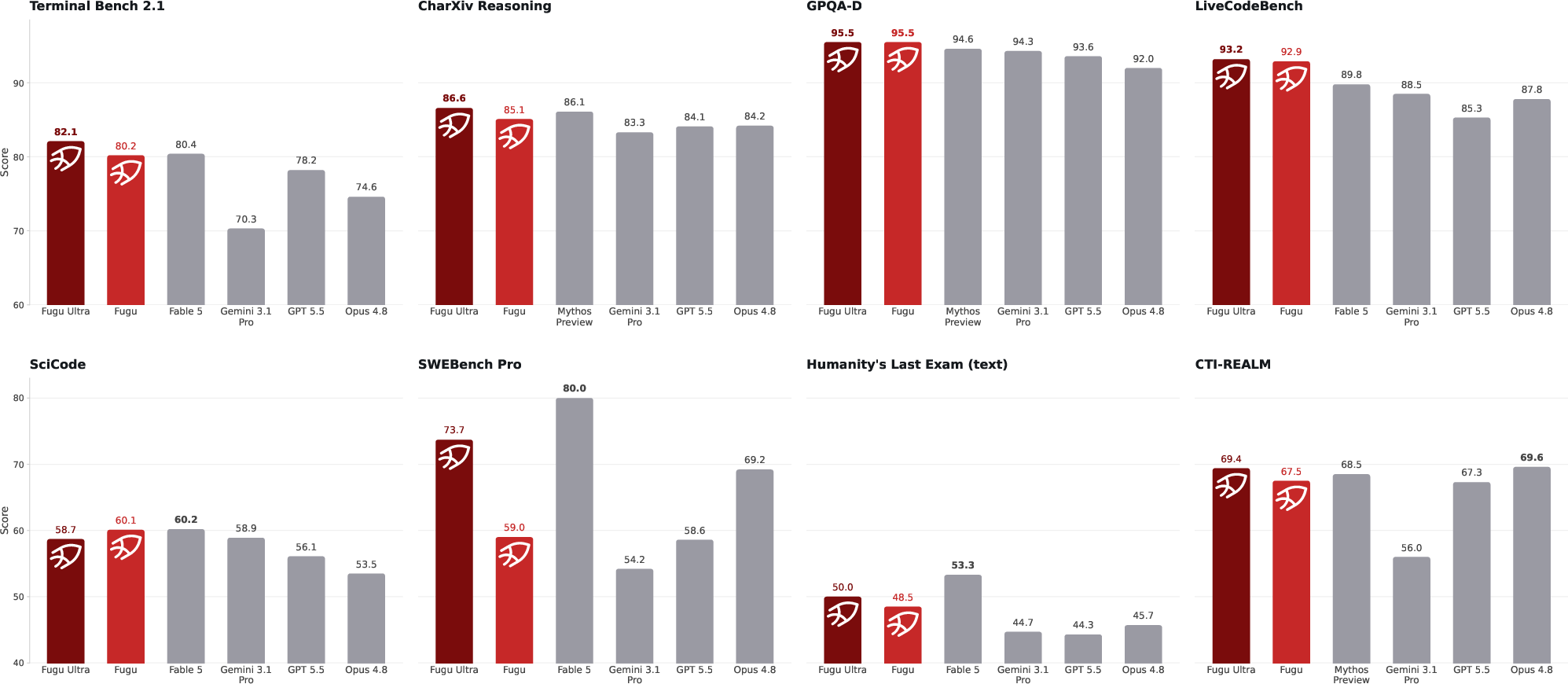
Figure 2: Sakana Fugu and Fugu-Ultra deliver superior aggregate performance across coding, scientific, and reasoning benchmarks relative to frontier and baseline models.
Agentic Coding and Generational Upgrades
Fugu-Ultra accesses performance gains typical of next-generation frontier models through orchestration, surpassing Claude-Opus in SWE Bench Pro and GPT-5.5 in Terminal Bench. Per-step alternation and topology adaption (builder–debugger role allocation) yield performance jumps of 5–6%—consistently tracking model generational upgrades.
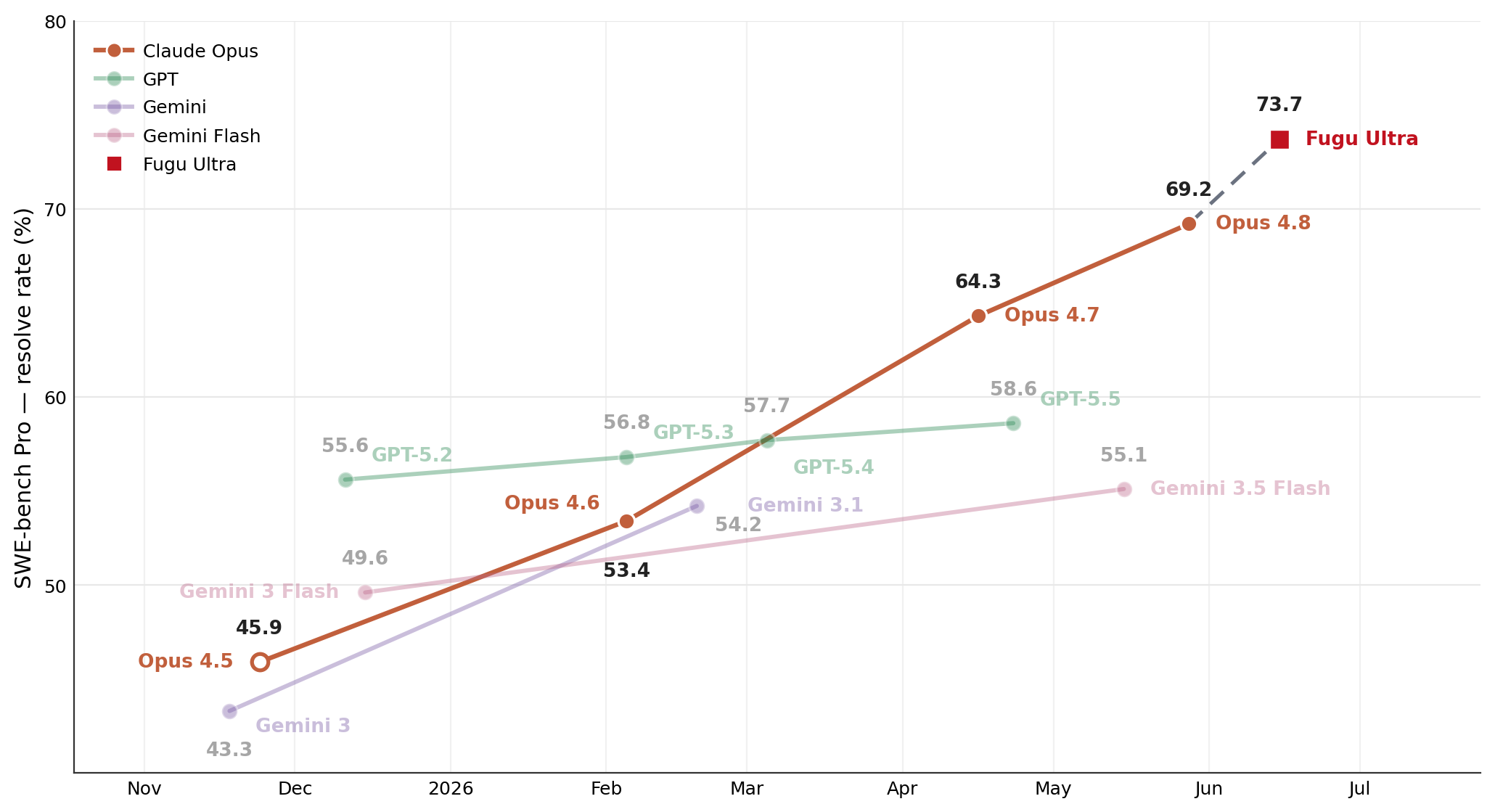
Figure 3: Fugu-Ultra's agentic coding scores are equivalent to generational advances in individual model training.
Scientific Reasoning and Model Class Exceedance
Fine-grained orchestration enables Fugu models to surpass best-in-class performance in scientific reasoning (GPQA-Diamond), using targeted agent routing to leverage mathematical expertise from GPT and scientific recall from Gemini. This exceeds both generational upgrades and closed model classes inaccessible to public evaluation.
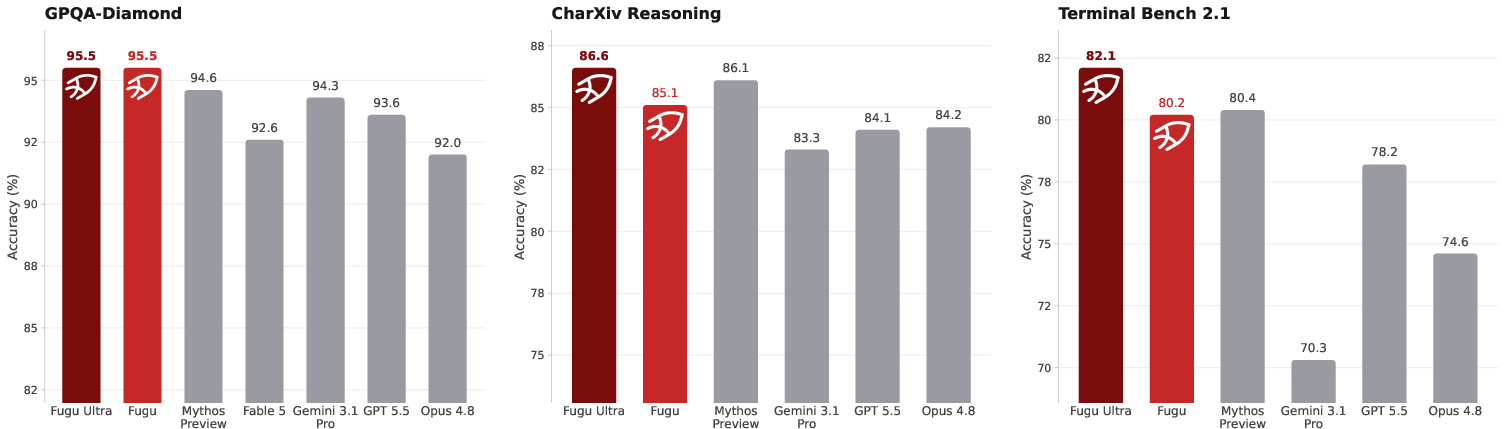
Figure 4: Fugu models achieve performance beyond Mythos Preview and Fable 5 by exploiting collective orchestration.
Adaptivity Across Domains
Routing distributions demonstrate consistent domain adaptivity, automatically specializing agent selection in accordance with SOTA priors (e.g., math to GPT, science to Gemini, debugging to Opus). In multidisciplinary and long-horizon tasks, models balance agent usage dynamically, matching task nature.
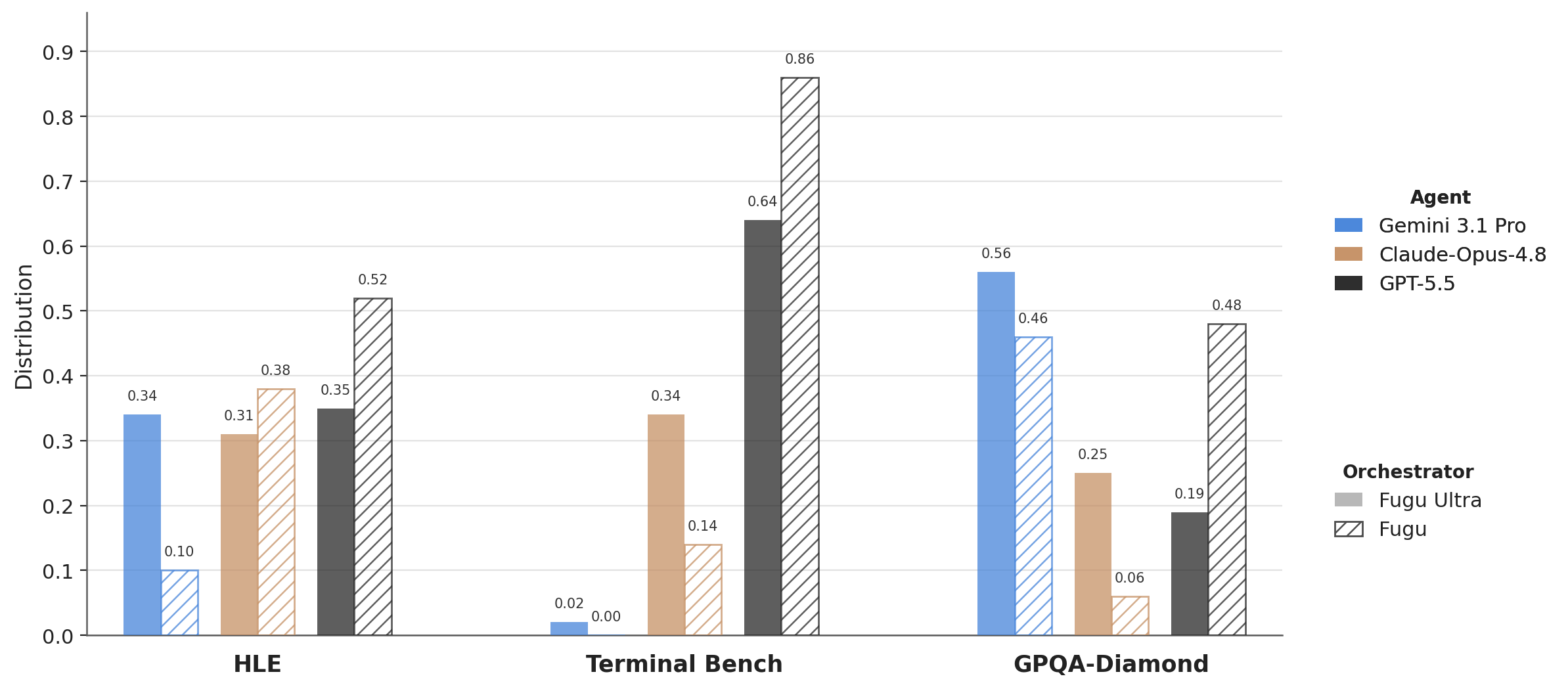
Figure 5: Fugu orchestrators adjust agent selection distributions per task, optimizing for domain-specific skillsets.
Qualitative Agentic Tasks
Autonomous ML Optimization
Fugu-Ultra outperforms all frontier single-agent baselines on AutoResearch, reducing validation BPB and improving both peak and mean cross-seed results (0.9748 vs 0.9766 best-run). Orchestration becomes increasingly valuable in fine-grained optimizer tuning post coarse configuration.
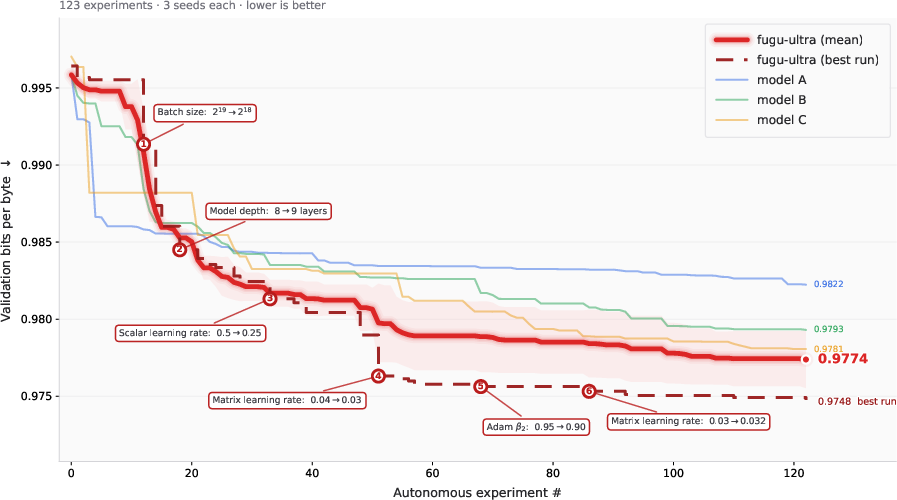
Figure 6: Fugu-Ultra (red) consistently achieves lower validation bits-per-byte in autonomous ML optimization.
Reading Order Recovery
On decoding scattered Japanese kana (chirashigaki), Fugu-Ultra outperforms all baselines, tracking expert reading order (NED 0.80 vs 0.24 for baselines), demonstrating capability to synthesize qualitative rule sets in the absence of training data.
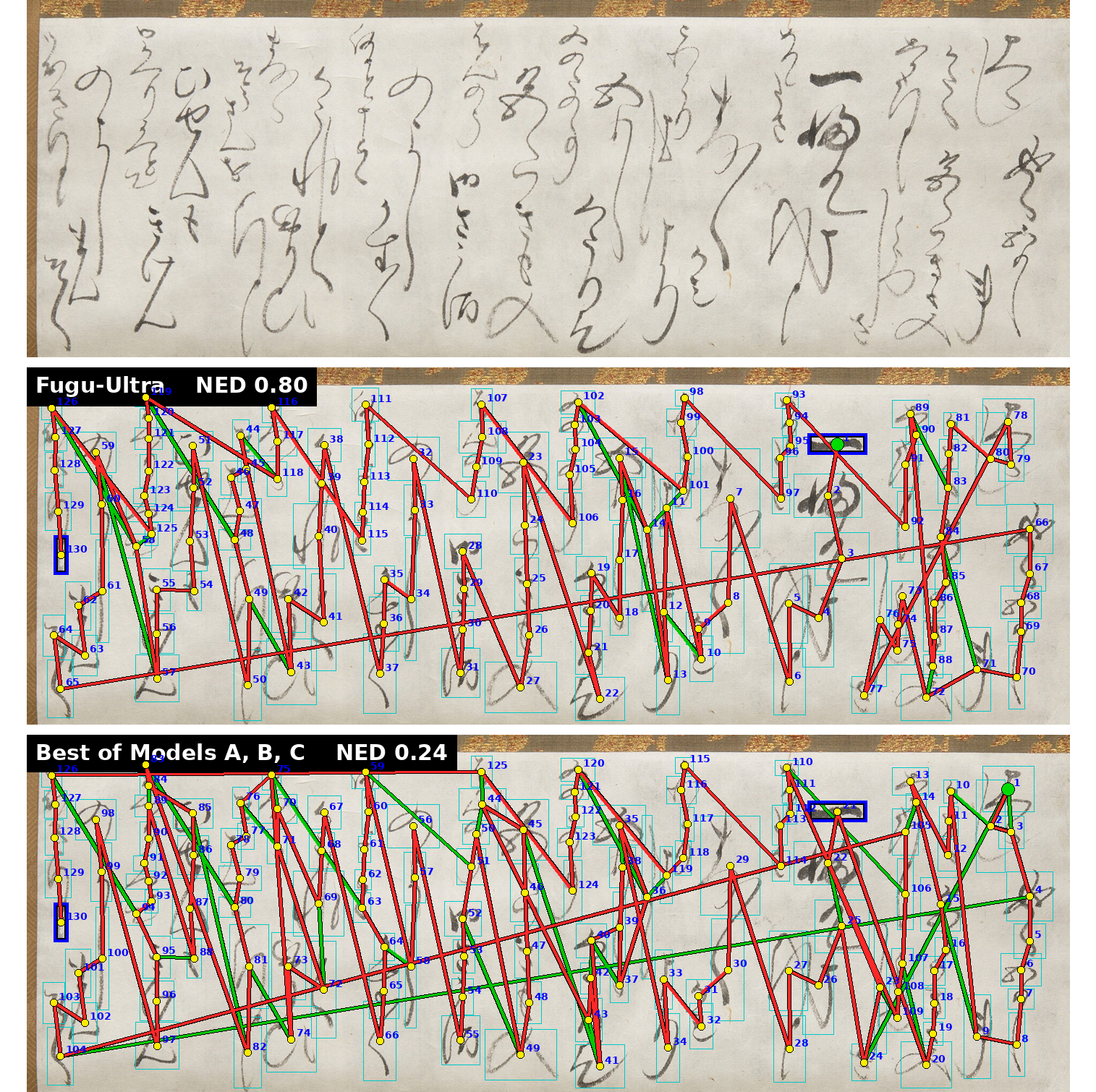
Figure 7: Fugu-Ultra accurately recovers expert reading paths in dense, scattered scripts.
CAD Generation
Mechanical iris CAD tasks illustrate qualitative superiority: Fugu-Ultra consistently produces physically valid designs, with correct blade rotation and aperture dynamics, outperforming frontier baselines that exhibit incomplete mechanical structures.
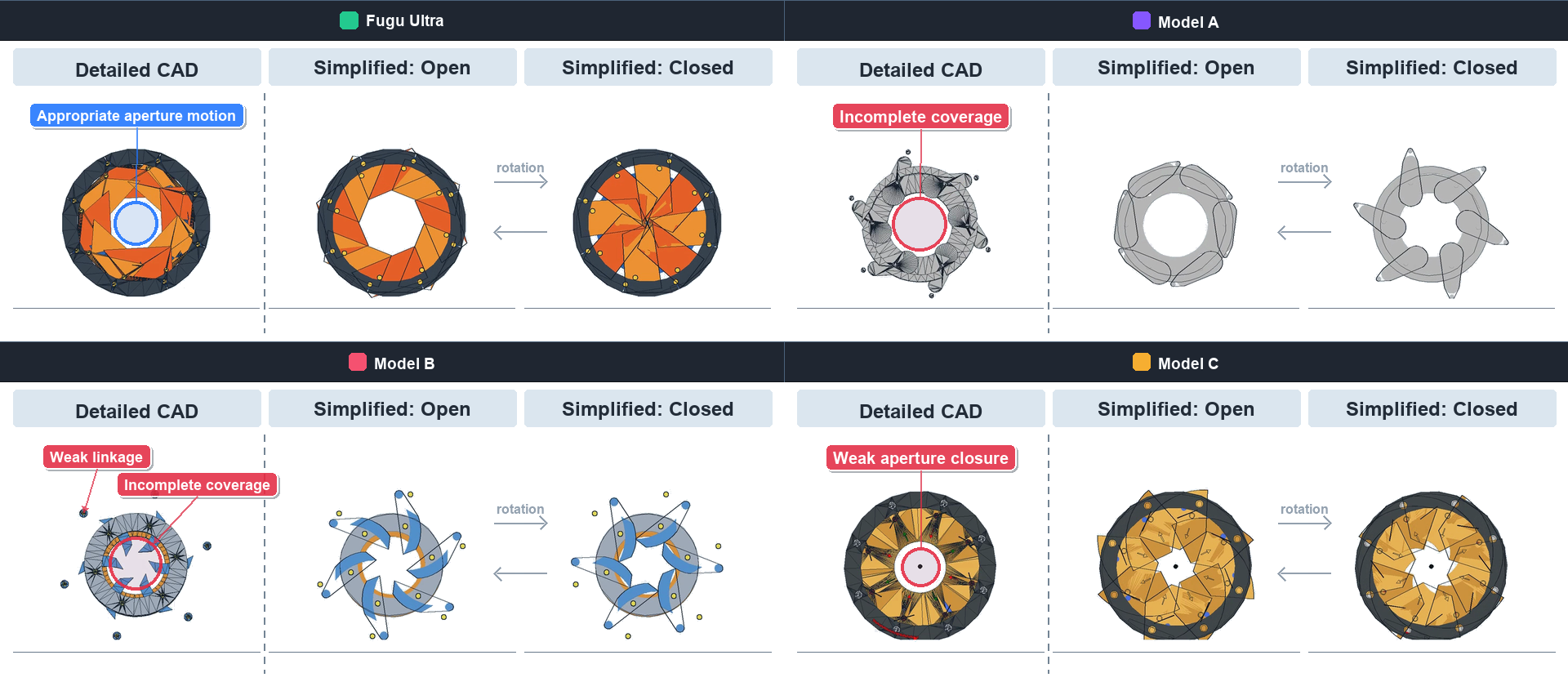
Figure 8: Fugu-Ultra's CAD solutions are structurally complete and dynamically correct versus competitive models.
Sequential Reasoning (Blindfold Chess, Online Trading)
In blindfold chess, Fugu sustains accurate play across long-horizon moves, committing zero blunders and outperforming frontier models and expert-level Stockfish in representative games, maintaining accurate state without external board representation.
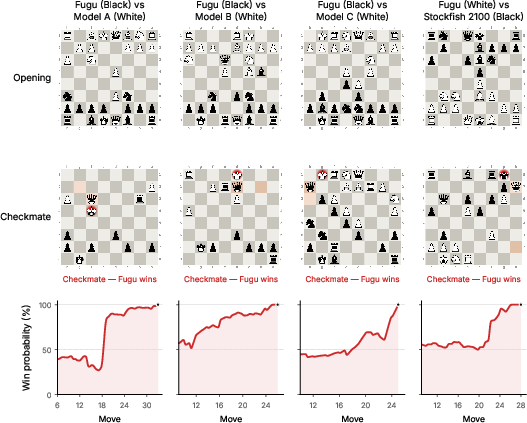
Figure 9: Fugu consistently plays blindfold chess with expert accuracy, outperforming baseline models and Stockfish.
For online stock trading, Fugu-Ultra achieves a mean return of +19.43%, outcompeting all frontier baselines. Performance gains derive from superior adaptation to feedback and avoidance of passive strategies.
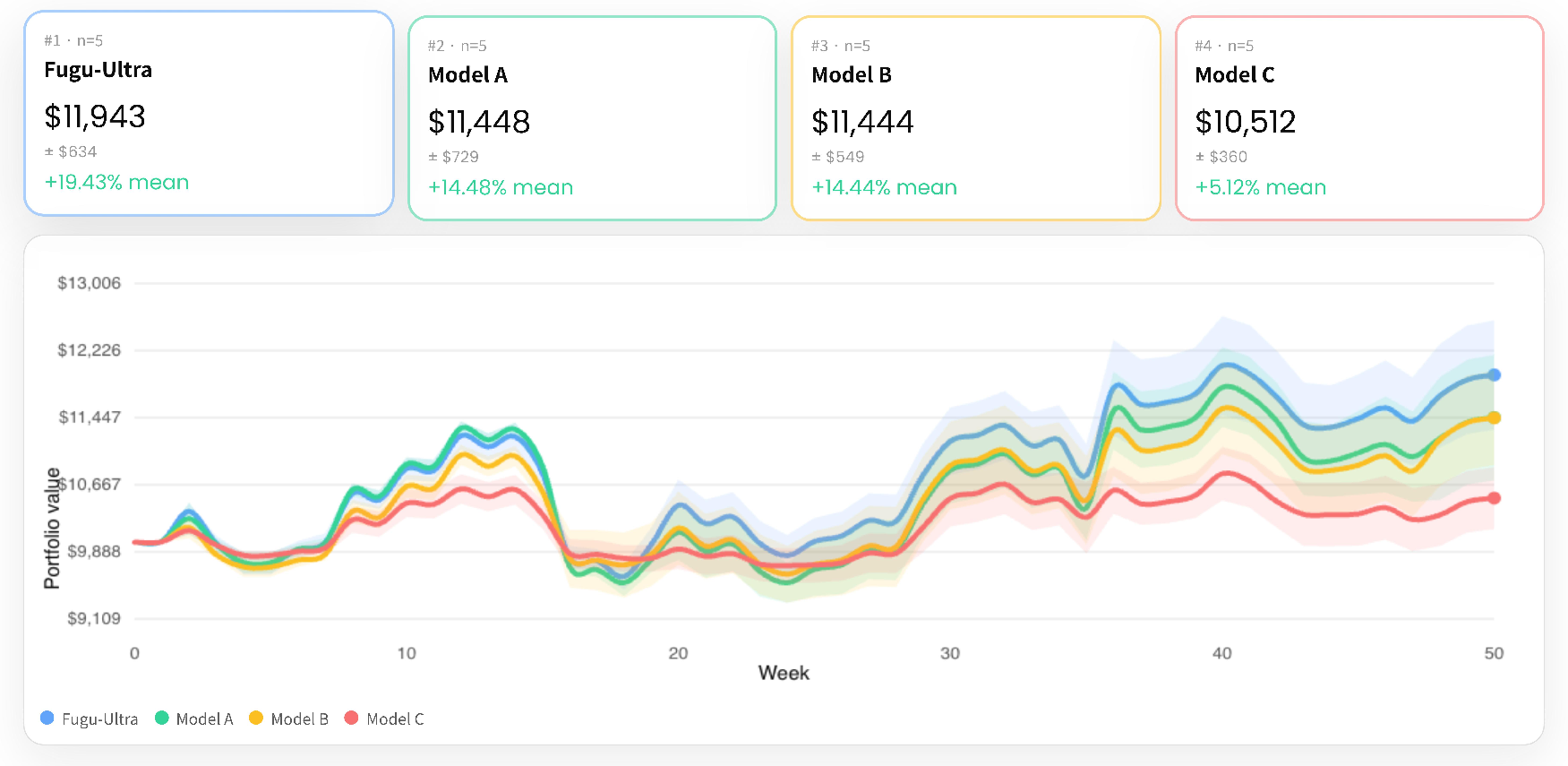
Figure 10: Fugu-Ultra realizes higher profitability in sequential stock trading via dynamic decision adaptation.
Analysis of Strategies and Coordination Topologies
Fugu-Ultra's ability to generate arbitrary workflow topologies (e.g., adaptive aggregation, multi-round debate, specialist injection) unlocks flexible, granular application of agent capabilities. Debater–aggregator cycles, builder–debugger alternation, and targeted specialist recruitment deliver consistent SOTA performance and resolve cross-domain tasks inaccessible to fixed single-agent approaches.
Practical and Theoretical Implications
Model orchestration as a behavioral scaling axis decouples AI progress from parameter count and training compute, enabling composability, modularity, and increased accessibility. Incorporating closed-source models, heterogenous providers, and user-specific constraints becomes feasible. As LLM ecosystems diversify, orchestration will facilitate rapid integration of new agents and adaptive compliance without retraining. Collective intelligence via learned coordination may prompt significant shifts in economic and geopolitical AI deployment, with modular orchestration models impacting resource distribution and innovation cycles.
Conclusion
Sakana Fugu demonstrates that learned, query-adaptive orchestration unlocks collective intelligence unattainable by individual LLMs. Through Fugu and Fugu-Ultra, the paper establishes orchestration as a scaling axis equivalent to parameter expansion, delivering SOTA performance across benchmarks, agentic coding, scientific reasoning, and qualitative tasks. Future developments should focus on advancing orchestration algorithms, leveraging modular and composable agent pools, and exploring theoretical limits of collective intelligence, with implications for both AI research and deployment at scale.