- The paper introduces FaraGen1.5, a modular pipeline that integrates live web and synthetic environments to generate over 1.5M agentic steps for training computer use agents.
- The paper employs a GPT-5.4-based solver and a multi-perspective verification system to ensure task correctness, efficiency, and safety across diverse digital tasks.
- The paper demonstrates significant performance improvements, with models achieving up to 72.3% success on benchmarks and enhanced data efficiency using scalable training strategies.
Fara-1.5: Scalable Data Generation and Modeling for Computer Use Agents
Motivation and Overview
Fara-1.5 addresses the principal challenge in training performant computer use agents (CUAs): the lack of scalable, high-quality demonstration data spanning the diversity of real-world digital environments. Human demonstrations are cost-prohibitive and limited in task coverage, while prior synthetic pipelines are constrained by what can safely be collected on the open web. Fara-1.5 introduces FaraGen1.5—a modular pipeline combining live web environments and rich synthetic sandboxes, a robust trajectory-solving harness leveraging frontier models, and a suite of verification methods to enforce correctness, efficiency, and critical-point adherence. The resulting data enables the training of agentic models that significantly outperform prior approaches across benchmark tasks, both in accuracy and in their ability to defer to user input at transactional boundaries.
Scalable Data Generation Pipeline
FaraGen1.5 instantiates tasks in online and synthetic environments:
- Live Web Environments: Tasks are generated via LLMs conditioned on site summaries and policy-relevant task dimensions. An automated proposal and filtering mechanism produces a broad, realistic task set, but collection is limited to what can be done without authentication or irreversible side effects.
- Synthetic Environments: To circumvent coverage gaps, the pipeline employs auto-generated sandboxed replicas of complex domains (e.g., email, scheduling, ML management). Coding agents iteratively refine these environments to functional fidelity, and tasks are proposed with tool-based access to frontend and backend state. These sandboxes allow safe execution of credentialed or state-mutating actions and guarantee verifiable success via backend predicates.
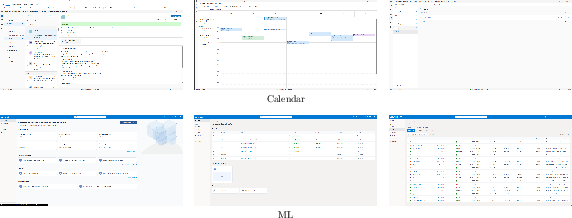
Figure 1: Sample synthetic Calendar and ML Management environments, exhibiting production-like workflows and coherent data.
- Solver: A single-agent harness based on GPT-5.4 generates trajectories reflecting agentic behavior, disabling capabilities not available to the target CUA (e.g., complex URL queries, dangerous side effects). Multi-turn interactions are simulated via a user simulator gated to prevent unsafe actions.
- Verification: Each trajectory is scored via three orthogonal LLM verifiers: task correctness (rubric-based, state-based, or answer-based), task efficiency, and adherence at critical points as determined by the presence of explicit permission, task specification, and necessary personal information. Only trajectories passing all three are admitted.
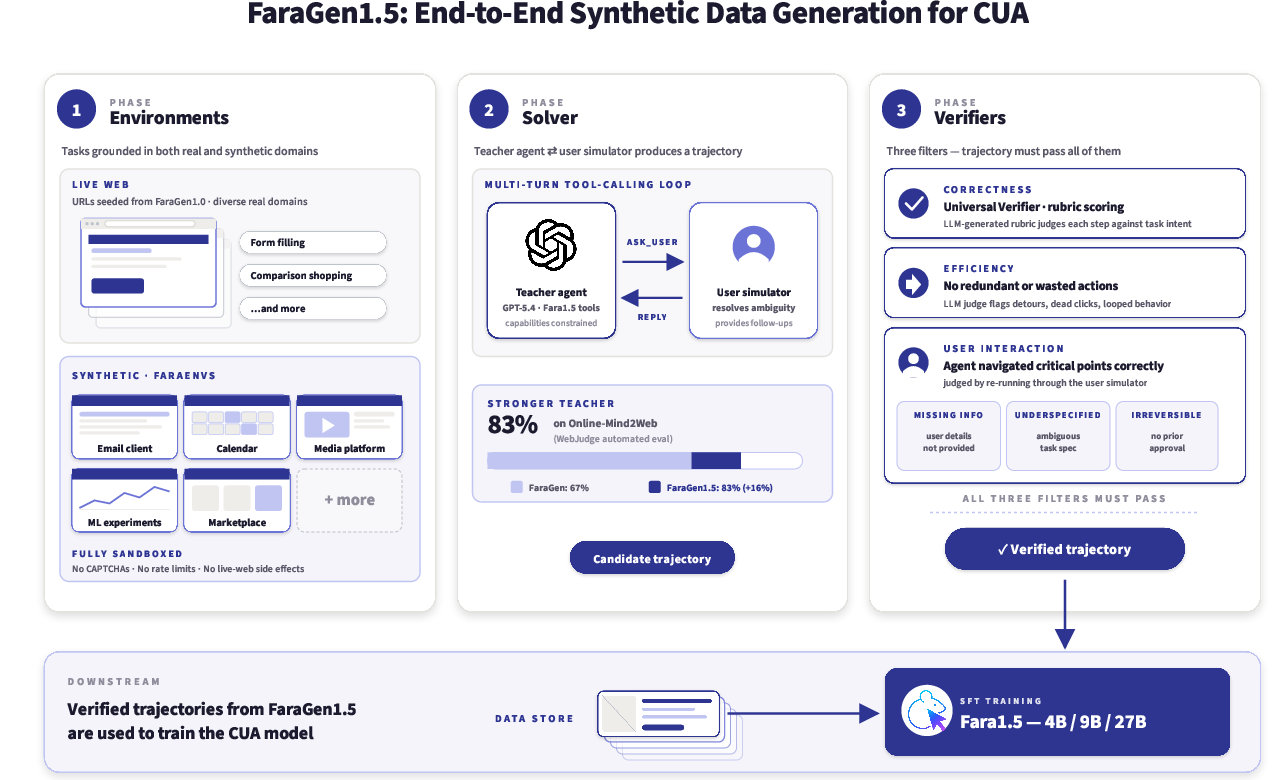
Figure 2: FaraGen1.5 pipeline architecture combining environment instantiation, solver execution, and multi-perspective trajectory verification.
- Data Mix: The pipeline has accumulated over 1.5M agentic steps, with web trajectories, synthetic trajectories, form-filling, grounding, VQA, and safety-enforced refusal data comprising the final training corpus.
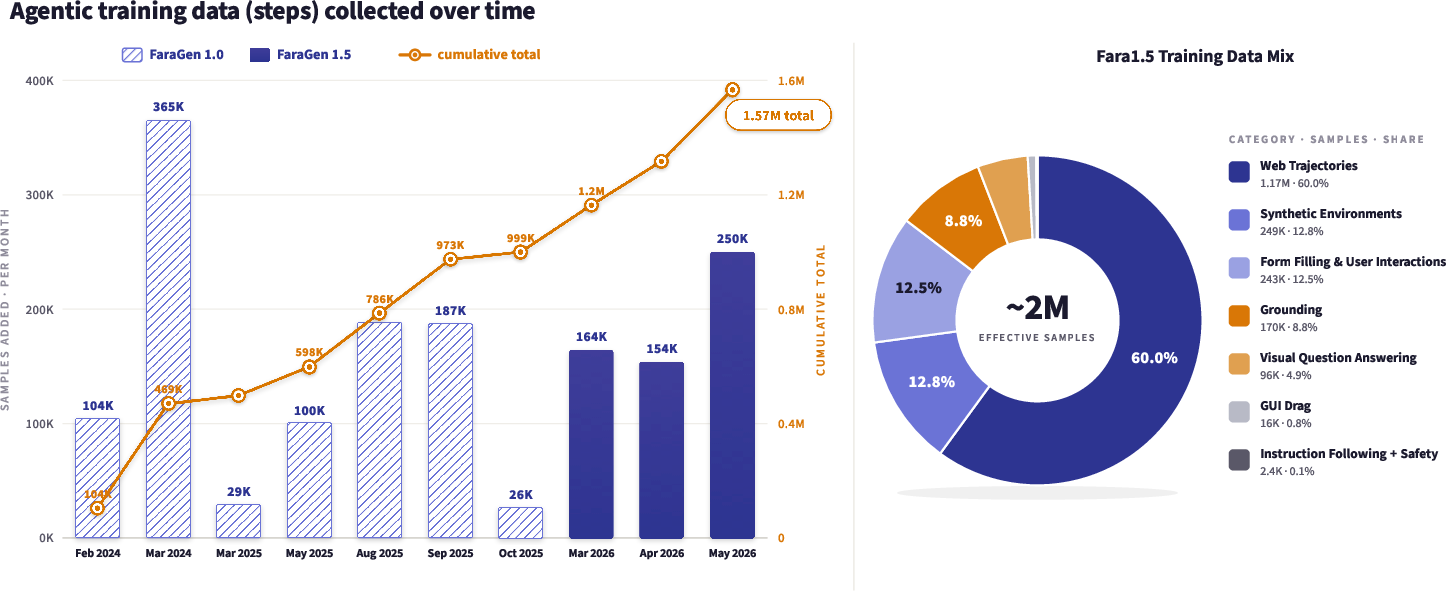
Figure 3: Cumulative agentic data volume and final Fara1.5 training mix, dominated by web agent trajectories and supported by synthetic and auxiliary task data.
Model Architecture and Training
Three Fara1.5 variants (4B, 9B, and 27B) are trained via SFT on Qwen3.5 backbones. Each operates as a vision-language agent consuming screenshots and emitting atomic actions (pointer/keyboard, browser navigation, meta-actions such as pause and user query) in an observe-think-act loop. No structured DOM is used at inference; only recent browser screenshots and compacted URL metadata are input for robust deployment across heterogeneous GUIs.
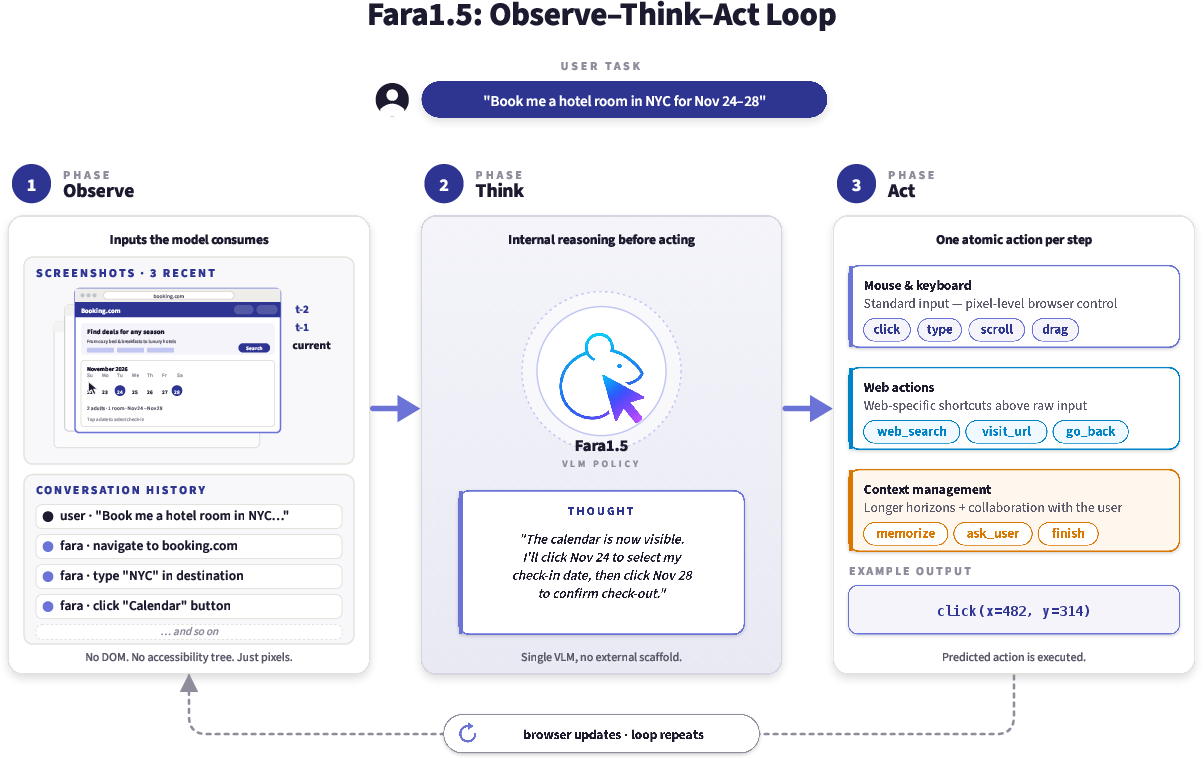
Figure 4: The observe-think-act loop: screenshot input, chain-of-thought, atomic action output; no DOM or external scaffold.
Supervised fine-tuning is applied per step, conditioning on full history but restricting image context to three steps to optimize token budget and performance.
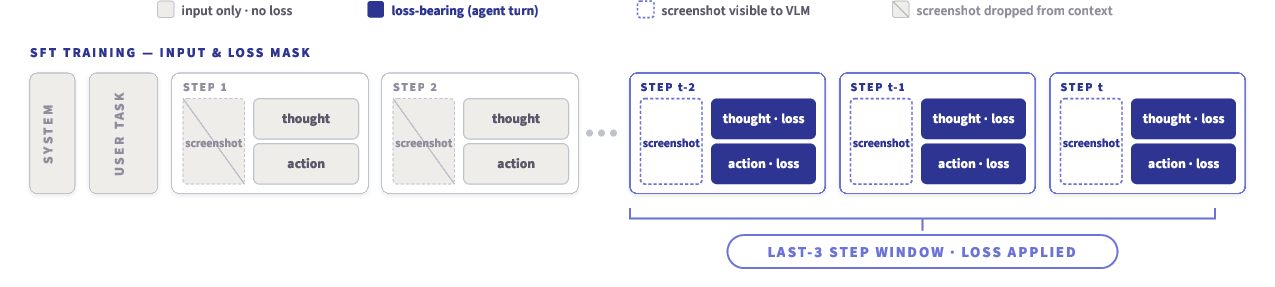
Figure 5: SFT input and loss masking, preserving conversations and thoughts but trimming historical screenshots for efficient training.
Auxiliary tasks (grounding, VQA, GUI drag, instruction following, safety refusal) are included to enhance transfer and agentic robustness.
Empirical Results and Analysis
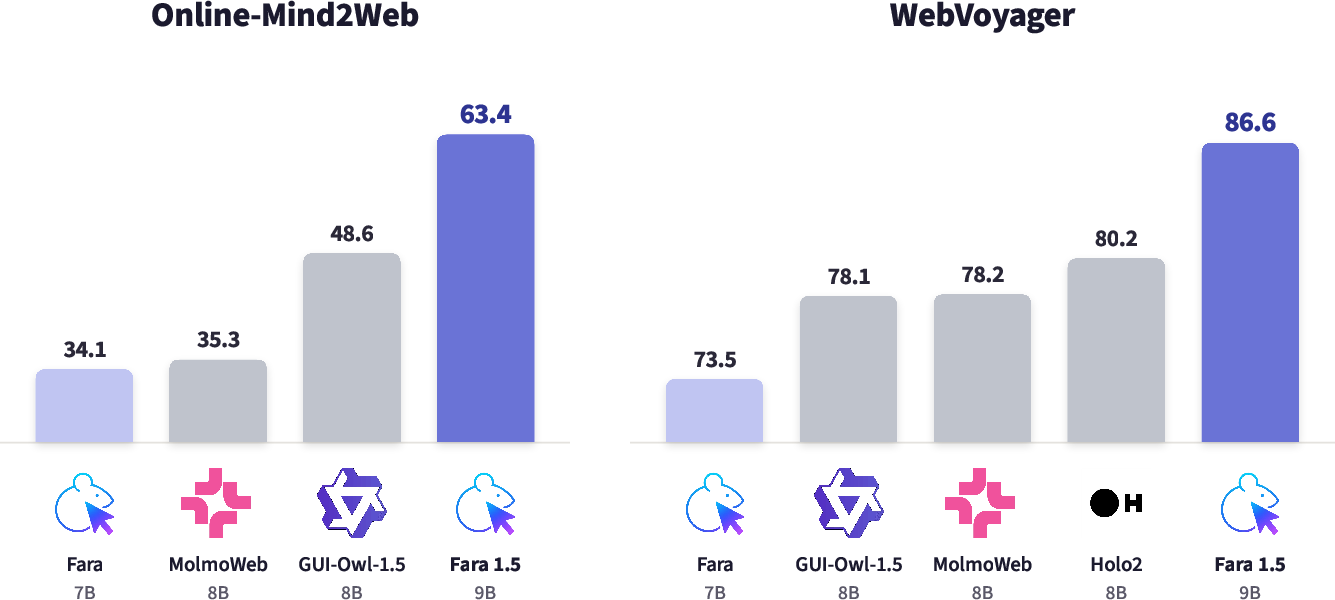
Across WebVoyager, Online-Mind2Web, and WebTailBench, Fara1.5 sets new state of the art for its size classes, with substantial gains over prior models, notably:
Scaling from 4B to 27B increases task accuracy monotonically (+8.5 for WebVoyager, +15.0 for Online-Mind2Web), with Fara1.5-9B covering most of the gain at substantially lower deployment cost.
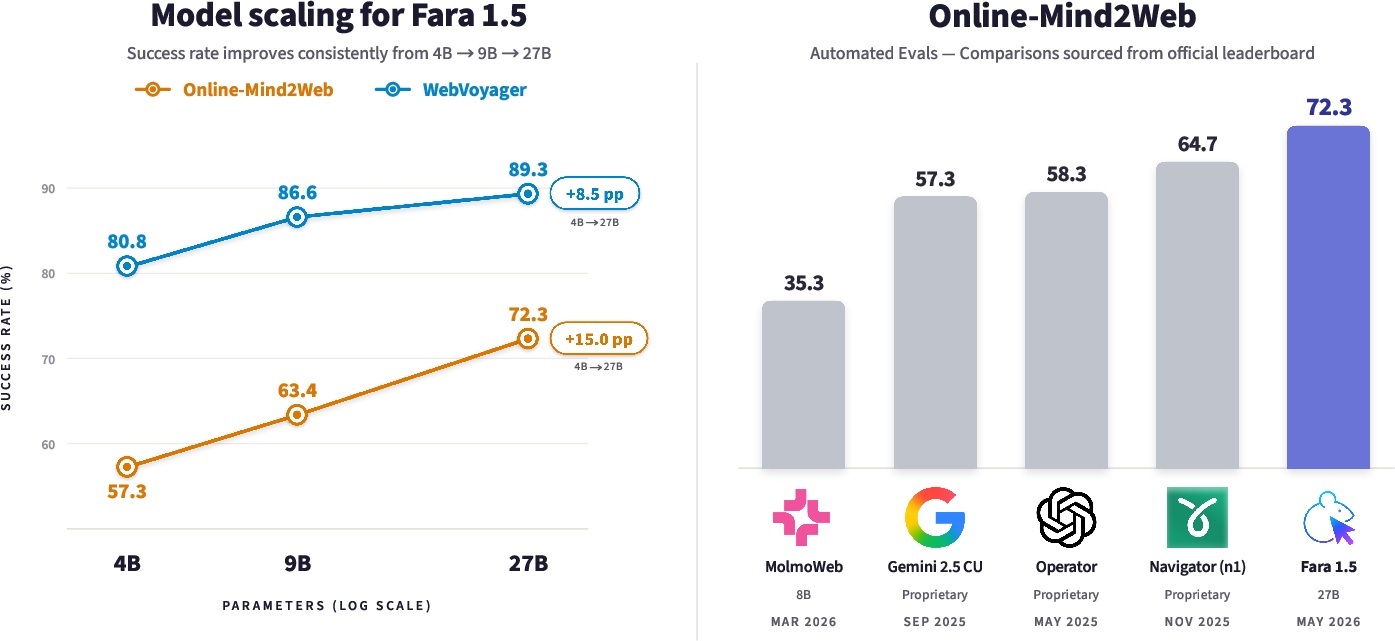
Figure 7: Task success rates versus model size, and comparison against proprietary CUAs.
Trajectory efficiency and step count analyses indicate correct solutions are consistently shorter, and model scaling reduces mean steps per task but does not impair step efficiency among successful trajectories.
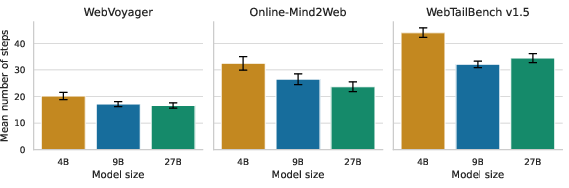
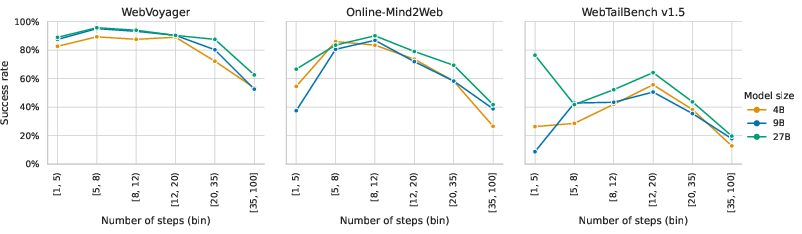
Figure 8: Mean steps per task per model size, demonstrating efficiency gains with increasing scale.
Synthetic environments are validated as learnable: Fara1.5-9B achieves 71.8% average success compared to 18.8% for Fara-7B (trained only on open-internet data), and synthetic-to-real transfer shows an absolute +10 combined improvement across four replica tasks.
Safety and Critical-Point Deferral
Fara1.5 enforces robust safety via refusal data and trajectory-level verification of critical-point adherence. The model consistently halts before irreversible actions without explicit user permission, and refuses 100% of harmful prompts in the WebTailBench-Refusals suite. Safety is maintained across scaling and augmentation.
Implications and Future Directions
Practically, Fara-1.5 demonstrates that scalable pipeline-driven data generation combining synthetic and online environments enables accurate, efficient CUAs at modest parameter counts. The synthetic pipeline unlocks domains with authentication gating and irreversible actions, broadening training and deployment viability.
Theoretically, the robust verifier system and critical-point framework represent generalizable solutions for trajectory filtering and user alignment. Step-level SFT on diverse agentic traces enhances reasoning and context adaptation, supporting future extensions to desktop software, terminal interfaces, and long-horizon monitoring.
Advances in synthetic environment generation, trajectory synthesis, and multi-perspective verification are likely to enable further scaling and generalization; research into richer environment diversity, step-efficient RL fine-tuning, and tighter human-control loops will drive the next generation of CUAs.
Conclusion
Fara-1.5 makes explicit the necessity of scalable, verifiable data pipelines for native CUAs, substantiates the value of synthetic environments for realistic agentic behavior, and achieves state-of-the-art performance across benchmark web tasks for its parameter class. The proposed architecture, data engine, and verification stack have broad implications for agentic model training and deployment. Continued research will extend coverage, safety, transferability, and user alignment for future agentic systems (2606.20785).