- The paper demonstrates that SoftSkill compresses lengthy skill texts into 32-token embeddings, achieving notable improvements in single-round QA tasks.
- The method utilizes next-token prediction with soft delta tuning on frozen models, emphasizing validation-based checkpoint selection over loss minimization.
- SoftSkill offers substantial context length reduction while revealing limitations in agentic tasks and challenges in transfer across models.
SoftSkill: Behavioral Compression for Contextual Adaptation
Overview
"SoftSkill: Behavioral Compression for Contextual Adaptation" (2606.20333) introduces SoftSkill, a method for distilling procedural knowledge from natural-language skill artifacts into compact, continuous prefix embeddings for frozen LLMs. This approach aims to replace lengthy, model-agnostic Markdown skill files with model-specific latent priors deployable as short virtual token sequences. By tuning only a soft delta via next-token prediction on ground-truth answers or successful trajectories, SoftSkill facilitates contextual adaptation while preserving operational advantages such as metadata auditability.
Methodology
SoftSkill operates on frozen LLM backbones and targets two regimes: single-round QA (direct answer generation) and agentic execution (long-horizon procedural behavior). The method begins by mapping a natural-language skill document to an embedding prefix (either mean-pooled or via direct token embedding), then trains a soft delta with supervised NTP loss:
LNTP(Δp)=−t=1∑Tlogpf(yt∣y<t,x,s,p0+Δp)
Checkpoint selection is done via held-out task validation rather than training loss, mitigating loss/accuracy decoupling observed in agentic tasks. Importantly, only the prefix delta—rather than the backbone weights—is updated.
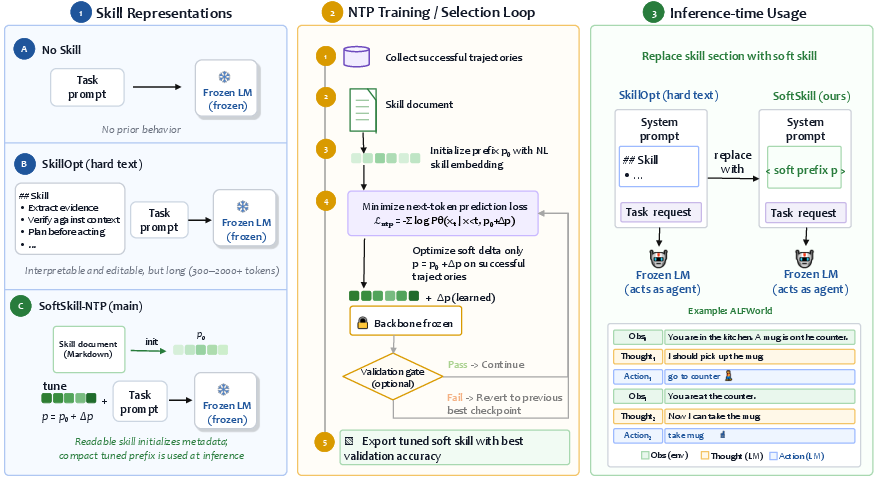
Figure 1: SoftSkill initializes a compact soft prefix from skill text, tunes only the soft delta with next-token prediction, and selects the deployed checkpoint by held-out task validation.
Empirical Results
On Qwen3.5--4B, a 32-token SoftSkill prefix delivers substantial gains:
- SearchQA: +8.3 accuracy points over no skill, +5.2 over SkillOpt, approaching LoRA.
- LiveMath: +42.1 over no skill, +12.5 over SkillOpt when inserted at skill_section.
- DocVQA: Small improvement over no skill, competitive with SkillOpt.
Skill-context length is reduced by one to two orders of magnitude: SoftSkill replaces 2035 tokens (SearchQA), 671 tokens (LiveMath), and 407 tokens (DocVQA) with 32 virtual tokens.
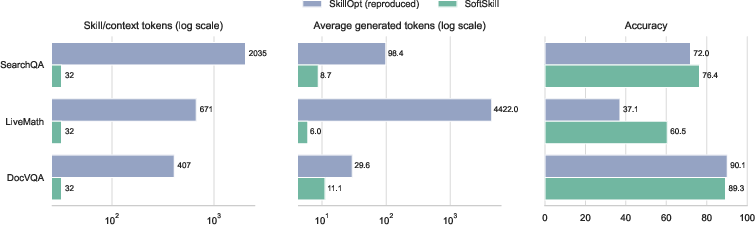
Figure 2: SoftSkill dramatically reduces skill-context length compared to SkillOpt text files, with secondary reductions in generated tokens resulting from direct-answer NTP supervision.
Loss reduction does not reliably predict task accuracy; validation-based checkpointing is essential for robust deployment.
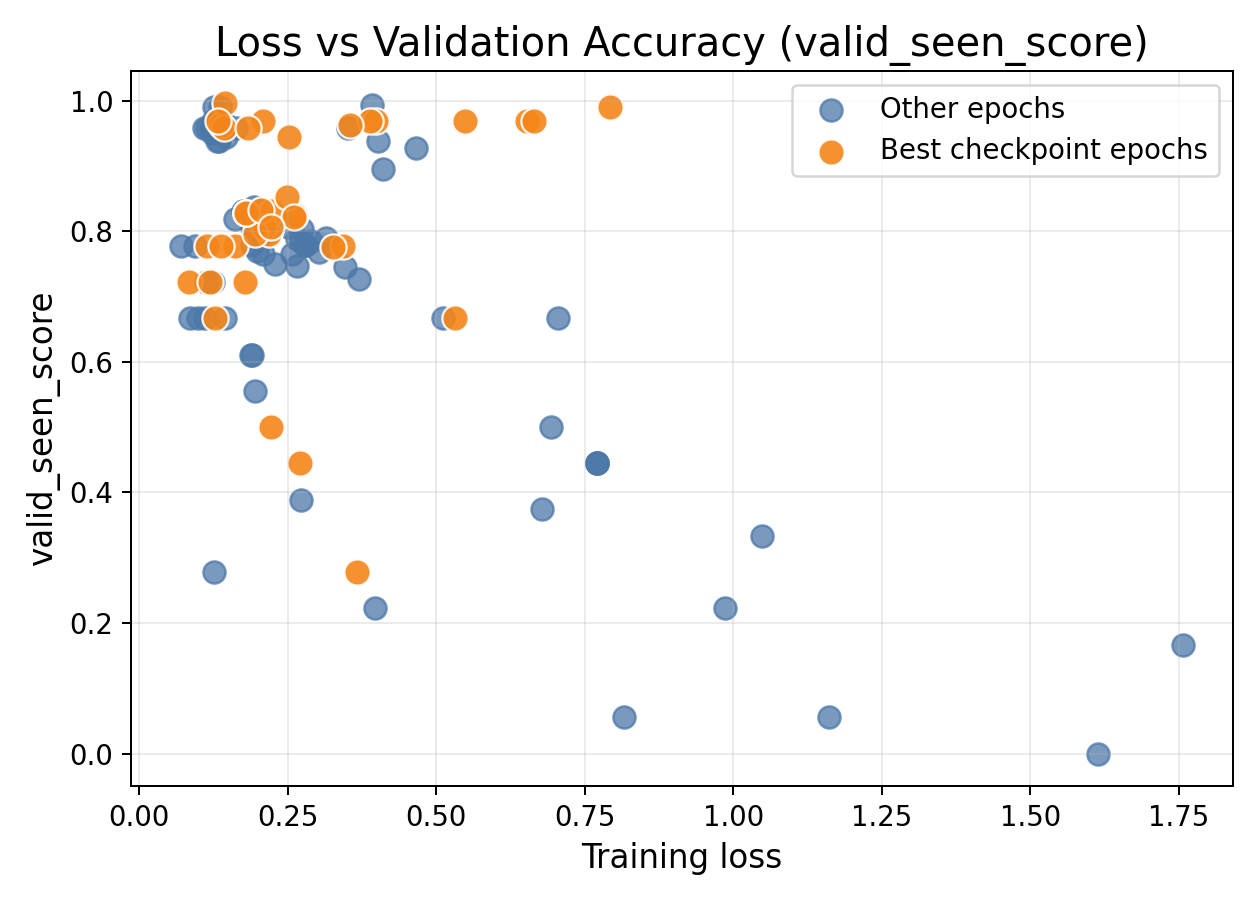
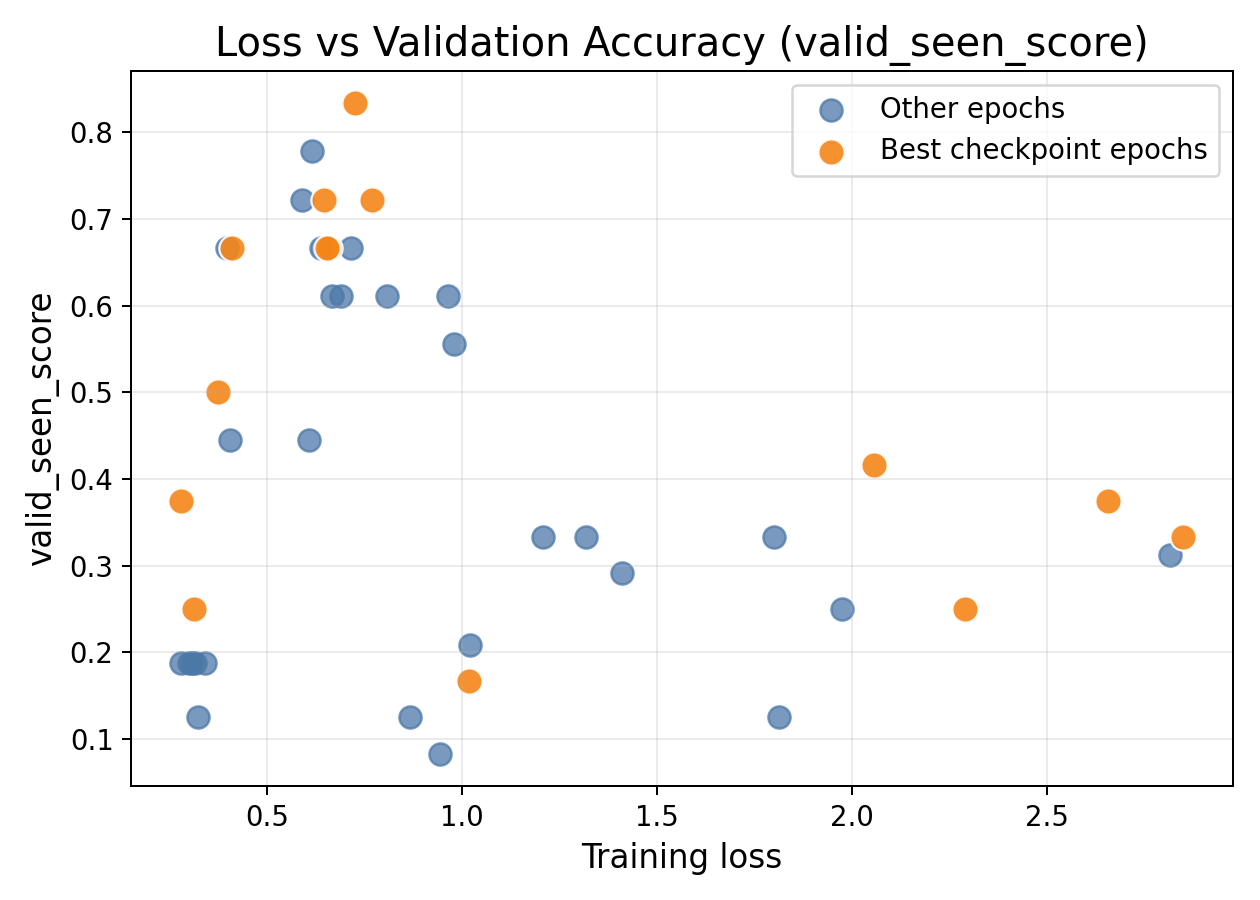
Figure 3: Validation-selected checkpoints do not correspond to minimum NTP loss—loss is not a reliable proxy for task success, especially in agentic settings.
Agentic Execution: Limits of Compression
SoftSkill partially internalizes procedural behavior but fails to robustly compress long-horizon tasks. Gains are pronounced in single-step tasks, but on OfficeQA, SpreadsheetBench, and ALFWorld, validation-selected SoftSkill is inconsistent—some agentic tasks see substantial improvement, whereas others exhibit accuracy drop relative to hard skill artifacts.
Prefix Geometry and Initialization
Pairwise cosine similarity heatmaps reveal task-dependent clustering in prefix embeddings. Learned soft prefixes diverge significantly from mean-pooled initialization and vary in run-to-run structure, especially for SearchQA.
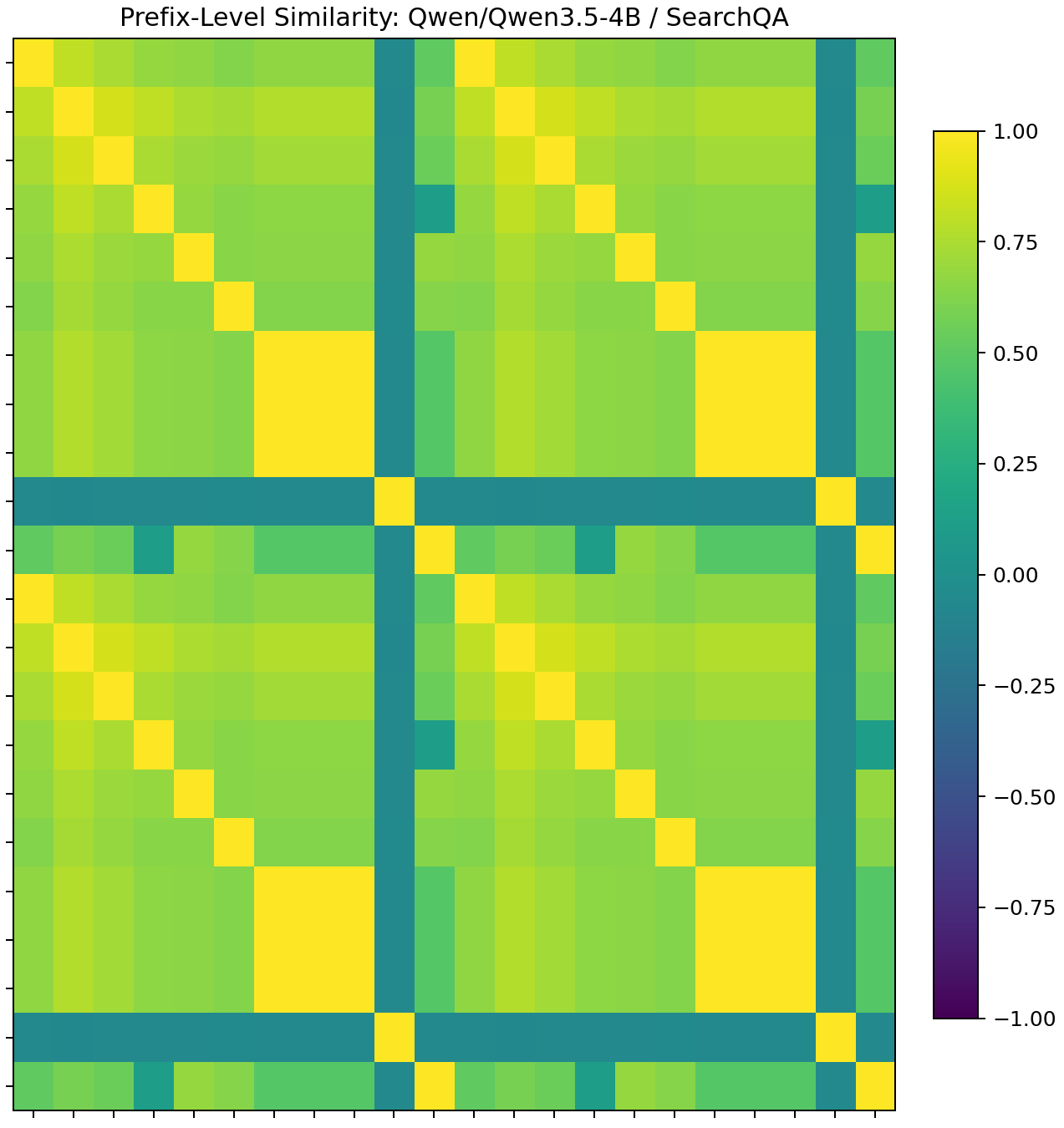
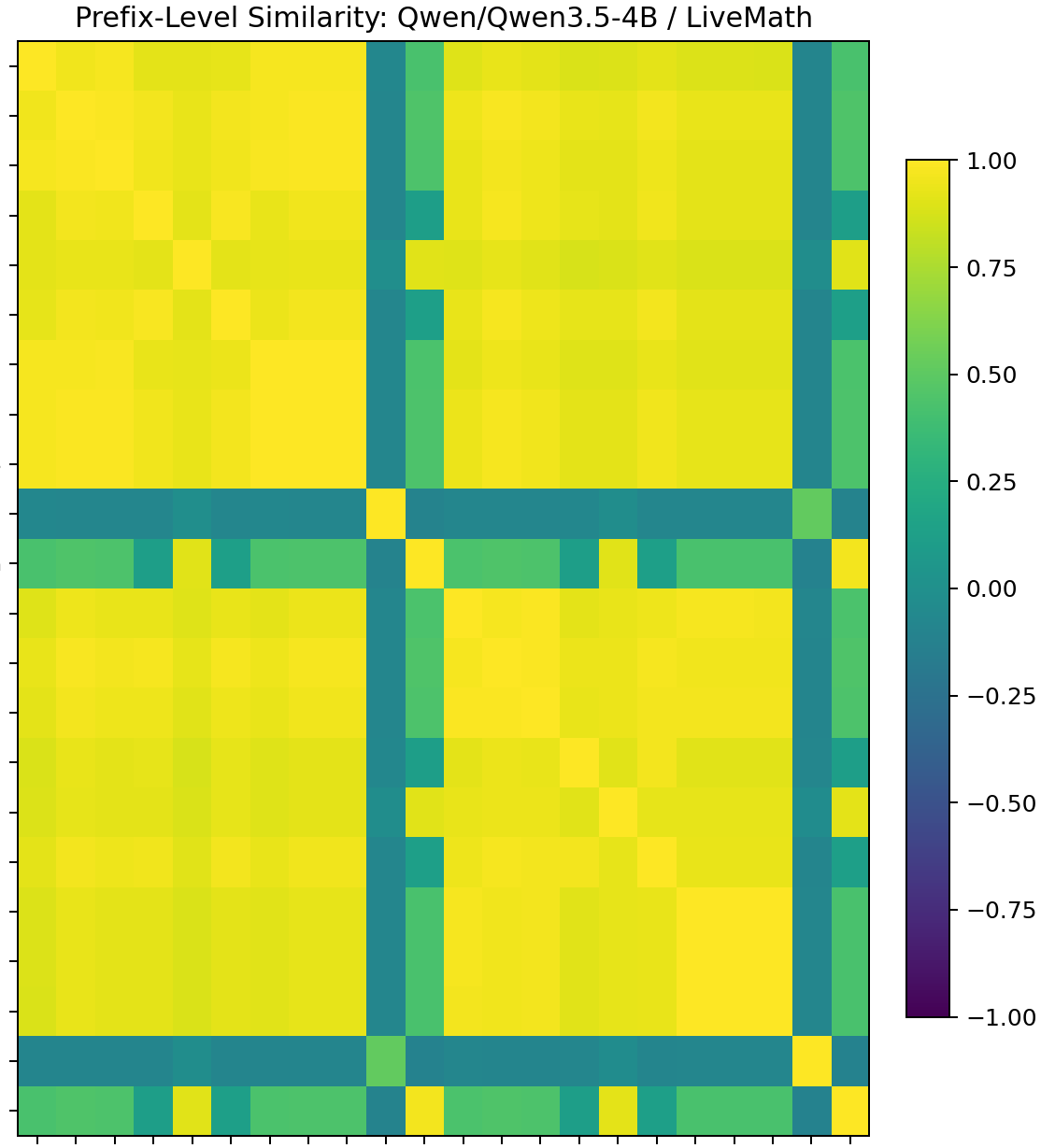
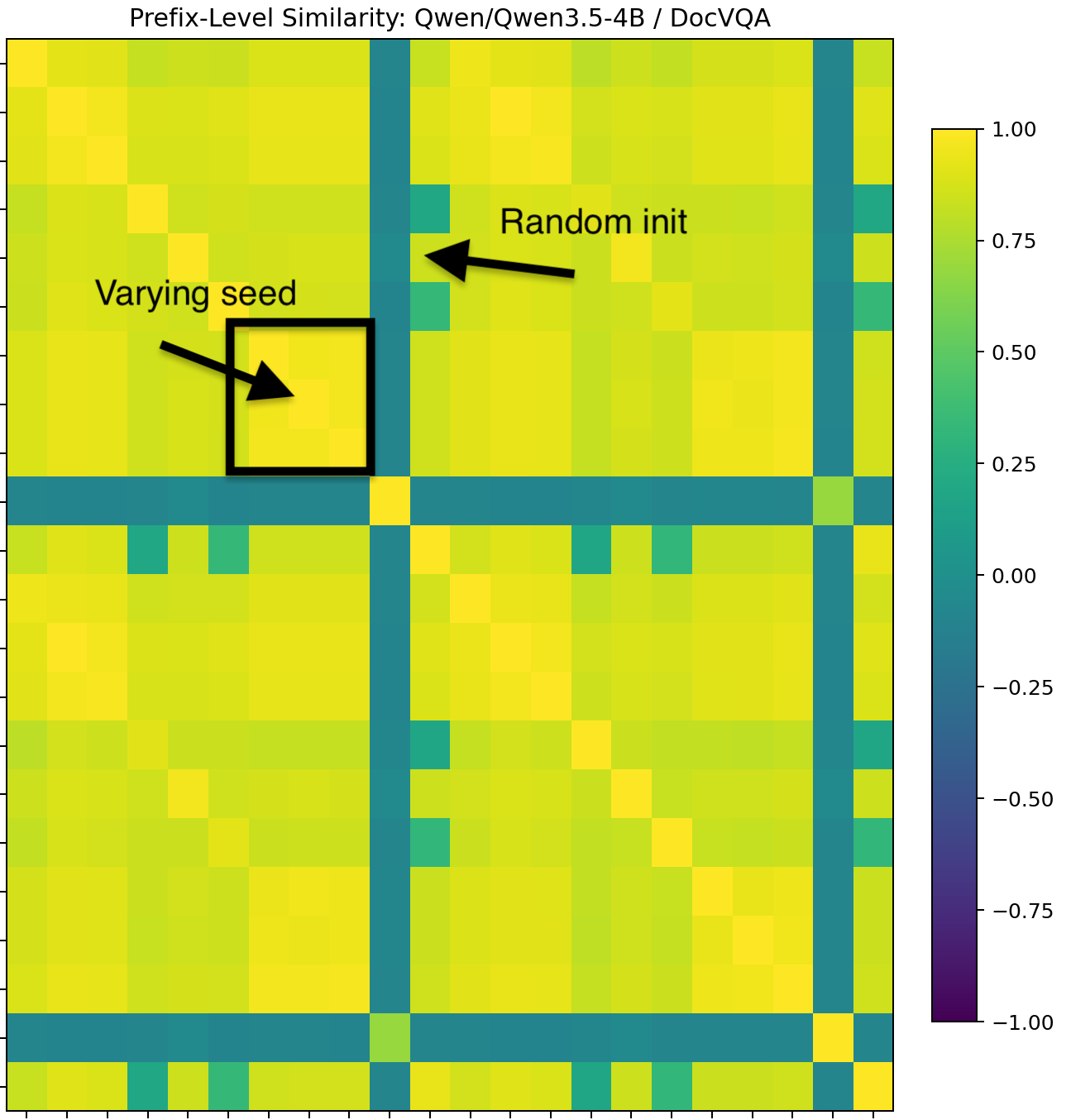
Figure 4: Prefix-level cosine similarity heatmaps show run-to-run variability and stronger clustering for tasks like LiveMath and DocVQA.
Per-position cosine similarity quantitatively measures how far the trained prefix moves from initialization; SearchQA displays greater divergence from initialization, emphasizing task-specific adaptation over trivial embedding reuse.
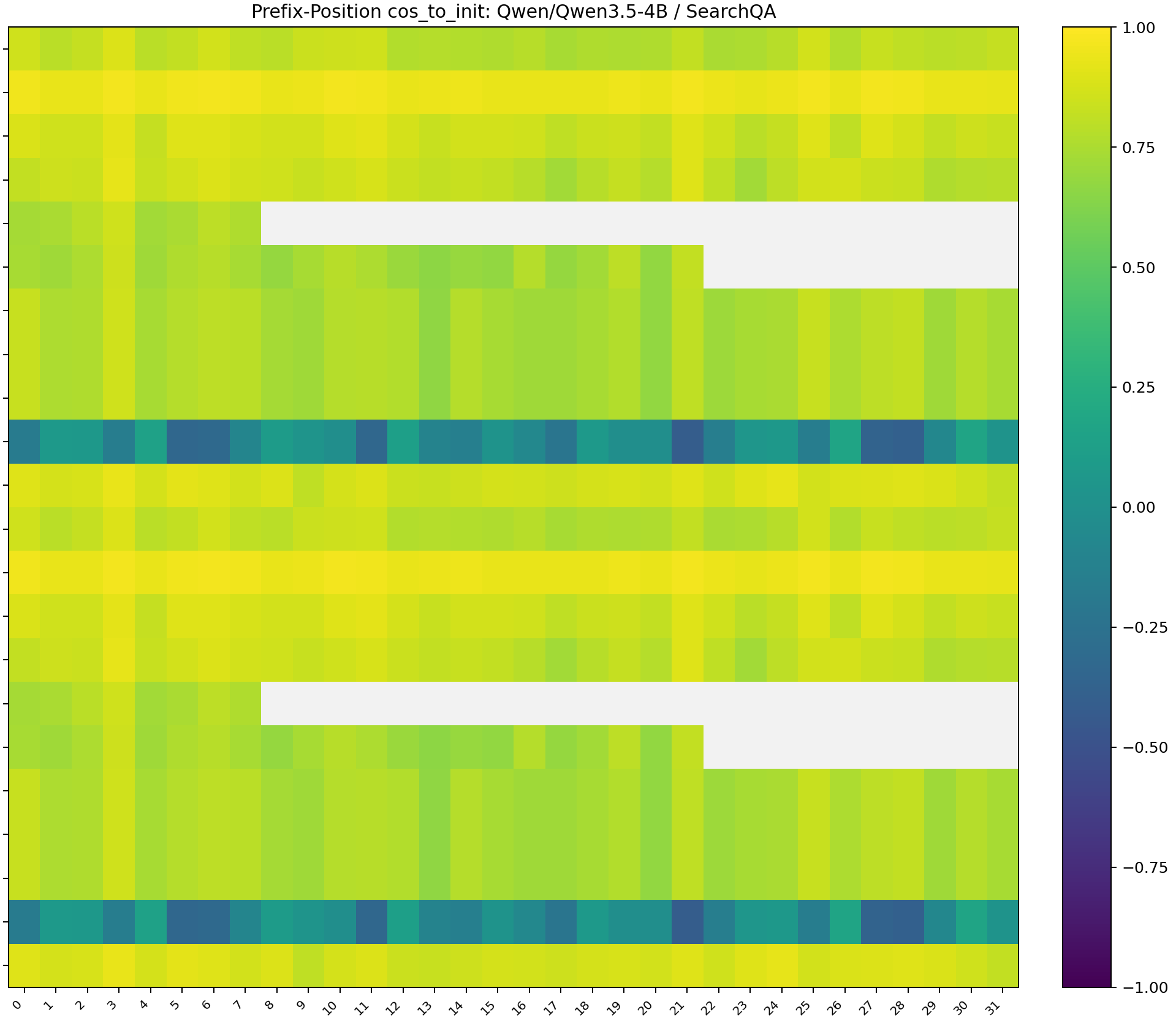
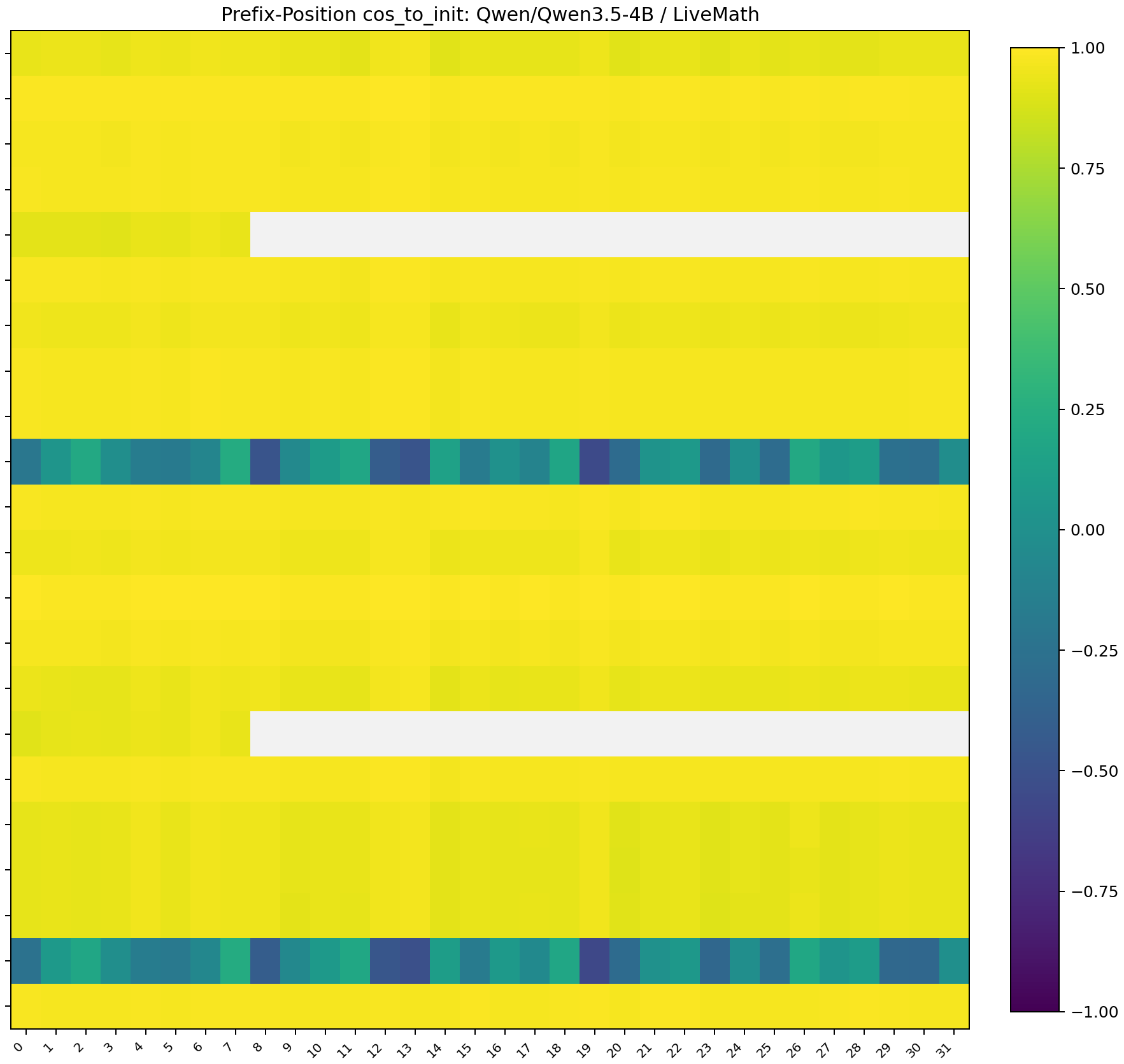
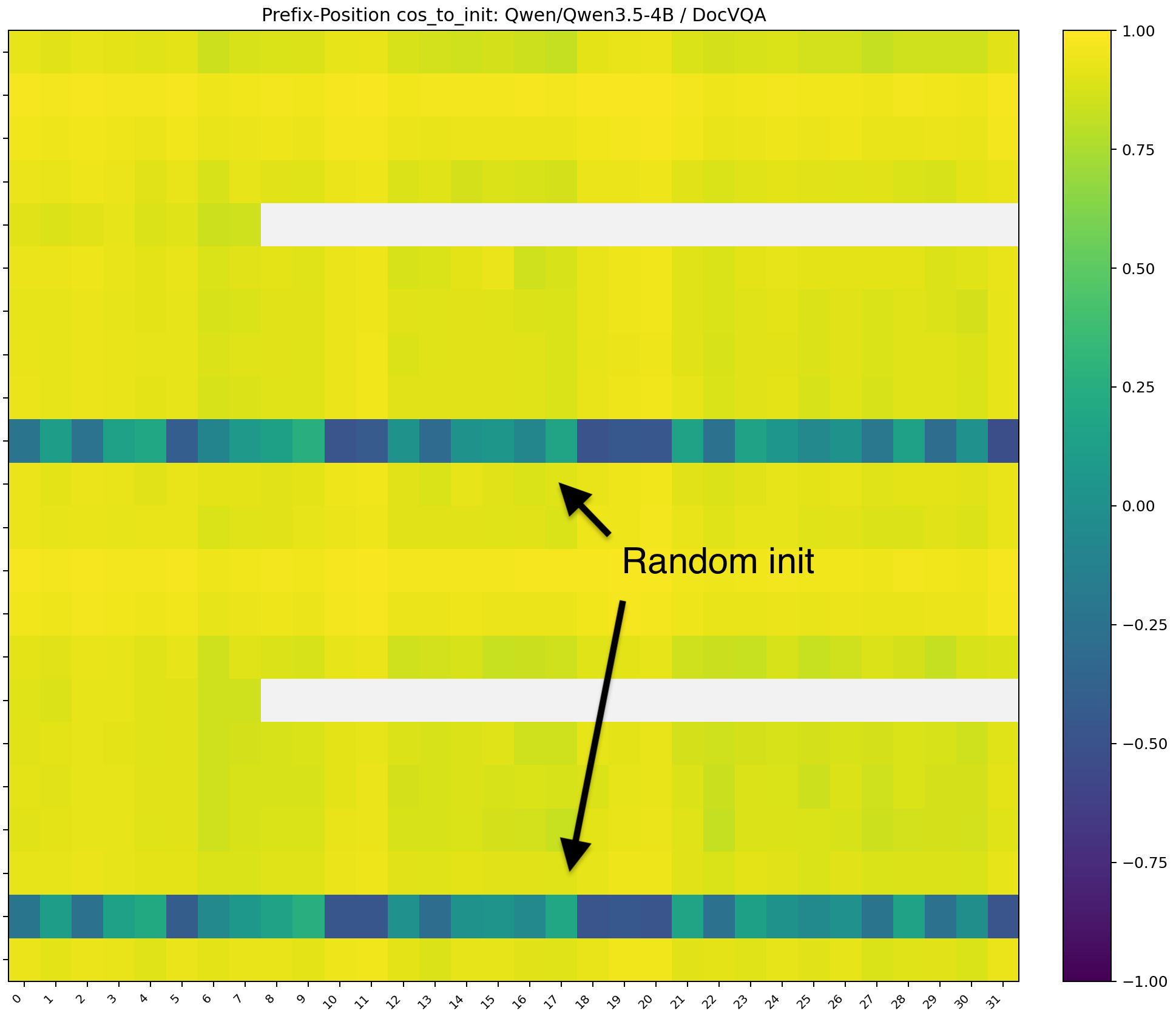
Figure 5: Per-position cosine similarity indicates largest learned displacement for SearchQA, minimal for DocVQA and LiveMath.
Analysis
Deployment and Practicality
SoftSkill requires model embedding interface access for training and serving, limiting its applicability to open or self-hosted models. It preserves some operational features of skill systems—metadata retention for audit and provenance—but the continuous prefix itself is less human-auditable.
Compression is most effective for tasks where answer style or response conventions dominate task success. Agentic tasks expose limitations: sparse trajectory supervision and lack of procedural structure impair prefix learning.
Transfer and Composition
There is no evidence that SoftSkill prefixes transfer across models or compose modularly; compression remains model-specific and niche to single-task adaptation.
Implications and Future Directions
SoftSkill demonstrates that compact prefix embeddings can efficiently replace textual skills for frozen backbone QA tasks, with competitive accuracy and deployment compression. However, robust procedural adaptation (e.g., tool-use, multi-step policies) requires stronger supervision or reward-based refinement. For practical AI, SoftSkill facilitates cheap deployment-side adaptation, freeing context and generation budgets. Theoretical implications center on the interplay between latent behavioral priors and explicit textual artifacts: prefix embeddings offer an efficient but less interpretable adaptation path.
Open research directions include:
- Advanced sparse trajectory imitation for agentic tasks
- Reward-based prefix refinement
- Multi-skill composition, modular transfer, and routing
- Robustness to prompt, tool, and harness perturbation
Conclusion
SoftSkill provides a parameter-efficient method for behavioral compression, distilling procedural knowledge into short, continuous prefixes for frozen LLMs. Its primary utility lies in single-round QA settings, offering substantial skill-context compression without loss of task accuracy. While agentic execution remains challenging, SoftSkill enables new contextual adaptation paradigms and highlights the importance of validation-guided checkpointing for practical deployment. Further advances are needed for universal procedural skill compression, compositional skill adaptation, and improved interpretability.