- The paper presents a comprehensive measurement study revealing systemic cryptographic misuses that enable cyber-physical exploits in embodied AI mobile apps.
- It employs the EAGLE framework with 507 real-world apps and semantic-aware static analysis to detect misuses across multiple domains, achieving 80.74% precision.
- The findings highlight the need for improved cryptographic standards in mobile control layers to prevent unauthorized physical actuation and kinetic harm.
Cryptographic Vulnerabilities in Embodied AI Mobile Applications: A Measurement-Based Perspective
Introduction
Mobile applications are increasingly integral to the control and provisioning of embodied AI (EAI) systems, spanning domains such as robotics, drones, wearables, and industrial IoT. The direct connection between these applications and physical actuators has shifted the trust boundary of cyber-physical systems from device/cloud layers to the mobile control path. Unlike conventional apps where cryptographic errors mainly result in privacy breaches, flaws in EAI mobile apps can grant adversaries unauthorized physical actuation and kinetic harm. Despite their critical role, the cryptographic security posture of the mobile layer in EAI ecosystems remains poorly characterized. This paper presents the first comprehensive, large-scale measurement of cryptographic misuse in EAI applications, uncovering systemic security weaknesses driven by both engineering pressures and legacy code dependencies.
System Architecture and Domain Context
EAI systems differ from traditional robotics by adopting a dual-mode control architecture: cloud-assisted communication (secured by PKI) and low-latency/offline local communication (often over Wi-Fi, BLE, or TCP/UDP). Mobile applications serve as the pivotal node linking users, cloud infrastructure, and physical devices, responsible for device provisioning, real-time command delivery, and authentication. Key design differences include broader user-facing interfaces, continuous connectivity, adaptive control paradigms, and reliance on AI models for behavior generation. This architectural openness increases the attack surface, particularly at the mobile layer where cryptographic logic is often implemented ad hoc.
Threat Model and Motivation
The threat model assumes an unprivileged adversary capable of reverse engineering APKs and performing MitM attacks on local networks. The primary attacker goal is unauthorized cyber-physical actuation enabled by cryptographic misuses—examples include extraction of hardcoded session keys to forge tokens or injection of commands over unprotected channels. Unlike pure data theft, this attacker aims to hijack physical devices, bypassing network-level protections and causing kinetic harm or surveillance.
Measurement Pipeline: The EAGLE Framework
The study employs EAGLE (Embodied AI Global Leakage Evaluation), a four-stage pipeline:
- Dataset Construction: Compilation of EAIAppZoo, a benchmark of 507 Android apps spanning six EAI domains, filtered for active physical control functionality.
- Preprocessing: APK unpacking, decompilation (JADX), third-party library filtration, and packing detection/unpacking for semantic analysis.
- Static Detection: Semantic-aware static analysis (Semgrep) targeting five cryptographic misuse categories: weak primitives, insecure parameters, weak randomness, hardcoded secrets, and insecure communication.
- Security Posture Assessment: Manual validation, misuse density normalization, and contextual mapping to physical control paths.
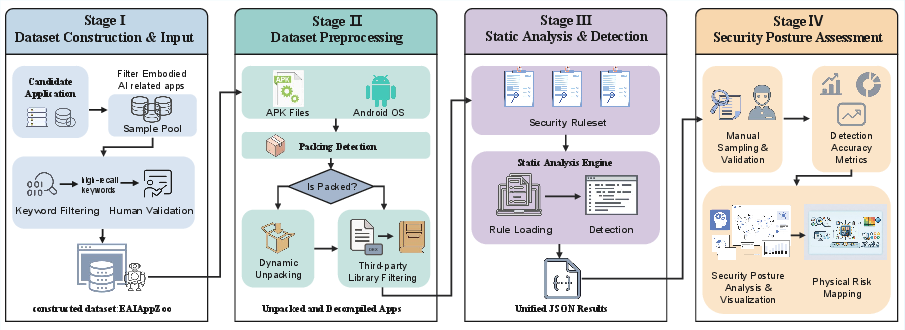
Figure 1: EAGLE framework: from dataset construction through semantic-aware analysis and security posture assessment.
Dataset and Measurement Setup
EAIAppZoo contains 507 real-world apps drawn from Google Play and AndroZoo, representing cleaning robots, service robots, industrial/agricultural robots, educational/social robots, wearables, and UAVs. Each APK is processed for semantic analysis and structural code inspection, with the pipeline aggregating misuse findings and their contextual relevance to device control.
Empirical Results and Analysis
Misuse Prevalence and Domain Distribution
Across the dataset, 12,975 cryptographic misuses were identified. Dominant categories include weak primitives (MD5, SHA-1, DES) and insecure communication (plaintext TCP/RTSP, disabled certificate checking). Misuses are highly concentrated—few applications contribute most findings, pointing toward domain-specific code reuse and supply chain effects.
(Figure 2)
Figure 2: Distribution of misuse categories across EAI domains, illustrating domain-specific risk concentrations and structured weaknesses.
UAVs and educational robots tend to rely on insecure communication channels for command/control and telemetry. Cleaning and service robots, while employing encryption, predominantly use deprecated algorithms, offering limited defense. These structural weaknesses are not random but reflect engineering trade-offs: low-latency communication, offline provisioning needs, and legacy SDK inheritance.
Analysis Pipeline Reliability
Manual validation of 244 randomly sampled findings yields 80.74% precision, demonstrating that the semantic-aware static pipeline reliably identifies cryptographic misuses. Wearable apps showed lower precision due to obfuscation and mature DRM libraries.
Cyber-Physical Exploitability
Real-world cases demonstrate the translation of cryptographic flaws into cyber-physical exploits:
- Case 1: Service robot apps package client private keys inside the APK, rendering mTLS ineffective and allowing adversarial takeover via emulated clients.
- Case 2: Robot arm control apps transmit commands over plaintext MQTT/TCP, enabling command injection and kinetic manipulation.
- Case 3: Quadruped robot apps hardcode AES keys and IVs for device provisioning. Attackers can intercept and decrypt Wi-Fi credentials, pivot into home networks, and inject forged kinetic commands, fully compromising both digital and physical security.
(Figure 3)
Figure 3: Physical hijacking of a Unitree quadruped robot via malicious command injection following a provisioning channel compromise.
Comparison with Prior Work
Prior studies on cryptographic misuse in mobile apps focus on conventional domains (finance, communications). Conventional measurement pipelines (e.g., static/dynamic analysis tools) are widely used [10.1145/2508859.2516693, sun2023cryptoeval, ami2022crypto, mykhaylova2024hardcoded], but fail to contextualize weaknesses in cyber-physical control loops. Although there is increased interest in embodied intelligence safety and trust [huang2025beyond, tan2025towards, Liu2025AligningCS], the mobile application layer has been largely ignored as a critical boundary in EAI risk assessments.
Practical and Theoretical Implications
From a practical perspective, the findings indicate that EAI mobile applications constitute a fragile cryptographic boundary with systemic weaknesses, highlighting the potential for direct cyber-physical attack chains enabled by trivial code flaws. Engineering compromises (static keys, plaintext channels) are driven by operational constraints rather than mere developer incompetence. Theoretically, these results signal a need to reconsider cyber-physical trust frameworks, factoring in the mobile control layer as an explicit security boundary. For future developments in AI, mitigation strategies could include mandatory secure provisioning with dynamic keys, non-negotiable transport encryption even for real-time local channels, and coordinated security audits across supply chains.
Future Directions
Extending static measurement to dynamic analysis—including physical testbeds—is essential for mapping exploit chains and validating kinetic impacts. Integration of runtime behavioral analysis with semantic detection may reveal additional risks from obfuscated logic, native code, and dynamically loaded modules. Collaborative disclosure and vendor engagement are critical for remediating high-impact flaws in real-world deployments.
Conclusion
Large-scale analysis of EAI mobile applications reveals systemic cryptographic vulnerabilities driven by operational engineering constraints and legacy dependencies. These flaws propagate through mobile control paths, undermining the security of cyber-physical systems and enabling direct physical attacks. Future research should expand dynamic analysis and strengthen mobile application audits to enforce robust cryptographic standards as EAI deployment scales.

