- The paper presents the first systematic evaluation of cryptographic API misuse detectors in Go by analyzing 328 repositories and uncovering 7,473 misuse instances.
- It employs both qualitative and quantitative methodologies across four tools and a unified taxonomy of 14 misuse classes to assess detection precision and tool performance.
- Findings indicate that ensemble tool strategies and standardization in rule semantics are critical for mitigating false positives and enhancing Go security.
Introduction
Cryptographic API misuse forms a foundational vulnerability class undermining modern software security. Despite extensive investigation in languages such as Java and Python, Go—currently the dominant stack for security-critical infrastructure—has been under-explored for crypto API misuse detection. This paper, "Evaluating Cryptographic API Misuse Detectors for Go" (2604.24085), presents the first systematic qualitative and quantitative analysis of API misuse detection in Go. Four prominent tools—CodeQL, Gopher, Gosec, and Snyk Code—are evaluated across a consolidated taxonomy of 14 misuse classes, leveraging an empirical dataset of 328 security-relevant open-source Go repositories. The results identify 7,473 misuses, reveal strong discrepancies in tool consensus and precision, and suggest immediate practical implications for Go security engineering as well as future theoretical research.
Taxonomy of Cryptographic API Misuses
A unified taxonomy is established to encapsulate the breadth of relevant issues, grouped into six domains: Cryptographic Primitives, Key Management, Password-based KDFs, Transport Security, Secure Shell, and Token-based Authentication. Each misuse type is mapped to severity and, when available, to published security advisories (CVEs). Notable misuse classes include insecure algorithm usage (e.g., MD5, SHA1), cryptographically insecure PRNGs, short or predictable keys and IVs, low salt or hash iterations in KDFs, unencrypted HTTP transmission, poor TLS/SSL configuration (e.g., certificate verification skipped), insecure SSH setups, and missing JWT verification checks. These categories cover both structural weaknesses in the API and configuration errors, reflecting failure modes observed in the Go ecosystem’s CVE history.
Dataset and Experimental Methodology
The quantitative analysis employs a curated set of 328 actively maintained, security-relevant open-source Go repositories. These projects range from small utilities to core infrastructure components such as Kubernetes and Terraform, representing millions of lines of code.
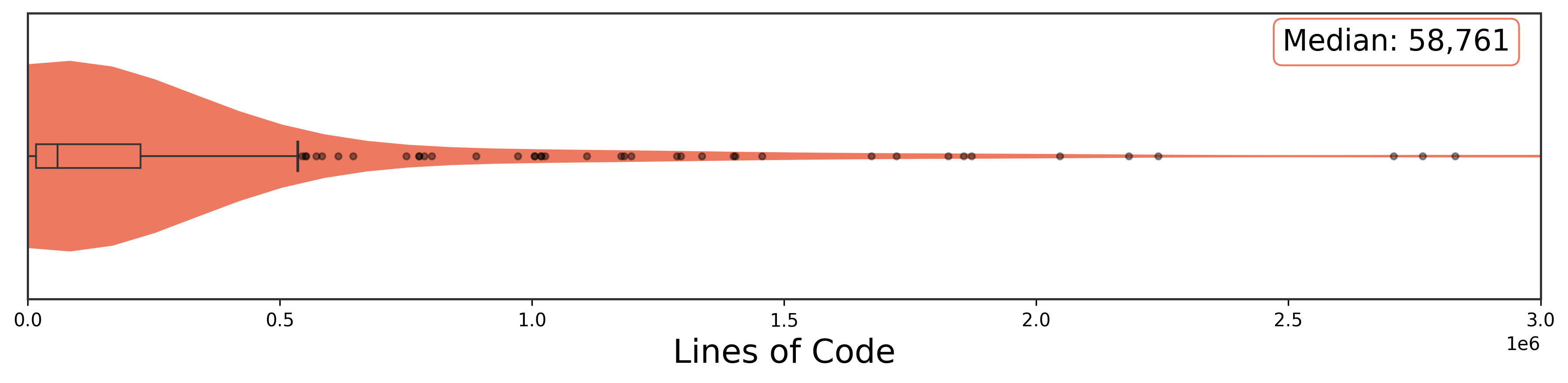
Figure 1: Distribution of lines of code per repository across the dataset, highlighting a right-skewed spectrum from small to massive projects.
Each tool is executed on every project, using built-in detection rules mapped to the unified taxonomy. Detections are compared by rule and location to evaluate the prevalence of misuses, tool reliability, consensus, and execution efficiency. Tool output precision (line versus column granularity, severity/confidence ratings) is also examined to characterize practical usability.
The four evaluated tools exhibit distinct technical, configurational, and output characteristics:
- CodeQL: Fully open-source, high configurability, column-level precision, severity ratings enabled, Datalog-based static analysis employing taint tracking and deep data-flow reasoning. Detects five rule classes, uniquely covering JWT verification.
- Gopher: Closed-source research binary, broad rule coverage (13/14), line-level precision only, SSA-based taint analysis with on-the-fly rule updates. Fails on a considerable subset of projects, but covers subtle misuse patterns missed by others.
- Gosec: Open-source, full rule configurability, column precision, severity/confidence scores, and hybrid AST/SSA analysis. Covers six rule classes, dominant in detection volume but prone to false positives.
- Snyk Code: Commercial, closed-source, column precision, severity gradation, static analysis amplified by proprietary ML heuristics. Limited rule coverage (four), rapid execution, and high reliability.
Detection coverage reflects each tool’s analytical depth and default rule settings. The primary detection mode is taint tracking over intermediate representations (SSA, fact databases), but rule granularity and heuristic specificity differ (e.g., blacklist versus full data-flow).
Detection Prevalence and Coverage
Detection prevalence varies drastically: Snyk Code and Gosec flag nearly all projects, Gopher flags half, and CodeQL flags fewer than one-third. Most repositories are flagged by at least one tool; aggregate detection volume reaches 7,473 misuse instances.
Detection Agreement and Uniqueness
Analysis of cross-tool consensus reveals that most detections are unique to a single tool, especially for Gosec and Snyk Code. Only a small fraction of findings are shared by all tools, indicating fragmented detection and unreliable precision. Aggregate agreement correlates with higher true positive rate; unique detections often include excessive false positives and security-irrelevant flags.
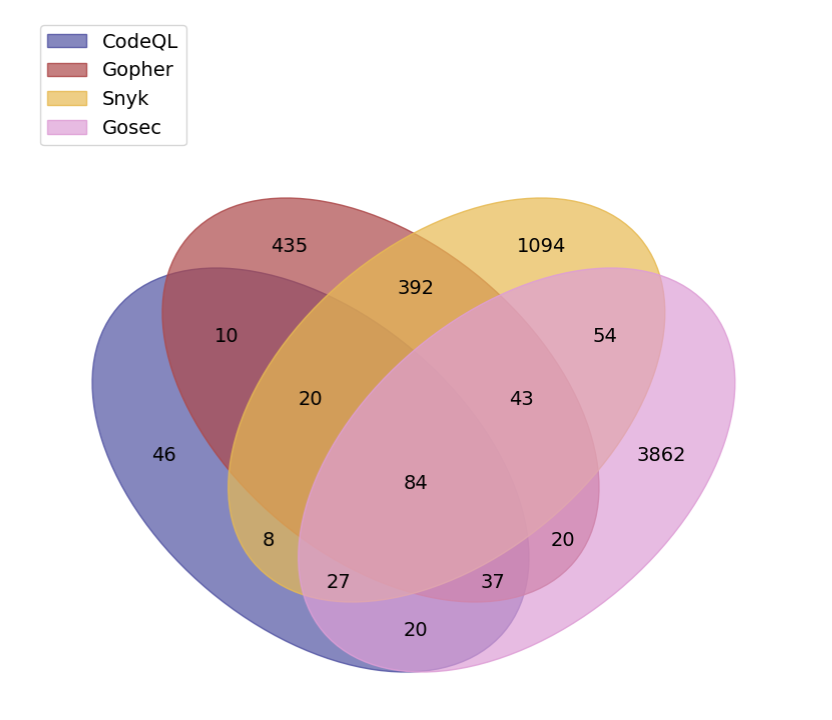
Figure 2: Venn diagram highlighting the detection agreement across all rules; most findings are tool-specific, with minimal overlap.
Rule-Specific Analysis
Three representative rules—short key length (#05), SSL/TLS issues (#11), SSH host key validation (#13)—demonstrate varying patterns of tool overlap and precision.
- Short Key Length: Extreme disagreement; most findings are mutually exclusive, and false positives abound in mock or non-production code.
- SSL/TLS Issues: Moderate overlap, with Gosec and Snyk Code confirming insecure configurations and dropped certificate verifications; true positive rates improve in overlapping detections.
- SSH Host Key Validation: Sparse, but high-precision consensus; CodeQL’s advanced reasoning captures unique cases where custom callbacks disable verification.
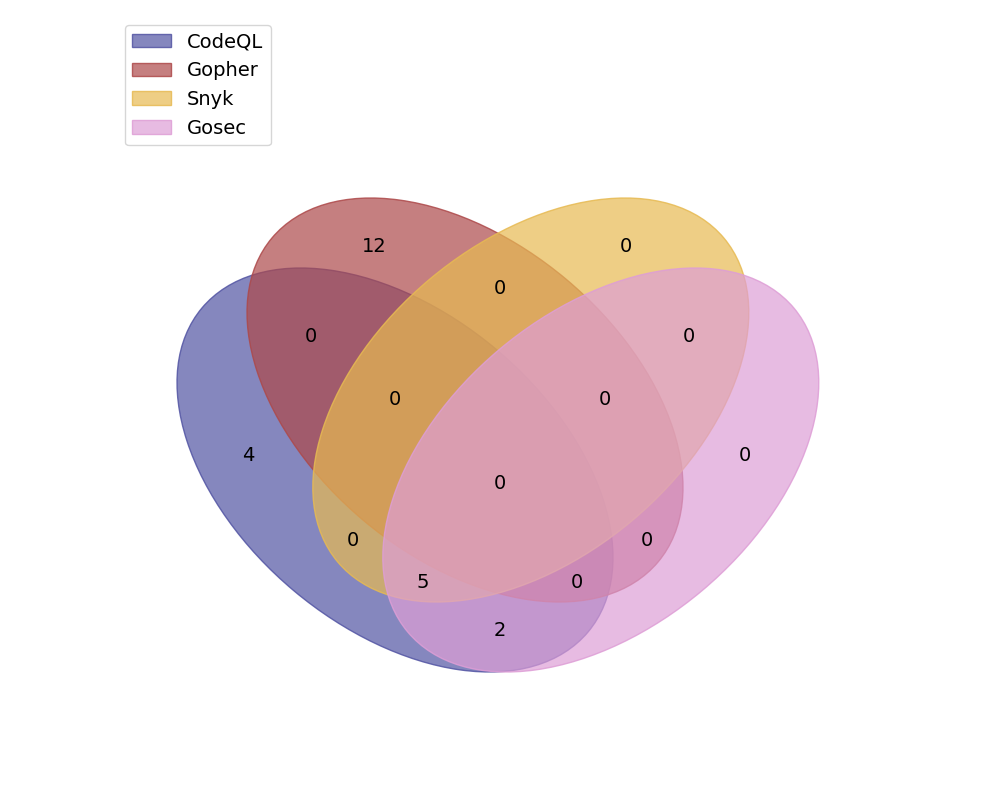
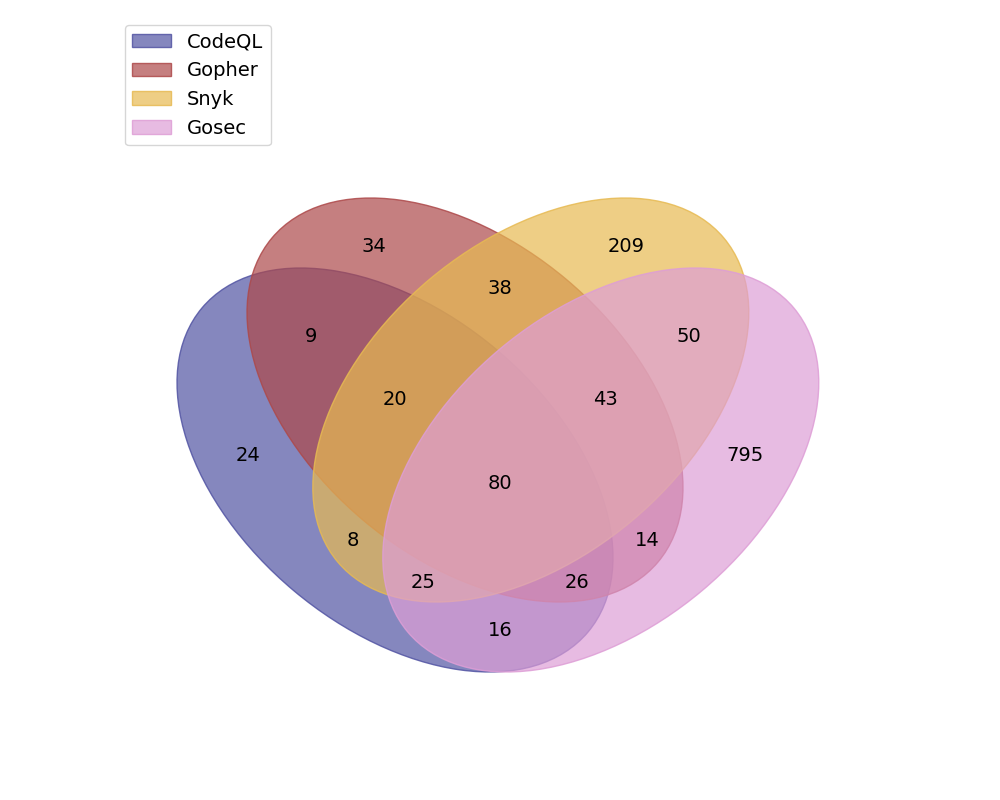
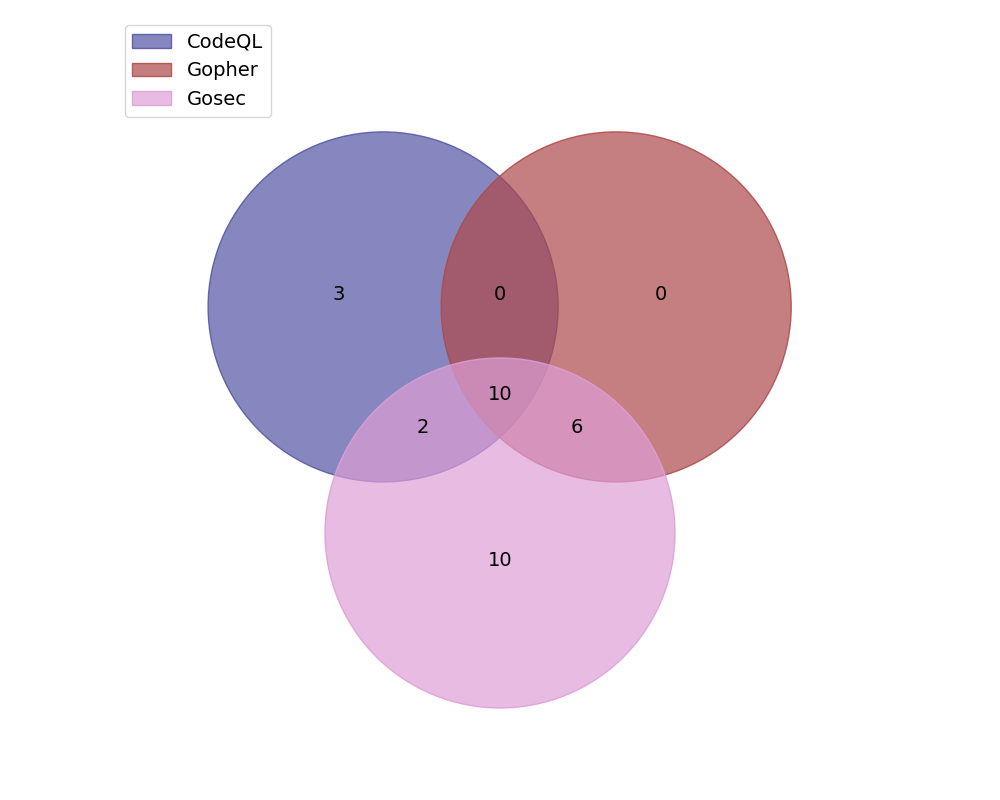
Figure 3: Venn diagram of detection overlap for Rule 05 (short key length), revealing minimal agreement and broad tool-specific findings.
Execution Time
Execution times per project differs substantially: CodeQL is slowest (median 219s/project), Snyk Code fastest (16s/project), Gosec intermediate (29s/project), and Gopher reflects its broader analysis (63s/project). This impacts scalability and CI feasibility.
Implications and Future Directions
The results demonstrate that cryptographic API misuse detection in Go remains immature, with substantial gaps in coverage, consensus, and contextual precision. Practically, Go security engineers should ensemble multiple tools, focusing attention on overlapping detections for prioritization, and manually investigating rule-unique findings due to potential false positives. Theoretically, the domain requires standardization of rule semantics and improved precision-oriented benchmarks to drive detection maturity. Long-term, the integration of LLMs into static analysis (as observed in Java/Python) may enhance coverage but also risks higher false positive rates unless robust feedback loops are established.
Conclusion
This systematic evaluation establishes a baseline for cryptographic API misuse detection in Go, exposing significant tool discrepancies and highlighting ensemble approaches as an immediate strategy for improved precision. Future research should address semantic standardization and deeper contextual analysis, leveraging both static and ML-enhanced frameworks, to advance practical security in Go-centric infrastructure.