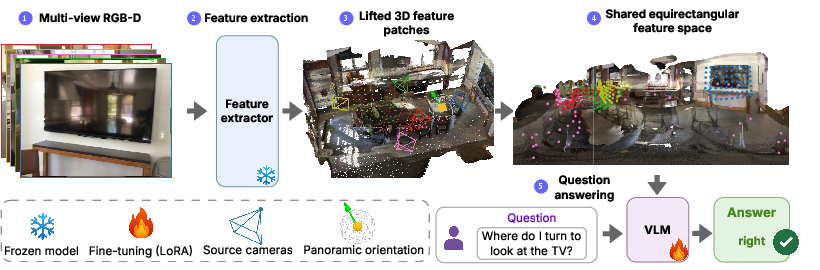
- The paper introduces a panoramic reprojection framework that unifies multi-view 3D features into a single input canvas for vision-language models.
- The paper integrates a spatial pretraining curriculum using synthetic tasks to enhance metric, navigational, and spatial QA capabilities.
- The paper demonstrates state-of-the-art results on SQA3D, VSI-Bench, and SPBench with significantly reduced training compute.
OneCanvas: Panoramic Reprojection for Efficient 3D Scene Understanding in VLMs
Motivation and Background
Advancements in Vision-LLMs (VLMs) have precipitated the need for robust 3D scene understanding, critical for embodied AI and spatial intelligence applications. Conventional approaches augment 2D VLMs with elaborate geometric encoders and extensive spatial QA datasets, yet often fail to fully utilize geometric input, reverting instead to textual and scene priors. Recent audits indicate weak spatial reasoning despite architectural complexity and data scale (Ma et al., 6 Mar 2026). OneCanvas introduces a paradigm shift: it leverages panoramic reprojection and a unified input canvas to enable comprehensive spatial reasoning without architecture modifications, prioritizing representation design for maximal compatibility with pretrained VLMs.
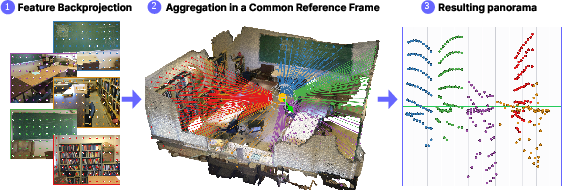
Figure 1: OneCanvas aggregates per-frame patch features via backprojection to 3D, subsequent placement in a common reference frame, and reprojection onto a panoramic canvas as a single image for VLM consumption.
Method Overview
OneCanvas operates by extracting patch features from multi-view RGB-D data, projecting them to 3D world coordinates using depth and camera pose, and situating each patch at its continuous angular position (longitude, latitude) on a panoramic equirectangular canvas centered on an arbitrary viewpoint. Critical elements include:
This design aligns per-frame patch features into a shared spatial coordinate system, enabling the VLM to process the 3D scene as a familiar image input, supporting both scene-centric and agent-centric spatial reasoning.
Spatial Pretraining Curriculum
A novel spatial pretraining curriculum is enabled by the panoramic representation. Synthetic objects are procedurally placed at arbitrary 3D coordinates; corresponding patch features are referenced within prompts to enforce geometric causality in supervision. The curriculum covers:
- Metric measurements: Pairwise distances, area computation.
- Egocentric direction: Left/right/front/back queries from arbitrary viewpoints.
- Navigation: Multi-turn route planning.
- Observability: Appearance ordering, line-of-sight visibility.
- Counting: Object counts including parity/divisibility.
- Bounding-box readouts: 3D localization.
Answer distributions are tightly controlled to suppress statistical shortcuts, ensuring the model learns genuine spatial reasoning rather than scene or language priors.
Training and Adaptation
Training proceeds in two stages:
- Stage 1: Spatial pretraining, optimizing LoRA adapters and the 3D position embedding solely via curriculum tasks, yielding geometric reading skills without scene-class biases.
- Stage 2: Target QA adaptation by merging stage-1 weights into the base model, then fine-tuning a fresh, lower-rank LoRA adapter on spatial QA corpora (SQA3D, VSI-Bench, and ViCA).
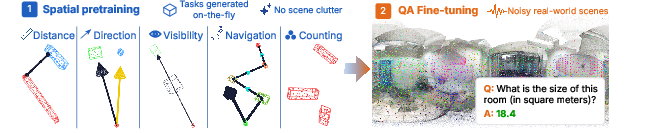
Figure 3: Two-stage training sequence—first stage pretrains LoRA/3D embedding on synthetic spatial tasks, second stage adapts via downstream QA fine-tuning.
Token embeddings remain frozen throughout both stages, ensuring transferability and stability.
Experimental Evaluation
OneCanvas achieves state-of-the-art accuracy on SQA3D (65.3 EM@1, +2.3pt over previous best), VSI-Bench (70.1 avg), and SPBench zero-shot (72.1 overall, +4.8pt margin), utilizing an order of magnitude less training compute compared to dominant methods.
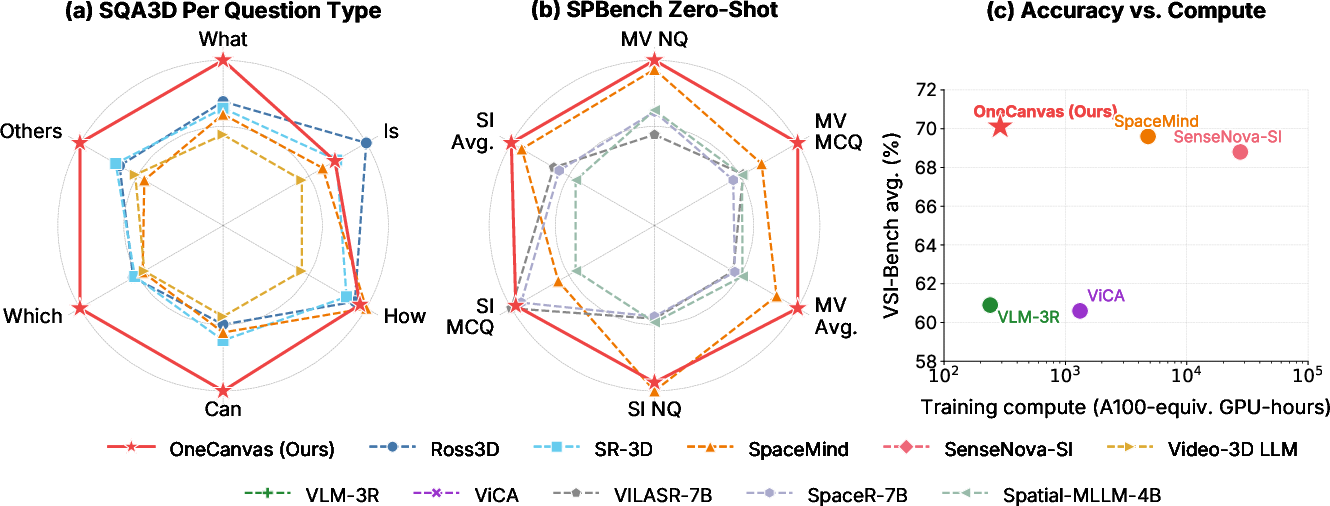
Figure 4: Benchmark comparisons—SQA3D per-question-type accuracy, SPBench zero-shot performance, and training compute vs. VSI-Bench accuracy.
Ablation studies confirm the necessity of each design element:
- Panoramic representation significantly improves cross-scene spatial tasks.
- 3D position embedding advances metric reading capabilities.
- Spatial pretraining is indispensable for route planning and nuanced spatial queries.
Canvas origin selection directly influences situated question performance, favoring agent-centric placement for viewpoint-dependent tasks.
Practical and Theoretical Implications
OneCanvas demonstrates that carefully engineered input representations deliver genuine spatial reasoning in VLMs without reliance on architectural overhauls or extensive dataset curation. The panoramic reprojection aligns multi-view input with the VLM's native processing style, enabling efficient training and strong generalization with modest compute requirements. The spatial pretraining curriculum induces metric and geometric capabilities even in models originally agnostic to 3D input.
Practically, this approach equips VLMs for robotics, augmented reality, and navigation scenarios where flexible viewpoint-centric reasoning is required. Theoretically, it substantiates the importance of representation design in unlocking latent spatial intelligence, suggesting broader applicability for panoramic canvases and synthetic curricula across multimodal models.
Limitations and Future Directions
OneCanvas depends on depth and pose availability, a constraint mitigated but not eliminated by recent feed-forward metric reconstruction. Large-scale or outdoor scenes may tax the global panoramic canvas's spatial precision, and creation of novel spatial tasks requires explicit curriculum engineering. Current experiments are limited to Qwen3-VL backbones; extension to other architectures with appropriate positional encoding mechanisms is pending.
Potential future developments include:
- Integration with pure RGB-driven pipelines via robust monocular depth and pose estimation.
- Application to outdoor and vast multi-room environments.
- Expansion of curriculum-driven pretraining for additional spatial reasoning tasks.
- Generalization to a broader set of VLM architectures.
Conclusion
OneCanvas reframes 3D scene understanding as panoramic 2D reasoning, unifying multi-view input into a single spatially consistent canvas consumed directly by existing VLMs. Through metric position embedding and spatially causal pretraining, it achieves superior spatial intelligence with minimal compute and infrastructure overhead. The methodology emphasizes input representation as the critical enabler for geometric reasoning in vision-LLMs, opening avenues for efficient embodied AI deployment and robust spatial QA benchmarking.