- The paper demonstrates that a lightweight LDM backbone with LCG and innovative Lλ MI blocks can achieve performance comparable to 10B-scale models.
- It introduces adaptive multi-granularity latent distillation, using coarse and fine L2 alignment to enhance structural and perceptual image restoration.
- Empirical results reveal over 15× acceleration and superior or equivalent fidelity across benchmarks, emphasizing efficient real-world applicability.
Introduction and Motivation
Moebius proposes a specialized approach to the image inpainting problem, targeting the efficiency-quality trade-off that has dominated recent diffusion-based generative models. While industrial-scale models such as FLUX.1-Fill-Dev and SD3.5 Large-Inpainting (parameter counts on the order of 10B) have demonstrated strong zero-shot and high-fidelity restoration, their practical deployment is limited by latency and resource requirements. Moebius directly addresses the representational bottleneck that arises when compressing diffusion models to the extreme regime (0.22B parameters), asserting that with rigorous architectural and optimization innovations, a lightweight specialist can rival or surpass heavyweight generalists for targeted inpainting tasks.
Framework Overview
Moebius adopts a Latent Diffusion Model (LDM) backbone augmented by Latent Categories Guidance (LCG) for semantic prior integration. The architectural core is the Local-λ Mix Interaction (LλMI) block, which synergizes local spatial and global semantic priors into fixed-size linear operators, thereby facilitating both self- and cross-attention with linear complexity and minimal parameter growth.
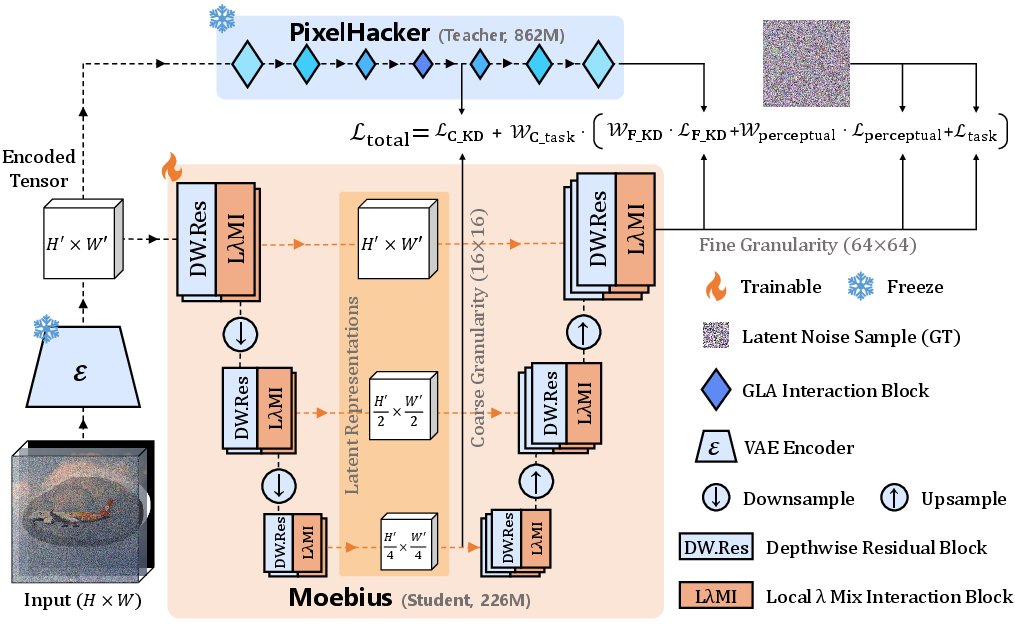
Figure 1: Overall pipeline of Moebius. Extreme efficiency is achieved by replacing the denoising U-Net with LλMI blocks and applying adaptive multi-granularity latent distillation alignment during training.
Architectural Innovation: LλMI Block
Representation Bottleneck in Model Compression
Conventional backbone compression, such as substituting standard convolutions and dense attention mechanisms with efficient alternatives (e.g., DWConv, Gated Linear Attention), leads to catastrophic performance drops due to inadequate contextual and semantic modeling. Importantly, linear attention variants are not natively compatible with cross-attention for global semantic integration, a critical factor in high-fidelity inpainting.
Local-λ and Interactive-λ Modules
The LλMI block consists of three integrated components: Local-λ (lightweight context aggregation for intra-image structure), Interactive-λ (cross-attention with semantic priors via linear operators), and Mix-FFN (depthwise-augmented, compressed feed-forward). Both Local and Interactive λ modules exploit efficient summary statistics to avoid memory- and computation-intensive pairwise maps, replacing them with matrix-product approximations that scale linearly with input dimensionality.
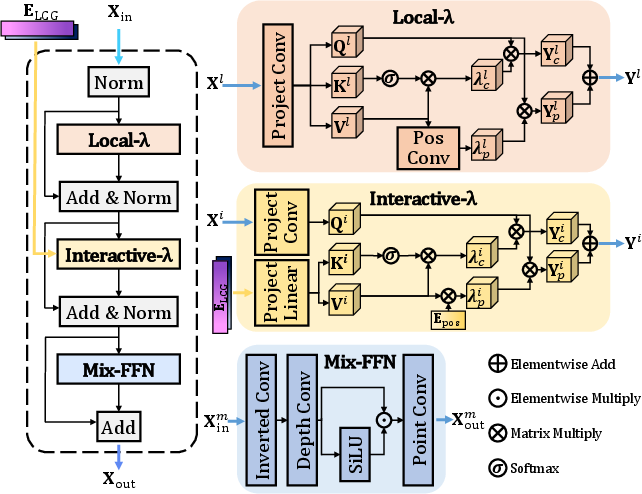
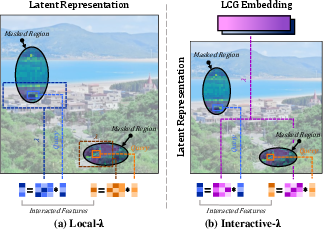
Figure 2: The LλMI0 block showing the chaining of Local-LλMI1, Interactive-LλMI2, and Mix-FFN. All attention operations are memory- and compute-efficient and tailored for latent-space representations.
Adaptive Multi-Granularity Knowledge Distillation
To compensate for the capacity collapse induced by architectural compression, Moebius employs a multi-granularity distillation strategy strictly in the latent domain, mitigating the overhead of pixel-space decoding. The student model is trained under coarse- and fine-level L2 alignment between teacher and student latent representations, augmented by a latent-space perceptual constraint and an adaptive gradient-based weighting scheme that dynamically balances the different loss terms based on their gradient magnitudes.
Ablation studies validate that each incremental addition to the distillation objectives substantially improves structural and perceptual generative performance, with the full latent-space distillation configuration providing the optimal trade-off under the model's parameter budget.
Empirical Evaluation and Results
Quantitative and Qualitative Benchmarking
Moebius was extensively benchmarked on the Places2, CelebA-HQ, and FFHQ datasets under standard protocols. It achieves:
- Inference latency of 26.01 ms/step (0.154 TFLOPs), leading to over 15× acceleration compared to FLUX.1-Fill-Dev.
- Comparable or superior FID and LPIPS scores versus 10B-scale models, e.g., FID: 0.92 (Places2 Small), outperforming the industrial SOTA on this setting.
- Robustness on out-of-distribution (OOD) evaluation sets, retaining strong generative quality with no catastrophic collapse in zero-shot setting.
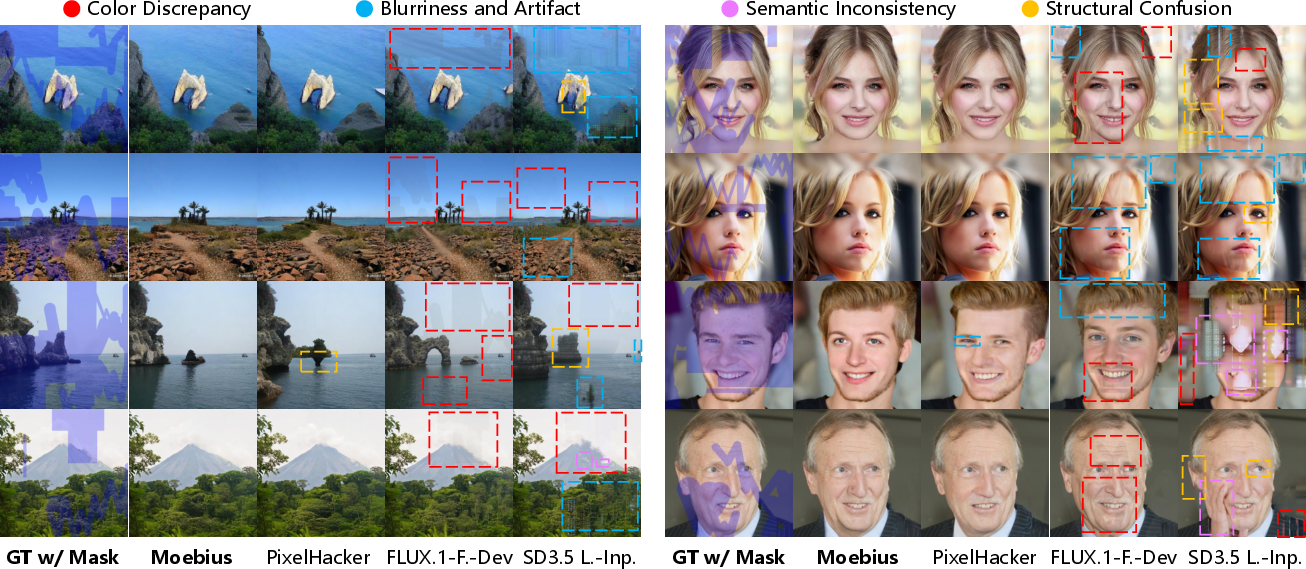
Figure 3: Qualitative comparison; Moebius yields superior contextual consistency and avoids typical big-model artifacts (color shift, semantic confusion) in both natural and portrait domains.

Figure 4: User preference study reveals Moebius matches its teacher and is consistently preferred to 10B-level generalist models, especially in highly structured domains.
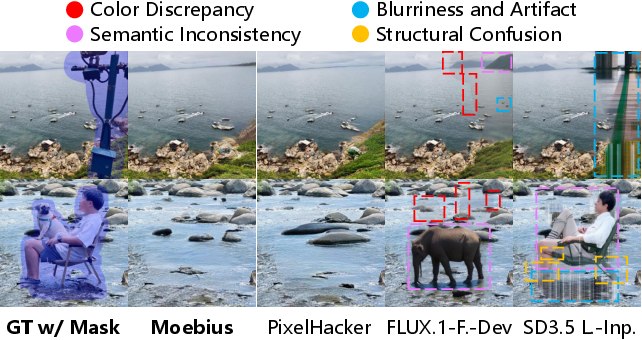
Figure 5: Ablation and real-world removal experiments indicate the necessity and additive effect of each multi-granularity distillation term. Moebius achieves superior artifact-free object removal.
Additional Analyses
Expanded qualitative studies on both academic and commercial datasets demonstrate that Moebius not only equates or exceeds open research baselines but also competes with large-scale proprietary systems, e.g., Google's Nano Banana and Qwen Image Edit, while operating at a fraction of their scale.
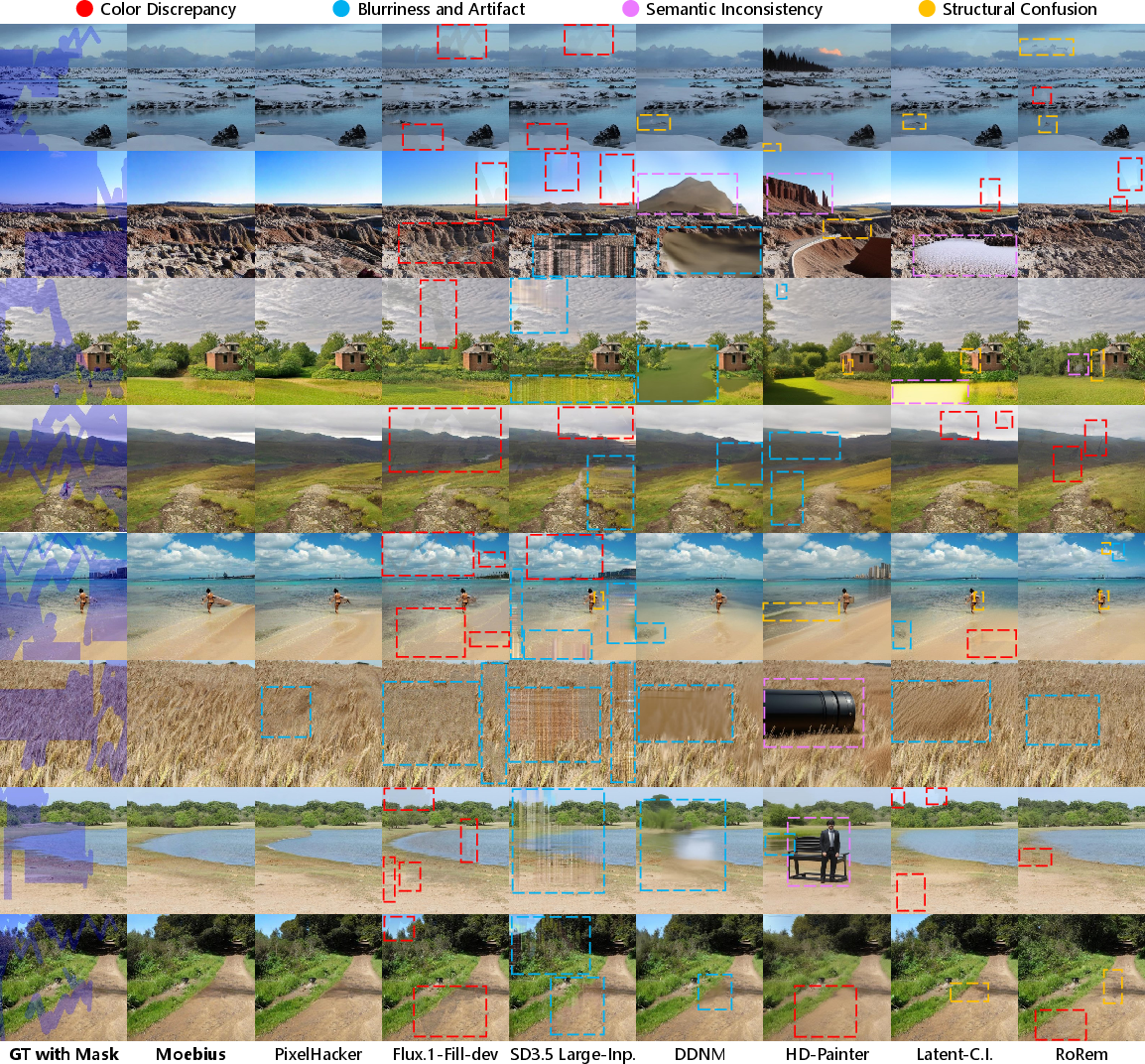
Figure 6: On complex natural scenes (Places2), Moebius avoids structural confusion and synthesizes consistent context even at low capacity.
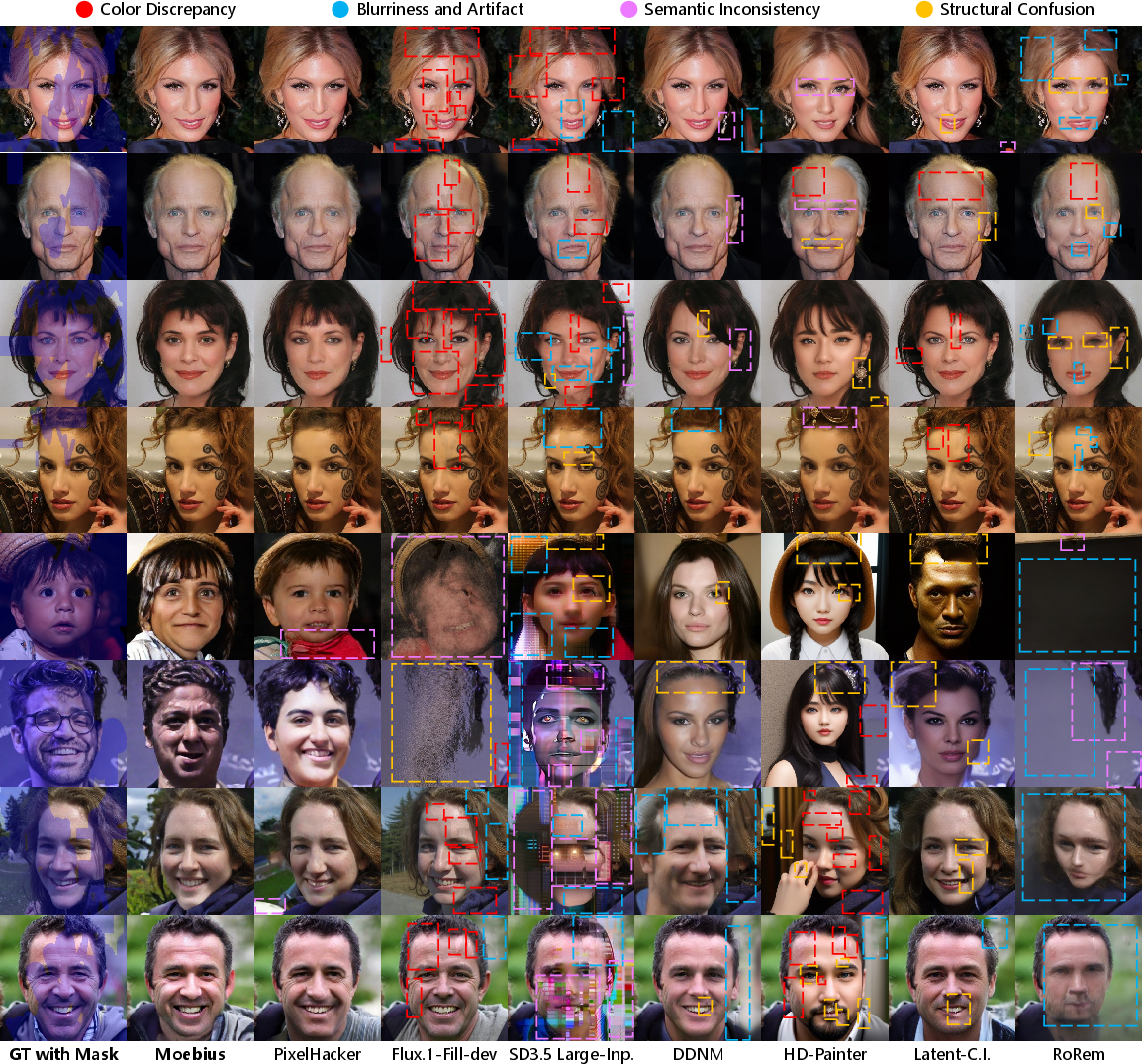
Figure 7: On portrait tasks, Moebius maintains facial structural coherence and avoids semantic/texture inconsistencies prevalent in both specialist and generalist alternatives.
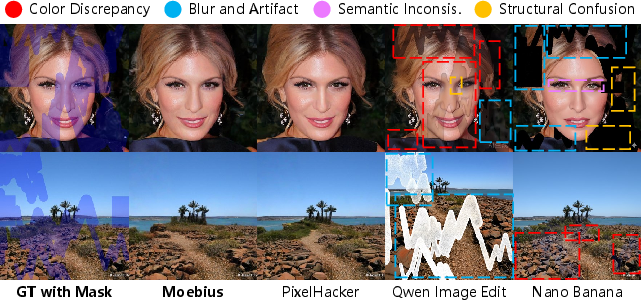
Figure 8: Comparison with commercial edit systems highlights Moebius' competitive visual integrity despite massive scale disadvantage.
Limitations
A critical observation is that extreme compactness entails rare, minor losses in microstructural texture when contextual priors are severely limited, as seen in failure case analysis. This represents an inherent trade-off rather than a flaw in the architectural or training pipeline.

Figure 9: Occasional minor texture/plausibility degradation in extremely constrained background regions evidences the capacity-efficiency boundary.
Implications and Future Directions
The findings in Moebius undermine the prevailing assumption that high-fidelity inpainting requires billion-scale parametric overprovisioning. This research invites two main implications for future work:
- Specialist model deployment at the edge: With drastic reduction in parameter count and inference cost, use cases in on-device photo editing, privacy-preserving visual retouching, and real-time visual communication become viable without cloud dependency.
- Efficient knowledge transfer for other vision tasks: The latent-space, granularity-aware distillation paradigm can be generalized to compact model training for restoration, generation, and editing across other structured visual domains.
Conclusion
Moebius empirically establishes that rigorous architectural reformulation and strictly latent-space, adaptive multi-granularity knowledge distillation enable a 0.22B inpainting specialist to compete directly with, and often surpass, state-of-the-art 10B-level generalist diffusion models. This contribution recalibrates efficiency and deployment expectations for task-specific generative vision systems, arguing that the “impossible triangle” of parameter count, speed, and generation quality can be resolved with precise architectural-optimization synergy (2606.19195).