- The paper introduces ReMP, a framework that decouples runtime state from fixed TP/PP topology, enabling rapid topology reconfiguration.
- It employs concurrent model loading and layer-wise KV cache migration to minimize downtime and avoid redundant recomputation.
- Evaluation on 7B to 70B LLMs shows ReMP achieves topology switching in 1–7 seconds, significantly outperforming restart-based methods.
ReMP: Low-Downtime Runtime Model-Parallelism Reconfiguration for LLM Serving
Motivation and Problem Statement
Traditional LLM serving systems rigidly bind the model parallelism topology, determined by tensor parallelism (TP) and pipeline parallelism (PP), to launch-time configuration. This static assignment creates a structural impedance mismatch with dynamic, fluctuating inference workloads, as evidenced by distinct traffic patterns in real-world deployments (Figure 1). Existing solutions, lacking online topological reconfiguration, mandate disruptive service restarts to alter TP/PP degrees. Such restarts incur minute-scale downtime, KV cache loss, and redundant recomputation—precluding practical workload-adaptive serving.
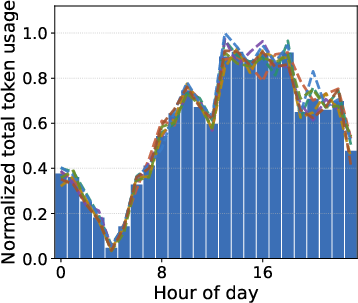
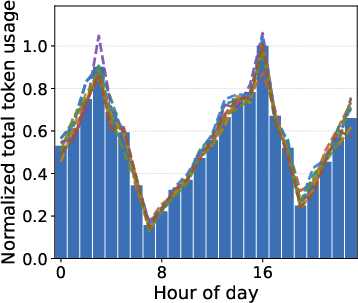
Figure 1: Token Usage Profile of INFINIGENCE Model Service, illustrating daily traffic variability and motivating dynamic topology adaptation.
ReMP Architecture and Decoupling Mechanisms
ReMP is conceived to allow online, low-downtime TP/PP reconfiguration by decoupling system runtime state from the fixed topology. It introduces six architectural components: Reconfiguration Controller, Shared Weight Store, MPU State Space, Worker Lifecycle Manager, KV Migration Engine, and Scheduler Adapter (Figure 2).
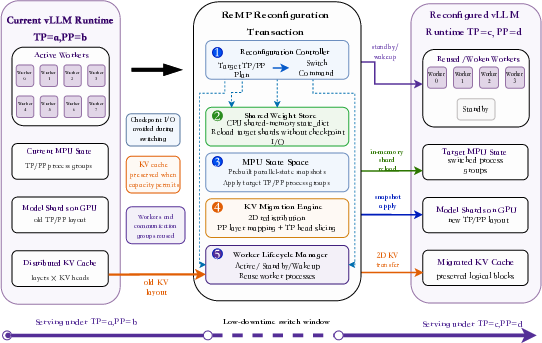
Figure 2: ReMP architecture, illustrating the decoupling of model weights, KV cache, communication groups, and worker lifetimes from static TP/PP topology.
Key decoupling strategies include:
- Model weights: Persisted in CPU shared memory, enabling GPU shard re-materialization without disk I/O under topology changes (Figure 3).
- KV cache: Migrated via a two-dimensional mechanism—along layer and head dimensions—to preserve request state across TP/PP transitions (Figure 4).
- Communication groups: Parallel-state snapshots preconstructed for candidate topologies, applied instantly during reconfiguration.
- Worker lifetimes: Standby/wakeup model leverages existing processes, minimizing process management overhead.
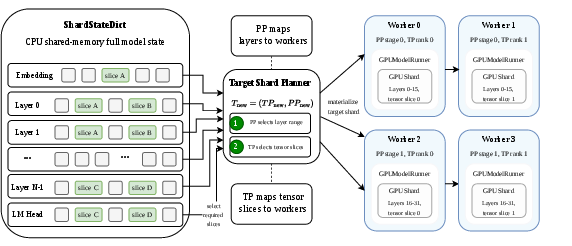
Figure 3: Shared model weight store; full model state resident in CPU shared memory, facilitating efficient topology-motivated GPU shard reconstruction.
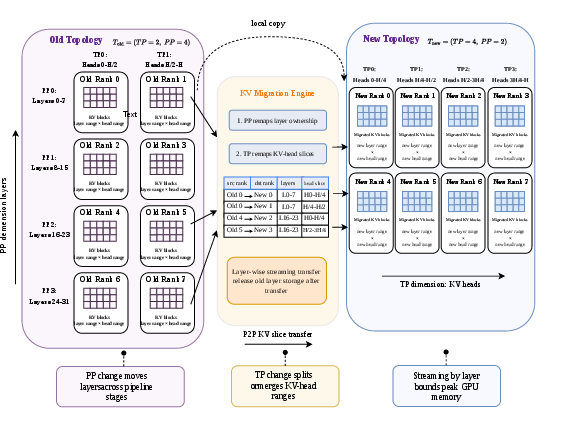
Figure 4: Two-dimensional KV cache migration process, enabling seamless redistribution of live cache across TP (head) and PP (layer) axes.
Transactional Runtime Switching and State Migration
Each TP/PP topology switch is framed as a controlled transaction, comprising quiescing the scheduler, applying new parallel state, migrating KV cache, loading GPU shards, and resuming execution. Critical optimizations underpin this process:
- Concurrent Model Loading and KV Migration: These disjoint operations are run in parallel, reducing latency from the sequential sum to their maximum duration.
- Layer-wise Streaming: KV migration is conducted layer-by-layer, constraining memory usage to manageable levels and averting OOM risks during migration.
- Worker Management: Workers transition only after their relevant KV slices are properly migrated, ensuring correctness and maintaining low downtime.
ReMP's empirical evaluation spanned models from 7B to 70B parameters and two 8-GPU platforms (H100 and RTX 5090). The core claims substantiated by experimental data are:
- ReMP achieves 1–7 second topology switching—tens to >100× faster than restart-based approaches. (Figure 5, Figure 6)
- For Llama2-70B, ReMP consistently stays within several seconds for most TP/PP transitions, despite substantial model-shard reconstruction requirements.
- Overlapping model-shard reloading and KV cache migration is instrumental in minimizing disruption and mitigating critical path overhead.
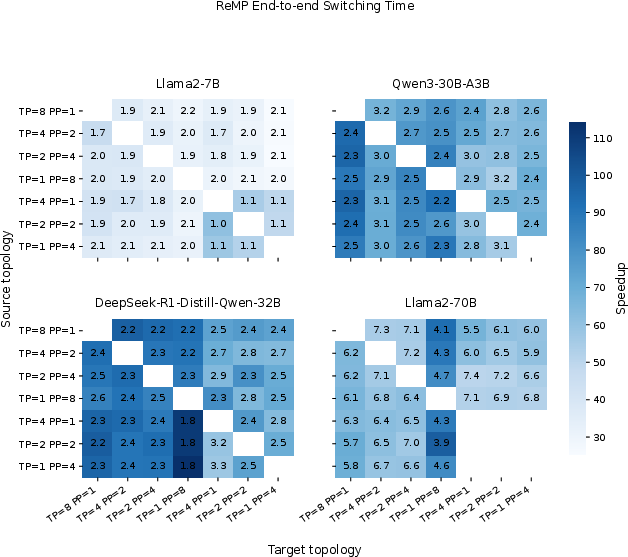
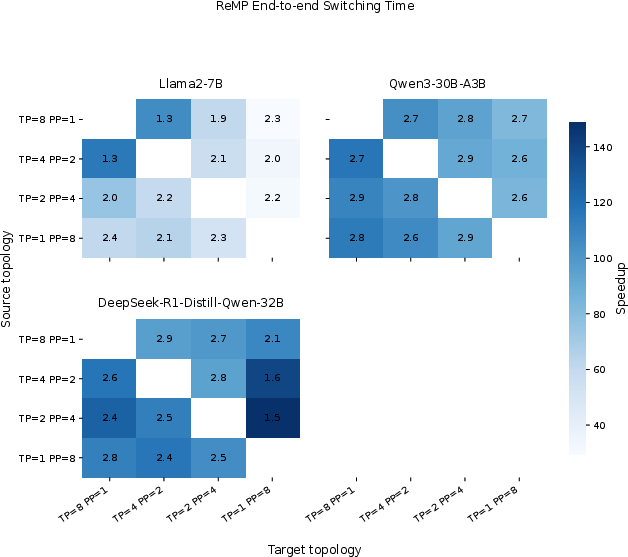
Figure 5: H100 platform.
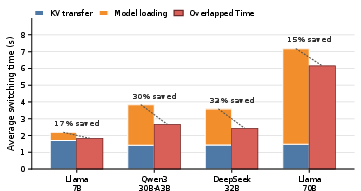
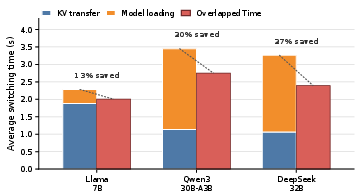
Figure 6: H100 platform.
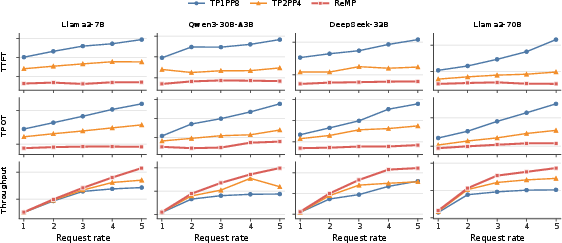
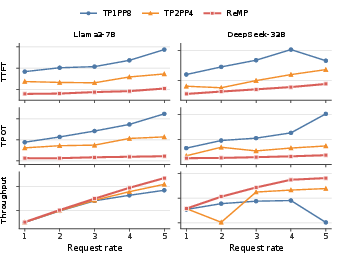
Figure 7: Serving performance comparison on the H100 platform; ReMP adaptively selects optimal TP/PP under each request rate, outperforming fixed baselines in both latency and throughput.
Adaptive Serving: Throughput and Latency Benefits
Serving experiments reveal that the best TP/PP configuration varies with model architecture and request rate: pipeline-heavy configurations can optimize throughput but suffer increased TTFT and TPOT; tensor-heavy configurations minimize latency but may bottleneck throughput.
Implications and Future Directions
By transforming TP/PP topology from static deployment parameters into runtime-adjustable resources, ReMP enables adaptive LLM serving, with direct gains in latency, throughput, and operational resilience. Practically, this can improve user experience (lower TTFT/TPOT), system efficiency (higher throughput), and cloud cost optimization (dynamic provisioning and resource utilization).
Theoretically, the decoupling mechanisms introduced—shared memory model state, layer/head KV migration, and parallel-state snapshotting—set a precedent for elastic LLM serving and could be extended to heterogeneous cluster environments and fine-grained topology adaptation, including MoE and hybrid parallelism paradigms. Recent works on pipeline reconfuguration [pipelive] and dynamic scheduling [llumnix] will likely integrate similar architectural concepts.
Future research directions include optimal probe-and-select mechanisms for online topology selection, amortized distributed group management for arbitrary topology sets, and advanced KV cache retention schemes for ultra-long context LLM workloads.
Conclusion
ReMP enables second-level, low-downtime TP/PP reconfiguration in production LLM serving systems by decoupling runtime state from topology. Experimental evidence demonstrates substantial speedups over restart-based adaptation and improved serving performance across dynamic workloads. The framework advances adaptive, workload-aware LLM inference, laying the foundation for highly elastic, efficient AI services.
(2606.18741)