- The paper demonstrates that adopting CMOS/CO2/FPGA configurations can achieve a 60% reduction in annual operational carbon emissions compared to legacy CCD systems.
- It employs a robust life-cycle assessment using SimaPro and EcoInvent to compare design alternatives across construction and operational phases.
- The analysis underscores the importance of strategic data infrastructure choices, such as cold storage and optimal site selection, for long-term emission reductions.
Integrating Sustainability in the Instrument Design and Data Infrastructure of the Wide-field Spectroscopic Telescope
Introduction
The Wide-field Spectroscopic Telescope (WST) represents a significant advance in the incorporation of environmental impact assessment directly into the early stages of astronomical facility design. With a 12-meter primary mirror and the integration of an IFS, MOS-LR, and MOS-HR, the WST aims to deliver high multiplexing and wide field capability while making explicit trade-offs between scientific performance, cost, and environmental footprint. This work systematically applies life-cycle assessment (LCA) methods to compare the carbon footprint of major design options and operational scenarios for both the hardware and the data infrastructure of the WST, with a particular focus on choices around detector technologies and cooling systems, and the projected data processing workflows.
Life-Cycle Assessment Framework and Instrument Design Trade-offs
LCA, implemented using the SimaPro tool and EcoInvent database with ReCiPe metrics, constitutes the backbone of the carbon footprint analysis. The system boundaries capture the construction and operation (one year, extrapolated to 20 years), excluding transportation, labor, and end-of-life, in line with practical limitations on data availability. The major variables probed are detector type—CCD (cooled with LPT cryocoolers) versus CMOS (cooled with CO2-based refrigeration and Peltier elements)—and the number and configuration of spectrographs within each instrument.
The operational energy inputs, dominated by detector cooling and readout electronics, are parameterized with optimistic and conservative estimates reflecting R&D uncertainty and projected technology advances at the 2040 implementation horizon.
The comparative results clearly demonstrate that switching from traditional CCD/LPT/NGCII systems to CMOS/CO2/FPGA configurations yields an approximately 60% reduction in annual operational carbon footprint across all three instrument subsystems—an effect dominated by the decreased cooling needs of CMOS operated at higher temperatures and lower power requirements of modern FPGAs for readout.
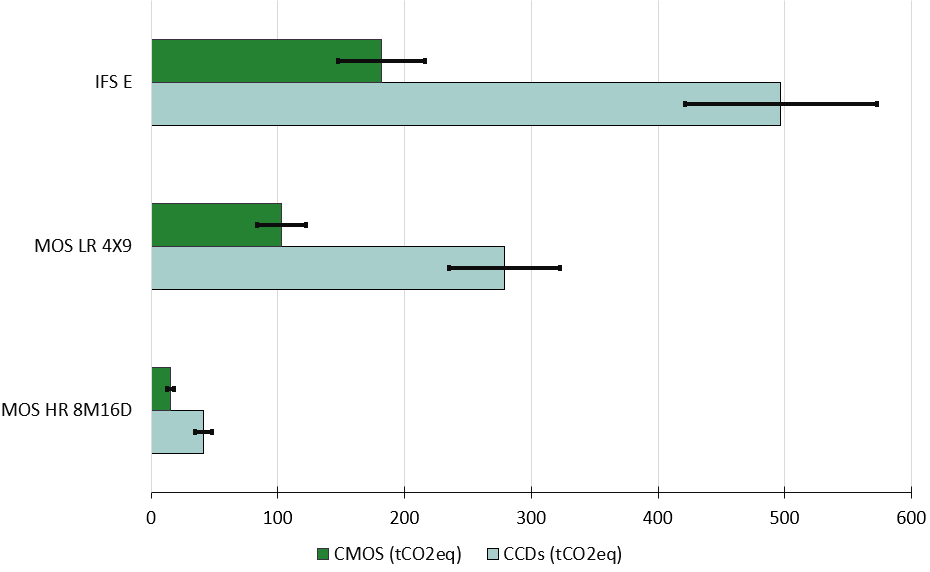
Figure 1: One-year operational carbon footprint comparison for IFS, MOS-LR, and MOS-HR options, highlighting substantial reduction with CMOS detectors and CO2-based cooling.
A critical finding is that while spectrograph design choices (e.g., number and size of units) alter the construction footprint—lighter, more numerous spectrographs yield lower upfront impact—operational energy dominates the cumulative footprint over time, often overtaking construction impacts after several years of operation.
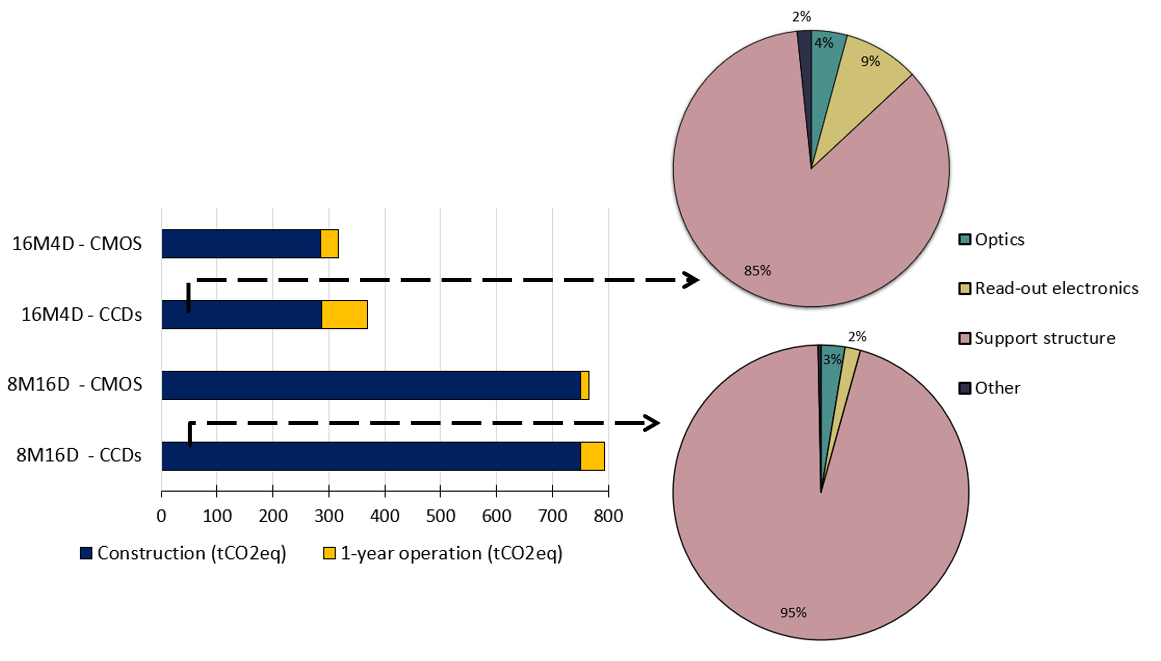
Figure 2: Construction versus 1-year operation carbon footprints for MOS-HR designs; operational emissions dominate over project lifetime, with optical bench and enclosure as principal construction impact sources.
Investigations into the correlation between instrument configuration and overall environmental impact show that reducing detector count achieves only modest gains relative to the strong effect of detector and cooling technology choices; for instance, varying the IFS detector count from 384 to 256 yields only a 26% decrease in 20-year carbon footprint, compared to the 58% reduction realized by switching from CCD to CMOS systems.
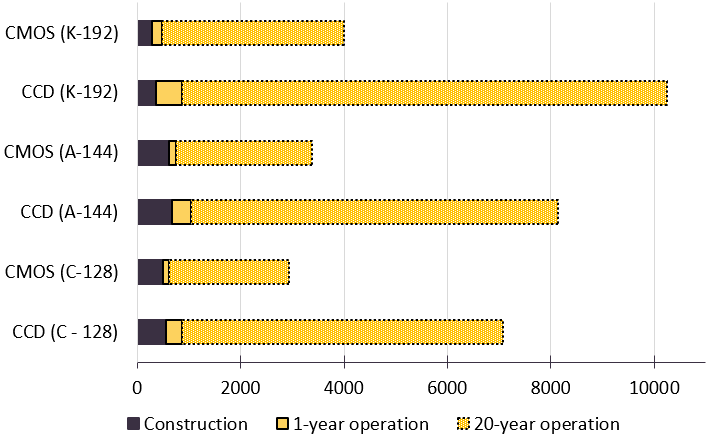
Figure 3: Comparison of 20-year cumulative carbon footprint for IFS designs with varied spectrograph counts and detector technologies; detector/cooling choice consistently dominates footprint differences among designs.
Environmental Implications of Data Processing and Storage
With an anticipated annual data rate of 1–3 PB, the data infrastructure of WST is a significant emissions source. The analysis, covering the carbon footprint of data transfer, reduction, and storage, evaluates three processing locations (Germany, France, Chile) with different energy mixes and consequent carbon intensities.
The results show that storage rapidly becomes the dominant factor in cumulative data infrastructure footprint, given the sustained data accumulation over decades. Mitigation via "cold" storage strategies and selection of regions with low-carbon electricity emerge as effective levers.
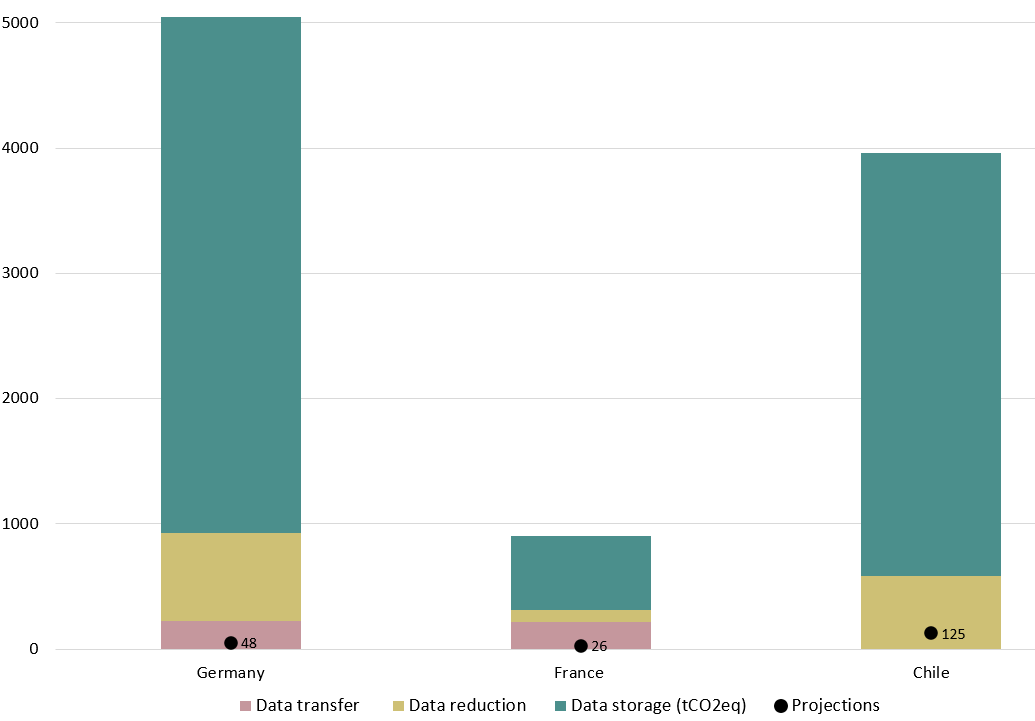
Figure 4: 20-year cumulative carbon footprint for data transfer, reduction, and storage in Germany, France, and Chile. Storage is the major contributor. Black dots indicate projected reductions due to greening electricity mix by the 2050s.
Projections incorporating expected grid decarbonization (to as low as 10 gCO2eq/kWh in Europe by 2050) reveal that data-related emissions can decrease by more than an order of magnitude, underscoring the importance of infrastructure location and supporting policy in operational planning.
Implications, Limitations, and Forward-Looking Perspectives
This study highlights that, given the multi-decade lifespan and scale of the WST, operational decisions (detector choice, cooling, site selection, and data handling) strongly outweigh differences in initial construction (excluding massive subsystems like the enclosure, which require improved future inventories). Clear evidence supports prioritizing CMOS/CO2/FPGA systems for sustainability. However, the realization of such gains depends on technological advances, particularly for Peltier cooling at low temperatures, and does not eliminate the need for construction-phase emissions reductions, for which sustainable procurement and use of recycled materials will be necessary.
Several limitations are acknowledged: the absence of detailed detector manufacturing data, incomplete mechanical inventories for some instrument options, and the exclusion of end-of-life and transportation impacts. Frontier research directions include refining system-level LCA as design matures, additional environmental metrics (resource depletion, toxicity), and the integration of closed-loop energy systems (solar/hydrogen), which preliminary studies have identified as feasible for Chilean astronomical observatories.
The LCA approach extends beyond hardware to the data chain, linking instrument architecture with data stewardship policies to achieve carbon reduction targets consistent with international climate goals.
Conclusion
By establishing LCA-informed sustainability as a core design parameter, this work provides a rigorous, quantitative framework for decision-making in next-generation astronomical facilities. The analysis demonstrates that the choice of detector and cooling technology is the single most important lever for operational carbon reduction in spectroscopic instruments, with CMOS/CO2/FPGA architectures reducing yearly emissions by approximately 60% relative to legacy designs. Similar principles apply to the data workflow, where strategic placement of data reduction and storage in low-carbon regions and the adoption of efficient storage policies can further diminish the overall environmental footprint. These results argue for the systematic inclusion of environmental trade-offs alongside scientific and cost criteria throughout the design lifecycle of astronomical infrastructure, supporting a transition to more sustainable large-scale observational science.
arXiv reference: (2606.18079)