NoiseTilt: Noise-Tilted Reverse Kernels for Diffusion Reward Alignment
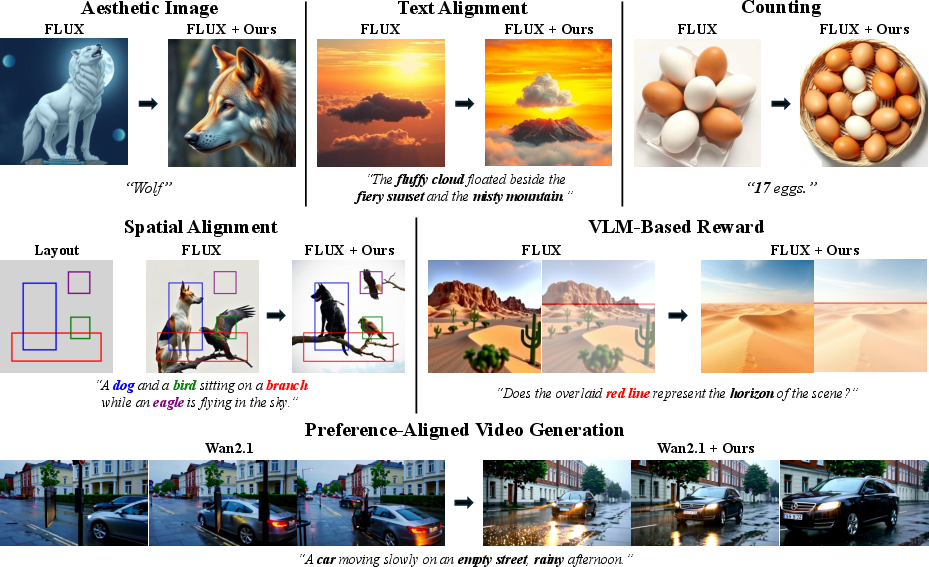
Abstract: We introduce the Noise-Tilted Reverse Kernel (NTRK), a reward-guided diffusion sampler that injects reward gradients through the noise term, leaving the pretrained reverse kernel unchanged and requiring only a single sample per step. Reward-guided sampling at inference time has greatly expanded the versatility of pretrained diffusion models. Yet existing methods face a trade-off. Gradient-based guidance shifts the reverse mean, steering generation but pushing intermediate states outside the region that the model was trained on and degrading quality. Search-based methods preserve quality but gain no gradient signal. No prior method achieves both. NTRK resolves this by keeping the reverse mean fixed and biasing the noise term toward high reward. We introduce a whitening operator, the central mechanism behind NTRK, that makes the reward gradient safe to inject as noise without losing its guiding signal. Across various reward alignment tasks, NTRK outperforms recent state-of-the-art baselines without losing sample quality. Remarkably, on aesthetic generation, NTRK surpasses the reward of the best baseline at 500 NFEs using only 25 NFEs, a 20$\times$ reduction in compute.




















Paper Prompts
Sign up for free to create and run prompts on this paper using GPT-5.
Top Community Prompts
Explain it Like I'm 14
Easy-to-Understand Summary of “NoiseTilt: Noise‑Tilted Reverse Kernels for Diffusion Reward Alignment”
What is this paper about?
This paper is about improving how image and video generators (based on diffusion models) follow preferences—like “make this image more beautiful” or “match this text better”—without retraining the model. The authors introduce a new sampling trick called Noise-Tilted Reverse Kernels (NTRK) that adds guidance in a safer, smarter way so results look good and match the goal, while using much less compute.
1) Main topic or purpose
Diffusion models create images or videos by starting with random noise and slowly removing it step by step. Sometimes, we want to steer this process toward results we prefer, such as higher aesthetic quality or better text‑image matching. The paper’s goal is to guide these models at run time (inference time) so they produce higher‑reward results (better according to a chosen score) without breaking image quality or needing lots of extra samples.
2) Key questions the paper asks
The authors focus on a simple question: How can we steer each denoising step toward better results (higher reward) while keeping the outputs natural and high‑quality?
They compare three ideas and look for a way to get the best of all:
- Shift the “mean” (the main direction of the next step) using gradients from the reward. This gives strong direction but can break image quality by moving into “unsafe zones” the model wasn’t trained for.
- Do a search by sampling many noisy candidates and picking the best. This keeps quality but needs many samples per step (expensive).
- New idea (NTRK): Keep the mean unchanged and inject the reward guidance into the noise in a careful, math‑safe way, so we get direction and quality—using only one sample per step.
3) How the method works (with simple analogies)
First, here are a few terms in everyday language:
- Diffusion model: Think of building an image by gradually removing “static” from a TV screen until a clear picture appears.
- Reverse kernel (per step): The recipe for the next small move the model makes—made of two parts: a “mean” direction and “noise.”
- Reward: A score telling us how good the result is (for example, how beautiful or how well it matches text).
- Gradient: A direction that points “uphill” toward higher reward, like an arrow showing how to improve the score.
- Gaussian noise: Random “TV static” with very specific properties the model expects.
- NFE (Number of Function Evaluations): A rough measure of how many steps or how much compute the sampling uses.
What usually happens:
- Mean-shift methods add the reward gradient directly to the mean. That’s like yanking the steering wheel hard toward the goal—fast, but you may leave the safe road the model knows, causing weird artifacts.
- Search-based methods draw many random noise options and pick the best. That’s like trying lots of gentle nudges and choosing the best one—safe but slow and expensive.
What NTRK does:
- It keeps the mean (the “steering direction”) exactly as the model learned (stays on the safe road).
- It puts the guidance into the noise instead. But not just any noise—the added signal must still “look like” the kind of noise the model was trained on (typical Gaussian static). If it doesn’t, quality drops.
The clever part: a whitening operator
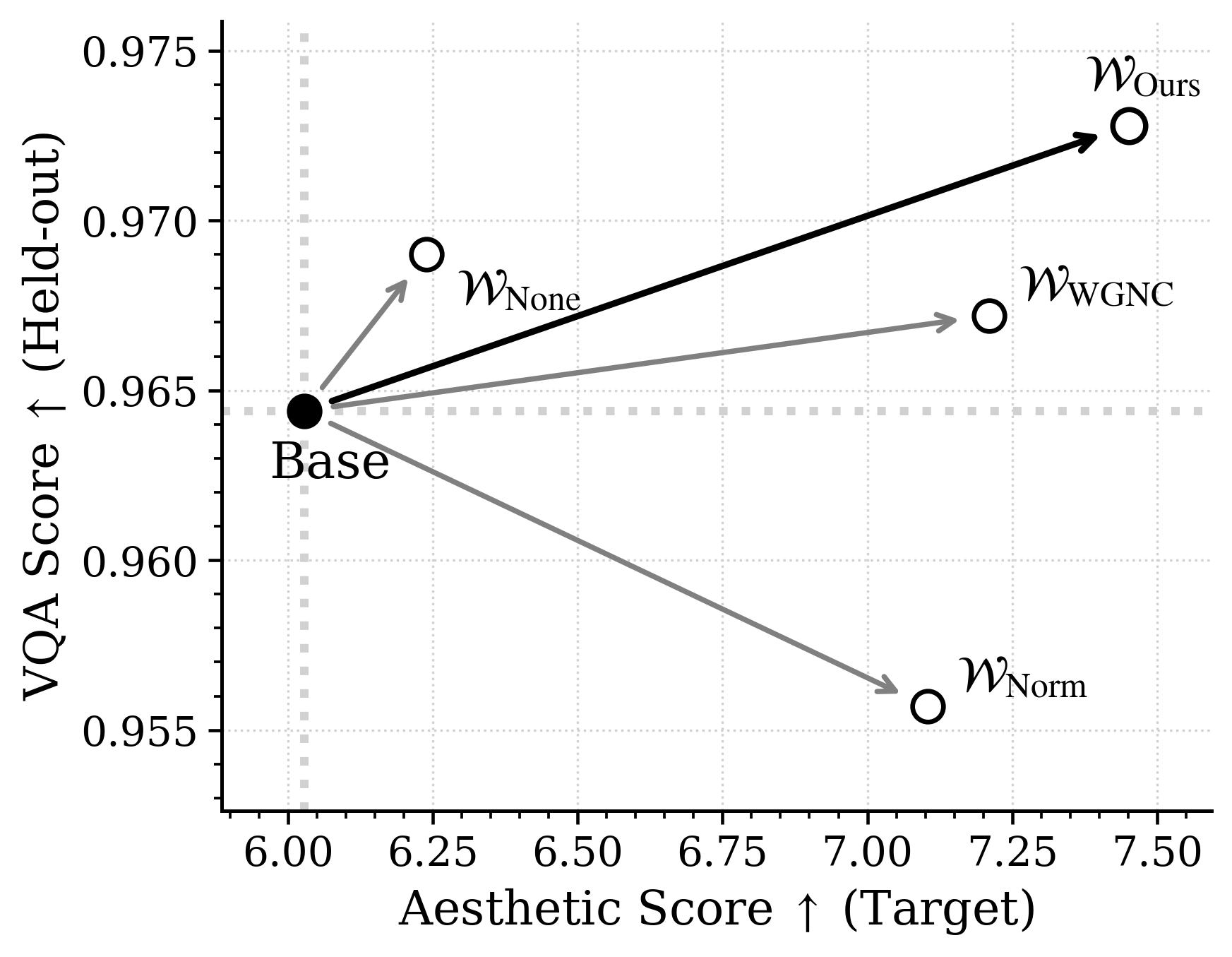
- A raw reward gradient is structured (not random-looking), so if you add it directly to the noise, it becomes “weird noise,” which breaks the model’s assumptions.
- The whitening operator “scrubs” the gradient so it behaves like normal, safe noise (like turning a patterned sound into harmless static, while keeping the push in the right overall direction).
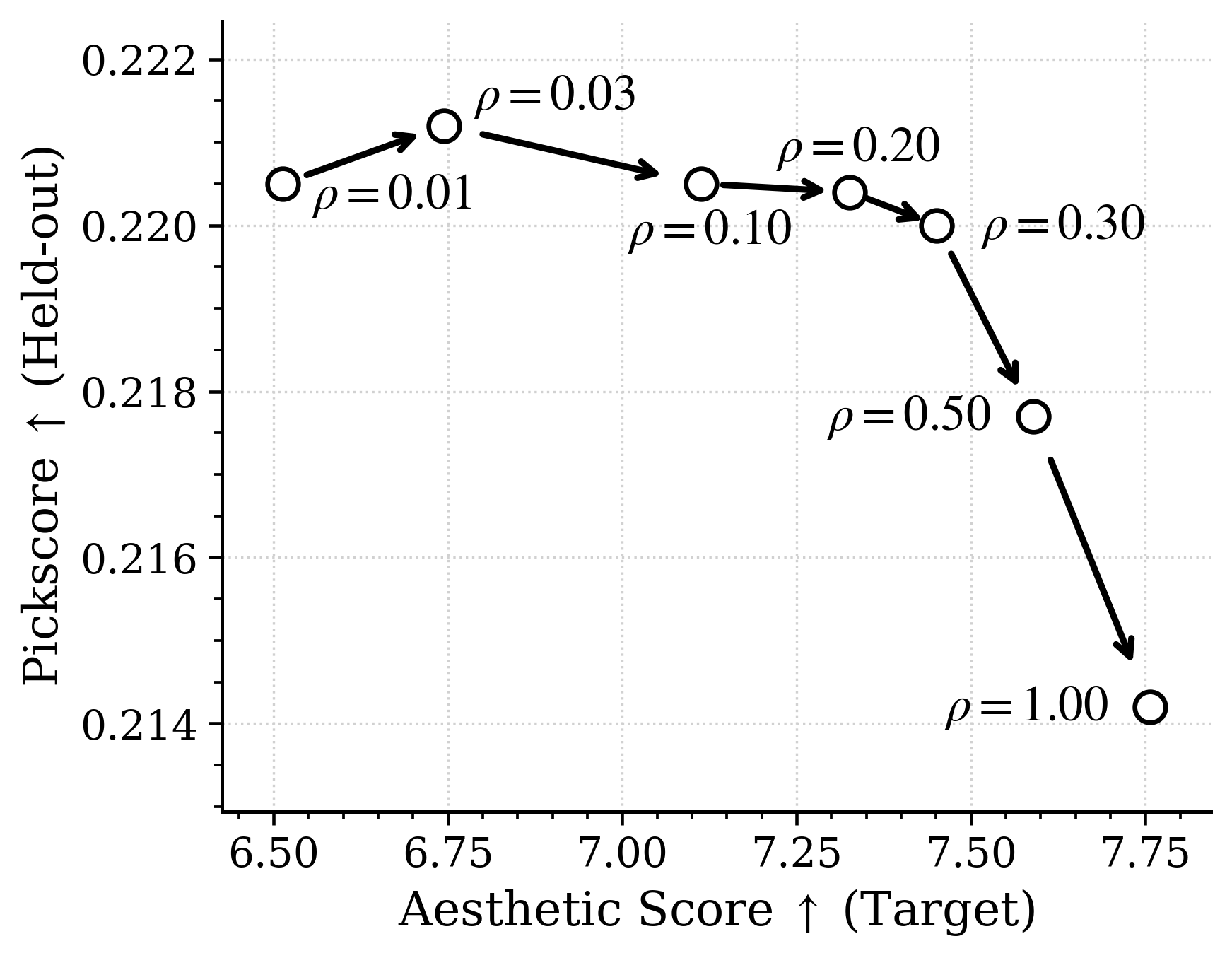
- After whitening, the method mixes a small amount of this cleaned guidance noise with ordinary random noise. Because mixing two proper noises still looks like proper noise, the model stays in its comfort zone.
Why this matters:
- The model keeps operating in the “noise-compatible” region (the safe zone it was trained for).
- You still get directional guidance from the reward.
- You only need one sample per step (not many), which saves compute.
4) Main findings and why they are important
The authors test NTRK on several tasks:
- Aesthetic image generation (making images look more pleasing).
- Text‑image alignment (making images match their prompts better).
- Video generation (keeping motion and quality good while aligning with prompts).
What they found:
- Much higher rewards with fewer steps: For aesthetic images, NTRK beats a strong baseline that uses 500 steps using only 25 steps (about 20× fewer).
- Quality stays high: Because it keeps the model’s mean unchanged and uses noise that looks normal, images and videos remain sharp and clean.
- Works across tasks: From aesthetic scores to text matching to video rewards, NTRK consistently performed very well or best.
Why this is important:
- Faster and cheaper: You can get better results without retraining and without paying the cost of many extra samples per step.
- More reliable: Staying in the model’s “safe zone” reduces weird artifacts and “reward hacking” (when the model tricks the reward without truly improving the result).
5) Implications and potential impact
- Plug-and-play improvement: NTRK can be added at inference time to many diffusion models without retraining.
- Better alignment in practice: Artists, developers, and researchers can guide models toward specific styles or goals while keeping quality and speed.
- General idea: Routing guidance through properly “whitened” noise may inspire safer control methods in other generative systems, including videos and possibly 3D or audio diffusion.
In short, the paper shows a neat way to steer diffusion models: don’t yank the steering wheel (mean-shift) or try a huge number of random attempts (search). Instead, keep the steering steady and carefully nudge the “static” to lean toward better results. This gives direction, safety, and speed all at once.
Knowledge Gaps
Knowledge gaps, limitations, and open questions
Below is a concise, actionable list of what remains uncertain or unexplored in the paper.
Theory and guarantees
- Lack of formal guarantees that the “noise-tilted” perturbation remains statistically close to a standard normal across steps (e.g., bounds in total variation/Wasserstein distance), given that the whitened direction is deterministic and only constrained by confidence-interval projections rather than sampled from .
- No convergence or consistency result showing that NTRK samples from, or closely approximates, the KL-regularized target distribution in Eq. (1) under practical conditions (approximate , finite steps, whitening).
- Unclear relationship between the temperature in Eq. (1) and the mixing coefficient in Eq. (12); there is no principled mapping or guarantee that a given schedule realizes a specific KL tilt.
- No error analysis for using (Tweedie’s posterior mean) as a proxy for the intractable value function—especially at early/late timesteps when this approximation is known to be biased.
- Absence of analysis on compounding effects: even if each step’s perturbation is “typical,” does repeated injection accumulate deviations that exit the typical set over long trajectories?
Algorithmic design and hyperparameters
- No principled method for selecting or adapting across timesteps/tasks; heuristic scheduling may under- or over-steer and lacks feedback control based on reward curvature or acceptance-like criteria.
- Sensitivity of performance to tile sizes, confidence level (e.g., 99.99%), and the number/types of transformed domains used in the whitening operator is not systematically studied.
- Unclear robustness when the reward gradient is weak, noisy, or highly structured: when clips most structure, NTRK may degenerate to unguided sampling—no detection or fallback mechanism is provided.
- Interaction with classifier-free guidance (CFG) and other common guidance signals is not analyzed; potential interference or compounded bias remains unquantified.
- No guidance for adapting NTRK to deterministic samplers/ODE solvers (e.g., DDIM-style ), where the noise channel is absent or reduced.
Whitening operator specifics
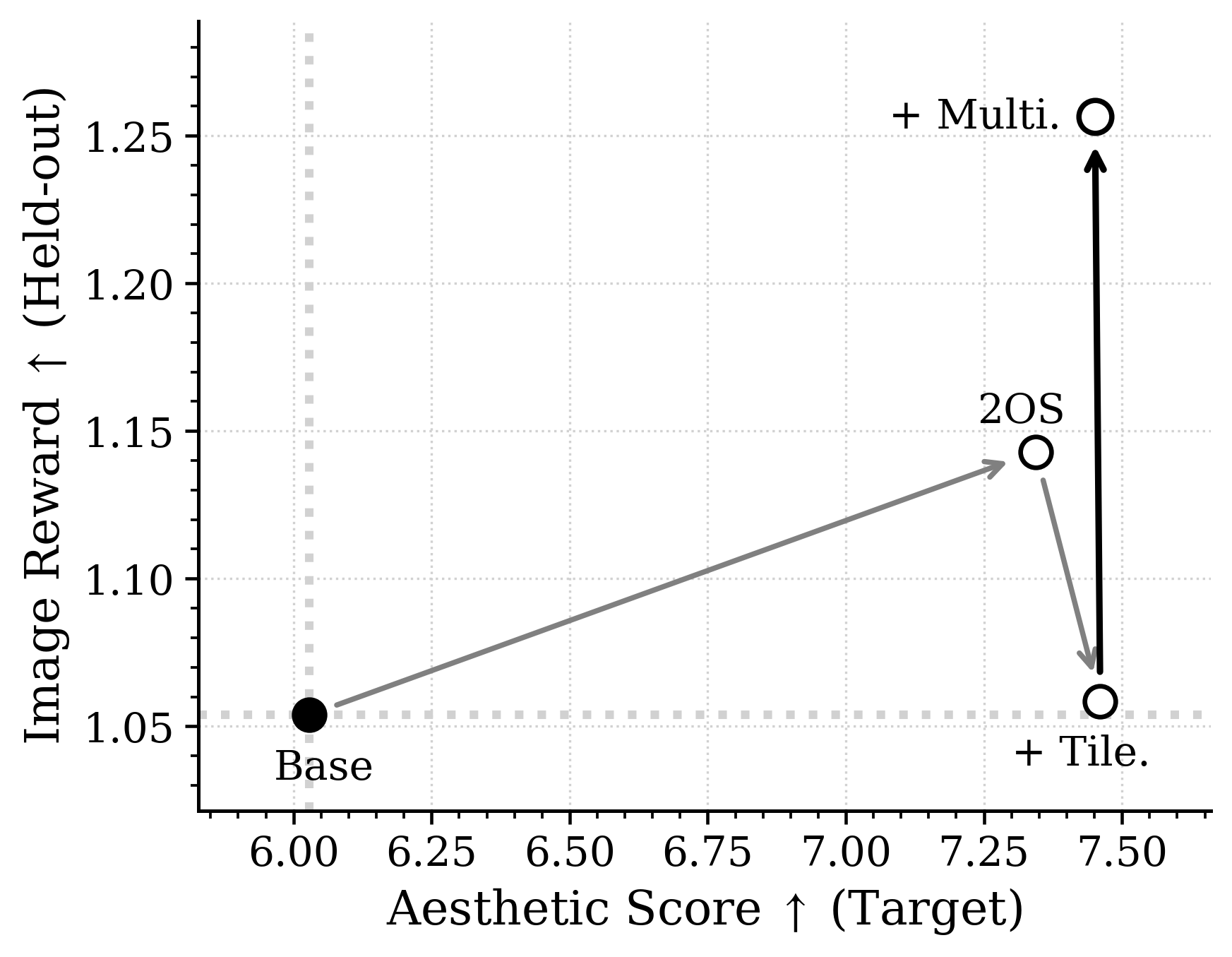
- The choice of statistics (2-level order statistics, tile-wise moments, multi-domain projections) is heuristic; there is no ablation to identify the minimal sufficient set or to quantify each component’s contribution to reward vs. fidelity.
- Projection-to-intervals may over-penalize informative structure in the gradient (especially for rare but valid signal patterns), but there is no mechanism to preserve task-relevant structure while enforcing typicality.
- Confidence intervals are derived for i.i.d. standard normal assumptions; latent spaces (e.g., VAE latents) may exhibit anisotropy/channel correlations. No calibration or adaptation to non-ideal latent noise distributions is provided.
- The operator is non-differentiable (due to sorting/clipping), which precludes gradient-based tuning of whitening strength or end-to-end learning of ; avenues for learned or adaptive whitening are not explored.
- For video, it is unclear whether whitening is applied temporally (across frames) or only spatially; lack of explicit temporal typicality constraints could affect motion consistency.
Computational and scalability considerations
- No report of wall-clock overhead or memory cost of whitening (multiple domain transforms, sorting ) relative to baselines; it is unknown if single-draw savings are offset by whitening compute on high-res images or long videos.
- Scalability to very high-dimensional latents (e.g., images, long videos) is not evaluated; practical constraints (GPU memory, latency) and efficiency optimizations are not discussed.
- Absence of analysis on the trade-off between the number of transformed domains/statistics and throughput—guidance on practical configurations for resource-limited settings is missing.
Robustness and generality
- Applicability to non-differentiable rewards (e.g., human-in-the-loop preferences, discrete metrics) is unclear; NTRK requires reward gradients and does not propose gradient-free surrogates.
- Robustness to reward misspecification or adversarial reward hacking is not systematically evaluated; while mean-shift issues are discussed, NTRK’s failure modes under misaligned or noisy reward models remain open.
- No study of diversity: because noise is tilted toward a common direction, intra-prompt diversity may decrease; diversity metrics (e.g., intra-prompt LPIPS, coverage) are not reported.
- Generality across modalities/backbones is only partially shown (FLUX for images, Wan2.1 for video). Extensions to other architectures (e.g., DiT, SDXL, consistency/flow models) and tasks (e.g., super-resolution, deblurring) are not comprehensively evaluated.
- Lack of stress tests on out-of-domain prompts, long-horizon video, or extremely strong guidance regimes to characterize when whitening over-constrains guidance or when typicality enforcement fails.
Experimental coverage and comparisons
- Missing direct comparisons to closest “noise-compatible” baselines (e.g., WGNC, MPGR) in the main results; it is unclear whether NTRK’s advantage stems from whitening or other design choices.
- Limited ablation of whitening strength (confidence level), tile partitioning, and domain choices on both reward and fidelity metrics; guidelines for tuning are absent.
- NFE parity is reported, but end-to-end compute (including whitening) and sample throughput are not; conclusions about “ compute reduction” may not hold in wall-clock terms.
- Evaluation focuses on target metrics and a few held-out rewards; more comprehensive perceptual quality and alignment audits (e.g., FID/KID, human preference studies, robustness across seeds) are not provided.
Integration and extensions
- Integration with multi-particle frameworks beyond simple BoN (e.g., SMC, importance resampling) is not explored; how NTRK interacts with selection/resampling remains open.
- No mechanism to adaptively balance whitening aggressiveness and guidance strength based on on-the-fly typicality diagnostics (e.g., statistical tests) or reward improvement rates.
- Theoretical and practical pathways to align (and whitening intensity) with a desired KL budget (from Eq. (1)) are not developed; a calibrated, user-controllable trade-off remains an open design question.
Practical Applications
Immediate Applications
The paper introduces a drop-in sampler (NTRK) and a whitening operator that enable reward-guided diffusion at inference time without degrading sample quality, while using only one noise draw per step. This directly lowers compute, stabilizes guidance, and improves reward attainment across image and video tasks. The following applications can be deployed now with existing models and reward heads.
- Aesthetic optimization for creative assets
- Sectors: advertising, design, social media, e-commerce.
- What to build: “Aesthetic Boost” knob in text-to-image UIs (e.g., Diffusers, ComfyUI, A1111); server-side presets for high-throughput asset generation.
- Workflow: attach a differentiable aesthetic scorer to a pretrained image diffusion model; apply NTRK at 20–25 NFEs; optionally add Best-of-N at output only.
- Why NTRK helps: maintains image quality while achieving higher aesthetic scores with ~20× fewer NFEs than search-based baselines.
- Assumptions/dependencies: differentiable reward model (e.g., AestheticScore), access to reverse-kernel mean and predicted x0 for gradient computation, license to deploy the base diffusion model.
- Prompt fidelity enhancement in text-to-image
- Sectors: education (diagramming), product documentation, publishing, generative UX tools.
- What to build: “Prompt fidelity” slider backed by VLM-based rewards (e.g., PickScore) plugged into NTRK.
- Workflow: compute gradients through the Tweedie-style posterior mean of x0; whiten and inject via NTRK; keep steps low (e.g., 25).
- Why NTRK helps: improves text–image alignment without moving off-distribution, reducing reward hacking artifacts common to mean-shifted methods.
- Assumptions/dependencies: differentiable text-image reward head; GPU budget for the reward forward/backprop pass per step.
- Preference-aligned video generation at lower cost
- Sectors: film previsualization, advertising, social video platforms, game studios.
- What to build: “Motion quality” or “Topic adherence” controls using VideoReward-like heads in video diffusion (e.g., Wan2.1) with NTRK.
- Workflow: apply NTRK frame-wise or in latent space with space–time tiling in the whitening operator; 25-step pipelines for near real-time generation.
- Why NTRK helps: raises target reward while matching or improving visual/text alignment metrics at equal or lower NFEs.
- Assumptions/dependencies: differentiable video reward model, time-tiling configuration for whitening operator, streaming GPU inference for VLMs.
- Classical image restoration (super-resolution, deblurring) with stable guidance
- Sectors: smartphone OEMs, photo apps, archival imaging.
- What to build: on-device or cloud “Sharpness/Clarity” enhancement using differentiable fidelity rewards (e.g., LPIPS, perceptual quality heads) and NTRK.
- Workflow: run pretrained diffusion restoration models; compute reward gradients on predicted x0; apply whitening and noise-tilting at each step.
- Why NTRK helps: avoids quality collapse from mean shifts; maintains Gaussian typicality of perturbations while still leveraging gradients.
- Assumptions/dependencies: differentiable proxy rewards for IQA, memory/compute budget for per-step backprop.
- Layout- and counting-constrained image synthesis
- Sectors: catalog/e-commerce, publishing, data generation for vision tasks.
- What to build: “Layout adherence” and “Counting” toggles using compositional rewards (e.g., object detectors with differentiable counts/alignment loss).
- Workflow: compute detection/alignment losses on x0 predictions; NTRK injects whitened gradients as noise, preserving base kernel mean.
- Why NTRK helps: achieves spatial constraints without drifting off the model’s training manifold.
- Assumptions/dependencies: differentiable detector/alignment modules; care with reward balance to prevent overfitting to detectors.
- Compute and energy cost reduction for genAI services
- Sectors: cloud providers, internal ML platforms, creative tooling SaaS.
- What to build: an “NTRK Sampler” option in inference stacks (image/video) with billing-aware NFEs and ρt scheduling; dashboards for reward vs. cost.
- Workflow: replace mean-shift or multi-sample search with NTRK; optionally keep a small BoN only at the final outputs for selection.
- Why NTRK helps: 1 draw/step guidance and lower NFE translate to higher throughput and lower energy cost.
- Assumptions/dependencies: ops support for reward head deployment; monitoring for reward hacking or drift.
- Safer, in-distribution guidance for policy and trust & safety
- Sectors: platform moderation, brand safety, regulated content workflows.
- What to build: guardrails that use differentiable safety or compliance scores (e.g., NSFW, watermark-presence, brand-color conformance) guided via NTRK.
- Workflow: plug safety rewards into NTRK to nudge sampling toward compliant regions while staying close to the pretrained distribution.
- Why NTRK helps: reduces off-manifold artifacts and reward hacking associated with mean-shift guidance.
- Assumptions/dependencies: reliable differentiable safety/compliance detectors; governance to prevent over-optimization.
- Developer tooling and open-source integration
- Sectors: software, open-source ML.
- What to build: a lightweight NTRK and whitening operator module for PyTorch/JAX; Diffusers/ComfyUI nodes; sample configs for popular models (FLUX, SDXL, Wan2.1).
- Workflow: expose APIs for ρt schedules, domain/tile settings for whitening, and BoN wrappers.
- Why NTRK helps: drop-in sampler that improves reward attainment without retraining.
- Assumptions/dependencies: maintenance of reward model checkpoints; clear licenses.
- Post-training alignment on fine-tuned models
- Sectors: enterprise model teams, brand-specific fine-tuning.
- What to build: “plug-and-play” alignment layer on top of LoRA/finetuned checkpoints for brand style or tone, without re-training.
- Workflow: wrap inference with NTRK + brand-specific reward head; use conservative ρt schedules for quality preservation.
- Why NTRK helps: aligns to new preferences without expensive additional fine-tuning.
- Assumptions/dependencies: availability of brand/style reward head; testing to avoid over-constraint.
- Edge and low-power deployments
- Sectors: mobile, embedded creative tools, AR/VR.
- What to build: on-device diffusion features (stickers, posters, wallpapers) that require few steps while still optimizing simple rewards.
- Workflow: quantized diffusion backbones + small differentiable reward heads; NTRK with minimal steps (e.g., 10–20).
- Why NTRK helps: single noise draw per step and low NFE cut latency and power.
- Assumptions/dependencies: compact reward heads; memory-efficient whitening kernels (e.g., FFT tiling on mobile GPUs/NPUs).
Long-Term Applications
These opportunities need additional research, scaling, or domain-specific adaptation (e.g., new reward heads, modality-specific whitening, or validation).
- Multimodal extensions (3D, audio, multimodal editing)
- Sectors: gaming/VFX (3D assets), music/audio, XR.
- Potential products: 3D asset generators with differentiable geometric/physical rewards; audio TTS prosody alignment using differentiable speech metrics; timeline-aware video editors.
- Dependencies: domain-specific whitening (e.g., spectral domains for audio, spatial–frequency for 3D), differentiable reward models for new modalities.
- Medical imaging assistance under strict validation
- Sectors: healthcare (research, training, anonymization).
- Potential products: structure-preserving enhancement or data augmentation guided by clinical proxy rewards.
- Dependencies: clinically validated differentiable rewards; rigorous QA; regulatory approval; ensured in-distribution operation for safety-critical use.
- Robotics and control via diffusion world models
- Sectors: robotics, autonomous systems, simulation.
- Potential products: reward-aligned sampling in diffusion-based planners/world models that stay within learned dynamics distributions.
- Dependencies: adaptation of NTRK to state–action spaces and multi-step control rewards; real-time constraints; safety guarantees.
- Compliance-by-design generation
- Sectors: finance, advertising, public sector.
- Potential products: generation constrained by legal/brand rules (e.g., logo integrity, disclosures) with differentiable compliance detectors.
- Dependencies: robust detectors with differentiable surrogates; calibration to avoid “gaming” detectors; audit trails.
- Automated creative refinement loops with human-in-the-loop
- Sectors: creative studios, marketing.
- Potential products: iterative refinement where human preferences train a reward model that NTRK uses for subsequent passes.
- Dependencies: preference data pipelines; online learning for reward heads; UX for collecting judgments at scale.
- Training-time data curation and preference model bootstrapping
- Sectors: ML research, foundation model teams.
- Potential products: sample harvesting pipelines that use NTRK to probe high-reward regions for further training/finetuning (e.g., GRPO-like workflows).
- Dependencies: mechanisms to prevent bias amplification; deduplication; compute for closed-loop data collection.
- Learned or adaptive ρt schedules and whitening configurations
- Sectors: ML platforms, AutoML.
- Potential products: auto-tuners that learn per-task ρt and tiling strategies from reward curvature and model uncertainty.
- Dependencies: meta-optimization infrastructure; monitoring for stability; generalization across prompts/tasks.
- Hardware acceleration of whitening operator
- Sectors: chip vendors, cloud accelerators.
- Potential products: CUDA kernels or on-chip primitives for sort–clip–unsort and multi-domain projections to minimize overhead.
- Dependencies: standardization of tiling and transforms; integration with inference runtimes.
- Marketplace personalization with small on-device reward models
- Sectors: consumer apps, e-commerce platforms.
- Potential products: per-user aesthetic/style reward heads to personalize generation with privacy-preserving on-device inference.
- Dependencies: compact, distillable reward models; on-device acceleration; privacy safeguards.
General assumptions and dependencies (cross-cutting)
- Differentiable reward models: Most applications assume gradients of reward w.r.t. predicted x0; for non-differentiable rewards, surrogate differentiable heads or gradient estimators are needed.
- Access to pretrained diffusion/flow models: NTRK is inference-time only and benefits from models that expose the reverse mean and noise variance per step.
- Whitening operator configuration: Tile sizes, transforms (e.g., Fourier, DCT), and confidence intervals may need to be adapted per modality (image vs. video vs. audio/3D).
- Scheduling and stability: Appropriate ρt schedules and conservative reward strengths are recommended to avoid subtle reward hacking or overfitting to reward heads.
- Compute trade-offs: While NTRK reduces NFEs and per-step draws, per-step backprop through reward heads adds overhead; end-to-end latency depends on reward model cost.
- Licensing and governance: Deployment requires compliance with model licenses and platform policies; safety-critical domains need additional validation and monitoring.
Glossary
- argmax: The operation that selects the argument (index) of a function that yields the maximum value. "select among them by a reward criterion such as argmax or importance sampling, without gradients or kernel modification."
- Best-of-N (BoN): A selection strategy that generates N candidates independently and chooses the one with the highest measured reward. "we demonstrate the effectiveness of NTRK, which can also be combined with multi-particle strategies such as Best-of-N (BoN)."
- confidence bounds: Upper and lower limits computed from data or a reference distribution that contain a statistic with a specified high probability. "we precompute confidence bounds"
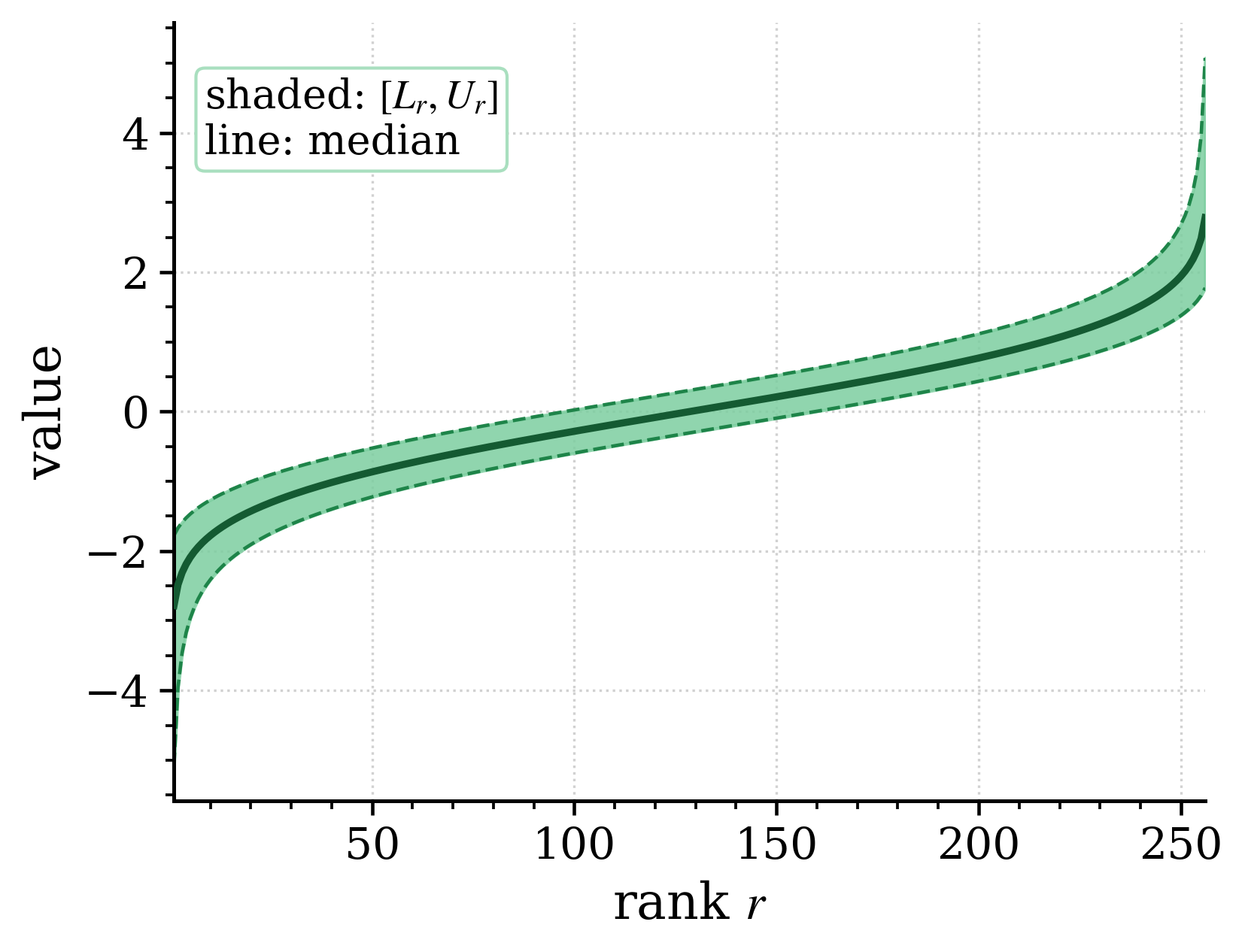
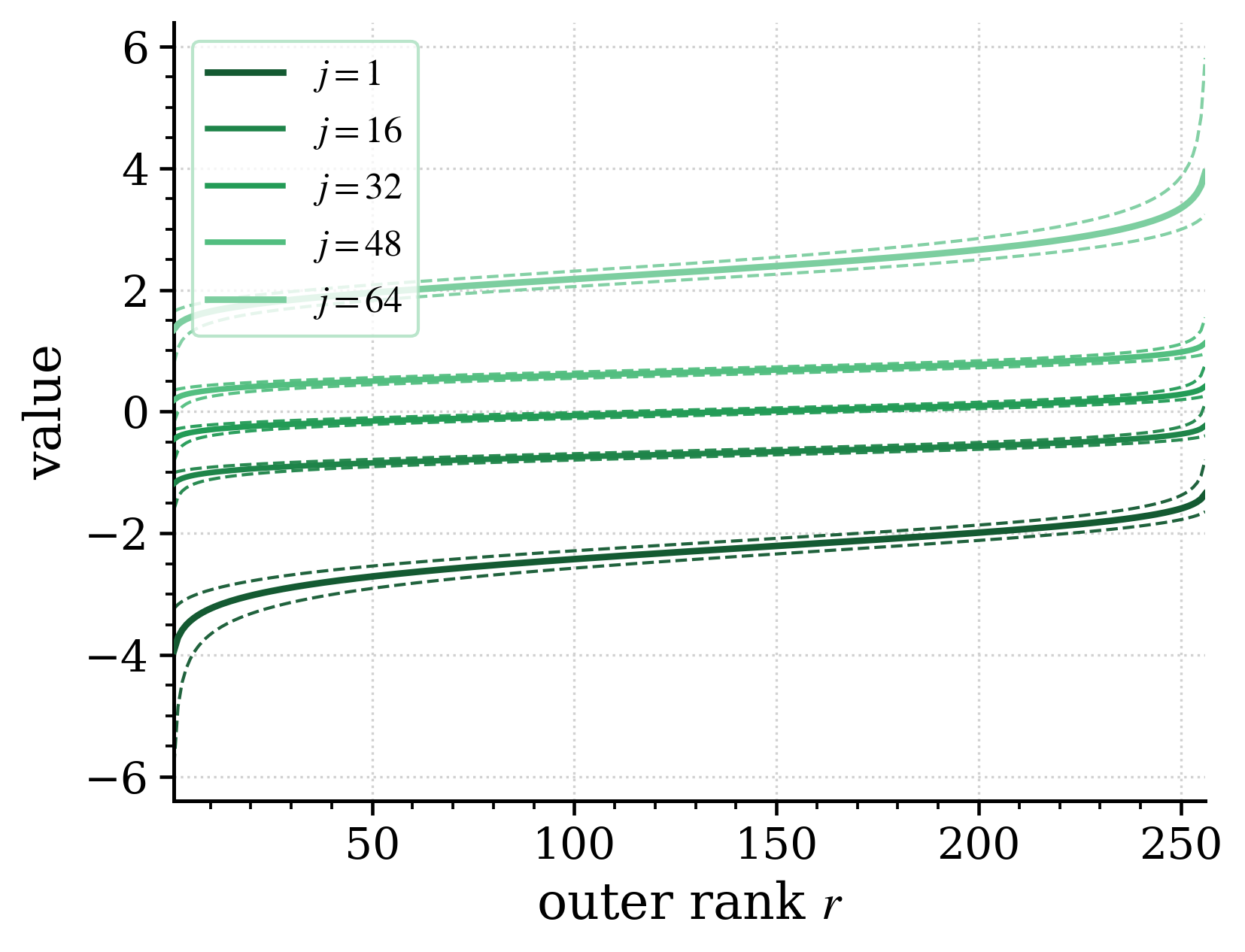
- confidence set: A set of values that, with high probability, contains the true parameter or statistic under a reference distribution. "These bounds specify a confidence set for the doubly-sorted matrix :"
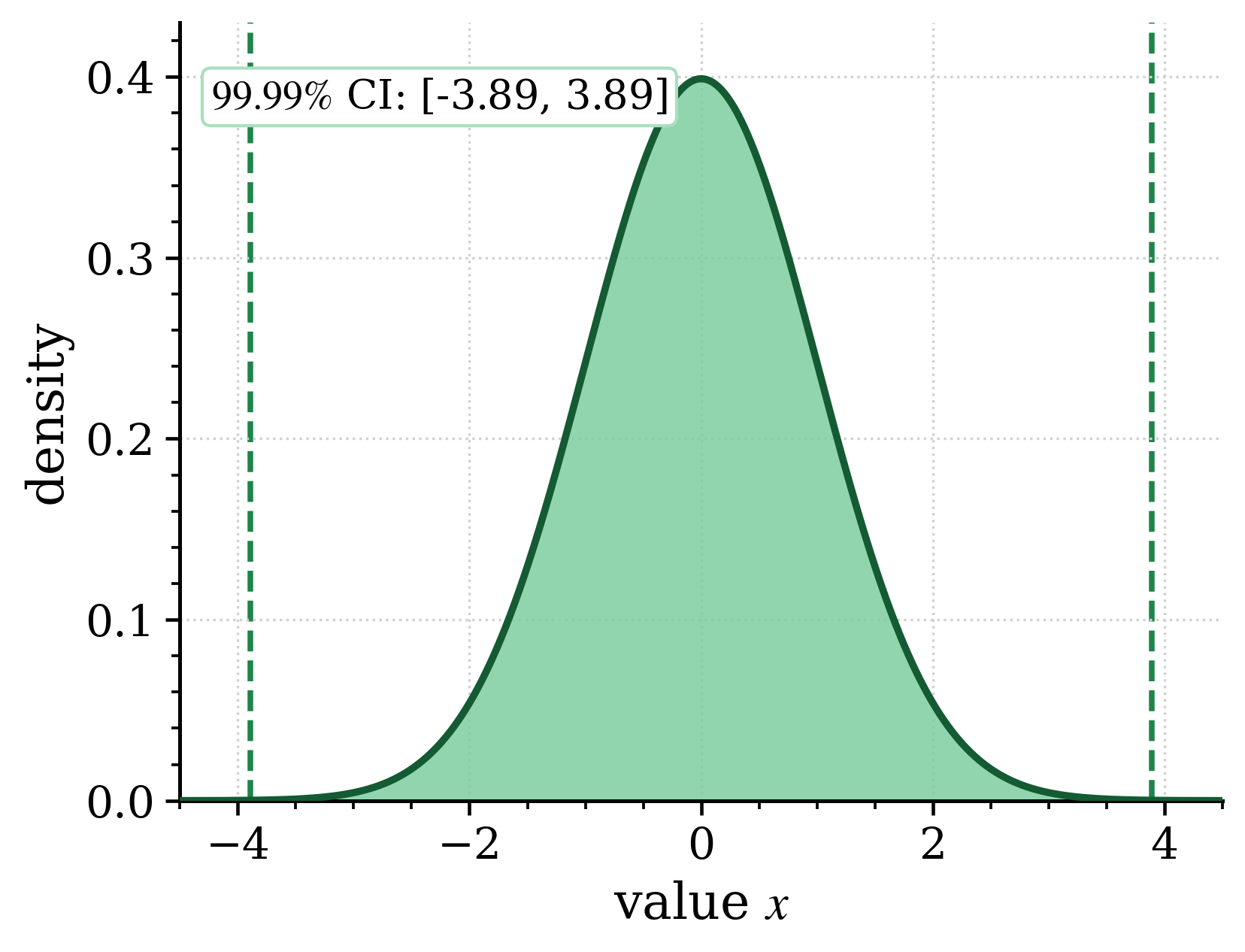
- confidence-interval projections: Projections that map values onto intervals derived from confidence bounds to enforce statistical typicality. "by replacing hard equality constraints with confidence-interval projections, it strongly suppresses atypical structure while leaving genuine Gaussian noise nearly unchanged"
- diffusion model: A generative model that samples by iteratively denoising noise through a learned reverse process. "A diffusion model~\cite{Ho:2020DDPM, Song:2021SDE} progressively denoises an initial Gaussian noise"
- Fourier domain: The representation of signals in terms of their frequency components, often used for imposing structure-based constraints. "white Gaussian noise feasible set defined by hard blockwise norm constraints in the Fourier domain."
- Gaussian typicality: The property of vectors exhibiting statistical characteristics expected from high-dimensional Gaussian noise. "encourage Gaussian typicality in vectors involved in diffusion inference"
- importance sampling: A technique that re-weights samples drawn from one distribution to estimate expectations under another, emphasizing high-reward or rare events. "select among them by a reward criterion such as argmax or importance sampling"
- KL divergence: A measure of how one probability distribution diverges from a reference distribution. "the KL divergence acts as a regularizer, preventing deviation from the pretrained data distribution."
- latent diffusion models: Diffusion models that operate in a compressed latent space rather than pixel space to improve efficiency. "the framework has been extended to latent diffusion models~\cite{rout2023:psld,rout2024:STSL}"
- Markovian: Having the property that the next state depends only on the current state, not on the full history. "by sequentially applying a Markovian reverse kernel"
- MCMC (Markov chain Monte Carlo): A class of algorithms that draw samples from a distribution by constructing a Markov chain with that distribution as its equilibrium. "MCMC-based extensions further build on this principle"
- mean-shifted reverse kernel: A reverse transition in diffusion where the kernel mean is adjusted by the reward gradient to guide sampling. "the mean-shifted reverse kernel~\cite{Chung:2023DPS} modifies the base reverse kernel by adding this gradient to its mean"
- Noise-Tilted Reverse Kernel (NTRK): A guidance method that keeps the reverse mean unchanged and injects reward information through a noise component that is statistically whitened. "We introduce the Noise-Tilted Reverse Kernel (NTRK), a reward-guided diffusion sampler that injects reward gradients through the noise term"
- noise-compatible regime: The region of perturbations consistent with the Gaussian noise assumptions under which the diffusion model was trained. "the noise-compatible regime, the narrow region where the pretrained model was trained to operate"
- norm concentration: The phenomenon in high dimensions where the norm of random vectors concentrates around a typical value. "norm concentration, spatial uncorrelatedness, and collective Gaussian statistics."
- order statistics: Statistics obtained from sorted samples, often used to derive robust bounds or constraints. "from the nested order-statistic distribution"
- particle filtering: A sequential Monte Carlo technique that maintains a set of weighted samples (particles) to approximate evolving distributions. "Several works combine both via particle filtering~\cite{Kim:2025DAS, wu2023:tds, yoon2025:psi}."
- reparameterization trick: A method to draw samples by expressing stochastic variables as deterministic transforms of noise, enabling gradient-based optimization. "using the standard reparameterization trick:"
- reverse Gaussian kernel: The Gaussian transition distribution used at each denoising step in the reverse diffusion process. "distinguished by how they modify or utilize the reverse Gaussian kernel."
- reverse kernel: The per-step stochastic transition in reverse-time diffusion that maps a noisy state to a slightly denoised one. "we focus on methods that modify the reverse kernel using a differentiable reward."
- reward alignment: Steering a generative model’s outputs toward higher values of a specified reward function at inference time. "a task generally known as reward alignment."
- reward hacking: Exploiting weaknesses or mis-specifications in the reward function to achieve high scores without genuinely improving the intended quality. "It also makes these methods prone to reward hacking~\cite{Gao:2023Scaling}."
- search-based methods: Guidance techniques that draw multiple candidates from the base kernel and select those with higher reward rather than altering the kernel. "The second, search-based methods~\cite{Ma2025:SoP, Li2024:SVDD, kim2025:rbf}, draw candidates from the stochastic reverse kernel and select among them by a reward criterion"
- Sequential Monte Carlo (SMC): A family of algorithms that propagate and resample a set of particles to approximate evolving posterior distributions over time. "within a Sequential Monte Carlo (SMC) framework"
- Tweedie's formula: A statistical identity relating posterior means under Gaussian noise to denoised estimates, often used to derive gradient guidance. "via Tweedie's formula~\cite{Robbins1992}"
- Tweedie's posterior mean: The posterior expectation used as a denoised estimate in Gaussian models, serving as a surrogate for reward evaluation. "is approximated using Tweedie's posterior mean~\cite{Robbins1992}."
- typical set: The subset of high-dimensional space where most probability mass concentrates for a given distribution. "The typical set is difficult to characterize exactly in closed form."
- white Gaussian noise: Gaussian noise with zero mean, unit variance, and no spatial correlation. "white Gaussian noise feasible set"
- whitening operator: A transformation that enforces the statistical properties of white Gaussian noise on a vector while retaining useful directional information. "we introduce a whitening operator that processes the reward gradient before injection"
- value function: A function assigning expected future reward to a state (or timestep) used to formalize optimal transitions. "the exact value function is intractable"
Collections
Sign up for free to add this paper to one or more collections.