- The paper demonstrates that generative recommenders, despite retaining higher semantic diversity, still induce information cocoons at coarse code layers.
- It introduces the RecLoop framework to quantify cocoon effects using metrics like category entropy, Jaccard similarity, and Gini coefficient.
- Findings reveal that tokenization schemes and model scale critically shape cocoon dynamics, suggesting the need for diversity-aware design in future systems.
Introduction
The manuscript "Do Generative Recommenders Deepen the Information Cocoon? A Closed-Loop Simulation with LLM-powered User Simulators" (2606.17707) presents a systematic exploration of information cocoon effects resulting from modern generative recommender systems using a closed-loop simulation paradigm. Traditional recommenders are known to induce exposure narrowing through feedback loops: recommendations influence user interactions, which recursively shape subsequent model training, often resulting in reduced diversity, homogenization, and concentration of item exposure—a phenomenon known as the "information cocoon" or "filter bubble." Unlike ID-based recommenders, generative recommenders produce recommendations by autoregressively generating code sequences over a learned hierarchical token space, which fundamentally alters the exposure landscape. This work aims to determine how these generative properties affect cocoon formation and whether generative recommenders fundamentally mitigate, inherit, or amplify long-term narrowing phenomena.
Simulation Architecture: RecLoop Framework
The RecLoop framework is central to this analysis, operationalizing controlled closed-loop simulations with LLM-powered user agents. Each agent is initialized from realistic historical behavior, maintaining dynamic preference profiles and dual-tier memory systems (short-term and long-term). These agents select from the exposure lists generated by the current recommender, providing simulated but sequentially realistic feedback, which is then appended to user trajectories for subsequent retraining. Each feedback cycle thus faithfully replicates real-world reinforcement of user-state and system-policy interaction.
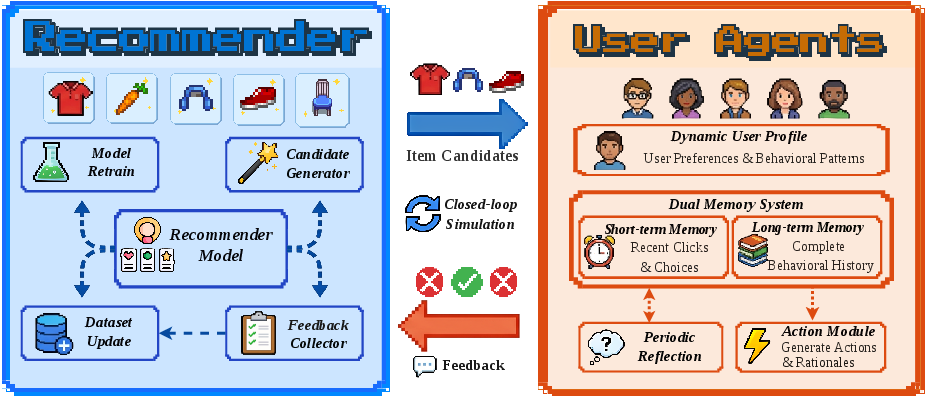
Figure 1: The RecLoop architecture couples a recommender and an LLM-powered user agent, realizing a realistic closed-loop feedback protocol.
Two generative recommenders (TIGER, OneRec in multiple scales) and two classical sequential models (SASRec, Mamba4Rec) are benchmarked on Amazon Office Products and Toys & Games. This supports a paradigm-level comparative analysis under consistent longitudinal simulation.
Metrics: Exposure & Model-Level Cocoon Quantification
Cocoon formation is dissected using both exposure-level and model-internal measures:
- Exposure-level metrics:
- Category Entropy (user-level semantic diversity)
- Inter-user Jaccard Similarity (cross-user homogenization)
- System-wide Coverage (item/category reachability)
- Gini Coefficient (exposure concentration)
- Model-level (Code-Space) metrics:
Generative recommenders' exposure concentration is analyzed within their hierarchical code space using layer-wise code entropy, top-k code concentration, and code prefix diversity. Relative entropy reduction per layer (structural cocoon effect) isolates where in the generative process diversity collapse initiates and propagates.
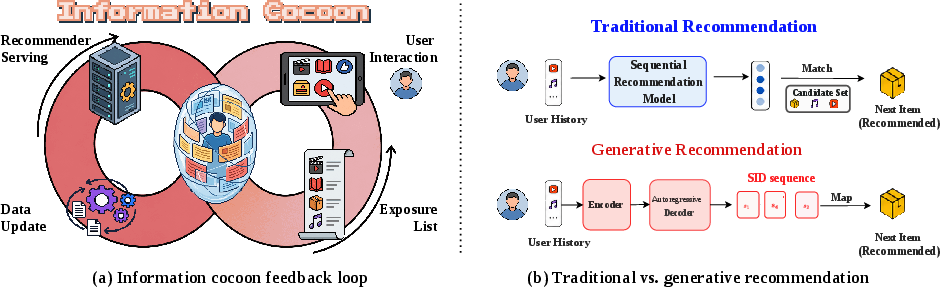
Figure 2: (a) Closed-loop cocoon formation; (b) Contrast between atomic-ID recommenders and generative, code-sequence-based recommenders. Unlike atomic ID scoring, hierarchical code generation can concentrate exposure at various semantic resolutions.
Core Findings
Generative Recommenders Mitigate but Do Not Eliminate Exposure Cocoons
Category entropy analysis consistently demonstrates that, compared to classical baselines, generative recommenders retain higher semantic diversity in user exposure over feedback cycles. While traditional sequential recommenders (SASRec, Mamba4Rec) manifest steep, monotonic entropy decline—quickly reducing exposure to fewer categories—generative models exhibit more gradual, stochastic, and sometimes oscillatory entropy dynamics.
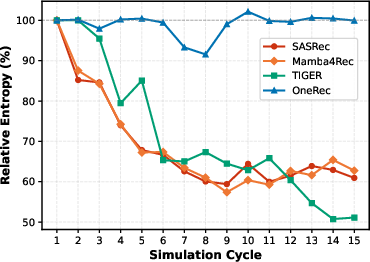
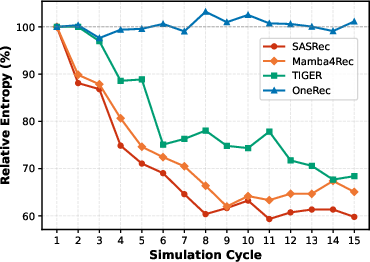
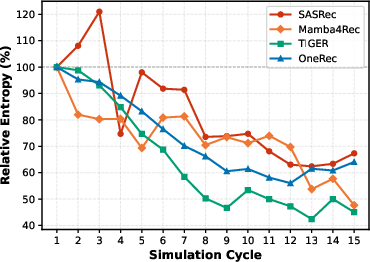
Figure 3: Category entropy over cycles—generative recommenders maintain higher normalized entropy and attenuate early collapse compared to sequential baselines.
Inter-user homogenization (Jaccard similarity) rises most rapidly for SASRec, less so for generative models. For instance, after 15 cycles on Office Products, OneRec's exposure homogenization (<0.07) is substantially lower than SASRec's (>0.22).
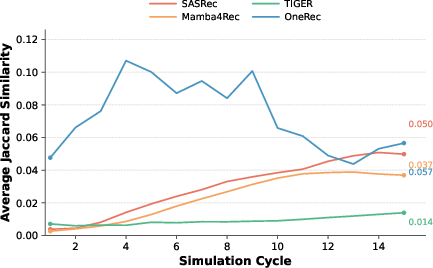
Figure 4: Generative recommenders systematically slow the cross-user homogenization process.
Despite these advantages, exposure mass still concentrates on a small canonical set of items across all paradigms (Gini coefficient increases), indicating that closed-loop reinforcement strongly amplifies head-item bias, regardless of the retrieval/generation mechanism.
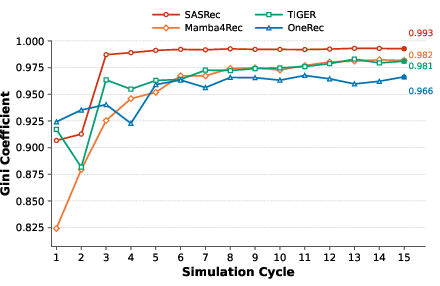
Figure 5: Gini coefficient rises for all models, reflecting inevitable exposure concentration on high-frequency items due to feedback reinforcement.
Structural Cocoon: Hierarchical Collapse in the Code Space
A novel, generative-only cocoon effect is shown at the level of hierarchical codes. Layer-wise entropy analysis reveals greatest diversity loss at coarse code layers (first tokens), with much less entropy reduction at fine-grained code layers—a phenomenon the authors term "structural cocoon."
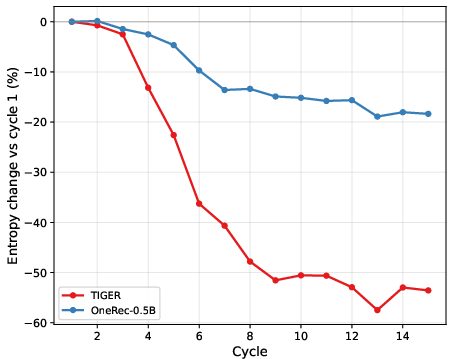
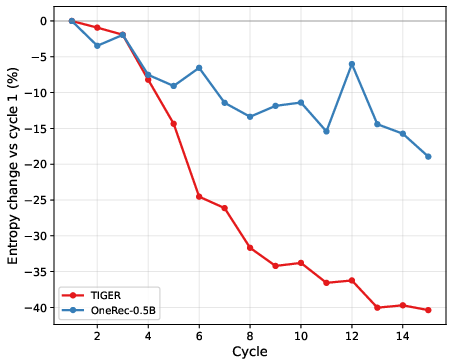
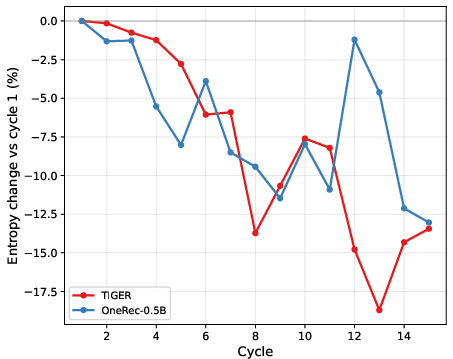
Figure 6: Layer-wise code entropy—coarse code layers see the strongest entropy collapse, fine layers act as a diversity buffer in generative recommenders.
This structure is not possible in atomic-ID models. Therefore, generative recommenders tend to funnel users into a small set of broad semantic branches (coarse codes), but maintain micro-diversity (fine codes) within those regions.
Tokenization Scheme and Model Scale Critically Shape Cocoon Dynamics
Tokenization of items into code sequences is a key control lever. Semantic (SID) and collaborative (CID) tokenizations are compared. Collaborative ID tokenization, which incorporates behavioral-popularity signals into code assignment, tends to increase cocoon severity and can eliminate fine-layer entropy buffering, especially in models like TIGER. However, this effect is dataset dependent and less predictive in LLM-scale generative architectures such as OneRec.
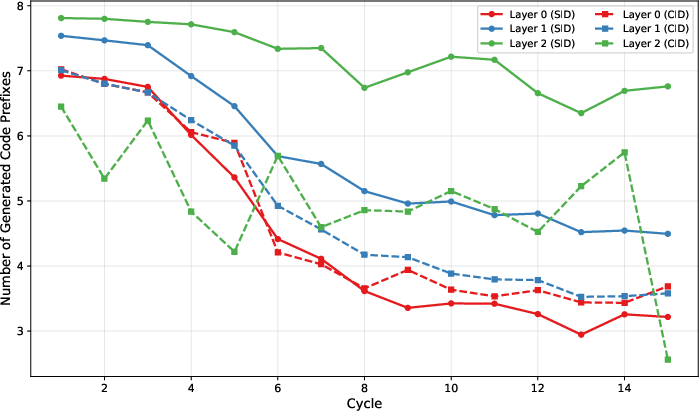
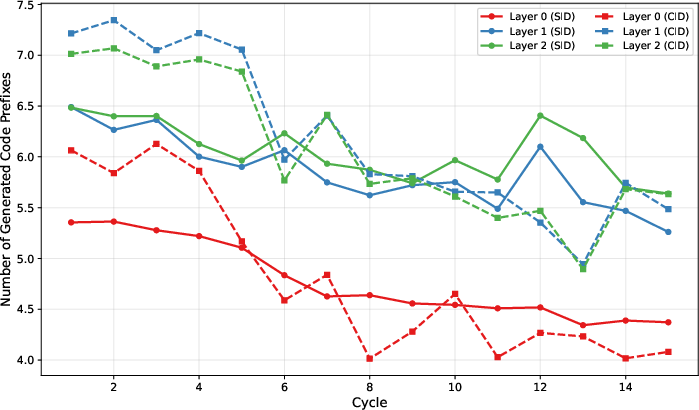
Figure 7: Code prefix diversity under SID and CID—in TIGER, collaborative tokenization accelerates fine-grained code collapse, eroding the structural diversity buffer.
Model capacity has a pronounced buffering effect. Larger generative models (OneRec 3B vs 1.5B vs 0.5B) maintain higher code entropy, more active codes per layer, and a longer tail in the code rank-frequency distribution even after 15 cycles, demonstrating greater resilience to structural cocoon formation.
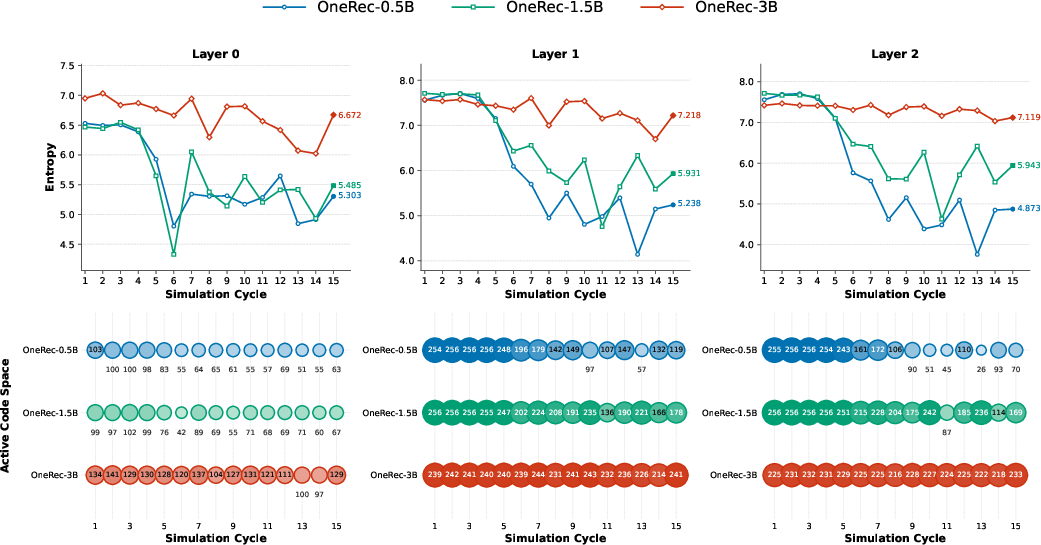
Figure 8: Larger OneRec models sustain significantly more active codes and entropy at all code layers, slowing cocoonization across cycles.
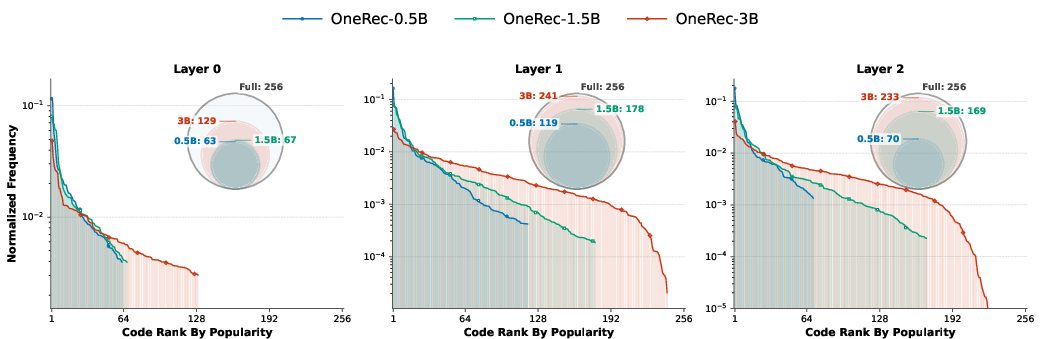
Figure 9: Final-cycle active code sets—model scale enables tail code diversity, not just top-code congestion.
Broader Implications and Future Directions
This work firmly establishes that generative recommenders, due to their autoregressive, code-based generation paradigm, modulate the onset and pattern of information cocoons compared to classic sequential recommenders. The code hierarchy distributes cocoon risk across layers, allowing for structural diversity resilience not available in atomic retrieval models. Nevertheless, concentration at coarse code layers functions as a semantic bottleneck, implying that generative algorithms are not inherently immune to filter bubble formation—especially under popularity-encoded tokenization or limited parameterization.
Practically, monitoring or regularizing diversity in the code space (not just in observed item exposure) becomes critical when deploying generative recommenders. Theoretically, these results call for new objectives and architectures that dynamically mitigate early stage code collapse, possibly by design choices in quantization, training with explicit diversity-aware losses, or multi-path decoding. Increasing model scale alone is effective but costly; improvements in code design and hierarchical regularization may be more robust.
Simulated LLM-based feedback loops represent a realistic and reproducible platform for long-term, systemic impact analysis, although limitations around agent calibration and dataset/domain generality remain.
Conclusion
Generative recommenders alter but do not resolve the information cocoon problem. They exhibit slower and more complex cocoon dynamics, characterized by hierarchical (layered) code-space concentration and greater micro-diversity post-collapsing. Tokenization and scale are decisive—collaborative signals can accelerate cocoon formation, while parameter expansion can buffer it. These results point to the need for cocoon-aware metric suites—including model-level, code-based diagnostics—and targeted diversity-aware modeling practices for the next generation of generative recommendation systems.