- The paper demonstrates that SID collisions significantly inflate traditional evaluation metrics, misrepresenting true item-level performance.
- It introduces Collision-Corrected Evaluation (CCE) to assign fractional credit for collision groups, yielding more accurate measurement in recommendation systems.
- The proposed Zero-Collision Reassignment (ZCR) method minimizes collision impact through optimal post-tokenization reassignment using a min-cost bipartite approach.
Reliability of SID-Based Tokenizer Evaluation in Generative Recommendation
Overview and Motivation
The paper "How Reliable Are Semantic-ID Tokenizer Comparisons in Generative Recommendation?" (2605.25330) rigorously interrogates evaluation practices within SID-based generative recommendation. It identifies and quantifies critical flaws in the prevailing paradigm that analogizes SID-sequence generation to item-level recommendation, emphasizing the nontrivial divergence induced by SID collisions in quantization-based tokenizers. The core concern is that matching SID sequences does not equal item identification except in the absence of collisions, yet evaluation metrics (e.g., Hit@K) often proceed as if this equivalence holds. Through empirical and algorithmic contributions, the paper dissects this mismatch and proposes solutions both for collision-aware metric computation and for post-tokenization collision resolution via minimum-cost reassignment.
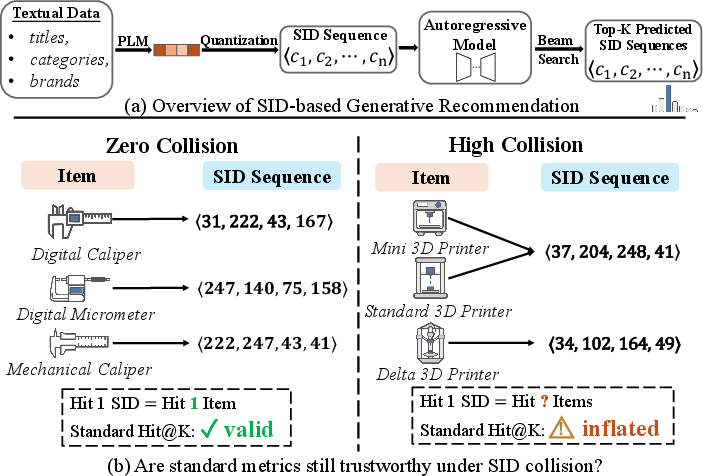
Figure 1: SID-based generative recommendation workflow and the inflation of item-level performance due to collision: under zero collision, a SID sequence uniquely identifies an item; under SID collision, the same SID sequence maps to multiple items.
SID Collision: Empirical Prevalence and Evaluation Impact
Tokenizers compress item representations into discrete code sequences (SIDs). When quantization schemes—such as RK-Means or RQ-VAE—pack collaboratively distinct but semantically similar items into the same SID, collision occurs. The paper documents collision rates reaching up to 30.5% for RK-Means on the Scientific dataset, with significant group sizes. As a result, generated SID sequences ambiguously identify collision groups rather than individual items, violating the one-to-one mapping required for faithful item-level evaluation.
Performance inflation follows: conventional SID-level Hit@10 overestimates true item-level performance (ItemHit@10) by up to 103.36%. The inflation grows with the collision rate, and is sufficient to reverse comparative rankings among tokenizers, leading to misleading conclusions about tokenizer quality.
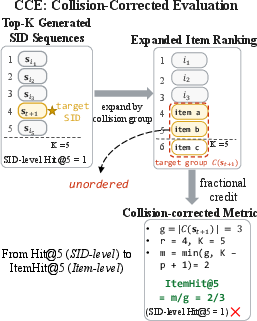
Figure 2: Collision-corrected evaluation schema: expanded item ranking apportions credit for a SID-level hit across all items in its collision group under top-K evaluation.
Collision-Corrected Evaluation (CCE): Methodology
To address this measurement bias, Collision-Corrected Evaluation (CCE) computes item-level metrics directly from beam search output. When a matched SID sequence maps to a group of g items, CCE assigns fractional credit ($1/g$) to each item for Hit@K and averages NDCG contributions. This protocol ensures that only unique mapping yields full credit, while collision groups receive distributed credit reflecting their indistinguishability.
Empirical results show that CCE robustly quantifies genuine item-level performance. For example, under high collision, RK-Means' native SID-level Hit@10 is 0.1330 versus a collision-corrected ItemHit@10 of 0.0654, marking a 103.36% inflation. Such results underscore the necessity for collision-aware metrics in SID-based generative recommendation.
Zero-Collision Reassignment (ZCR): Algorithmic Solution
Even with collision-aware metrics, comparisons across tokenizers can remain confounded due to differing native collision rates. The paper introduces Zero-Collision Reassignment (ZCR), a post-tokenizer procedure that constructs collision-free SID assignments at minimum cost by reassigning only the last-level codeword within each prefix group (provided codebook capacity is sufficient). ZCR formulates the reassignment as a min-cost bipartite assignment (solved by the Hungarian algorithm) and proves optimality within the last-level-only constraint.
ZCR produces collision-free assignment with negligible distortion to original structure, permitting controlled evaluation and fair tokenizer comparison.
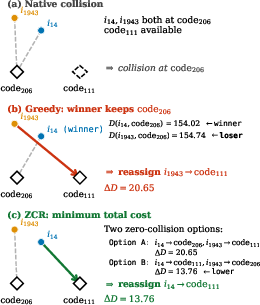
Figure 3: Case study of reassignment within one collision group—ZCR vs. greedy sequential reassignment: ZCR achieves minimum aggregate assignment cost, preserving semantic structure.
Experimental Results and Analysis
Experiments across four datasets (Scientific, Cell, Beauty, Yelp) and five tokenizers (RK-Means, RQ-VAE, LETTER, QuaSID, MQL4GRec) validate the analytic claims:
- Collision prevalence: RK-Means and RQ-VAE show substantial collision rates, LETTER and QuaSID much less.
- Metric inflation: High-collision tokenizers exhibit massive performance inflation under conventional metrics.
- Ranking reversals: SID-level evaluation favors RK-Means; item-level correction through CCE and ZCR reorders rankings to favor LETTER or QuaSID.
- ZCR efficacy: ZCR reduces assignment cost by 8–24% compared to greedy reallocation schemes, and markedly improves item-level performance for collision-prone tokenizers.
- Collaborative signals: Integrating collaborative embeddings with RK-Means boosts item-level performance further, especially where textual features are weak (e.g., Yelp).
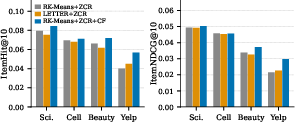
Figure 4: Collaborative signal integration yields improved item-level performance under zero-collision evaluation, especially for sparse or duplicate text.
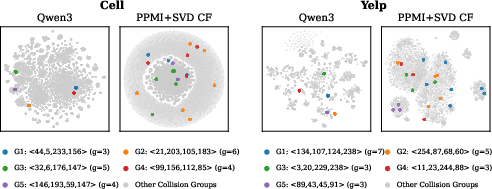
Figure 5: t-SNE visualization of item embeddings in textual and collaborative spaces reveals that collision groups are compact in text but more diffuse in collaborative, underscoring the limitation of text-only quantization.
Broader Implications and Future Directions
The study exposes foundational flaws in SID-based generative recommendation evaluation, with substantial implications for both practice and theory:
- Metric design: Future evaluation protocols must distinguish between SID-level and item-level metrics, assigning credit reflective of item identifiability.
- Tokenizer development: Tokenizer objectives should integrate collision minimization, potentially via recsys-aware constraints or multimodal feature fusion.
- Dataset curation: Datasets with high item duplication pose challenges that require attention to both collaborative and semantic sources.
- Fair comparison: Uniform zero-collision SID assignments are vital for fair cross-tokenizer benchmarking.
- Model robustness: The findings highlight that generative recommenders can misrepresent performance if collision is unaddressed, motivating end-to-end retraining and possibly joint tokenizer-generator optimization.
Speculatively, as generative recommendation matures, future developments may include:
- Explicit collision-aware training objectives
- Dynamic, context-adaptive tokenization to preserve item uniqueness
- Multimodal SID assignment leveraging both semantic and collaborative signals
- End-to-end architectures optimizing item-level identifiability alongside semantic fidelity
Conclusion
The paper rigorously demonstrates that SID-level evaluation in generative recommendation inflates item-level performance due to SID collisions, leading to misleading benchmarking of tokenizers. Through the introduction of collision-corrected evaluation and minimum-cost zero-collision reassignment, it establishes protocols for faithful, unbiased comparison. The results call for community-wide adoption of item-level metrics and collision-aware tokenizer design, and open avenues for future developments in identifiable, semantically meaningful SID representations in generative recommendation systems.