- The paper introduces the Ghost framework that decouples token-level starvation with Skeleton-Founded Tokenization to combat filter bubbles.
- It leverages Asymmetric Unlikelihood Optimization to rebalance gradient signals, markedly improving long-tail recommendation performance.
- Empirical results show up to a 57% improvement in tail Hit-Rate and significant fairness gains with minimal overall accuracy loss.
Diagnosing and Curing Popularity Bias in Generative Recommenders: The Ghost Framework
Introduction
Generative Recommendation Systems (GRs) underpinned by LLMs have redefined sequential recommendation with end-to-end architectures and semantic indexing. Yet, their operational paradigm remains susceptible to popularity bias—an inherent tendency to over-represent frequent (head) items and marginalize rare (tail) items due to the long-tailed nature of user-item interactions. Despite the sophistication of current SOTA GRs (e.g., LC-Rec, LETTER, ED2), this paper reveals that popularity bias persists at both the token and structural levels, resulting in severe filter bubbles and poor coverage of long-tail content. Previous debiasing methods, largely inherited from conventional recommendation settings, fail to address the generative, token-based underpinning of these models.
This work provides a theory-grounded diagnosis of popularity bias in GRs, deconstructing its emergence into token-level gradient starvation under MLE optimization and bias amplification from undifferentiated item tokenization. The authors propose Ghost, a novel GR architecture equipped with Skeleton-Founded Tokenization (SKT) and Asymmetric Unlikelihood Optimization (AUO), explicitly designed to provide countervailing signals to tail tokens and structurally regularize the SID space for head/tail separation. Ghost achieves decisive gains in long-tail recommendation and fairness without significant utility loss, approaching Pareto optimality in the accuracy-fairness-coverage trade-off.
Diagnosing Popularity Bias: Gradient Starvation and Tokenization Effects
Popularity bias in GRs manifests as a dual-level phenomenon. First, under the standard maximum likelihood estimation (MLE) regime, training distributions reflect the long-tail: head tokens are frequently the positive target, while tail tokens are relegated to negative status in the softmax normalization, rarely receiving reinforcement. Analytical decomposition of the MLE gradient update shows systematic "starvation" of tail token embeddings—they are persistently pushed away from user preference at each optimization step, precluding accurate modeling or retrieval for tail items.
Second, SID-based generative frameworks (under schemes like RQ-VAE, RQ-KMeans) tokenize all items without respect to their popularity, resulting in undifferentiated SID assignments. During generation, tail item SIDs share variable-length prefixes with a multitude of head items; at each "branching point," head tokens dominate due to the aforementioned gradient starvation. The cumulative probability suppression over the SID path results in exponential degradation for tail item recall (see Lemma 2).
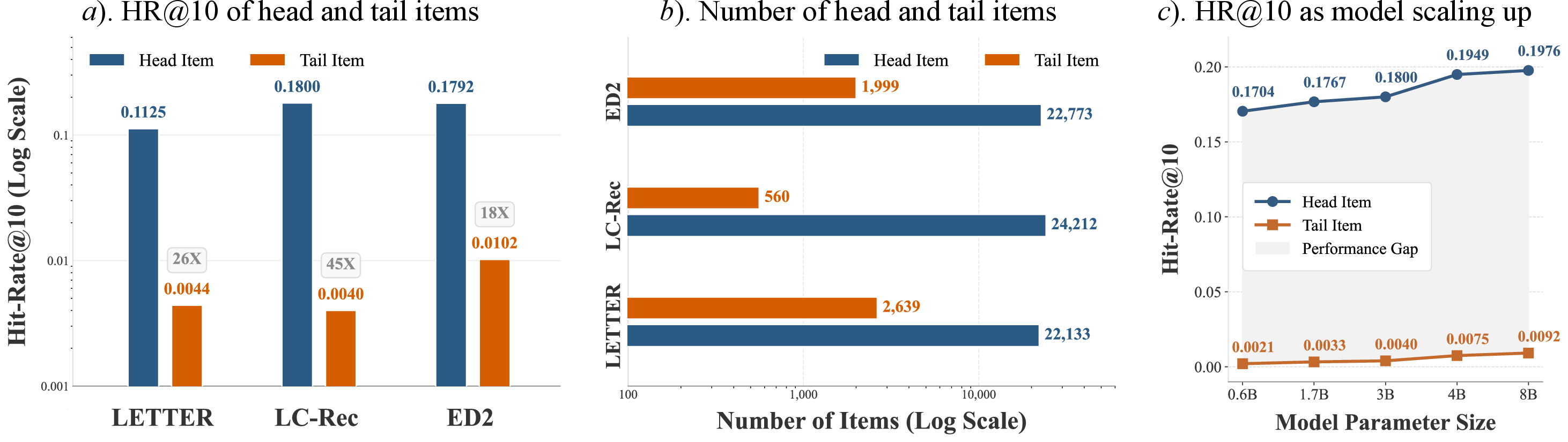
Figure 1: Head/tail Hit-Rate@10 disparity (a), exposure imbalance in recommendation lists (b), and persistent bias across backbone scales (c) for SOTA GRs, evidencing severe filter-bubble effects.
Empirically, head items account for over 97% of recommendations in standard GRs and the performance gap between head and tail items can exceed an order of magnitude. Moreover, scaling LLM backbones does not ameliorate the bias.
Existing Debiasing: Pareto Suboptimality
Attempts to extend traditional reweighting or post-hoc reranking methods (e.g., IFairLRS) to the generative framework yield marginal improvements and face the classic accuracy-fairness trade-off, as evidenced by persistent gaps to the Pareto optimal region even with aggressive debiasing.
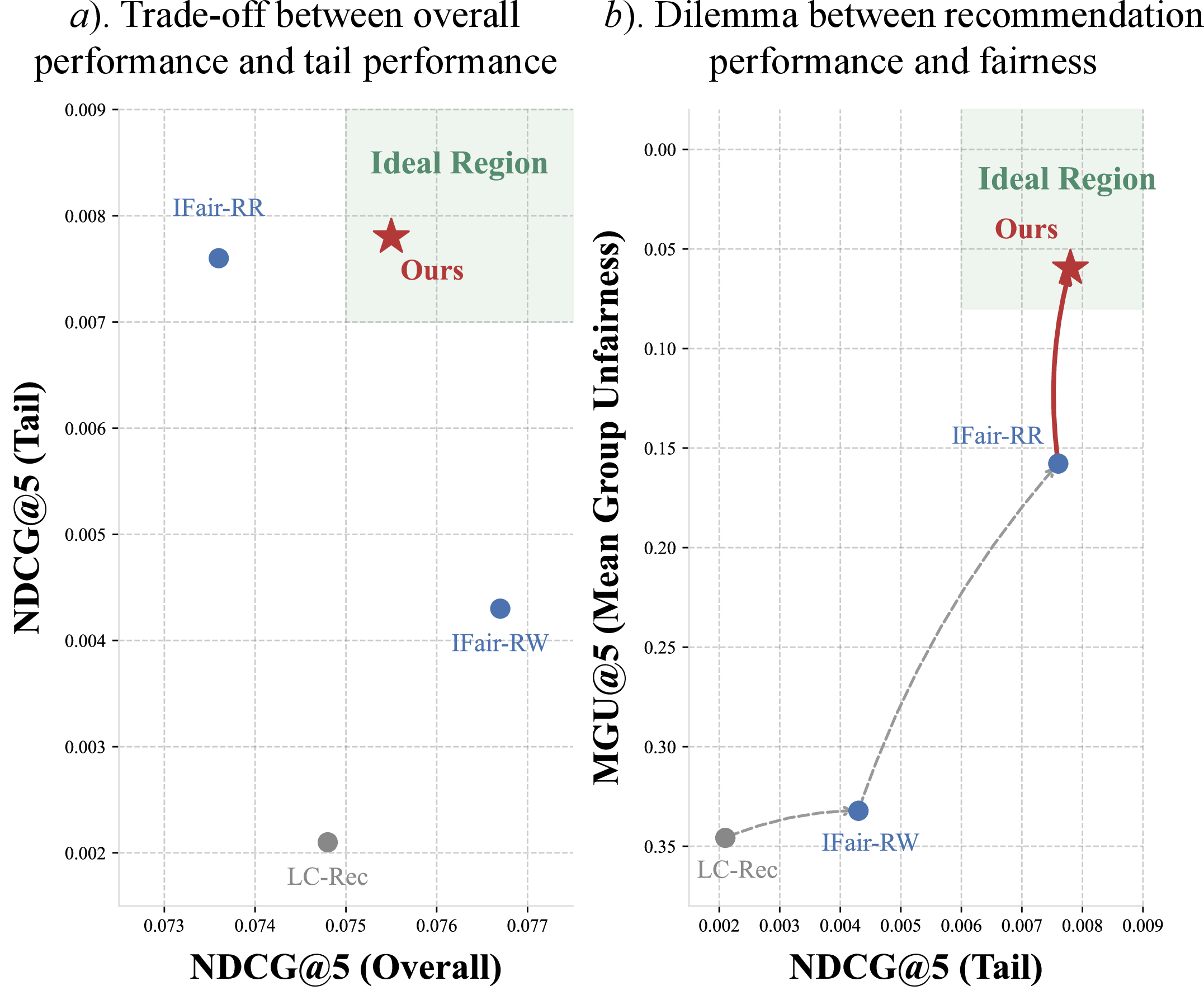
Figure 2: Visualizing trade-offs in overall/tail performance and fairness; even re-weighted or re-ranked GRs remain far from ideal Pareto efficiency.
The Ghost Architecture: Skeleton-Founded Tokenization and Asymmetric Unlikelihood Optimization
Grounded in the theoretical diagnosis, Ghost targets both root causes: token-level starvation and structural bias amplification.
Skeleton-Founded Tokenization (SKT)
SKT abandons undifferentiated tokenization by partitioning SID generation. Head item SIDs ("the skeleton") are generated first via RQ-KMeans. Each tail item then inherits the full head SID prefix from its most semantically similar head item and extends it with additional tokens unique to itself. This localizes the head-tail "branching point" to a single, known step, eliminating the exponential suppression of tail item probability (see Lemma 3).
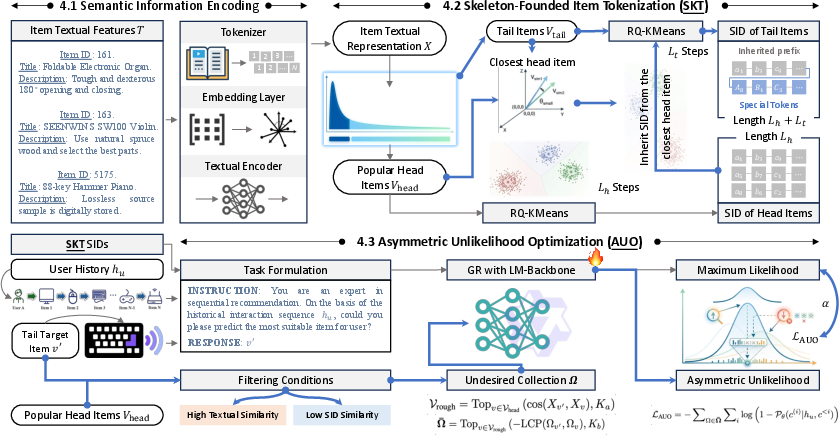
Figure 3: Ghost overview—SKT encodes hierarchy, tail items inherit head prefixes, and AUO actively penalizes contextually undesirable head token generations during training.
Asymmetric Unlikelihood Optimization (AUO)
To correct persistent suppression of tail token embeddings, AUO modifies the optimization objective. AUO identifies a tail-item-specific "undesired collection"—nearby head items in both semantics and SID space—and introduces explicit unlikelihood penalties when the model over-generates these competitors. This redirect suppression from the head tokens, redistributing gradient signal to the tail tokens competing at SID branching.
Empirical Results
Evaluations on standard Amazon benchmarks ("Instruments", "Arts", "Games") and across multiple backbone scales (0.6B–8B) demonstrate that Ghost consistently outperforms both SOTA GRs and adapted debiasing baselines along key dimensions:
- Tail Recommendation: Ghost achieves up to 57% improvement in tail Hit-Rate@10 and NDCG@10—even for extremely sparse tail items—relative to reweighting/reranking debiasing baselines.
- Fairness: Mean Group Unfairness (MGU) is reduced by up to 66% compared to strongest non-generative debiasing models.
- Overall Utility: The loss in overall HR/NDCG is bounded to ∼7%, competitive with or better than non-tail-focused debiasing.
- Exposure Distribution: Ghost produces a substantially more balanced head/tail ratio in recommendation results, as opposed to head-dominated lists from baselines.
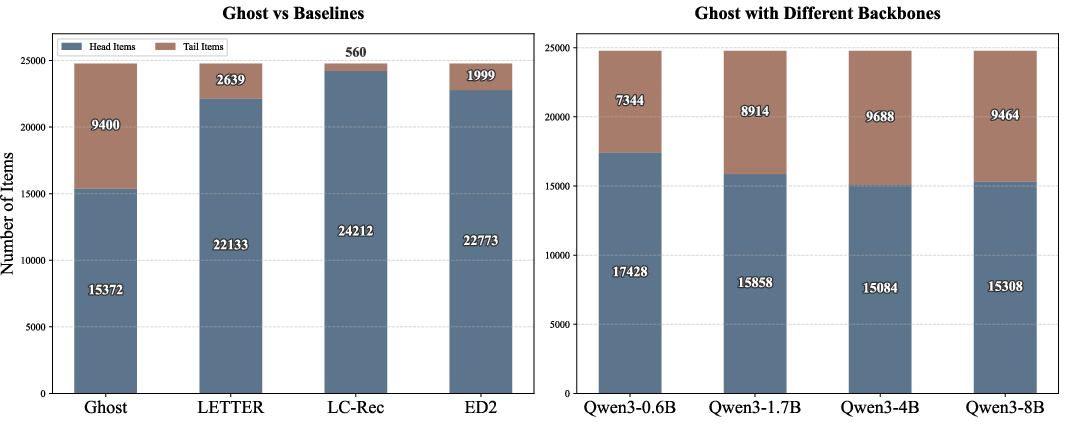
Figure 4: Recommendation exposure shifts: Ghost achieves a balanced split between head and tail items, in contrast with GR baselines’ near-complete head polarization.
Hyperparameter studies reveal the necessity of appropriate SKT prefix lengths and AUO weightings. Notably, AUO delivers benefits only when combined with SKT—that is, without structural regularization, negative samples cannot correct for the geometric bias amplification.
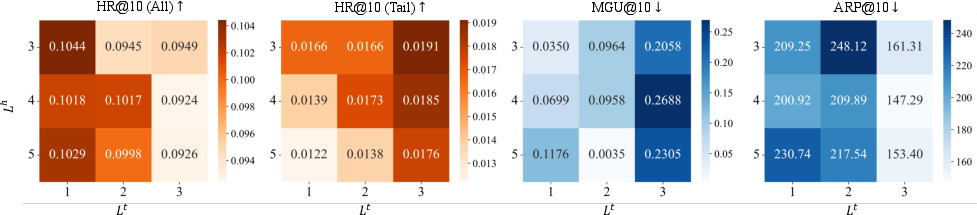
Figure 5: Varying SID prefix allocation (skeleton vs tail extension) reveals trade-offs between overall accuracy and tail sensitivity.
Analysis across equal-sized popularity buckets confirms that Ghost's improvements originate from systematic long-tail excavation, not indiscriminate reweighting. Larger backbones further improve Ghost's results, consistently amplifying tail recall rather than exacerbating head overfitting.
Theoretical Implications
The Ghost model demonstrates that the primary challenge for generative LLM-based recommenders is not simply popularity-driven dataset imbalance per se, but rather the confluence of generative optimization and undifferentiated SID structure. By localizing branching points and dynamically regularizing the allocation of negative signal, it is possible to systematically break the gradient starvation and filter-bubble cycle. This paradigm suggests future research trajectories in generative tokenization and structured optimization for mitigating various forms of exposure bias or unfairness in LLM-based systems.
Practical Implications and Future Work
Practically, Ghost enables fairer and more diverse recommendations from LLM-based GRs with minimal accuracy cost and negligible complexity overhead. The approach contributes towards mitigation of algorithmic Matthew effects, supporting more equitable visibility for niche items and content creators. Future work should extend these methods to reinforcement learning fine-tuning regimes and explore adaptive, online undesired collection construction for even tighter head-tail calibration.
Conclusion
This work rigorously diagnoses the token-level and structural roots of popularity bias in GRs, establishing that existing methods inadequately address exponential bias amplification induced by MLE optimization and undifferentiated SID tokenization. Ghost, via Skeleton-Founded Tokenization and Asymmetric Unlikelihood Optimization, provides a principled and empirically validated remedy that robustly enhances fairness, diversity, and long-tail coverage in LLM-based recommendation.
Reference: “Echoes in Filter Bubble: Diagnosing and Curing Popularity Bias in Generative Recommenders” (2605.16825)

