- The paper demonstrates a dynamic refinement approach using CART, UC3, and CPDE, which repairs and preserves SID assignments for cold-start items.
- It employs collaborative-aware tokenization and conservative gating to boost cold-start Recall@K and NDCG by up to 11.5× over baselines.
- The methodology maintains overall system utility by isolating cold-start adaptation, ensuring performance on warm items while recovering ambiguous SID paths.
DREAM: Dynamic Refinement of Early Assignment Mappings for Cold-Start Robustness in Generative Recommendation
Introduction
This paper addresses a core structural limitation in SID-based generative recommender systems: the early, static commitment of each cold-start item to a single Semantic Identifier (SID) prior to meaningful interaction data. The authors identify and rigorously dissect the cold-start bottleneck in generative recommendation as a failure arising from unsupported SID assignment, premature commitment, and rigid inference-time single-path restriction. The proposed DREAM framework overcomes this by decoupling candidate construction, support-gated SID commitment, and inference-time path preservation through a three-stage dynamic refinement methodology.
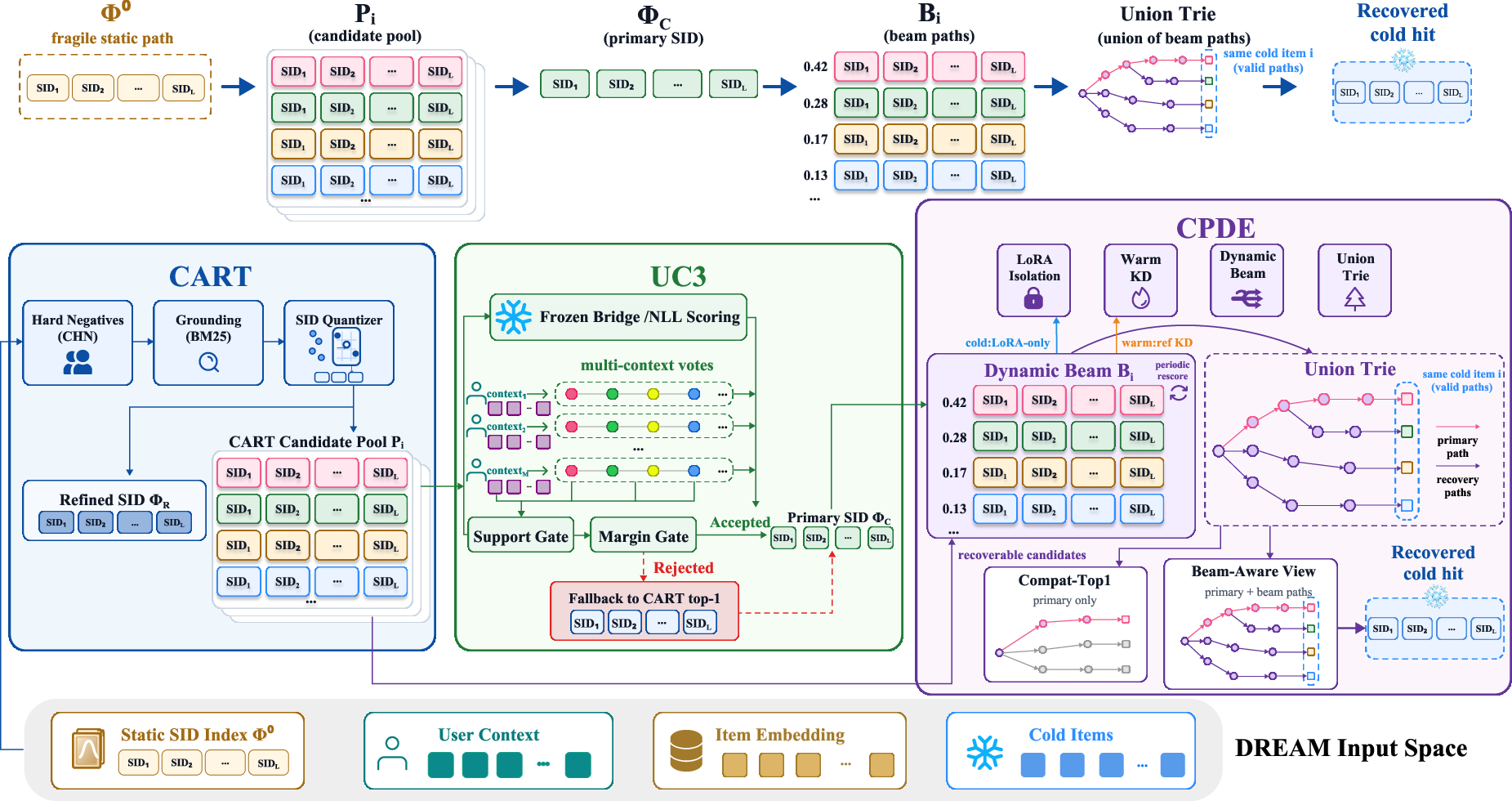
Figure 1: Overview of the DREAM framework highlighting the SID evolution stages, from fragile static paths to dynamically refined candidate pools, conservative commitment, and beam-based multi-path decoding for cold-start recovery.
Background and Motivation
SID-based generative recommendation—where candidate retrieval is cast as next-token prediction over semantically meaningful item token sequences—has achieved substantial progress relative to classical candidate generation coupled with two-tower or sequence models. However, the standard approach involves assigning each item a static SID via offline tokenization (e.g., hierarchical residual quantization, RQ-VAE/RQ-KMeans), before adequate user feedback is available. This architecture results in cold-start items being essentially unreachable: misaligned SIDs receive almost no gradient during model training, precluding both further adaptation and exposure at inference time. The problem is acute because cold-start items form a non-trivial subset of catalogs in high-churn domains.
The failure mode is not primarily due to model capacity but the inherent inflexibility in the item-to-SID assignment pipeline. While prior work has improved semantic informativeness and collaborative signal in codebooks, or pursued end-to-end tokenization-recommender co-optimization, the one-shot commitment remains unresolved, especially for items lacking early behavioral data, and single-path generation precludes beam search over alternative but valid codes.
Methodology
DREAM structurally isolates and resolves each cold-start failure source through three orthogonal stages:
Collaborative-Aware Refined Tokenization (CART)
CART reconstructs the SID space with collaborative geometry. Item embeddings are augmented with learnable residuals trained via dual contrastive and intent-aware (counterfactual hard negative) objectives. Key to CART is generating, for each cold-start item, not just an upgraded singleton SID, but a bounded candidate pool of prior-supported alternatives. Diversity regularization on SID quantization prevents token collapse, maintaining a discriminative yet robust candidate set.
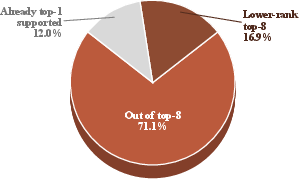
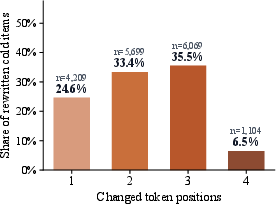
Figure 2: CART prior support analysis, showing the inherited static SID's typical absence from the pool of top collaborative candidates, evidencing the necessity of prior-support repair.
CART’s impact is pronounced: over 70% of static cold SIDs are not in CART’s top-8 candidate pool. The great majority of cold SID rewrites involve only 1–3 token edits—demonstrating that the failure is often local and repairable (see Figure 3 for case illustrations).
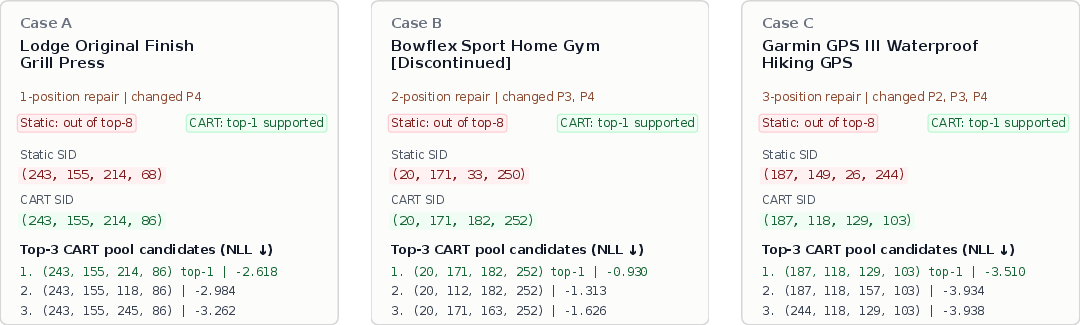
Figure 3: Examples of CART prior-support repair—cold-start items move to top-1 supported SIDs after a few local token substitutions, concretely demonstrating the plausibility of collaborative SID alternatives.
User-Conditioned Candidate Condensation (UC3)
UC3 refrains from immediate SID commitment unless there is decisive evidence. The frozen backbone computes, for each candidate SID per cold-start item, user-history-conditioned negative log-likelihoods, aggregating confidence-weighted votes across all available user contexts. Two explicit thresholds—support count and margin—are required for any SID change; otherwise, the CART assignment persists.
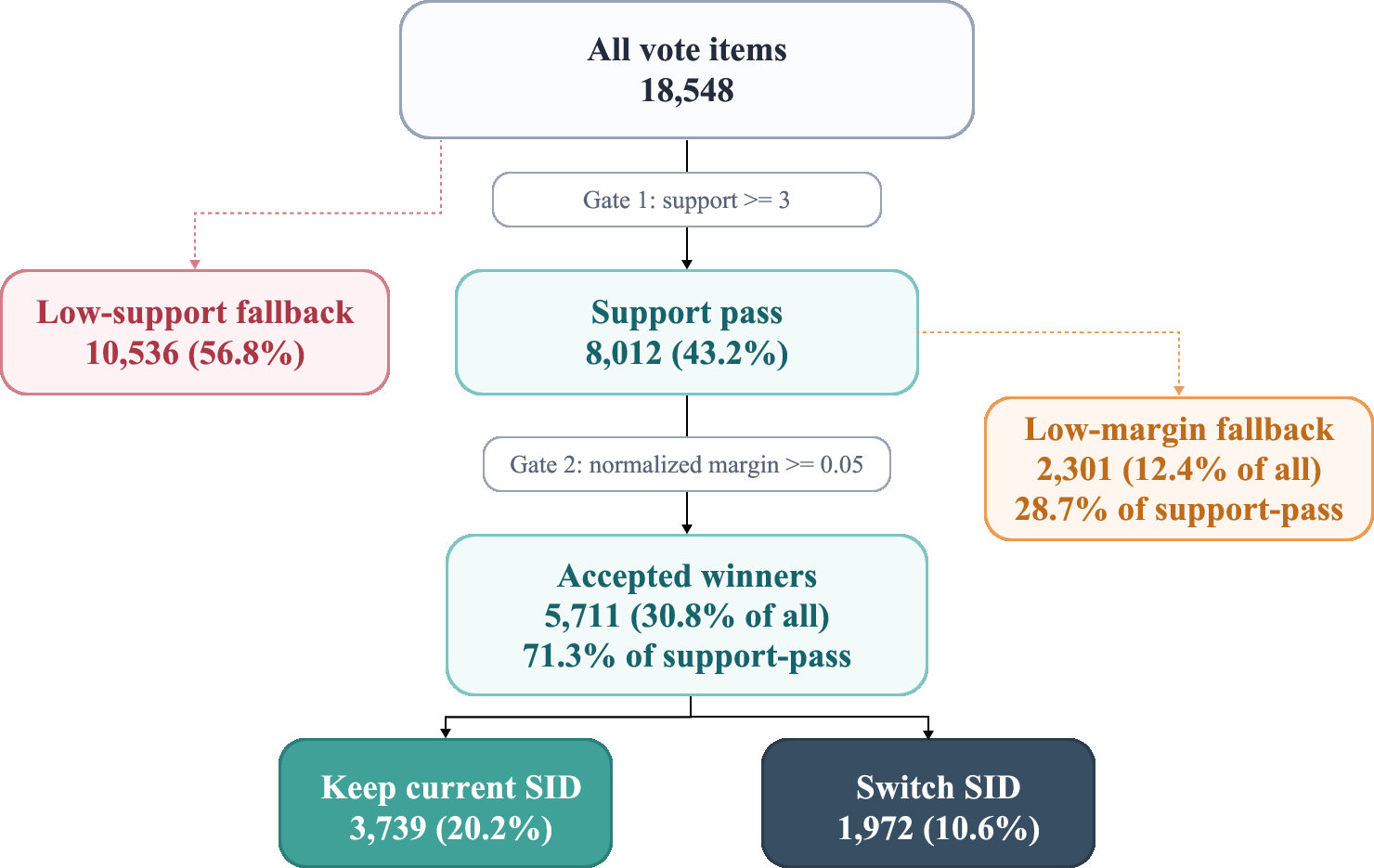
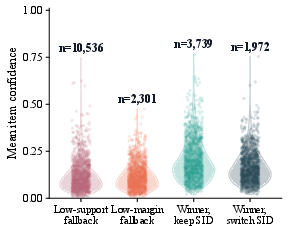
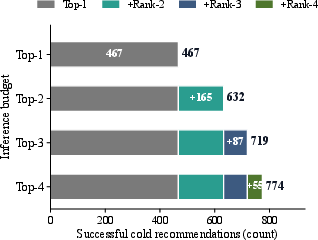
Figure 4: The UC3 gate cascade mechanism. Most cold-start SID changes are gated: only items with strong, unambiguous multi-context support cross both the support and margin thresholds.
This explicit conservative gating ensures that premature SID commitment—before adequate behavioral signal is available—does not occur, drastically mitigating the risk of misaligned assignment.
Cold-Preserved Dynamic Beam Evolution (CPDE)
Acknowledging that cold-start items may still possess residual path ambiguity, CPDE employs dynamic beam maintenance. A small, weighted set of SID hypotheses per item is continually updated during training and registered for constrained decoding. LoRA adapters isolate cold-item gradient updates, thus maintaining warm-item performance. At inference, all beam candidates are valid decoding paths, enabling the model to recover cold-start items even when the optimal SID varies by user context.
Empirical Evaluation
DREAM demonstrates substantial and consistent improvements on all cold-start metrics over strong baselines, including both ID- and SID-based generative recommenders. On three Amazon benchmarks (Beauty, Sports, Toys):
- DREAM outperforms the strongest baseline by 4.3× to 11.5× on cold-start Recall@K and NDCG@K.
- On the Sports dataset, cold NDCG@10 increases from 0.03 (baseline) to 2.52 under DREAM.
- Overall metrics remain competitive, with only modest tradeoffs on warm-item recall—a clear sign that cold-start gains do not come at the expense of broader catalog utility.
The ablation analysis strongly supports the isolation and necessity of each stage. CART yields the largest lift by repairing unsupported assignments. UC3 sharply reduces unsubstantiated reassignments. CPDE’s multi-path beam decoding produces an additive gain, rescuing cold-start items left unrecoverable under a single-path constraint.
Theoretical and Practical Implications
The core insight is that semantic item identifiers should not be treated as monolithic, immutable names but as interfaces whose reliability increases as behavioral knowledge accrues. By operationalizing progressive refinement, DREAM allows recommender models to dynamically defer, re-evaluate, and, when safe, diversify item-to-SID assignments for sparsely-supported items. This changes how generative retrieval methods can accommodate catalog churn, providing a principled mechanism for path recovery and assignment repair.
On the practical side, this enables deployable retrieval models with dramatically improved new item coverage. The architecture is agnostic to underlying backbone and compatible with prevailing generative recommendation systems. Notably, LoRA isolation preserves warm utility while enabling targeted cold-start adaptation, making integration tractable in large-scale industrial settings.
Future Directions
Generalizing dynamic SID assignment to non-stationary catalogs—where new items, user interests, and even the underlying taxonomy may shift post-deployment—naturally follows. Further, integrating progressive refinement into lifelong or continual learning paradigms opens the way for generative recommenders that remain robust to ongoing churn, both in item inventory and in collaborative dynamics.
Conclusion
DREAM makes a compelling, empirically-validated case for decoupling SID assignment from both static codebook quantization and monolithic registration in generative recommendation. By structuring refinement as prior-support repair (CART), support-gated commitment (UC3), and path-preserving decoding (CPDE), the framework achieves optimal cold-start coverage while safeguarding overall system utility. These results strongly suggest that support-conditioned, revisable item identifier spaces are foundational for robust, scalable generative recommendation.

