- The paper introduces a hybrid model that fuses a 2D convolutional VAE with a parametric smile re-fit to robustly reconstruct crypto volatility surfaces.
- The approach achieves markedly lower RMSE across random and structured masking regimes and demonstrates strong cross-market generalization between BTC and ETH.
- The hybrid routing leverages ConvVAE for deficient tenor rows and smile re-fit for rank-sufficient cases, while also providing an unsupervised anomaly detection signal linked to market events.
Hybrid Convolutional VAE for Crypto Volatility Surfaces
The paper proposes a hybrid model for reconstructing cryptocurrency implied volatility (IV) surfaces, fusing a 2D convolutional variational autoencoder (ConvVAE) and a parametric smile re-fit via a deterministic per-tenor routing rule. The ConvVAE is trained on cleaned, gridded Binance Options end-of-hour snapshots representing IVs across 6×7 tenor–delta grids for BTC and ETH options, spanning mid-May to late October 2023.
The architecture comparison includes an MLP and an AttnVAE with self-attention; ConvVAE achieves strictly superior RMSE across all random and structured masking regimes, underscoring the importance of spatial locality bias over capacity for this domain.
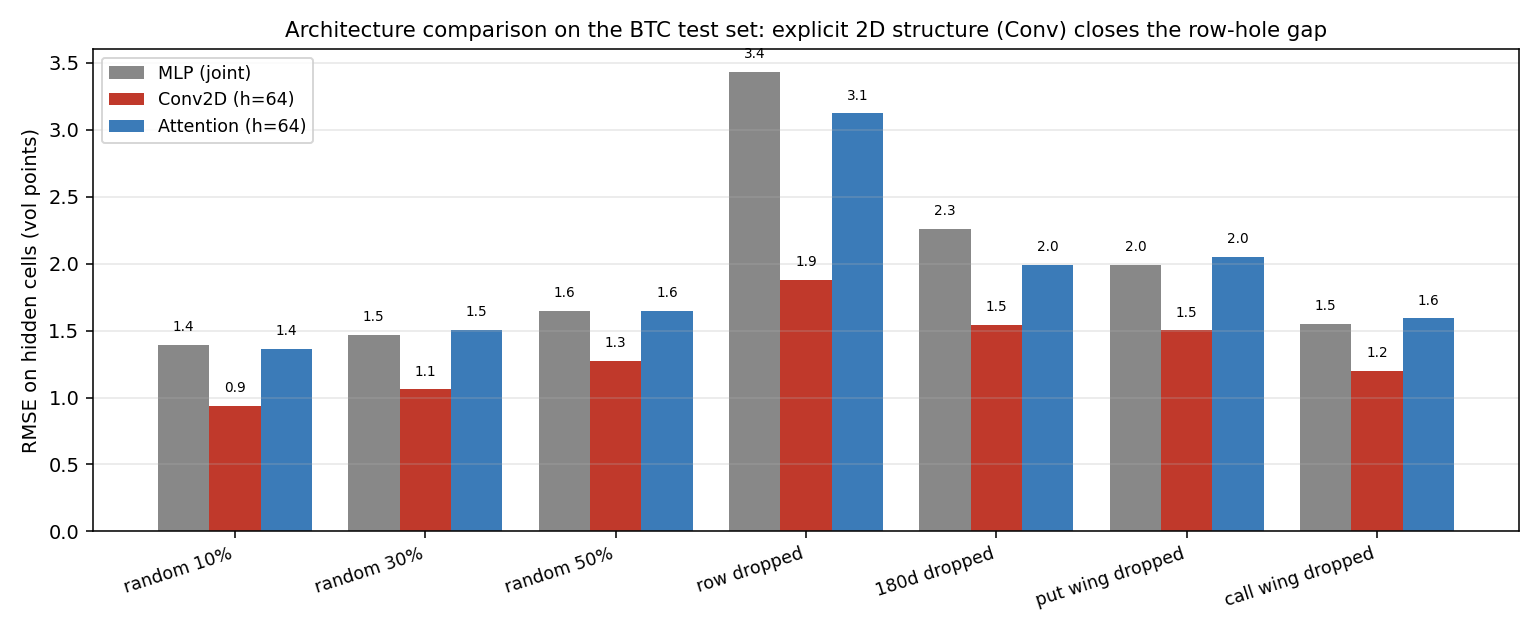
Figure 1: ConvVAE architecture consistently outperforms MLP and AttnVAE across various random and structured masking scenarios on BTC test set, with maximum reduction occurring on row-shaped holes.
Surface Completion and Hybrid Routing
Surface completion under random masking is studied extensively. The smile re-fit baseline is highly effective when each tenor row is adequately populated (rank-sufficient), but fails catastrophically when faced with structured holes (e.g., full tenor dropout). The ConvVAE produces low, stable completion error regardless of mask rate by exploiting a learned latent manifold of typical surface shapes. The hybrid routing rule leverages smile re-fit for rank-sufficient tenors and ConvVAE for deficient ones, leading to robust performance.
The hybrid predictor attains $0.83$ vol points RMSE at 50% masking—an eightfold reduction versus the smile re-fit alone—without increasing inference latency.
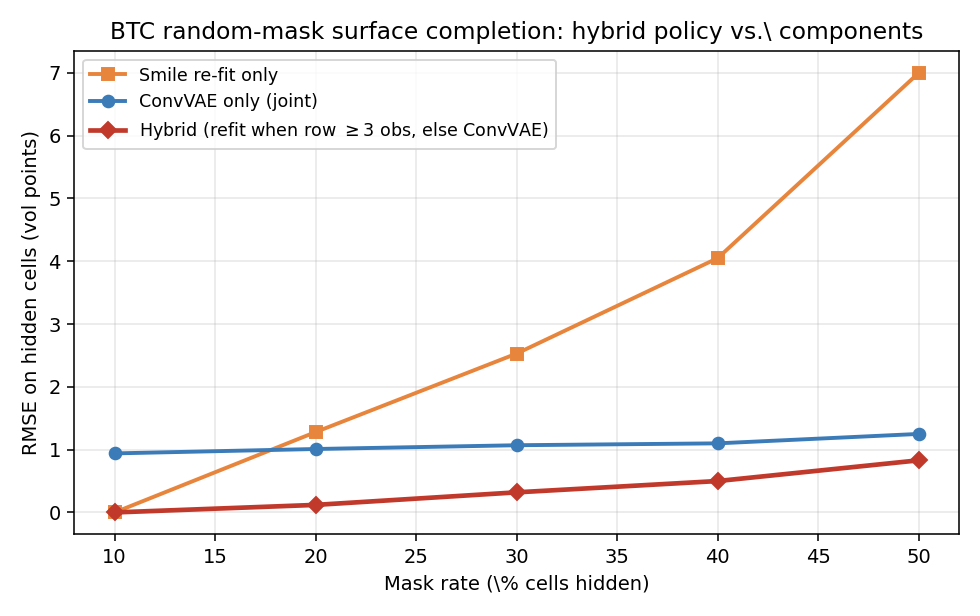
Figure 2: Hybrid routing (red diamonds) yields lower completion RMSE than either component at all random mask rates; at 50% masking, hybrid is markedly more accurate.
Cell-wise error mapping reveals that the smile re-fit's errors concentrate at boundary tenors with limited data, while ConvVAE distributes errors more uniformly. Hybrid routing always attains the lowest per-cell error, as each hidden cell is assigned to the structurally qualified predictor.
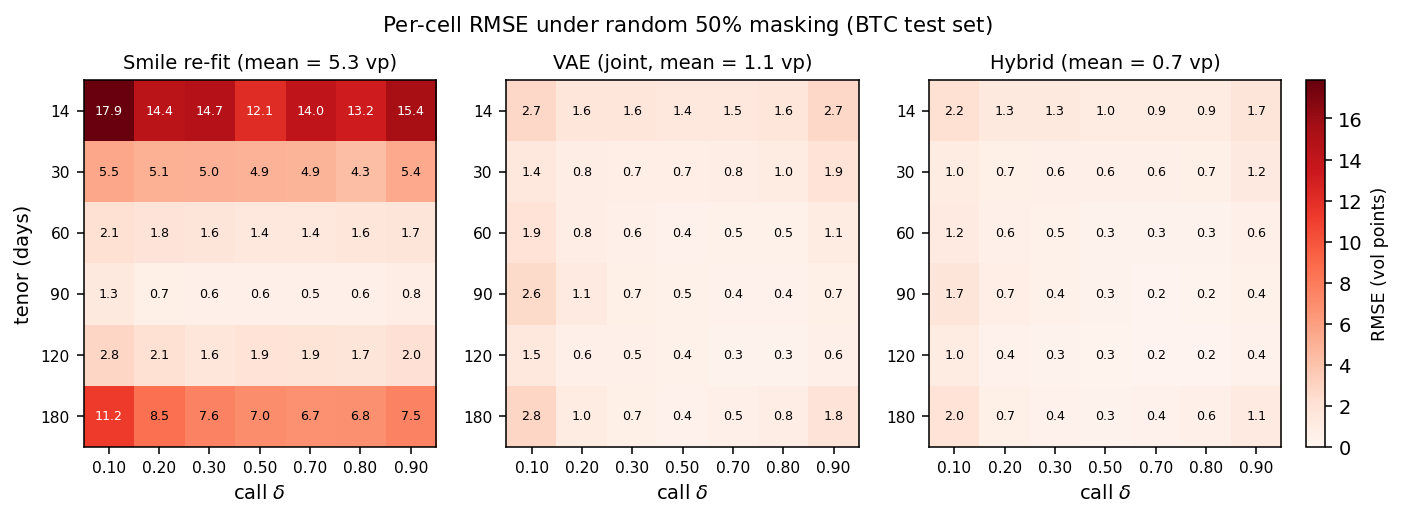
Figure 3: Hybrid model demonstrates lowest per-cell hidden-cell RMSE, outperforming smile re-fit and ConvVAE alone, especially at boundaries.
Structured Holes and Failure Modes
Operationally relevant structured holes, such as full tenor or delta column dropout, highlight regimes where parametric approaches fail—row or long-tenor holes yield 10–13 vol points error for the smile re-fit, whereas ConvVAE recovers plausible completions within 1.5–1.9 vol points. In wing-hole scenarios (put or call deltas), the parametric fit remains effective, and the hybrid defers accordingly. There is a measurable, but bounded, structured-versus-random penalty for ConvVAE on row-shaped holes, indicating room for further architectural refinement.
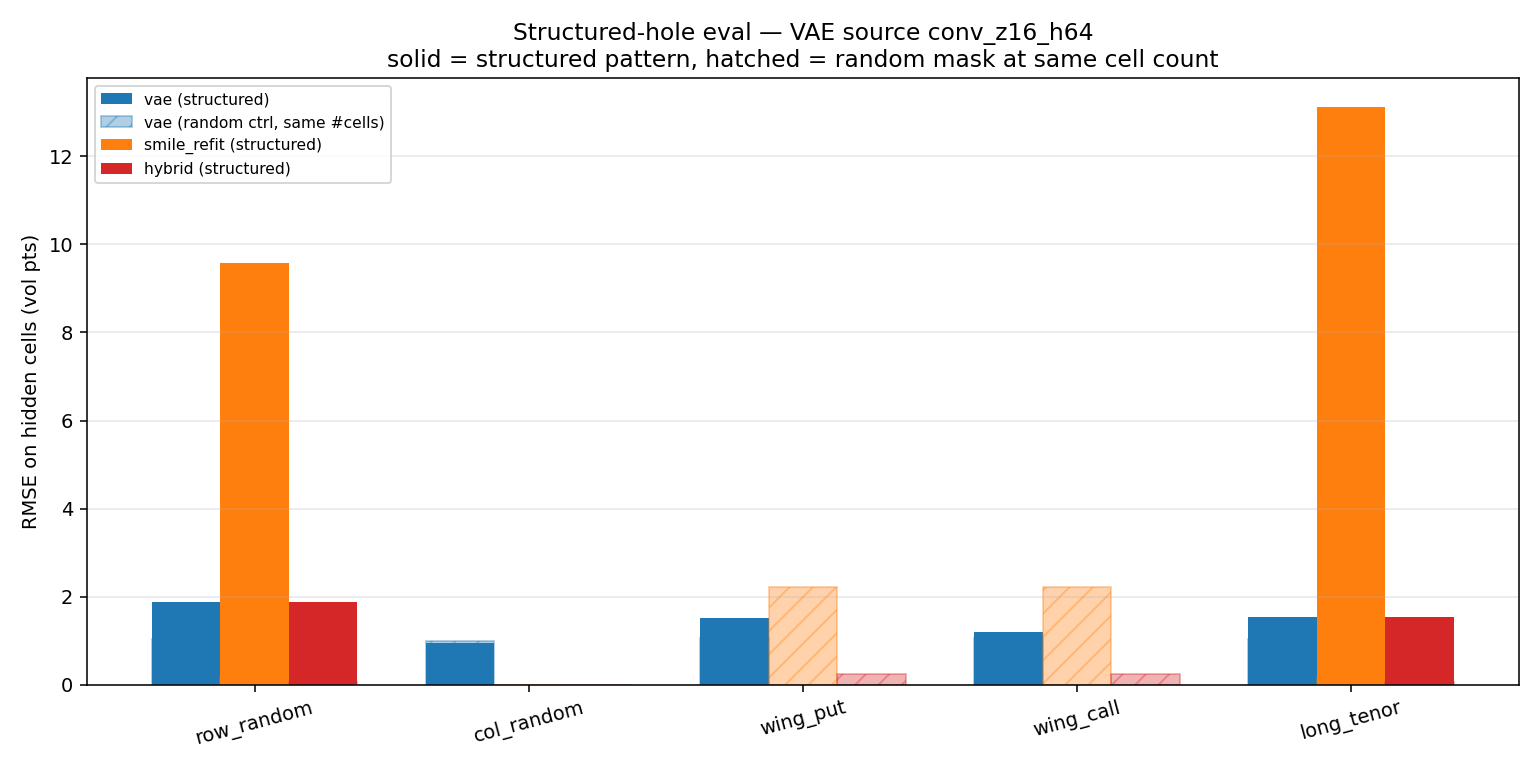
Figure 4: Smile re-fit fails on row/long-tenor holes; ConvVAE remains viable and hybrid routes correctly, reproducing gridded targets on rank-sufficient structures.
Arbitrage Compliance
At the seven listed strikes per tenor, static calendar and butterfly arbitrage tests confirm that ConvVAE and the hybrid predictor are arbitrage-free by construction, inheriting compliance cellwise from the gridded data. Smile re-fit alone, under high mask rates, admits butterfly arbitrage violations in 33–39% of cases. Calendar projection via isotonic regression is operationally free (<$0.001$ vol points RMSE change) for learned models, and improves baseline RMSE.
Cross-Market Generalisation
The learned vol-surface manifold is robustly shared between BTC and ETH: a BTC-only ConvVAE achieves within 5–27% of its own in-distribution accuracy when evaluated on ETH, outperforming the ETH-specific parametric baseline at high mask rates. Joint training yields further RMSE reductions (9–27%) relative to either single-symbol model, confirming substantial manifold commonality and suggesting strong transferability for multi-currency deployment.
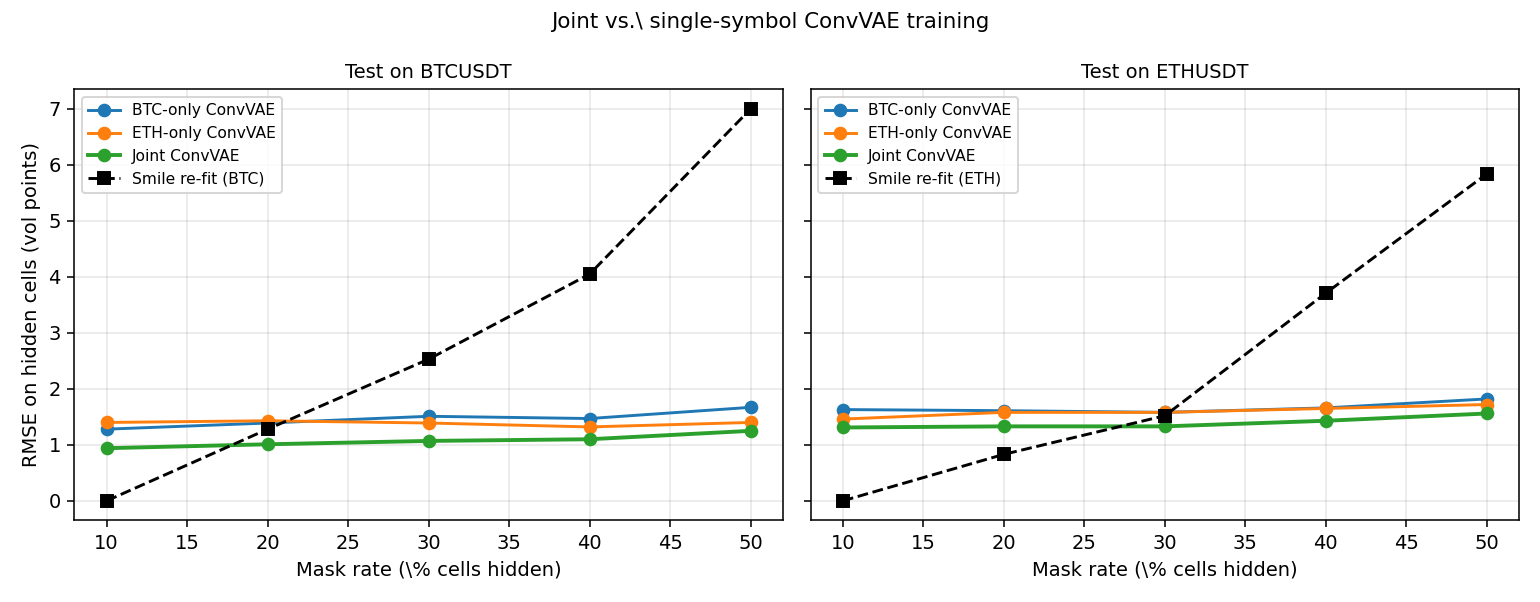
Figure 5: Joint ConvVAE achieves lower RMSE than single-symbol ConvVAEs on both markets, regardless of mask rate.
Synthesis of Results
Across three random mask rates and four structured-hole scenarios, hybrid routing with joint ConvVAE training Pareto-dominates all baselines. Smile re-fit remains competitive only when each tenor row has at least three observed cells; ConvVAE is the sole viable predictor for fully unobserved tenors.
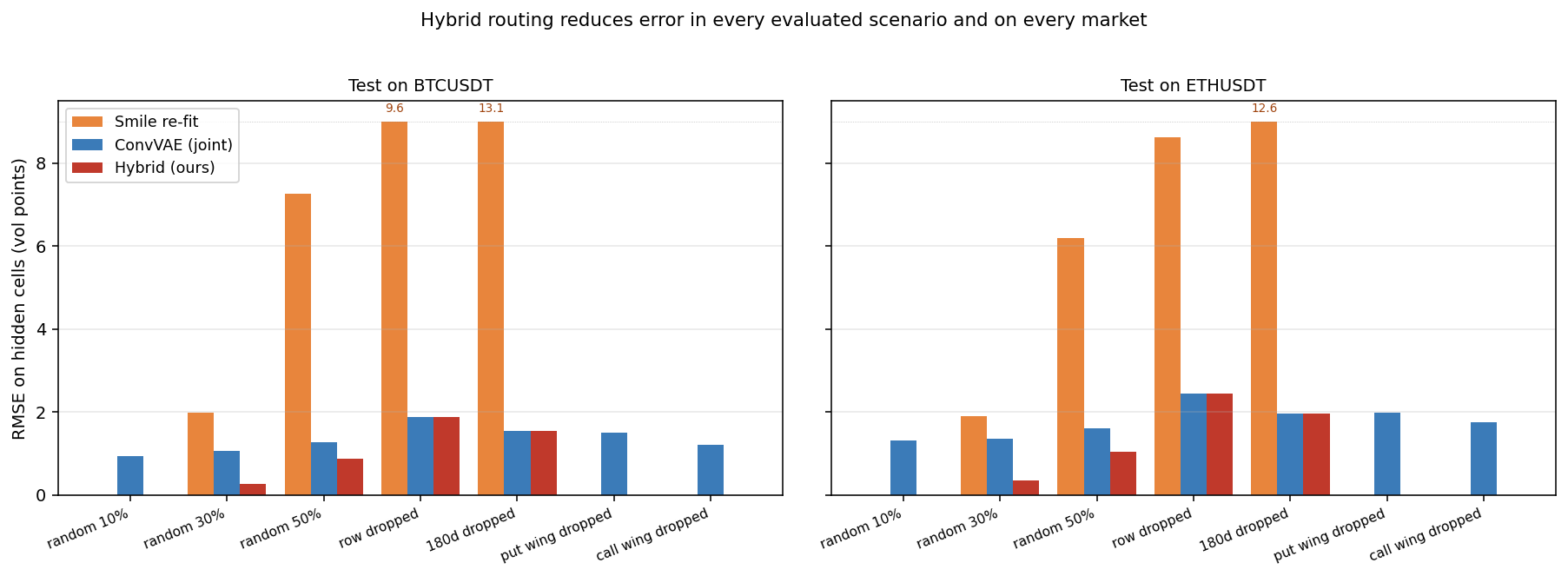
Figure 6: Hybrid model dominates across all scenarios and both markets, suppressing parametric baseline's categorical failures.
Anomaly Detection and Latent Geometry
Besides surface completion, the ConvVAE provides an unsupervised anomaly signal via per-snapshot reconstruction error. Known market events, such as the late-October ETF anticipation rally and the August 17, 2023 flash crash, are flagged as elevated-error periods. Latent codes exhibit time-continuous manifold geometry; high-error anomalies cluster at the manifold periphery, as expected from a generative reconstruction error detector.
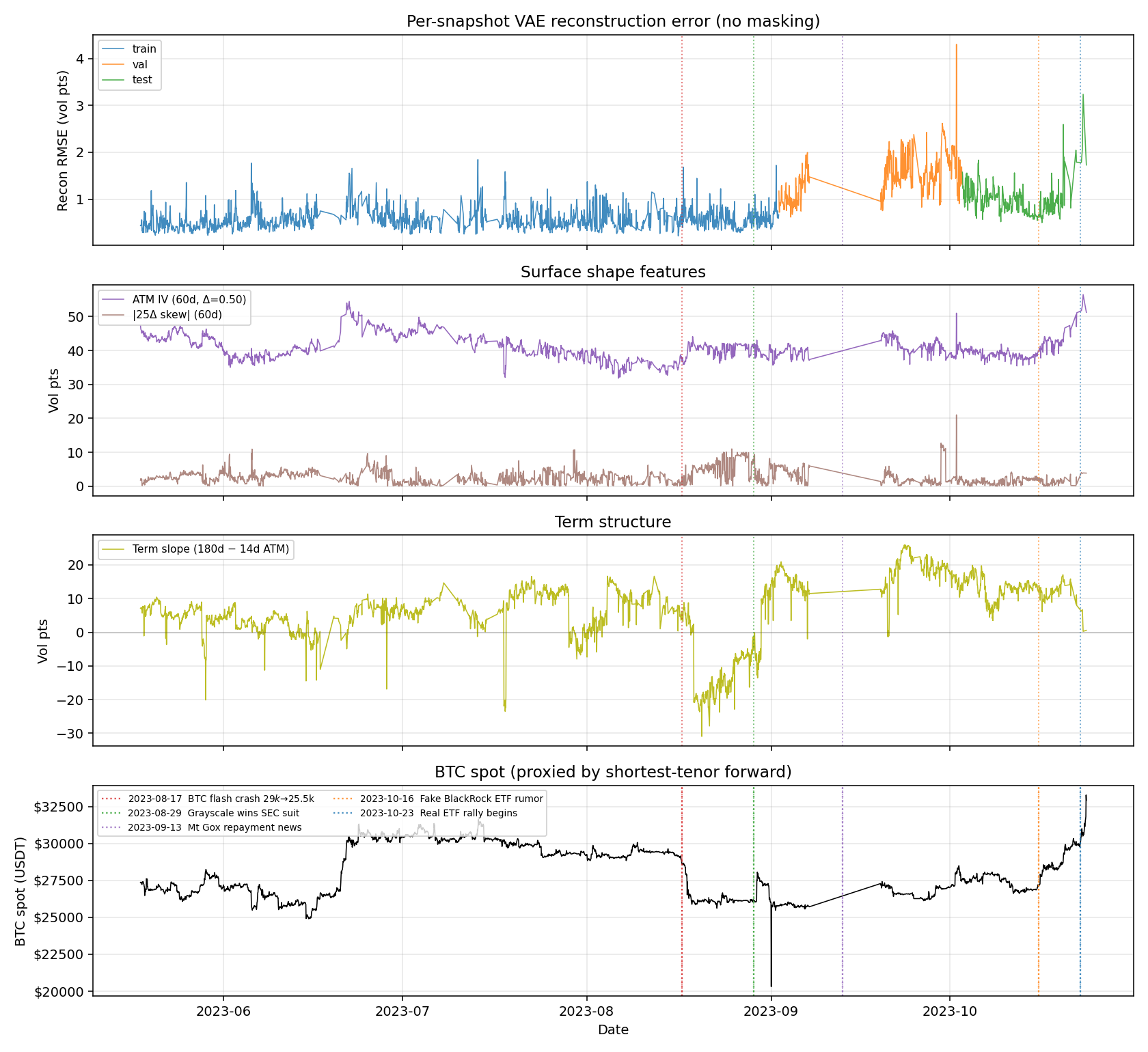
Figure 7: Reconstruction RMSE time series tracks regime shifts and market events; surface diagnostics and spot evolution contextualize anomalies.
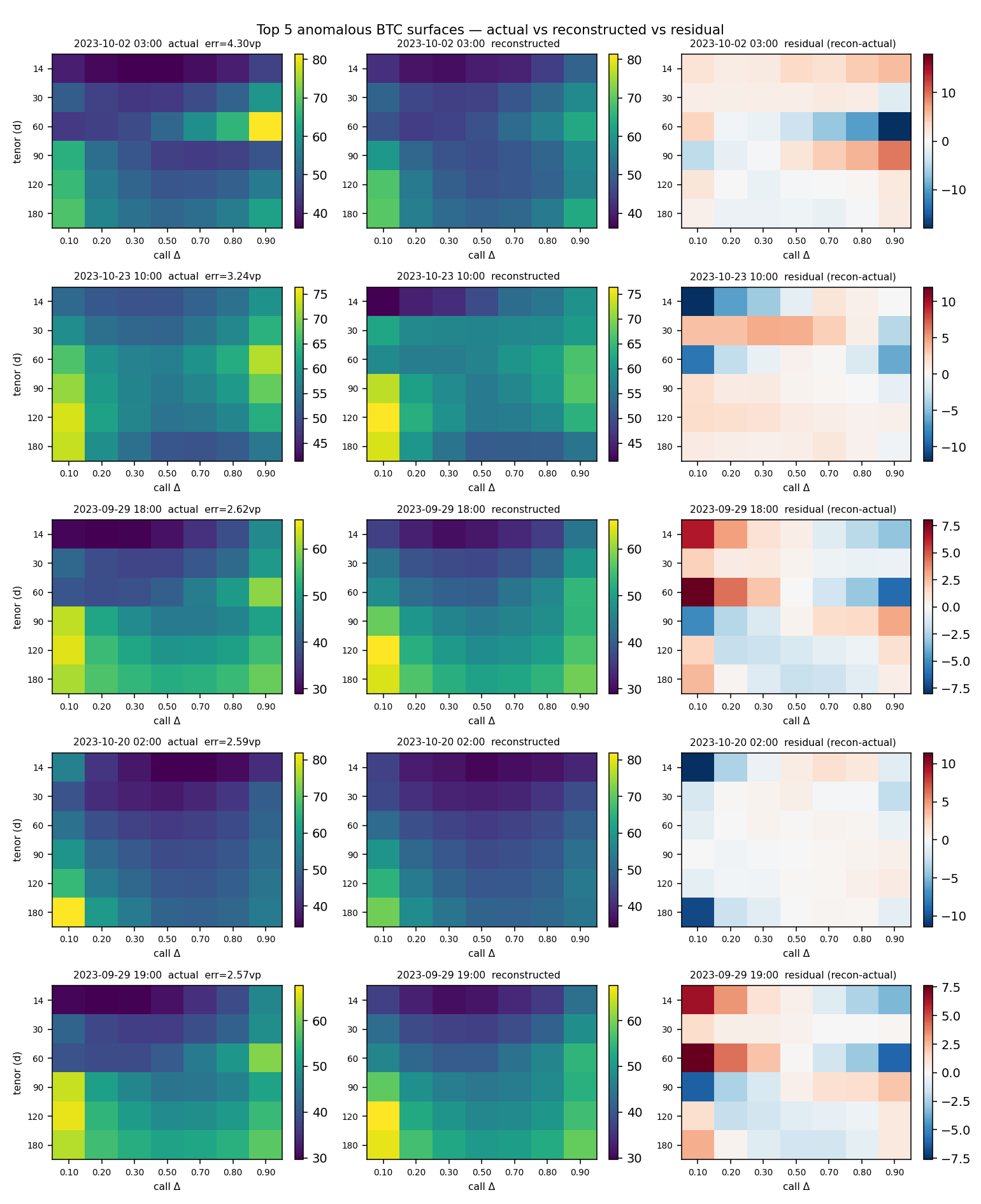
Figure 8: Top-5 anomalous BTC surfaces demonstrate spatially coherent residual heatmaps, revealing systematic shape departures from learned manifold.
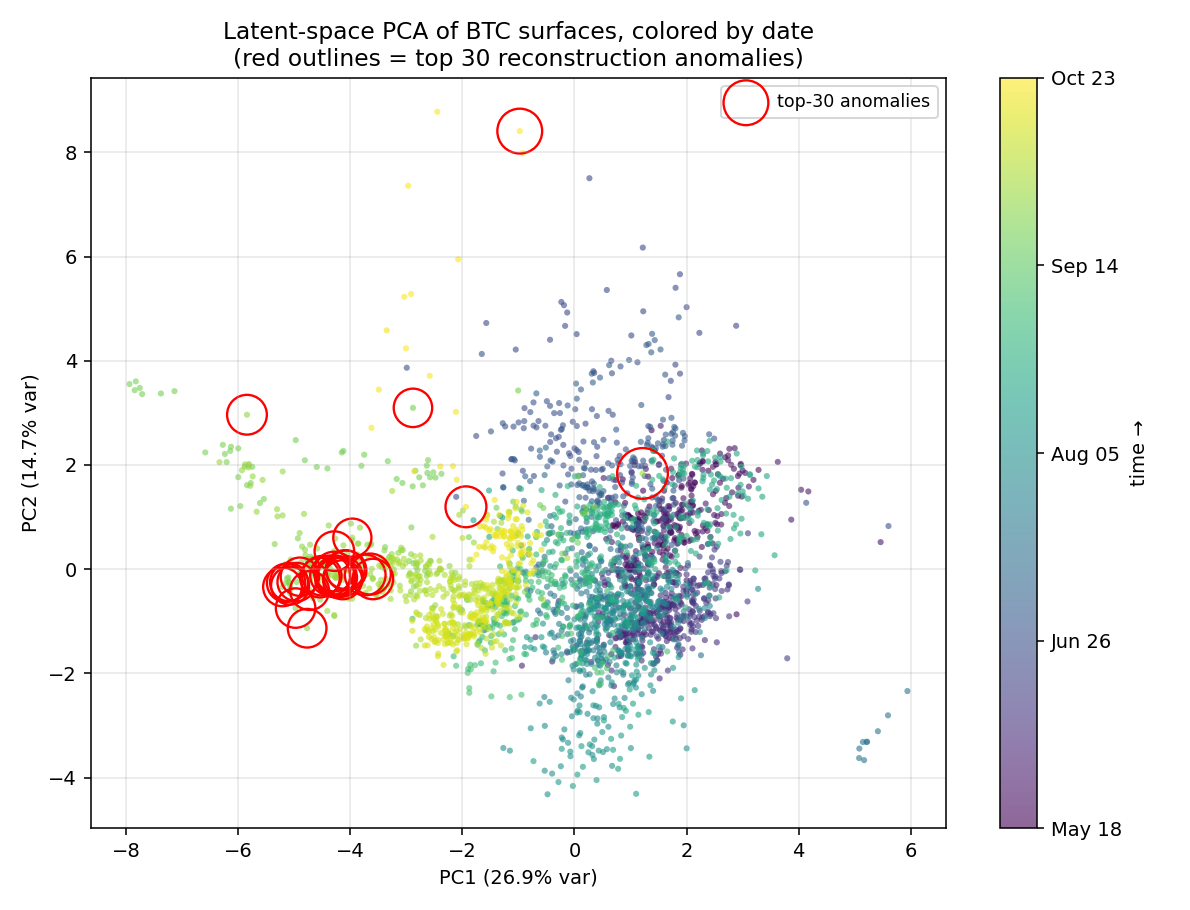
Figure 9: PCA projection of latent ConvVAE encodings reveals anomalies sitting at manifold edges, with normal surfaces in the dense interior.
Practical, Theoretical, and Future Implications
The hybrid ConvVAE-smile routing paradigm delivers a deployable, arbitrage-free, and robust volatility surface estimator, suitable for both risk and market-making engines in cryptocurrency derivatives markets. Empirical cross-market transfer implies that the principal volatility shape variations are encoded by a shared latent manifold; joint training further enhances accuracy.
Architecturally, convolutional locality bias is more effective than translation equivariance, self-attention, or global MLP for this surface domain—a direct consequence of spatially structured noise and operational failure modes.
Potential future work includes direct training on raw un-gridded chains, structured latents for per-tenor conditioning, continuous arbitrage enforcement via smooth interpolants, and adaptation for markets exhibiting pronounced skew or term-structure heterogeneity (e.g., equities).
Conclusion
A hybrid convolutional VAE and parametric smile re-fit, combined via per-tenor routing, achieves superior surface completion accuracy across all test regimes for BTC and ETH options. The model is deployable, arbitrage-free, and operationally robust, and its latent representation yields an effective unsupervised anomaly indicator. The vol-surface manifold is shared across both major cryptocurrencies within the observation window, supporting practical joint training for multi-currency portfolios.
All code, data pipeline, evaluation, and figures are available for full reproducibility and extension.