- The paper introduces CircuitLasso#1, which employs sparse linear regression to recover interpretable circuits from SAE features in LLMs.
- It achieves circuit recovery accuracy comparable to intervention-based methods while offering 2-3× runtime improvements.
- The approach extends to domain generalization by isolating spurious signals, enhancing fairness without sacrificing predictive performance.
Scalable Circuit Learning for Interpreting LLMs
Motivation and Background
Mechanistic interpretability aims to resolve the functional “why” behind LLM behaviors, often via circuit discovery among model internals. Conventionally, circuits are recovered among raw neurons, MLP modules, or attention heads, but the polysemantic nature of these primitives impedes interpretability—individual neurons activate for diverse, semantically distinct concepts. Sparse autoencoders (SAEs) provide a higher-dimensional, but monosemantic, basis for circuit analysis: their features align closely with human-interpretable concepts. Yet intervention-based circuit learning methods are computationally prohibitive in such high-dimensional feature spaces. This paper proposes CircuitLasso#1, a scalable, observational circuit discovery methodology using sparse linear regression to overcome this bottleneck.
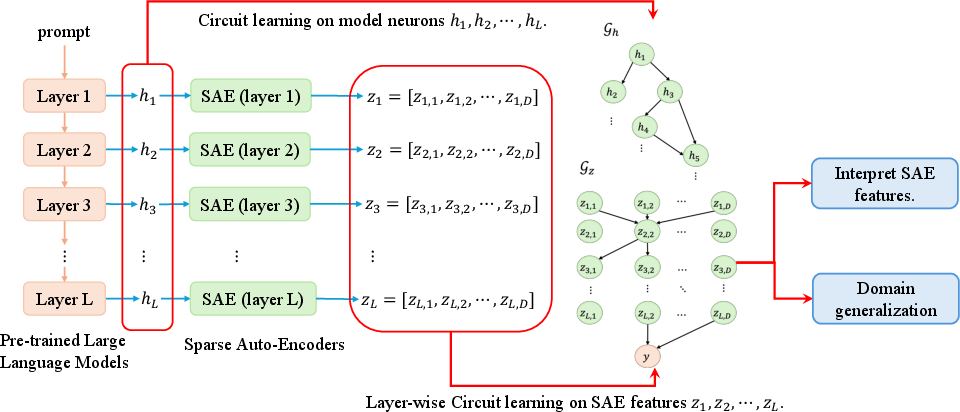
Figure 1: An illustration of model neuron activation, SAE feature collection procedure, learned circuits, and potential downstream tasks.
Methodological Foundations
Sparse Regression for Circuit Discovery
CircuitLasso#1 models circuit recovery as learning a dependency skeleton via sparse linear regression, analogous to a linear structural equation model. For N components (neurons, attention heads, or SAE features), activations across M prompts yield matrices on which Lasso (ℓ1-penalized regression) is performed. The objective includes reconstruction error and a sparsity penalty, subject to acyclicity constraints enforced via block upper-triangular masks reflecting transformer computation order. This surrogate does not attempt to recover fine-grained causal effects but instead yields a conservative map of the strongest dependencies.
Complexity Analysis
In direct comparison to intervention-based methods (e.g., EAP, EAP-ig), CircuitLasso#1 omits costly backward passes and requires only an initial forward activation sweep. Theoretical analysis demonstrates that CircuitLasso#1 matches or outperforms intervention-based baselines in runtime as model size or feature dimensionality increases, especially when token sequence length is substantial relative to hidden dimension.
Circuit Discovery on Neurons and SAE Features
CircuitLasso#1 is first evaluated on model neurons using InterpBench, which supplies synthetic transformers with ground-truth circuits as well as the Indirect Object Identification (IOI) task. Structural Hamming Distance (SHD) quantifies circuit recovery accuracy; wall-clock runtime quantifies efficiency.

Figure 2: Circuit discovery accuracy and efficiency on InterpBench showing SHD and runtime comparisons across CircuitLasso#1 and SOTA circuit learning baselines.
Empirically, CircuitLasso#1 matches baselines in circuit recovery accuracy (mean SHD $3.16$ vs. EAP-ig $2.98$), with runtime improvements: 3× faster than EAP-ig and 2.1× faster than EAP. The nonlinear variant yields only marginal accuracy gains at substantial computational cost, reinforcing the suitability of the linear surrogate for dependency skeleton extraction.
The approach is then extended to learned SAE features. By operating directly on monosemantic features, CircuitLasso#1 reveals model behaviors in terms of human-interpretable concepts—demonstrated on the CoLA dataset and GPT-2 small. Layer-wise adjacency matrices show semantic propagation, merging, and pruning across transformer blocks.
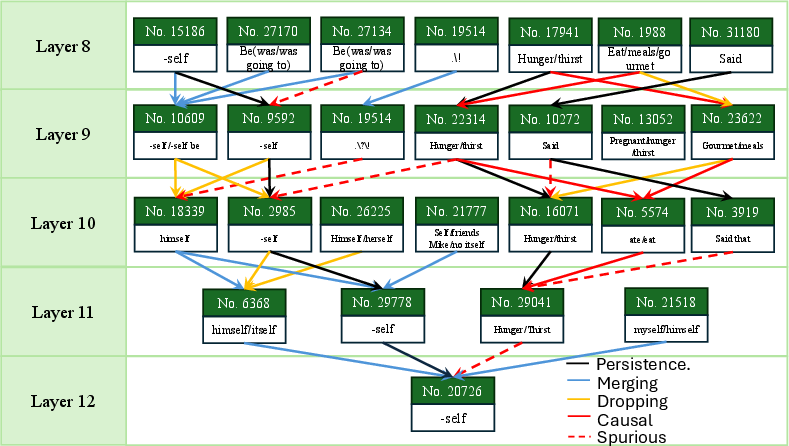
Figure 3: Example circuit path over SAE features in GPT-2 small, tracing interpretable semantic concepts across multiple layers via learned adjacency matrices.
Interpretability and Evaluation
Semantic Tracing and Path Analysis
Circuits learned via CircuitLasso#1 facilitate tracing semantic concepts (e.g., “-self”, “hunger/thirst”, “ending punctuation”) backward through layers, identifying persistent, merged, or dropped features. Both multi-prompt and single-prompt approaches confirm semantic alignments via feature activation patterns and targeted perturbations.
Faithfulness and Completeness
Rigorous ablation studies validate circuit faithfulness (ideal: 1) and completeness (ideal: 0) under both node and edge ablation protocols. CircuitLasso#1 circuits match intervention-based shift baselines for faithfulness, while explicit edge coefficients enable novel edge ablation, isolating critical edges for model behavior explanation.
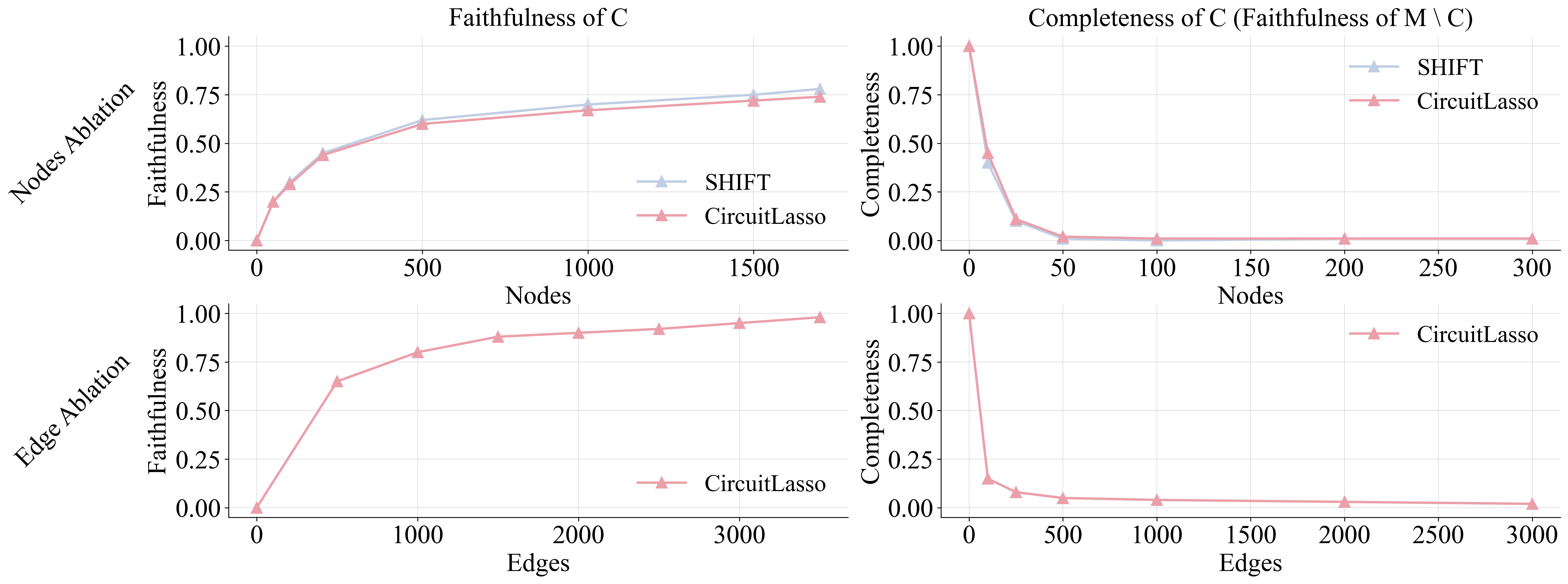
Figure 4: Faithfulness and completeness scores for learned circuits on CoLA, demonstrating node and edge ablation performance.
Weight Distribution
Analysis of circuit weight distributions shows strong sparsification: a small fraction of SAE features contribute disproportionately to downstream prediction, highlighting the capacity of CircuitLasso#1 to isolate essential semantic elements.
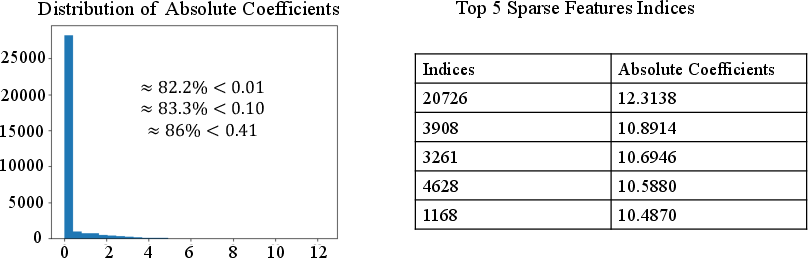
Figure 5: The distribution of ∣AL,y∣ coefficients, with dominance by top 5 essential features.
Practical Utility: Domain Generalization
CircuitLasso#1 is tested for domain generalization on the Bias-in-Bios dataset using multiple LLM architectures (Pythia-70M, Gemma-2-2B, Gemma-2-9B) and pre-trained SAEs. By zeroing SAE features correlated with spurious demographic signals (e.g., gender), downstream classifiers exhibit accuracy and group fairness competitive with prior baselines, but at reduced computational cost. The efficiency gap widens with larger models. Manual identification of spurious features is feasible due to the semantic disentanglement provided by SAE circuits.
Implications, Limitations, and Future Directions
The observational, Lasso-based surrogate introduced here offers substantial advancements in scalable circuit discovery, explicitly addressing high-dimensional SAE feature spaces where intervention-based methods are untenable. CircuitLasso#1 translates mechanistic interpretability tasks into tractable, sparsified graphs enabling semantic tracing, hypothesis-driven editing, and generalization.
Theoretical implications include open questions about quantitative faithfulness of linear surrogate coefficients to true nonlinear causal relations and architectural generalizations to models with within-layer feedback. Relaxing approximate causal sufficiency via enhanced residual-stream modeling is pertinent for robustness, especially as SAE and LLM architectures diversify.
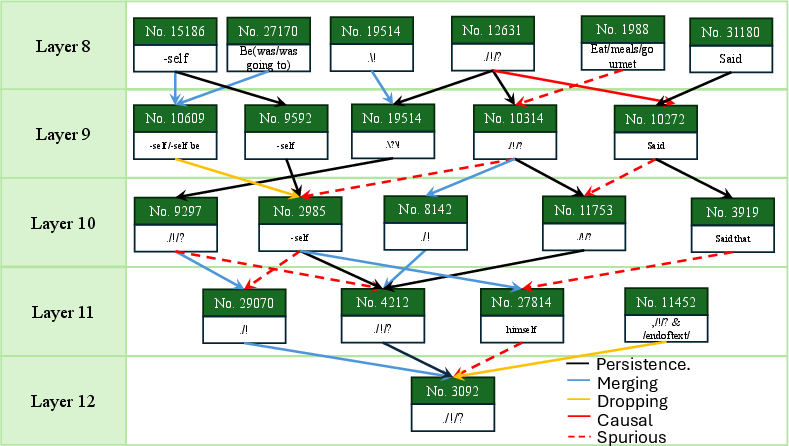
Figure 6: Example learned circuit over SAE features in GPT-2 small—tracing from starting feature No.\ 3092 in layer 12.
Conclusion
CircuitLasso#1 establishes a scalable, accurate, and interpretable framework for circuit learning in LLMs, particularly over monosemantic SAE features. Experimental evaluations confirm efficiency at parity of accuracy relative to intervention-based methods, with benefits in interpretability and practical utility (domain generalization). Future research should refine surrogate fidelity, address architectural generality, and formally characterize causal sufficiency in complex LLMs (2606.16939).