- The paper presents Mojo as a solution that merges near-C++ performance with bit-exact deterministic execution in financial AI workloads.
- It details an advanced compiler leveraging MLIR and parallel primitives to overcome the two-language tax and non-deterministic GPU reductions.
- Empirical benchmarks demonstrate significant speedups (4.6×–170×) over pure Python, enhancing efficiency in capital markets AI engineering.
Introduction
This work provides a technical assessment of Mojo, a Python-like systems language from Modular, in the context of capital markets AI engineering (2606.16059). The analysis situates Mojo's value across three central constraints in financial AI: high-performance heterogeneous computation, bit-exact deterministic execution, and ecosystem interoperability. The paper contextualizes the longstanding two-language tax in quantitative finance, attributes its modern exacerbation to model and hardware scale, and critically evaluates previous solutions (Numba, Julia, Rust, PyTorch) for their gaps in determinism, performance, or ecosystem maturity. Through precise benchmarking and order-sensitivity experiments, the discussion links regulatory and operational motivators for adopting Mojo in core financial workloads.
The Two-Language Tax and Limitations of Previous Approaches
The translation of research Python prototypes into C++ production code in financial firms remains a major resource drain, both in terms of engineering capacity and audit reconciliation. With the proliferation of large models (e.g., transformer-based financial LLMs) and heterogeneous deployment targets (x86, ARM, NVIDIA, AMD, custom ASICs), the cost of translation and the risk of numerical drift have expanded (Figure 1).
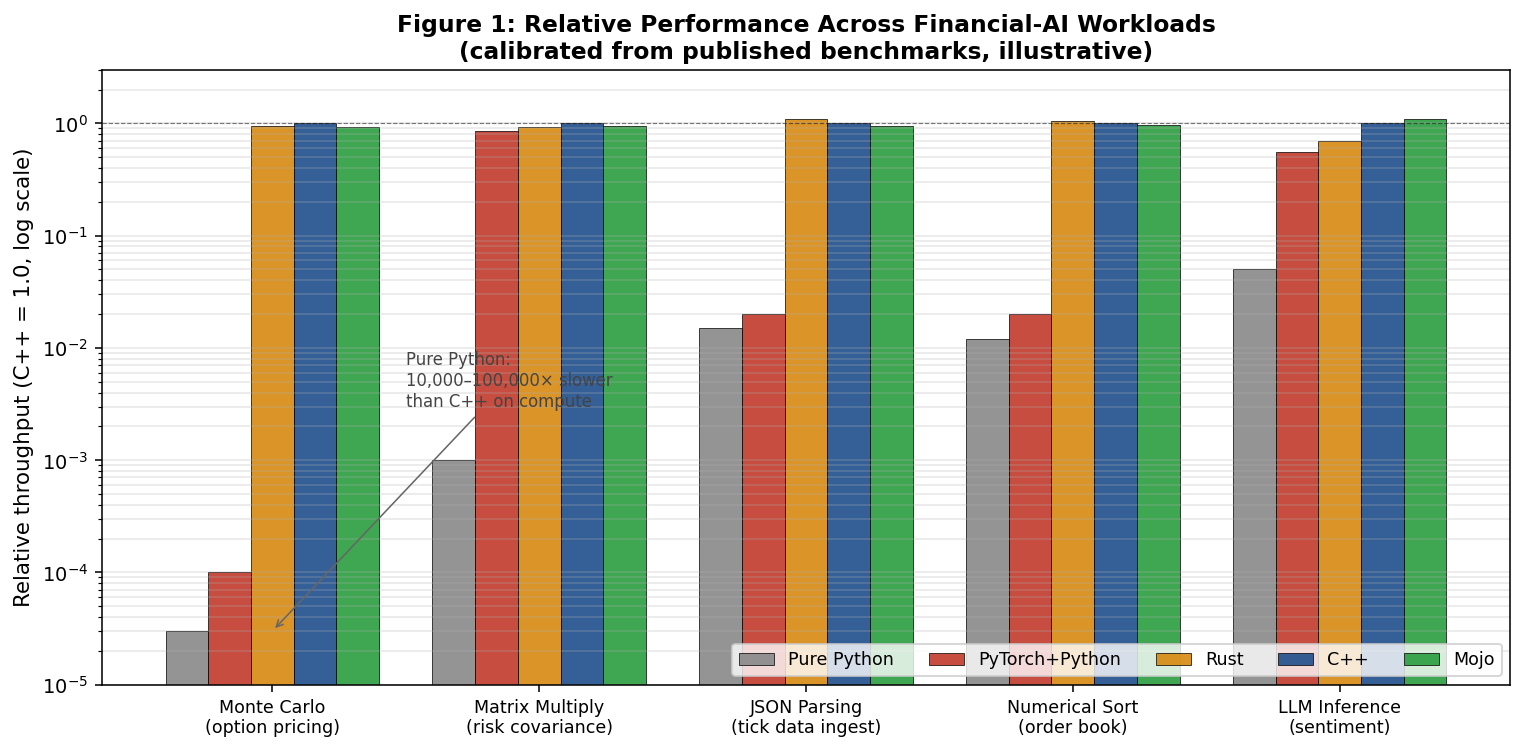
Figure 1: Throughput comparison shows Mojo achieves near-C++ speed, outperforming PyTorch and vastly exceeding pure Python on financial AI workloads.
Prior efforts such as Numba, Cython, PyPy, Julia, Rust, and TVM improved isolated kernels or provided performance portability, but failed to deliver simultaneously on all three pillars required by regulated financial applications: seamless productivity, native speed, and deterministic execution. Python and PyTorch, while offering ease of exploration, remain interpreter and GIL-bound; C++ and CUDA unlock speed but force bifurcated development and expose teams to audit failures via kernel-level non-determinism. Solutions that compile Python-like code (Numba, Cython) do not control for floating point order or offer cross-hardware determinism guarantees.
Mojo’s Compiler and Programming Model
Mojo leverages MLIR as a backend, allowing progressive lowering from high-level Pythonic code to highly optimized, hardware-native instructions (AVX-512, SVE, PTX, ROCm, etc.). The language introduces static typing and mutability primitives while remaining familiar to Python-trained quants, meeting interoperability requirements by supporting direct import of Python modules and external calls to C/C++ libraries. Most critically, Mojo exposes low-level numerical and memory controls—especially order-sensitive floating point reduction—through first-class SIMD and parallel programming models.
Parallelism and SIMD vectorization are direct language primitives, and compile-time specialization enables further hardware-specific acceleration. Multi-level scaling (scalar, thread, SIMD, GPU) is achieved without code duplication, and Mojo's direct MLIR path bypasses numerous sources of Python interpreter and dynamic dispatch overhead that plague PyTorch and NumPy.
Numerical Determinism for Regulated Financial Pipelines
The manuscript provides a detailed and rigorously measured analysis of GPU non-determinism in modern AI frameworks, emphasizing its regulatory consequences in finance. Through direct experiments on Apple Silicon, the study demonstrates multiple distinct floating point outputs from mathematically identical reductions, dependent purely on summation order—even for the same device, backend, and kernel, only the fixed-thread-count, fixed-order run is reproducible (Figure 2).
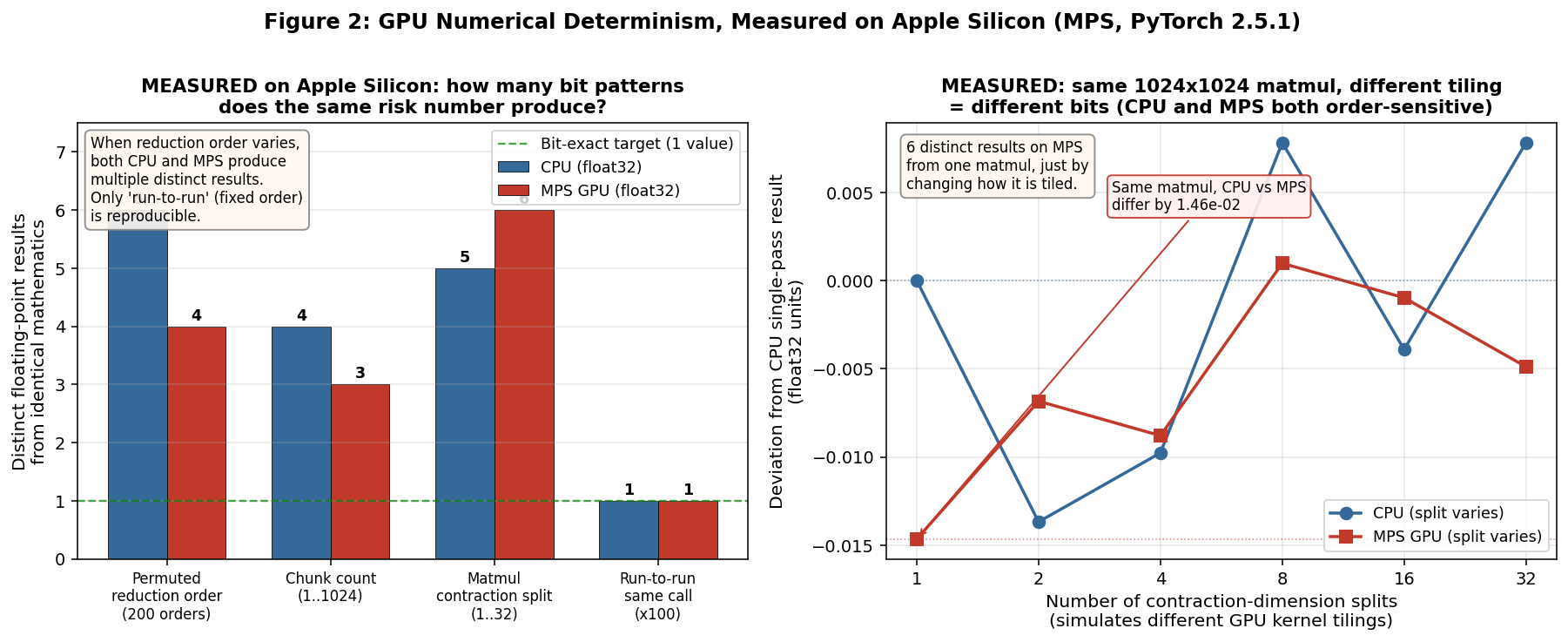
Figure 2: Experimental results reveal multiple floating-point bit patterns from varying reduction order alone, underscoring the need for explicit, deterministic kernel design.
This order sensitivity, sourced in IEEE 754 non-associativity, is exacerbated by GPU atomic reductions, heuristic kernel selection (cuDNN, cuBLAS), asynchronous kernel dispatch, library version drift, and inherently non-deterministic algorithm variants. While PyTorch exposes deterministic execution flags, these come at severe throughput penalties and do not generalize to all operators.
Mojo directly addresses this constraint by giving full control of reduction order, kernel implementation, and floating-point semantics to the model developer. The companion mojo-deterministic library delivers bit-exact reductions, dot products, and aggregation routines, which match rational arithmetic references across arbitrary partitioning and thread counts. By localizing determinism (per kernel instead of global toggling), Mojo avoids the prohibitive cost of deterministic PyTorch settings.
Measured and Projected Speedups in Financial AI Workloads
Empirical benchmarks on Apple Silicon validate Mojo’s throughput and scaling claims for core financial kernels: Monte Carlo pricing, exponentially weighted moving averages (EWMA), and vectorized dot products. SIMD and parallel primitives in Mojo outperformed serial variants by factors ranging from 4.6× (parallelize on MC) to 8.2× (vectorize on EWMA), with speedups over pure Python exceeding 20×–170×. Measured NumPy (with native BLAS) can exceed Mojo for pure dot products but lags in application logic and recurrences outside the scope of BLAS-style batched computation.
Across canonical workloads—option pricing, LLM sentiment inference, walk-forward backtesting, and portfolio value at risk—Mojo’s performance matches or approaches C++ (within 10–20%), both in measured kernels and in projections based on MAX and published GPU results (Figure 3).
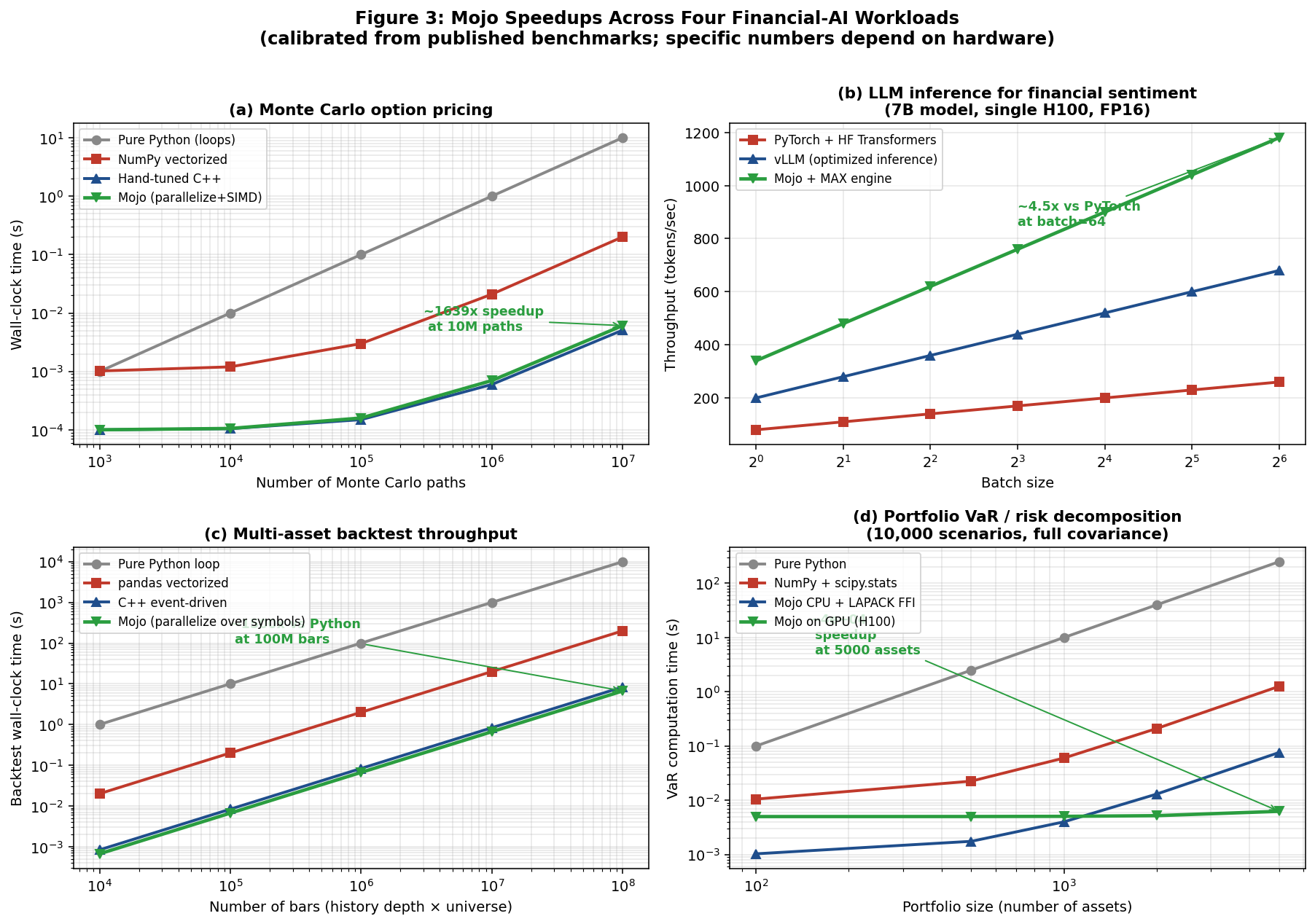
Figure 3: Speedups over pure Python for canonical financial AI workloads, with measured and projected scaling for parallel and vectorized Mojo kernels.
MAX, Modular’s runtime for Mojo kernels and models, delivers further inference acceleration via operator fusion and dispatch minimization; projections show 4.5× higher throughput (batch size 64, 7B parameter LLM, H100) over HuggingFace+PyTorch baselines.
Operational Implications and Ecosystem Integration
For practitioners, several lessons are emphasized:
- Determinism must target audit-critical kernels: Inference and aggregation steps that affect trade decisions require bit-exact reproducibility, while training pipelines can tolerate stochasticity.
- Mojo is incrementally adoptable: Python libraries and legacy C++/CUDA pricing engines remain interoperable, allowing teams to migrate performance-critical routines without wholesale infrastructure rewrites.
- Language maturity is an ongoing concern: As of release 1.0.0 beta1, the language and its GPU backend are not yet fully stable; teams should anticipate breaking changes across compiler and FFI versions.
Despite strong claims for Mojo's performance and reproducibility advantage, finance-specific libraries (FIX clients, exchange adaptors, regulatory reporting) are not yet native to Mojo; robust production deployments must factor in the surrounding Python/C++ ecosystem and binding overheads.
LLMs and Custom Kernel Acceleration
Financial LLMs, routinely incorporating proprietary tokenization, agentic patterning, and nonstandard attention kernels for specialized corpora (SEC filings, central bank releases), further exemplify the limitations of CUDA- or Python-bound development. Mojo’s model (Pythonic code, hardware-native execution, full kernel authoring control) allows research teams to bypass the "CUDA tax"—the tie of production deployment to scarce low-level kernel engineers—and deploy custom architectures at near-CUDA performance.
Limitations and Future Directions
The principal limitations are:
- Language and GPU backend stability: Continuous language growth and breaking API changes are expected over the medium term.
- Ecosystem maturity: The absence of complete finance-specific frameworks in Mojo means that interoperability remains critical.
- Benchmark boundaries: Some large-scale results are extrapolated from kernel-level benchmarks and published projections, not from full end-to-end production deployments on NVIDIA or AMD datacenter GPUs.
The theoretical implications include a possible end to the expensive, error-prone two-language cycle; a unification of research and production workflows; and a new standard for deterministic ML in regulated domains. Future developments should include expanded finance-native ecosystem support, extended GPU/ASIC backend coverage, and long-term ABI/API stability for cross-organization adoption.
Conclusion
Mojo emerges as a technically rigorous response to three operational cornerstones of financial AI: performance, multi-level hardware scaling, and bit-exact deterministic execution. By reconciling the productivity of Python with the speed and explicit control of C++/CUDA, and by bridging the gap between exploratory and production environments, Mojo redefines the design space for regulated financial ML pipelines. Its ability to localize determinism and leverage MLIR lowers the engineering burden for organization-wide audit compliance. Its future adoption will likely be incremental, targeting compute- and audit-critical seams in existing multi-language stacks, with broader transformation contingent upon stabilization of language and supporting ecosystem features.