Certified Finite-Shot Operating Windows for Virtual Distillation and Symmetry Verification
Published 13 Jun 2026 in quant-ph | (2606.15464v1)
Abstract: Quantum error mitigation methods are usually compared through their infinite-shot bias, but on real devices the comparison is decided by finite sampling budgets, estimator instabilities, and per-shot resource costs. We develop a finite-shot operating-window theory that makes this comparison certifiable for virtual distillation (VD) and symmetry verification (SV): for each method we derive a mean-squared-error law with explicit, non-asymptotic remainder constants. For VD, the law captures the statistical bias and denominator instability of its quotient estimator, with a concentration certificate locating the sample size beyond which the quotient is trustworthy; for SV, it isolates the bias floor left by undetectable errors and the sampling penalty set by the acceptance probability. A selection trichotomy classifies any two-method comparison into a tie, uniform dominance, or a genuine tradeoff with a certified crossing window, including a self-consistency test that rejects spurious crossings. The theory makes falsifiable predictions -- operating-window locations scaling as $p{-2}$ or $p{-1}$ in the noise rate, and the sign pattern of all pairwise comparisons -- which exact white-box experiments confirm with fitted exponent $-1.97$ against the predicted $-2$ and with $300/300$ sign agreement, within a pre-registered analysis whose single failed gate, an over-strict all-instance criterion, is reported and audited in full. Gate-level simulation and archived runs on two IBM backends then test the windows under device conditions: idealized VD windows exist, but realistic interferometry overhead and denominator instability erase them, and calibrated SV is the practical winner in the tested QAOA instances. This absence of a universal winner is not a failure of mitigation; it is the regime structure that certified operating windows predict.
The paper derives non-asymptotic MSE laws for VD and SV, accounting for bias, variance, and explicit remainder terms.
It certifies operating windows through an analytically derived regime trichotomy that guides resource-constrained method selection.
Hardware and simulation studies validate the framework, revealing VD's sensitivity to denominator instability and SV's robust performance.
Certified Finite-Shot Operating Windows for Virtual Distillation and Symmetry Verification
Overview
This paper establishes an analytically rigorous finite-sample assessment framework for quantum error mitigation (QEM), specifically comparing Virtual Distillation (VD) and Symmetry Verification (SV) under explicit, non-asymptotic Mean Squared Error (MSE) laws. The framework certifies operating windows for each method via explicit bias floors, statistical sampling costs, implementation-dependent variance inflation, and denominator-concentration phenomena in the quotient estimator. The comparison translates into an operating-window trichotomy: unique certified crossing (tradeoff regime), uniform dominance, or local ties—with an explicit self-consistency criterion that can reject spurious crossings. The theory's predictions are verified in closed-form, white-box circuit simulations, realistic device-level Qiskit/Aer simulation studies, and on archived IBM Q hardware.
Finite-Shot MSE Laws and Certificates
The central contribution is the derivation of non-asymptotic MSE laws for both VD and SV, integrating leading-order bias, sampling variance, cross-terms, and certified higher-order remainders. For VD, the law captures:
Population bias (dominant eigenvector misalignment)
Statistical variance
Quotient-induced statistical bias
Instability from small random denominators
The quotient structure necessitates concentration diagnostics, as small denominators can cause estimator blowup. To this end, a Bernstein concentration certificate is derived, which guarantees tail suppression and the minimal sample-size regime in which the quotient expansion is valid. The main finite-shot law reads:
where bm(p) is the mitigation method's bias, cm(p) is the cross-bias coefficient due to the quotient structure, vm(p) is the leading variance coefficient, and ρm(p,B)≤Cm(p)/B2+Cm′exp(−γmB) is a fully explicit remainder.
For SV, explicit formulas for the residual bias (due to undetectable symmetry-preserving errors) and postselection-induced sampling penalty are given. Remarkably, for Bernoulli postselection, the cross-term cSV vanishes identically.
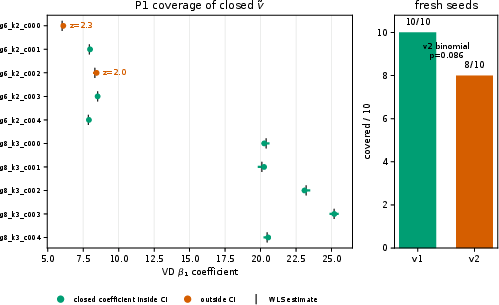
Figure 1: Level 1 coverage audit for the P1 leading VD MSE coefficient demonstrates the agreement of fitted empirical and closed-form v coefficients.
Certified Operating Windows and Comparison Trichotomy
With the certified MSE laws, method selection is formulated as a "lower-envelope" problem: for given physical resource budget R, method m has Bm=R/κm(p) effective samples given method-specific resource normalization bm(p)0. For two methods bm(p)1, the difference in MSE curves permits only three structural regimes at fixed bm(p)2:
Degenerate tie (identical leading behavior)
Uniform dominance (one method dominates throughout the resource range)
Unique certified crossing (tradeoff: one method wins at low resources, and the other at high resources—crossing location is explicitly certified)
The regime structure is governed by bias gap bm(p)3, sampling advantage bm(p)4, and the explicit bounds bm(p)5 in the certified law. A unique crossing at resource scale bm(p)6 is certified if the correction bm(p)7 and bm(p)8 lies within the denominator-concentration regime.
For typical noise models, the operating-window (i.e., crossing) scales as bm(p)9 (if sampling coefficients differ at cm(p)0 order) or as cm(p)1 (if only cm(p)2 differences matter). White-box and device-level simulations confirm these theoretical scalings.
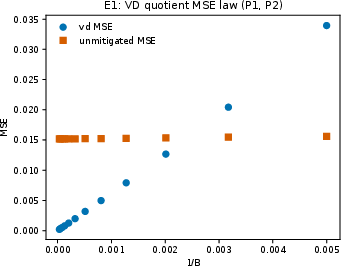
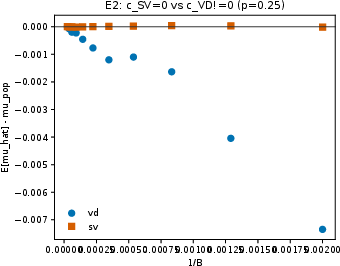
Figure 2: Level 1 quotient-law and cm(p)3-coefficient diagnostics highlighting the VD quotient curvature and differentiating nonzero cm(p)4 vs. vanishing cm(p)5.
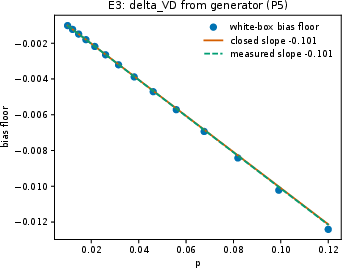
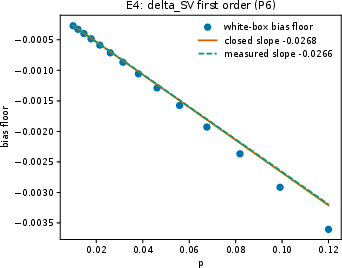
Figure 3: First-order bias-floor checks for VD and SV; measured generator slopes closely match theory.
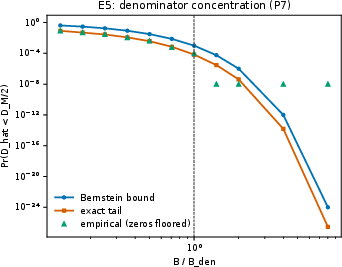
Figure 4: Denominator-concentration diagnostic; the bad-denominator probability collapses at the predicted threshold scale.
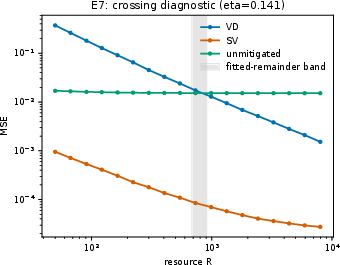
Figure 5: Level 1 crossing diagnostic showing the operational crossing band around the predicted window scale.
Implementation Effects and Device Considerations
The practical application of certified operating windows is sensitive to both the implementation overhead (circuit depth, ancilla requirements, Hadamard test scaffolding, etc.) and population-level noise. The framework defines the resource-normalized sample cost cm(p)6 explicitly including all physical gate, classical, and calibration overheads.
VD's denominator-concentration penalty grows with copy number cm(p)7; thus, copy number is not a free performance knob but must be locally optimized against denominator concentration and bias reduction. Implementation analysis includes Hadamard/derangement test details, demonstrating that physical device overheads (e.g., realistic interferometric circuits) frequently displace the ideal VD window outside the operational resource range in hardware.
In contrast, SV's acceptance probability cm(p)8 sets both the postselection penalty and variance rescaling. The residual bias is strictly determined by the projected first-order channel action, and for specific noise models (e.g., depolarizing) SV achieves zero first-order bias in given symmetry sectors.
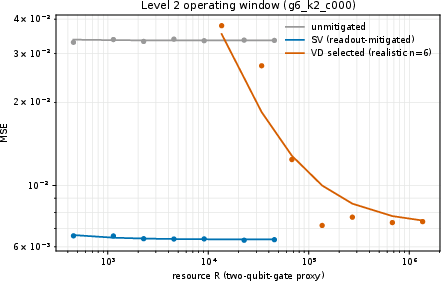
Figure 6: Representative Level 2 operating-window curve for a realistic device simulation, highlighting SV's operational dominance under two-qubit-gate resource normalization.
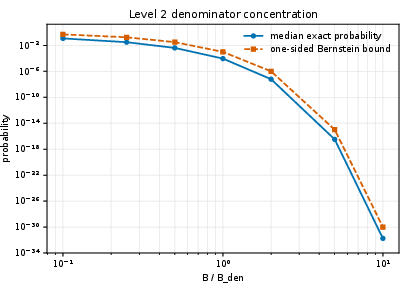
Figure 7: Device-simulation level denominator concentration. The empirical bad-denominator probability closely follows the certified one-sided Bernstein bound.
Validation Across Abstraction Layers
The results are tested at three independent validation layers:
Level 1 (White-box): Exact density-matrix simulations of QAOA circuits validate the finite-shot certified laws and confirm predicted scaling exponents (cm(p)9 observed versus vm(p)0 predicted for vm(p)1 window scaling), vm(p)2 sign agreement in regime classification, and denominator-concentration mechanisms.
Level 2 (Device simulation): Qiskit/Aer with realistic thermal/readout noise and compiled circuit overhead recovers the population-bias plus variance structure, denominator-threshold transitions, and practical erasure of optimistic VD windows due to real device overheads.
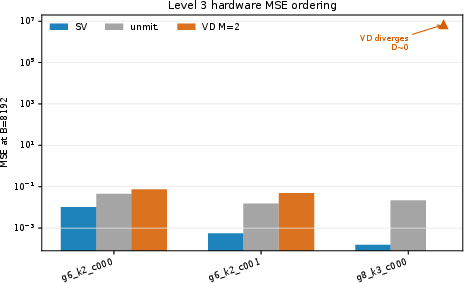
Level 3 (Hardware): Archived IBM Q experiments demonstrate that realistic VD circuits (especially large vm(p)3 or vm(p)4) can be dominated by denominator blowup and circuit depth, with SV maintaining stable performance under calibrated postselection and readout correction. No operational VD-over-SV crossing is observed in tested resource regimes.
Figure 8: Level 3 hardware MSE at vm(p)5; VD fails due to denominator blow-up at vm(p)6, whereas SV remains operationally robust.
Theory-Limited Lower Bounds and Practicality
The framework includes a two-point Le Cam testing lower bound for fixed transcript models, yielding explicit, non-asymptotic MSE floors. When transcript distributions for distinct ideal values are physically indistinguishable at budget vm(p)7, no mitigation can succeed below the corresponding risk. This benchmarks not only method performance but also the information-theoretic barriers imposed by the device and noise model.
Operationally, all finite-shot, remainder-corrected certificates and their constants are fully reproducible via openly released code, artifacts, and archived hardware data.
Conclusion
This work establishes a mathematically rigorous, implementation- and resource-normalized approach for finite-shot QEM method selection, going beyond infinite-shot or purely asymptotic bias analyses. Certified operating windows reveal that no universal mitigation method dominates for all devices, circuits, or noise rates. VD and SV exhibit pragmatic, regime-dependent tradeoffs dictated by bias, sampling variance, quotient instability, and implementation cost. The finite-shot framework and certified self-consistency guarantee that observed crossovers are robust, falsifiable, and reflect real hardware and noise-induced constraints.
Future advances may tighten the non-asymptotic constants, further optimize denominator-regularization or circuit compilation, and integrate additional techniques (e.g., Clifford Data Regression) with comparable certified MSE analysis. The methodology provides a foundation for physically meaningful, reproducible, and analytically justified QEM benchmarking in the NISQ regime.
“Emergent Mind helps me see which AI papers have caught fire online.”
Philip
Creator, AI Explained on YouTube
Sign up for free to explore the frontiers of research
Discover trending papers, chat with arXiv, and track the latest research shaping the future of science and technology.Discover trending papers, chat with arXiv, and more.