Error-Mitigated Hamiltonian Simulation: Complexity Analysis and Optimization for Near-Term and Early-Fault-Tolerant Quantum Computers
Published 12 Mar 2026 in quant-ph | (2603.11527v1)
Abstract: Simulating real-time dynamics under a Hamiltonian is a central goal of quantum information science. While numerous Hamiltonian-simulation quantum algorithms have been proposed, the effects of physical noise have rarely been incorporated into performance analysis, despite the non-negligible noise levels in quantum devices. In this work, we analyze noisy Hamiltonian simulation with quantum error mitigation for Trotterized and randomized LCU-based Hamiltonian simulation algorithms. We give an end-to-end comprehensive complexity analysis of error-mitigated Hamiltonian simulation algorithms using the mean-squared error. Because quantum error mitigation incurs an exponential cost with the number of layers in quantum algorithms, there is a trade-off between the sampling cost and the bias in simulation accuracy or the algorithmic sampling overhead. Optimizing this trade-off, we derive an analytic depth-selection rule and characterize the optimal end-to-end scaling as a function of target accuracy and noise parameters. We further quantify the noise-characterization cost required for error mitigation via gate set tomography and the recently proposed space-time noise inversion method, showing that the latter can significantly reduce the characterization overhead.
The paper presents a detailed complexity analysis comparing product formula and randomized LCU methods under physical noise and error mitigation.
It demonstrates that probabilistic error cancellation and space-time noise inversion can optimize sampling overhead and circuit depth in noisy simulations.
The work establishes critical error thresholds that guide resource allocation for Hamiltonian simulation on NISQ and early-fault-tolerant quantum devices.
Error-Mitigigated Hamiltonian Simulation: Complexity, Optimization, and Characterization on Near-Term and Early-Fault-Tolerant Quantum Computers
Introduction
Hamiltonian simulation is a foundational application for quantum computation, supporting tasks such as electronic structure calculation, quantum phase estimation, and quantum linear system solving. While the algorithmic complexity of various quantum simulation protocols has been studied extensively, finite device noise remains a significant challenge, especially for near-term hardware and in the early stages of fault tolerance. This paper presents a comprehensive complexity analysis of Hamiltonian simulation algorithms under both physical noise and quantum error mitigation (QEM), with a focus on optimized error-mitigated protocols suitable for noisy intermediate-scale quantum (NISQ) computers and early-fault-tolerant quantum machines (2603.11527).
Hamiltonian Simulation Algorithms and Error Metrics
The paper focuses on two leading algorithmic paradigms:
Product Formula (Trotter–Suzuki) Methods: This expands the time-evolution operator e−iHt via sequential exponentiation of Pauli terms, yielding a channel whose bias is upper bounded using commutator norms and diamond distance. First-order and higher-order Suzuki-Trotter decompositions are considered, with explicit scaling of algorithmic bias in terms of layer number d, system size, and time.
Randomized Linear Combination of Unitaries (RLCU) Algorithms: Adopting a Taylor expansion-based LCU construction, the RLCU protocol samples Pauli products and applies stochastic circuit construction, enabling unbiased estimation of evolved observables. This approach allows for explicit characterization of sampling overhead and gate-depth distributions, which are essential for resource estimation under noisy conditions.
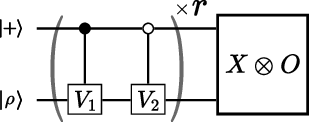
A diagrammatic representation of the RLCU quantum circuit (Figure 1) is introduced early to clarify the stochastic circuit structure and measurement protocol.
Figure 1: Quantum circuit for implementing the linear map (Sr)r=(∑μαμUμ)r and measuring an observable O against an input state ρ, using the RLCU algorithm with random sampling according to LCU coefficients.
Both paradigms use the mean-squared error (MSE) as the unified measure of estimation quality, incorporating both sampling variance and systematic bias—thus enabling a rigorous end-to-end resource analysis.
Impact of Device Noise and Critical Error Thresholds
The core technical results rigorously bound simulation error under physical noise and optimize circuit depth accordingly. The central insight is the nontrivial trade-off: for fixed device error rate γ and target accuracy ϵ, increasing simulation depth (number of Trotter steps or LCU repetitions) improves algorithmic accuracy but eventually accumulates noise, setting a lower bound on achievable accuracy without error mitigation.
For product-formula methods, this leads to the definition of a critical error ϵc—below which further accuracy incurs exponentially increasing sampling cost. Explicitly, for a k-th order Trotter formula,
For ϵ>ϵc, the sampling cost M(ϵ) grows polynomially in 1/ϵ.
For ϵ<ϵc, M(ϵ) increases exponentially in 1/ϵ.
In contrast, the RLCU method—by virtue of its unbiased estimator—avoids algorithmic bias, and its cost is dominated by sampling overhead, which can be further optimized by tuning the repetition parameter r. Optimization yields a square-root improvement in the scaling exponent of resource overhead, with M(ϵ)∼exp(O(γt)), compared to the quadratic dependence from non-optimized choices.
To combat irreducible noise floors, the paper applies Probabilistic Error Cancellation (PEC)—a QEM protocol that “inverts” known noise at the cost of exponentially increasing sampling overhead. The improved error scaling with PEC raises the achievable critical error ϵc for Trotter simulations from O(γk/(k+1)) (without mitigation) to O(γk) (with mitigation of order-k formulas), a qualitative exponent improvement.
For randomized LCU, the absence of algorithmic bias eliminates the critical-error barrier—sampling cost again grows only polynomially in 1/ϵ, with exponential dependence only on the system-time-noise volume. The paper provides precise resource-counting formulas, including the cases with optimized parallel repetition.
Overhead of Noise Characterization and Space-Time Noise Inversion
Implementing PEC hinges on precisely characterizing the logical noise model. For conventional per-gate gate set tomography (GST), the characterization overhead becomes significant as device fidelity improves, with a resource cost scaling as O(1/γ) in the low-noise regime. This analysis is completed by deriving explicit bounds for both product-formula and RLCU approaches, in terms of required tomography samples per target observable accuracy.
To address this bottleneck, the paper evaluates the Space-Time Noise Inversion (SNI) approach, which requires only measurement and mitigation of the total error probability of the full circuit, rather than all constituent gates. SNI is shown to dramatically reduce characterization cost: even as γ→0, characterization cost remains bounded—unlike with GST. Segmentation of the circuit further ensures SNI remains effective despite high total circuit error rates. The resource analysis confirms that characterization cost under SNI is always equal to or less than the cost of running the computation itself.
Implications, Broader Applications, and Future Work
Practically, these results map out the optimal regime and performance limits for error-mitigated Hamiltonian simulation on near-term and early-fault-tolerant quantum hardware, clarifying both the opportunities and bottlenecks. The end-to-end analysis—including algorithmic, noise, sampling, and characterization costs—provides a quantitative foundation for experimental design and scaling law extrapolation.
Theoretically, the framework developed is extensible to a broad class of quantum algorithms where algorithmic error and device noise coexist, and QEM protocols must be optimally applied. The analysis invites extension to recent advances such as TE-PAI and probabilistic-angle-interpolated simulation, to alternative QEM techniques (e.g., virtual distillation, zero-noise extrapolation, subspace expansion), and to hybrid quantum-classical resource allocation strategies.
The resource-tradeoff analysis presented here should inform both the design of quantum simulation algorithms under realistic noise and QEM constraints and the global optimization of quantum-classical computation stacks in the face of restricted quantum resources.
Conclusion
This work offers a unified, quantitative framework for understanding and optimizing error-mitigated Hamiltonian simulation under realistic physical noise constraints and finite quantum resources. Key findings include the identification of algorithm-dependent critical error thresholds, the demonstration of sample overhead scaling with and without QEM, and the resource advantage of global noise characterization via SNI over conventional GST. The results provide critical guidance for both theorists and experimentalists in navigating the complexity landscape of near-term and early-fault-tolerant quantum simulation, as well as suggesting promising avenues for future methodological improvements and broader algorithmic applications.