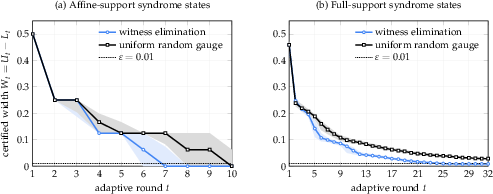
- The paper introduces an adaptive witness elimination protocol that selects informative stabilizer generators to iteratively tighten fidelity intervals.
- The paper derives both certified lower and novel upper fidelity bounds, addressing gauge-dependence issues in traditional certification methods.
- The paper validates the approach with numerical simulations, demonstrating rapid interval contraction and robustness against shot noise.
Adaptive Stabilizer State Fidelity Certification: An Expert Analysis
Introduction
The work "Adaptive Stabilizer State Fidelity Certification" (2605.29820) presents a detailed, rigorous framework for certifying stabilizer state preparation fidelities via adaptive gauge design. Unlike static certificate methods which rely on a fixed measurement basis, this work formalizes, analyzes, and numerically validates an approach that adaptively tightens certified fidelity intervals by selecting successively informative stabilizer-generator gauges. The context is quantum information experiments, specifically those requiring scalable and adversarially robust certification of high-fidelity stabilizer resource states, such as surface codes, cluster states, and logical qubits.
Background: Stabilizer States and the Gauge Dependence Problem
Stabilizer states are defined as common +1 eigenspaces of independent, commuting Pauli operators. Their structure underpins various QEC and MBQC protocols. In practice, certifying the fidelity of a prepared state ρ to a target stabilizer state ψ is essential for validating experimental advances. The conventional paradigm, typified by the Kalev-Kyrillidis-Linke (KKL) protocol, fixes a gauge by selecting n independent generators, measures their expectations, and reports a worst-case lower bound on F(ρ,ψ)=Tr(ρΠ0), expressible as a minimal value over all syndrome distributions consistent with observed data.
However, the lower bound provided by KKL is gauge-dependent—different generator gauges can yield drastically different certificates for the same ρ, and a fixed gauge can leave substantial ambiguity in fidelity estimates, as it only constrains certain Walsh characters of the syndrome distribution. The authors formalize this limitation and provide explicit counterexamples to show that significant residual ambiguity may persist (Section 3).
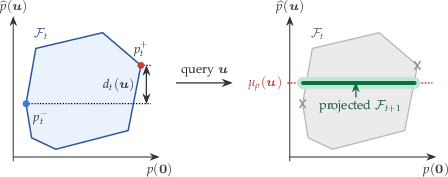
Figure 1: Geometric illustration of the witness elimination principle; constraining the feasible polytope via informative Walsh character queries.
Certified Upper Bound: Completing the Fidelity Interval
A significant technical advance is the derivation of the certified worst-case upper bound complementary to the KKL lower bound. The optimal upper endpoint, for a fixed gauge A with generator expectations μρ(ai), is
Fmax=21+21iminμρ(ai)
as proved analytically in Proposition 4. This upper endpoint, not previously emphasized, closes the logical gap in single-gauge certification and allows experimentalists to report a full fidelity interval from one round of generator measurements.
To systematically reduce the certified interval, the authors introduce an adaptive protocol (Algorithm 1) which selects generator gauges in each round to maximize the expected contraction of the fidelity interval. The key heuristic is the "witness elimination" principle: candidate gauges are scored by their ability to maximally separate the current lower/upper endpoint witnesses on their respective Walsh character projections.
The protocol operates on the feasible syndrome polytope Ft defined by all accumulated generator expectation constraints and at each stage selects the next gauge by solving a maximum-weight basis problem over ρ0 vector matroids. This efficiently targets remaining sources of endpoint ambiguity without redundant queries.
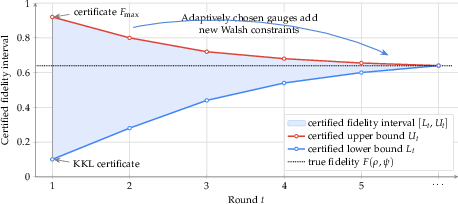
Figure 2: Adaptive certified fidelity intervals concentrate as each measurement round tightens the feasible syndrome polytope.
Formally, for each candidate label ρ1, the disagreement score ρ2 quantifies its informativeness. The next gauge is chosen to greedily maximize the sum of such scores over linearly independent unqueried stabilizer directions.
Theoretical Analysis: Guarantees and Tightness
The analysis establishes several critical properties:
- Monotonicity: The certified interval width ρ3 shrinks monotonically and never increases with additional measurements.
- Completeness: If all ρ4 nontrivial stabilizer expectations are measured, the syndrome distribution is uniquely determined and the interval collapses to the true fidelity.
- Worst-Case Behavior: For arbitrary (possibly adversarial) states, the exponential stabilizer coverage is necessary for perfect identification; i.e., there can be no universal shortcut in the worst case.
- Coverage Rates: For practical states, the interval contracts much faster. For example, for affine-support syndrome distributions (uniform on affine subspaces of syndrome space), far fewer measurements are required for exact identification, as shown in Proposition 12.
Additionally, randomized or mixed-adaptive policies can be used to guarantee convergence for generic states, at an exponential-in-ρ5 rate, though adaptivity significantly accelerates convergence for physically structured states.
Numerical Simulations
The authors support their theory with numerical simulations on ρ6-qubit GHZ target states. They demonstrate that:
They also examine the effect of finite measurement statistics by simulating shot noise in expectation estimation and including robust confidence intervals in the feasible set. Unsurprisingly, interval contraction is limited by the statistical error floor, but the protocol maintains certified coverage of the true fidelity with high probability.
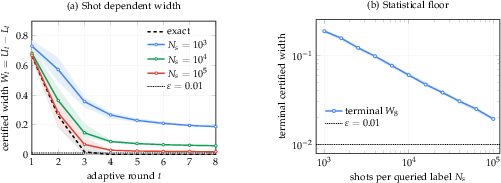
Figure 4: Effect of finite-shot noise—finite sample constraints determine the achievable contraction, with interval width floors decreasing with increased sampling budget.
Comparison with Other Methods
The framework is situated relative to DFE (Direct Fidelity Estimation), PAC-learning of stabilizer states, and adaptive tomography:
- DFE is mean-value estimation over the full group, rather than adversarial certification from minimal (generator-only) data; the exponential information bottleneck is not present for mean estimation.
- Adaptive tomography reconstructs the full state, but at much higher measurement cost.
- This method provides adversarial (worst-case) certificates from minimal, implementable data and can be efficiently tailored to the experiment's structure.
Implications and Future Directions
This work expands the certification toolkit for stabilizer quantum information protocols, providing the first fully adaptive and interval-valued fidelity certification method based on generator expectation data. The framework is particularly salient for experimental settings targeting practical validation of error-corrected states, resource entanglement, and mid-circuit operations, as well as for deployments where measurement resources are highly constrained and adversarial overfitting must be avoided.
Further research directions include:
- Scalable relaxations of the endpoint search (such as LP relaxations, cutting-plane, or tensor network surrogates) to push the approach beyond small ρ7;
- Integration of more advanced statistical analysis for finite-sample effects and adaptivity-driven experiment design;
- Extension to stabilizer codes with geometric or local structure, possibly exploiting further symmetries to reduce the exponential dependence.
Conclusion
The adaptive stabilizer state fidelity certification protocol presented in (2605.29820) supplements the conventional KKL fixed-gauge method by introducing a mathematically principled, computationally tractable, and numerically validated pathway to strong adversarial certification with explicit, data-driven upper and lower bounds. The work elucidates both the statistical and combinatorial structure of the certification problem and delivers practical recommendations for experimental stabilizer state validation.