- The paper introduces a scalable BEQS framework that jointly learns Hamiltonian and Lindbladian operators to quantify dynamic observables with bounded error.
- The paper employs rigorous statistical regression and analytic error propagation techniques to derive high-confidence uncertainty intervals directly from experimental data.
- The paper demonstrates the protocol on trapped-ion quantum simulators with up to 51 ions, validating its effectiveness even in classically intractable regimes.
Bounded-Error Quantum Simulation via Hamiltonian and Lindbladian Learning
Introduction and Motivation
Quantum simulation, particularly with analog quantum simulators, has advanced as a primary route to explore nontrivial many-body quantum dynamics exceeding the reach of classical computational approaches. However, a significant technical limitation of contemporary quantum simulators is the absence of rigorous and operationally meaningful uncertainty quantification for computed observables. Without tight quantitative error bars, the reliability and scientific utility of quantum simulation remains limited, especially in regimes approaching quantum advantage, where verification by classical means is infeasible.
The work "Bounded-Error Quantum Simulation via Hamiltonian and Lindbladian Learning" (2511.23392) introduces a comprehensive and scalable framework—Bounded-Error Quantum Simulation (BEQS)—for quantitative quantum simulation, in which both the coherent and dissipative generators of dynamics are experimentally inferred together with precise, statistically validated uncertainty intervals. The methodology combines recent advances in Hamiltonian learning and Lindbladian estimation, propagating uncertainties rigorously to the simulated observables, and providing confidence bounds that are derived directly from experimental data. The protocol is experimentally demonstrated on large-scale trapped-ion quantum simulators implementing long-range spin models with up to 51 ions.
Protocol Overview and Theoretical Framework
The BEQS protocol consists of two primary stages:
- Statistically Rigorous Learning of System Dynamics: Employing Hamiltonian and Lindbladian learning, the protocol infers the operator structure and numerical parameters of the effective many-body generators. The inference is based on experimentally measured time-resolved traces of few-body observables, with uncertainty modeled as a posterior distribution over parameters.
- Construction and Propagation of Error Bounds: Given learned generators and their error distribution, error propagation techniques—both numerical (sampling-based) and analytic—are employed to quantify the uncertainty intervals of measured observables (Figure 1).
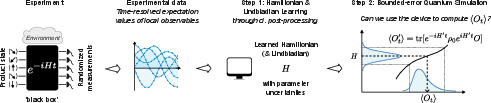
Figure 1: Schematic overview of the BEQS protocol integrating experimental measurement, learning of system dynamics, and error quantification.
The approach is agnostic to physical implementation, requiring only standard capabilities of programmable simulators: state initialization and measurement in arbitrary product bases. No full quantum process tomography or error-robust multi-qubit gates are required.
Hamiltonian and Lindbladian Learning
The first step is an efficient, operator-structure-aware learning process. The effective generator is assumed to be efficiently parametrizable within a physical ansatz (e.g., for spin models, a sum of few-body Pauli operators). Learning proceeds via statistical regression from time-dependent correlator measurements, performed either via randomized measurement or overlapping tomography protocols. The result is a posterior distribution—typically well approximated by a Gaussian—over all Hamiltonian and Lindbladian parameters reflecting both finite shot noise and systematic effects (Figure 2).
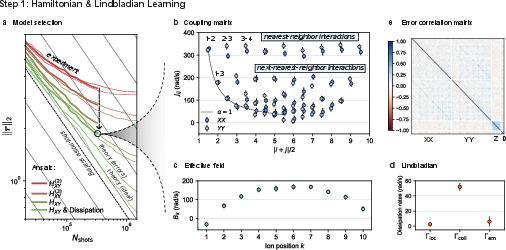
Figure 2: Experimental learning of Hamiltonian and Lindbladian parameters for a 10-ion system, showing uncertainties and comparison with theoretical models.
A central strength of the protocol is direct and operationally transparent model selection: the decay of the residual norm with measurement shots detects inadequacies in the chosen operator ansatz or unmodeled open-system effects. The framework extends to learning correlated Lindbladian noise models, going beyond simple local decoherence processes.
Quantitative Error Bounding in Quantum Simulation
Given an ensemble of possible learned Hamiltonians and Lindbladians representing experimental uncertainties, characterized statistically via their covariance matrix, the propagation of this ensemble through unitary and dissipative time evolution yields a distribution over predicted observable values. The error for a given observable is split into two contributions:
- Expected Error (Bias): Systematic deviation of the prediction obtained from the mean learned parameters versus the true ensemble mean.
- Deviation Bounds (Concentration): The range in which observable values fall with specified probability, quantifiable via concentration inequalities such as the Hanson-Wright bound and in some regimes (short times) by explicit second-order expansions.
The key outputs are efficiently computable high-confidence intervals for observables of interest, both via classical sampling and purely analytic (system-size-independent in local models due to Lieb-Robinson bounds) expressions, enabling practical application in the quantum advantage regime (Figure 3).
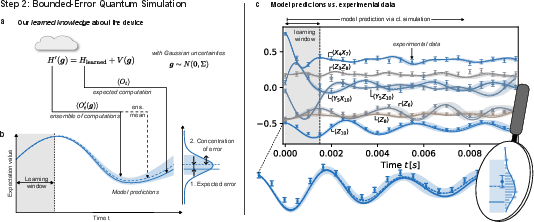
Figure 3: Characterization and propagation of error bounds for experimentally learned ensemble dynamics, with analytic and sampling-based approaches.
Experimental Demonstration
The protocol is instantiated on a modern trapped-ion platform, with two main experimental regimes:
- Tractable Benchmark Regime (N=10 ions): Complete learning and uncertainty propagation are cross-validated with classical simulation. Observed decay of the residual norm is consistent with shot noise-limited learning. Notably, the physical interaction profile was found to decay exponentially, rather than with the anticipated power law, and the presence of global dephasing is rigorously identified and quantified (Figures 4–6).
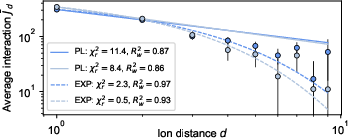
Figure 4: Decay profile of long-range interactions, showing exponential rather than power-law behavior in the experimental regime.
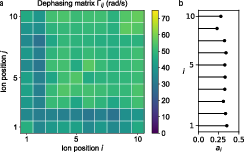
Figure 5: Structure of the inferred Lindbladian dephasing matrix and dominant decoherence eigenmode.
- Scalability Regime (N=51 ions): The learning protocol and uncertainty quantification are extended well into classically intractable settings. Despite statistical challenges, regularization and model selection yield physically plausible interaction matrices and noise processes, with the uncertainty intervals cross-validated against independent experimental runs (Figures 7–8).
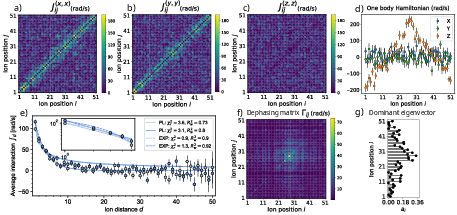
Figure 6: Dominant interaction terms inferred for a 51-ion quantum simulator, with uncertainties and long-range decay structure.
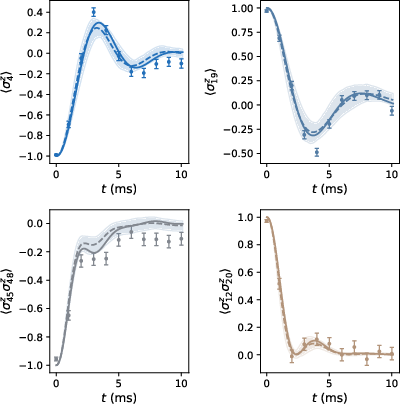
Figure 7: BEQS prediction intervals for time-evolved observables in a 51-ion experiment, showing direct consistency between experimental data and model-based certified error bounds.
In all regimes, observable time traces consistently lie within the BEQS-predicted uncertainty intervals, validating both the learning framework and error propagation methodologies.
Practical and Theoretical Implications
This work provides a general, scalability-oriented solution to the core challenge of quantitative quantum simulation under experimental uncertainties. Key immediate implications and features include:
- Built-in, experimentally certified error bounds on computed observables which persist even in the quantum advantage regime inaccessible to classical simulation.
- Applicability far beyond the platforms or models demonstrated, with direct extensibility to digital quantum simulation (e.g., learning effective Floquet Hamiltonians and faulty circuit Lindbladians).
- Theoretically robust concentration inequalities for uncertainty propagation, which remain efficient and system-size independent for local Hamiltonians due to Lieb-Robinson physics.
- Systematic approach to integrated verification, validation, and calibration—BEQS naturally bridges existing validation protocols and foundational questions of quantum-device trustworthiness.
Outlook
Potential directions for further development involve:
- Incorporation of Heisenberg-limited learning protocols for tighter uncertainty bounds;
- Iterative closed-loop feedback on experimental control, optimizing simulator performance via online BEQS diagnostics;
- Extending to non-Markovian noise models and slow parameter drifts, as well as colored noise inference;
- Quantifying and bounding systematic calibration errors relative to target models.
These advances directly impact the ability of analog and digital quantum simulators to function as quantitative scientific computing devices and provide trusted results for condensed matter, chemistry, and quantum information settings.
Conclusion
The BEQS framework systematically closes a critical gap in quantum simulation by providing scalable, experimentally grounded, and statistically rigorous error quantification for observed dynamics and computed observables (2511.23392). The methodology integrates statistical learning of both coherent and dissipative processes and provides both numerical and analytic propagation of uncertainty. The protocol is experimentally validated across classical and quantum-advantage settings. These capabilities will be indispensable for future high-precision, large-scale quantum simulation, and for the ongoing development of quantum technologies as reliable scientific instruments.

