MVEB: Massive Video Embedding Benchmark
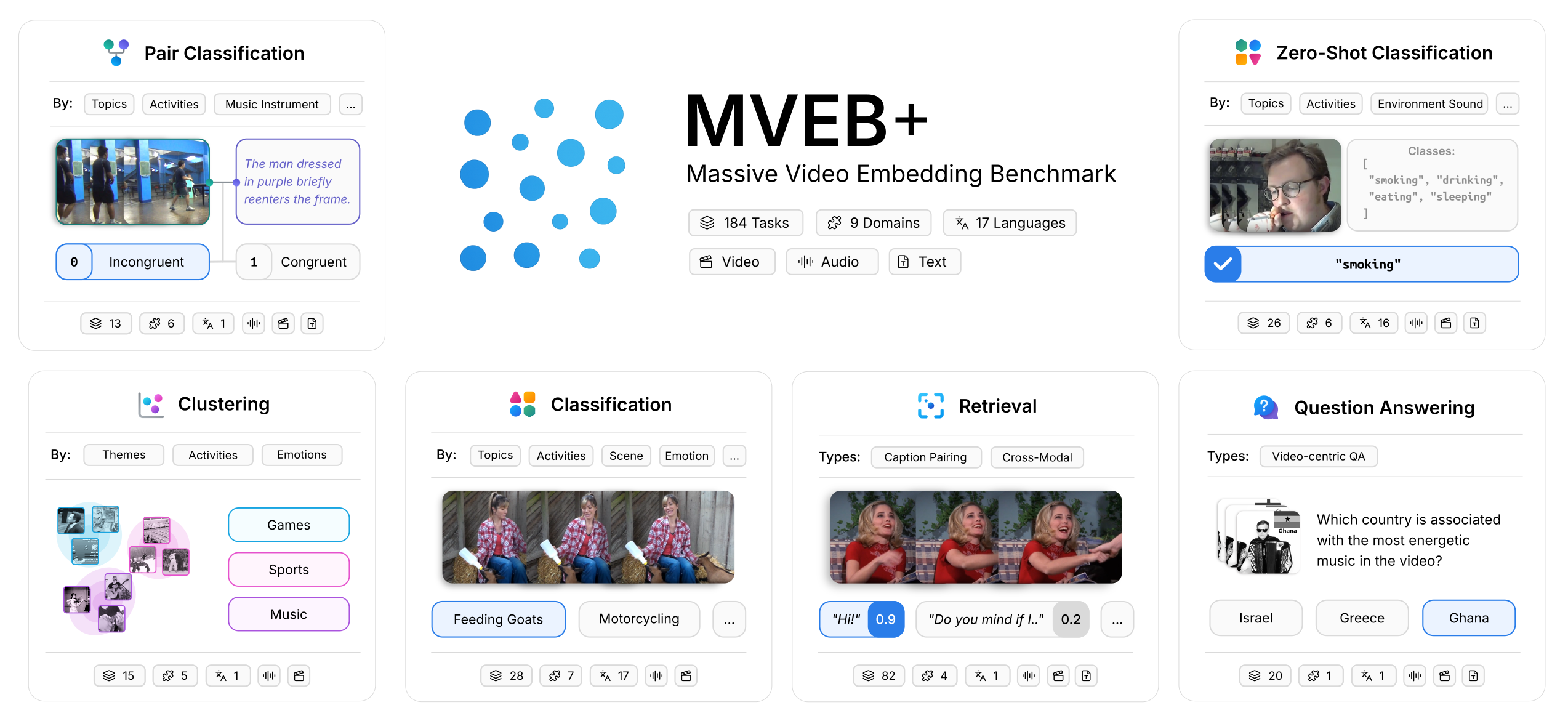
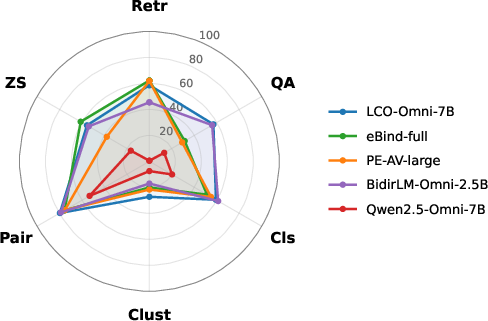
Abstract: We introduce the Massive Video Embedding Benchmark (MVEB), a 23-task benchmark for video embeddings spanning classification, zero-shot classification, clustering, pair classification, retrieval, and video-centric question answering. We evaluate 33 models and find that no single model dominates: MLLM-based embeddings lead on classification, clustering, pair classification, and QA; multimodal binding leads on retrieval and zero-shot classification; generative MLLMs without contrastive adaptation collapse on cross-modal tasks. Paired video-only vs. audio+video evaluations show that audio's contribution depends on dataset annotation provenance: audio helps when labels were produced from both modalities and hurts when they were produced from visuals alone, a six-point gap consistent across model families. MVEB is derived from MVEB+, a 184-task pool, and is designed to maintain task diversity while reducing evaluation cost. It integrates into the MTEB ecosystem for unified evaluation across text, image, audio, and video. We release MVEB and all 184 tasks along with code and a leaderboard at https://github.com/embeddings-benchmark/mteb.
Paper Prompts
Sign up for free to create and run prompts on this paper using GPT-5.
Top Community Prompts
Explain it Like I'm 14
What is this paper about?
This paper introduces MVEB, a big “report card” for how well AI systems understand videos. It tests many kinds of skills at once, like recognizing actions, finding matching clips, and answering questions about videos. The goal is to fairly compare different AI models and see which ones make the best all-around “video fingerprints” (embeddings) that work across lots of tasks.
What questions did the researchers ask?
In simple terms, they wanted to know:
- Can we build one fair, wide-ranging benchmark that tests video understanding, not just on one task but on many?
- Which kinds of models make the best general-purpose video embeddings?
- Does adding sound (audio) to the video help or hurt, and when?
- Can a smaller, well-trained model beat a bigger one if it’s trained the right way?
- Can we keep evaluation affordable while still getting reliable rankings?
How did they study it?
First, a few key ideas explained simply:
- Embedding: Think of an embedding as a short “fingerprint” made of numbers that captures the meaning of a video. If two videos are about the same thing, their fingerprints should be close. If they’re different, they should be far apart.
- Benchmark: Like a sports league with many events, a benchmark tests models on different tasks using the same rules so we can fairly compare them.
- Modalities: The types of information in a clip—video (pictures), audio (sound), and text (words).
- Zero-shot: Like taking a quiz on a new topic without practice questions. The model relies on what it learned before, without fine-tuning for that specific task.
- Contrastive training: Training that teaches the model to pull matching pairs (like a video and its correct caption) closer together and push non-matching pairs apart—like sorting socks into the right pairs.
They built MVEB in two layers:
- MVEB+: a huge pool of 184 tasks covering many topics and formats.
- MVEB: a carefully chosen set of 23 tasks that still represents the variety but runs about 7–10× faster, saving time and money while keeping rankings nearly the same as the full set.
They tested 33 different models from several families:
- Self-supervised video encoders (learn from video only).
- Contrastive video–text or audio–video encoders (learn by matching across modalities).
- Multimodal binding models (align many modalities into one shared space).
- MLLM-based embedding models (large multimodal LLMs adapted to produce strong embeddings).
- Generative MLLMs used as embedders without special adaptation (storyteller models repurposed to make fingerprints).
They also did something special with audio:
- For every dataset that has sound, they ran each task twice: once with video only, and once with video + audio. This let them directly measure how much the soundtrack helps or hurts.
What kinds of tasks are in MVEB?
Here are the six types of tasks, explained with plain examples:
- Classification: Train a simple classifier on top of the fingerprints to label a video (e.g., “soccer” vs. “basketball”).
- Zero-shot classification: Match the video’s fingerprint to label prompts (like “a video of swimming”) without training a classifier.
- Clustering: Group videos by similarity automatically—like sorting a pile of photos into meaningful stacks.
- Retrieval: Given a query (text, audio, or video), search a large set to find the best matches—like a library search.
- Pair classification: Decide if two videos are “the same” in some way (e.g., same activity).
- Video-centric question answering: Answer multiple-choice questions about a video (sometimes including its audio).
What did they find?
Here are the main takeaways:
- No single model is best at everything. Different model types shine on different tasks. Some are great at finding matches (retrieval), others at answering questions or grouping (clustering).
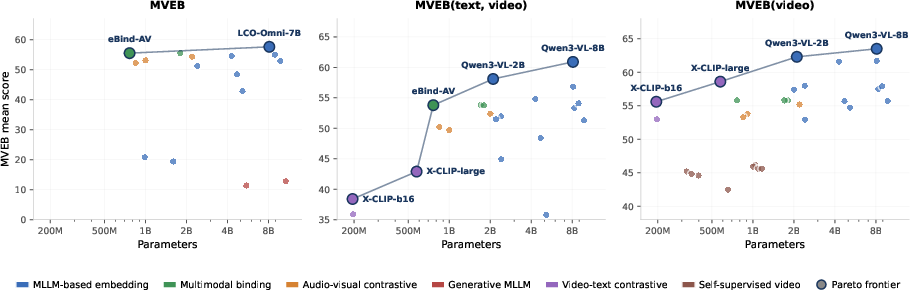
- MLLM-based embedding models (big multimodal models adapted for embeddings) do very well overall on many categories like classification, clustering, pair classification, and question answering.
- Multimodal binding models lead on retrieval and zero-shot classification, even though they are often much smaller than the biggest models.
- Generative models used “as-is” for embeddings perform poorly on cross-modal tasks (like text-to-video search). In other words, if a model was trained to write stories but not trained to make strong fingerprints, it struggles. A special contrastive embedding stage is almost required.
- Audio helps or hurts depending on how the dataset was labeled:
- If the original labels were based on both sound and visuals (AV-grounded), adding audio helps.
- If labels were based only on visuals (V-grounded), adding audio actually hurts.
- This difference is big—about 6 percentage points on average—and shows up across many tasks and model types.
- Smaller, well-aligned models can beat larger ones. Training with the right cross-modal data matters more than just making the model bigger.
- Evaluating without audio (“text + video” only) reshuffles the leaderboard. Some models that don’t even handle audio take the top spots there. So the “full” leaderboard and the “text+video” leaderboard reward different strengths.
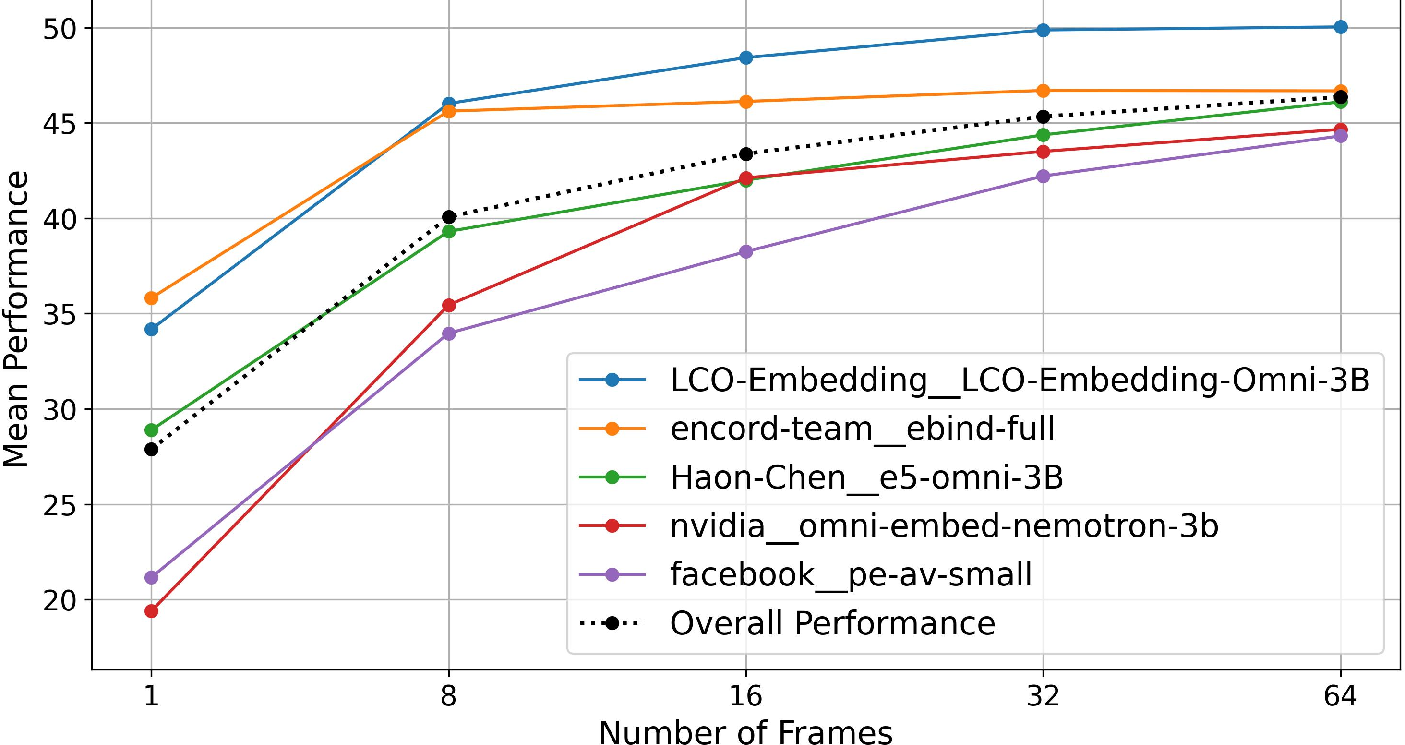
- More frames isn’t always better. Sampling a few frames instead of just one gives a big boost, but improvements get small beyond about 32 frames.
Why does this matter?
- Clear guidance for building better models: To do well on cross-modal tasks (like matching text to video), models need contrastive embedding training, not just generative training.
- Smarter use of audio: Don’t just add audio by default. If the task’s labels were made from visuals only, audio can distract the model and lower scores.
- Fairer, broader evaluation: One common, regularly updated benchmark helps researchers compare models on the same playing field across many skills, not just one.
- Cost-effective testing: The 23-task set keeps results trustworthy while being much faster than running all 184 tasks, making it practical for more teams.
- Community impact: MVEB plugs into the larger MTEB ecosystem (which already covers text, images, and audio) so the community can add tasks and models over time, keeping the benchmark fresh and useful.
In short, MVEB is like a multi-event championship for video understanding. It shows that balanced training, the right use of audio, and contrastive embedding matter more than sheer size, and it gives the field a shared, evolving scoreboard to aim for.
Knowledge Gaps
Knowledge gaps, limitations, and open questions
Below is a consolidated list of what remains missing, uncertain, or unexplored, expressed as concrete gaps to guide future work.
- Benchmark curation stability: MVEB’s 23-task subset is selected via rank-correlation pruning using the current model roster; it is unclear how stable this subset remains when substantially different model families (e.g., future omni or AV binders) are introduced. Needed: periodic re-pruning analyses with out-of-sample model sets and published deltas in rank/score stability across MVEB versions.
- Task weighting and statistical uncertainty: The benchmark uses equal task weights (Borda) and reports means without confidence intervals. Needed: task weighting sensitivity studies, bootstrap CIs per task/category, and significance tests for model deltas to avoid over-interpreting small differences.
- Instruction bias: Only instruction-tuned models receive task prompts, while others do not. Needed: controlled ablations (with/without standardized prompts across all models; prompt variants) to quantify instruction-induced advantages and prompt sensitivity.
- Zero-shot prompting design: Zero-shot classification relies on hand-crafted templates; no evaluation of template diversity, paraphrasing robustness, or multilingual prompts is provided. Needed: systematic prompt sets (multiple paraphrases, language variants), and reporting of prompt variance.
- Modality fusion comparability: For models lacking native joint encoders, the benchmark uses model-declared late fusion (mean/concat), which is not standardized and may confound cross-model comparisons. Needed: a “fairness mode” with benchmark-provided fusion baselines (mean/weighted mean/CCA) and per-model vs standardized-fusion comparisons.
- Compute and sampling parity: Models run with their own frame counts, fps, and audio truncation policies; absolute scores mix capability with budget. Needed: FLOPs-controlled evaluation tracks with standardized frame/audio budgets and matched preprocessing to isolate model quality from resource allocation.
- Audio duration and preprocessing effects: Audio truncation rates and sampling rates differ across models; only video frames were swept in test-time scaling. Needed: audio duration and sampling-rate sweeps, SNR robustness tests, and analyses of how audio budget interacts with video budget.
- Audio contribution causality: The AV- vs V-grounded finding is correlational and may conflate provenance with domain, SNR, or content type (speech/music/ambient). Needed: per-content-type breakdowns (speech vs music vs ambient), SNR-stratified analyses, language-stratified analyses, and controlled datasets where provenance is experimentally manipulated.
- Provenance labeling method: The process for classifying datasets as AV-grounded vs V-grounded is not fully specified or audited. Needed: a transparent rubric, inter-annotator agreement, and release of per-dataset evidence supporting the provenance labels.
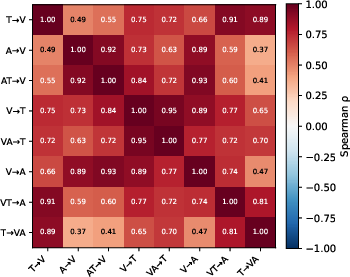
- Retrieval direction redundancy: Eight directions cluster into three capability groups, but the benchmark still scores all eight. Needed: a reduced, orthogonal direction set, or direction-specific weighting justified by measured independence, plus studies showing minimal score loss under reduction.
- Clustering evaluation design: Clustering scores are low and rely on MiniBatchKMeans with V-measure, which is sensitive to label noise and k. Needed: alternative unsupervised metrics (e.g., NMI, ARI), density-based methods, model selection for k, and datasets with cleaner labels to separate metric artifacts from model weaknesses.
- Limited long-form video: Long-duration video (lectures, documentaries, multi-minute activities) is largely absent due to runtime. Needed: scalable long-video tracks (chunked retrieval, hierarchical pooling, temporal grounding) and efficient evaluation protocols that retain temporal reasoning.
- Fine-grained and specialized domains: Coverage is thin in sports beyond a few datasets, scientific/medical video, sign language, and safety-relevant domains. Needed: curated, license-clear datasets in these areas with both V and AV variants.
- Multilingual and cross-lingual evaluation: Low-resource languages and cross-lingual text–video retrieval/QA are underrepresented. Needed: multilingual prompts/labels, cross-lingual retrieval tracks (e.g., non-English T→V, speech queries), and language-balanced datasets.
- Contamination auditing: Train–test overlap is assessed only from disclosed model data, leaving unknown contamination for non-disclosing models. Needed: content-based audits (near-duplicate search, hash-based checks, membership inference) and standardized contamination flags integrated into leaderboard scores.
- Category balance and task size: Equal-weight Borda treats small and large tasks uniformly; QA is a single task while retrieval spans multiple directions. Needed: category-balanced scoring options and sensitivity analyses to task-count imbalances.
- QA formulation scope: VCQA is multiple-choice via retrieval of candidate answers; no open-ended QA or temporal-localization QA tracks are included. Needed: open-ended QA with embedding-compatible scoring, temporal reasoning questions, and analyses of option-set sensitivity.
- Generative MLLMs as embedders: Only default pooling is tested; intermediate-layer pooling, token selection, or simple contrastive adapters are not explored. Needed: layer-wise and pooling ablations, light-weight adaptation (e.g., projector heads), and minimal-contrastive fine-tuning studies to map Pareto-efficient adaptation.
- Training data vs model scale: The claim that training-data alignment matters more than scale is inferred, not causally tested. Needed: controlled ablations holding architecture constant while varying alignment and scale, and vice versa.
- Fair comparison across modalities: Models without audio paths are evaluated on modality-restricted leaderboards, but cross-leaderboard comparability is unclear. Needed: unified “capability-normalized” scores that factor in unavailable modalities and report “within-capability” and “global” ranks distinctly.
- Temporal budget sensitivity across tasks: Frame-count scaling is shown in aggregate and on a subset; per-task dependence and optimality are not fully characterized. Needed: per-task scaling curves (frames vs accuracy/ndcg), cost–benefit frontiers, and guidance for budget-aware evaluation.
- Preprocessing and codec effects: Video decoding (fps, resize/crop policy) and audio resampling choices can affect embeddings; these are model-specific and not benchmark-standardized. Needed: standardized preprocessing baselines and ablations to quantify preprocessing-induced variance.
- Reproducibility of stochastic components: Clustering (KMeans) and some retrieval pipelines may introduce randomness; seeding and multi-run variability are not reported. Needed: multi-seed runs, variance reporting, and deterministic evaluation options.
- Ethical and demographic fairness: No subgroup performance analyses (e.g., gender, age, region) are reported for people-centric datasets. Needed: fairness audits with subgroup labels (where available), bias diagnostics, and guidelines for responsible deployment of video embedders.
- Dataset quality upgrades: Some tasks suffer from label noise (emotion/sentiment). Needed: re-annotation campaigns, human-model agreement audits, and clear migration plans that preserve historical comparability while improving label quality.
- Leaderboard versioning transparency: While versioning is mentioned, users lack a concise changelog linking version changes to score shifts. Needed: structured version-to-version diffs (added/removed tasks, metric changes), and per-model score migration reports.
Practical Applications
Practical Applications of MVEB (Massive Video Embedding Benchmark)
MVEB is a unified, multi-task, multi-modal benchmark for video embeddings, integrated into the MTEB ecosystem. Its findings and tooling enable concrete decisions about model selection, product design, data curation, and policy. Below we group applications by deployment horizon and link them to relevant sectors, along with assumptions and dependencies that affect feasibility.
Immediate Applications
The following can be deployed now using MVEB’s released codebase, tasks, and leaderboard results:
- Model selection and procurement for video-AI products
- What: Use MVEB’s category-wise results to pick embedders tailored to your task: MLLM-based embedders for classification/QA/pair classification, multimodal binding for retrieval/zero-shot classification; rely on the modality-restricted MVEB(text, video) leaderboard when audio ingestion is not feasible.
- Sectors: software platforms (search, ranking), media & entertainment, e-commerce (product-video tagging), enterprise knowledge management, social platforms (content understanding), security analytics (video-only scope).
- Tools/workflows/products: internal “model-picker” dashboards keyed to MVEB task categories; RFP checklists referencing MVEB scores by task family; pre-production bake-offs using MVEB code.
- Assumptions/dependencies: task distribution must resemble MVEB categories; compute to evaluate candidates; acceptance that some models do not fully disclose training data (contamination risk).
- Design of robust video retrieval and search systems
- What: Structure retrieval stacks around MVEB’s three retrieval capability groups (text-target, audio-in-query/video-target, text-as-query) to simplify index design and evaluation; choose binding models when retrieval dominates.
- Sectors: media archives, MAM/DAM, streaming platforms, edtech (course-video search), customer support (how-to video retrieval).
- Tools/workflows/products: separate indexes per capability group; evaluation suites built from MVEB retrieval directions (e.g., T→V, V→T, A→V); late-fusion fallbacks when native multimodal encoders are missing.
- Assumptions/dependencies: availability of clean text/audio metadata; customer queries align with tested directions; latency budgets for cosine-similarity retrieval.
- Modality policy for audio usage (provenance-aware toggling)
- What: Apply MVEB’s finding that audio helps on AV-grounded datasets but hurts on V-grounded ones (~6-point gap). Default to disabling audio when labels (or downstream KPIs) are visually grounded; enable it for jointly grounded tasks (e.g., memes, music, speaker/context).
- Sectors: social media (AV memes), compliance monitoring, advertising (contextual matching), accessibility tooling.
- Tools/workflows/products: dataset and task “provenance flags”; ingestion-time toggles for audio; A/B tests verifying va vs v deltas against your KPI.
- Assumptions/dependencies: ability to infer or document label/data provenance; legal clearance to process audio.
- Cost/performance tuning of video inference
- What: Use the test-time frame-scaling guidance (logarithmic gains; 32 frames as a reasonable ceiling) to set default sampling (e.g., 2 fps, ≤32 frames) that balances latency/cost and accuracy.
- Sectors: edge/cloud video analytics, mobile SDKs, robotics (perception prefilters), contact-center video support.
- Tools/workflows/products: auto-tuners that sweep frame budgets in staging; per-task overrides where long-temporal context matters.
- Assumptions/dependencies: representative validation clips; support for variable-length inference in chosen model.
- Continuous evaluation in CI/ML-Ops
- What: Integrate MVEB tasks into CI to catch regressions across categories when updating encoders, data, or pre/post-processing.
- Sectors: platform teams providing organization-wide embedding services.
- Tools/workflows/products: MVEB subset suites; Borda-count dashboards; experiment scoping/versioning from MTEB.
- Assumptions/dependencies: GPU capacity for periodic test runs; pinned dataset/task versions.
- Task-appropriate modality scoping for regulated settings
- What: Use MVEB(video) for privacy-constrained deployments (e.g., surveillance, clinics) and MVEB(text, video) where audio must be excluded by policy.
- Sectors: public sector, healthcare, finance (compliance), safety-critical environments.
- Tools/workflows/products: modality-specific leaderboards to justify choices; SOC review artifacts.
- Assumptions/dependencies: documented privacy constraints; acceptance of possibly lower performance without audio.
- Academic benchmarking and reproducibility
- What: Adopt MVEB as the baseline for multimodal embedding research; compare new training strategies (e.g., contrastive vs generative) in a unified setup.
- Sectors: academia, industrial research labs.
- Tools/workflows/products: MTEB-native task wrappers; per-subset versioning; reproducible configs.
- Assumptions/dependencies: research compute availability; adherence to MVEB protocols (zero-shot evaluation).
- Dataset curation and labeling policy
- What: Encode “annotation provenance” in dataset cards and label pipelines; ensure training/evaluation modality matches label production to avoid audio confounds.
- Sectors: data vendors, internal data teams, annotation firms.
- Tools/workflows/products: provenance fields in data schemas; QA checks that enforce modality alignment.
- Assumptions/dependencies: curator access to source materials; annotator guidelines and audits.
- Practitioner guidance on training objectives
- What: Prefer contrastive/adaptation stages for embedders over repurposing generative MLLMs (large observed gap); prioritize training-data alignment over sheer parameter count for cross-modal tasks.
- Sectors: all building or fine-tuning embedders.
- Tools/workflows/products: contrastive fine-tuning pipelines; retrieval-targeted curricula.
- Assumptions/dependencies: access to aligned AVT (audio–video–text) pairs; licensing for web-video pretraining.
- Personal and SME media organization
- What: Use MVEB-ranked text–video embedders to power desktop/mobile tools for searching home or team video libraries by natural language.
- Sectors: consumer apps, SMB productivity.
- Tools/workflows/products: local semantic video search; “find the clip where…” utilities.
- Assumptions/dependencies: device compute or efficient server inference; no-audio mode when privacy-sensitive.
Long-Term Applications
These require further research, scaling, or domain adaptation before wide deployment:
- Domain-specialized benchmarks and encoders
- What: Extend MVEB methodology to long-form and domain-specific video (medical, scientific, sports, sign language, low-resource languages); retrain/adapt encoders accordingly.
- Sectors: healthcare, education, sports analytics, public-sector archives.
- Tools/products: MVEB-like internal suites; fine-tuned embedders for clinical procedures or lectures.
- Dependencies: curated, licensed datasets; expert annotation; runtime budgets for long videos.
- Rights- and policy-aware multimodal systems
- What: Build ingestion stacks that automatically select modalities based on legal consent and benchmarked utility (e.g., disable audio where unconsented and where MVEB suggests no gain).
- Sectors: public sector, finance, healthcare, HR.
- Tools/products: policy engines tied to data provenance; auditable modality toggles.
- Dependencies: organizational policy frameworks; reliable consent metadata; regulator acceptance.
- On-device and edge-optimized video embedders
- What: Develop small-footprint models and dynamic frame-sampling policies guided by MVEB’s scaling curves for mobile/IoT cameras and robotics.
- Sectors: robotics, automotive, smart cameras, AR/VR.
- Tools/products: distillation of top-performing paradigms; adaptive inference controllers.
- Dependencies: hardware constraints; energy budgets; dataset shifts (egocentric views).
- Provenance-aware training and evaluation automation
- What: Create classifiers/heuristics to infer whether tasks are AV-grounded vs V-grounded and auto-configure training/evaluation pipelines (e.g., loss weighting for audio vs video).
- Sectors: data platforms, ML tooling vendors.
- Tools/products: provenance detectors; pipeline plugins that route tasks to v-only or va modes.
- Dependencies: ground-truth provenance for supervision; generalization across domains.
- Standards and procurement frameworks
- What: Incorporate MVEB categories into industry standards and government procurement (minimum performance thresholds by task family, required modality disclosures, contamination reports).
- Sectors: policy, public procurement, standards bodies.
- Tools/products: standardized scorecards; conformance test suites.
- Dependencies: cross-stakeholder consensus; benchmark governance and updates.
- Fairness, bias, and safety evaluation for video embeddings
- What: Expand MVEB with demographic and linguistic diversity tests; create model cards that report subgroup performance across modalities and task families.
- Sectors: regulators, platforms with user-generated video.
- Tools/products: bias-audit subsets; fairness dashboards.
- Dependencies: ethically sourced, representative datasets; community review; mitigation playbooks.
- Agentic systems leveraging retrieval + VCQA
- What: Build agents that ground decisions in video evidence by combining high-recall retrieval (binding models) with strong VCQA/classification embedders from the MLLM-based family.
- Sectors: enterprise search, film/TV production, sports review, compliance.
- Tools/products: retrieval-augmented video assistants; chain-of-evidence pipelines.
- Dependencies: high-quality metadata; latency-tolerant UX; human-in-the-loop verification.
- Training-data strategy and curricula optimization
- What: Systematically test how training-data alignment vs scale affects cross-modal capability; design curricula that maximize retrieval and zero-shot performance at lower parameter counts.
- Sectors: foundation model labs, startups optimizing cost-performance.
- Tools/products: data curation frameworks; curriculum schedulers.
- Dependencies: access to large, diverse AVT corpora; compute for ablations.
- Cross-modal compliance and meeting analytics
- What: Apply provenance-aware audio–video embeddings to regulated communications (e.g., detect policy-relevant events across camera and mic feeds) with strict privacy safeguards.
- Sectors: finance, healthcare, legal.
- Tools/products: compliant meeting archives with semantic retrieval; alerting on defined behaviors.
- Dependencies: robust consent capture; organizational risk tolerance; domain-tuned evaluation suites.
- Marketplace and ecosystem integrations
- What: Provide “MVEB-certified” embeddings in model hubs and vector databases; expose MVEB-category filters in procurement and developer tools.
- Sectors: MLOps, vector DBs, cloud providers.
- Tools/products: model tags by MVEB category/rank; turnkey pipelines that match retrieval directions.
- Dependencies: vendor adoption; periodic re-evaluation as models evolve.
Notes on assumptions and dependencies common across applications:
- Computing resources for video embedding evaluation and deployment (GPU/TPU, memory).
- Licensing for datasets and for processing audio streams; regional privacy laws may restrict audio use.
- MVEB’s current gaps (e.g., long-form video, low-resource languages) may require internal MVEB-like suites for domain transfer.
- Training data disclosure varies by model; contamination audits may be partial.
- Evaluation metrics are zero-shot and rely on frozen embeddings; fine-tuned downstream performance may differ and should be validated separately.
Glossary
- Annotation provenance: The origin and modality basis of dataset labels (e.g., whether labels were created using audio+video or visuals only), which affects how models should be evaluated. "Annotation provenance predicts audio's contribution."
- Audio-Visual Contrastive Encoders: Models trained to align audio, video, and often text into a shared embedding space using contrastive objectives, enabling cross-modal tasks. "Audio-Visual Contrastive Encoders jointly align video, audio, and text in a shared embedding space, enabling cross-modal retrieval that involves the audio track of the video."
- AV-grounded: Dataset type where labels are based on both audio and visual content. "AV-grounded datasets had labels produced from both audio and visual content"
- Borda count: A rank aggregation method that assigns scores based on position in each task’s preference ordering to produce an overall leaderboard rank. "we compute model ranks using a Borda count"
- Contrastive adaptation: Fine-tuning a model with a contrastive objective to improve embedding quality, especially for cross-modal tasks. "generative MLLMs without contrastive adaptation collapse on cross-modal tasks."
- Contrastive pretraining: Training embeddings by bringing matched pairs closer and pushing mismatched pairs apart, usually at scale across paired data. "contrastive pretraining over web-scale video-caption pairs."
- Cosine similarity: A similarity measure for embeddings based on the cosine of the angle between vectors, commonly used for retrieval ranking. "Retrieval evaluates ranking a corpus by relevance to a query under cosine similarity."
- Cross-modal retrieval: Retrieving items across different modalities (e.g., text-to-video or audio-to-video) using a shared embedding space. "enabling cross-modal retrieval that involves the audio track of the video."
- Few-shot linear probing: Training a simple linear classifier on top of frozen embeddings using only a small number of labeled examples per class. "We use few-shot linear probing with 8 examples per class"
- Generative MLLMs used as embedders: Multimodal LLMs trained for generation whose hidden states are pooled to produce embeddings without dedicated embedding training. "Generative MLLMs used as embedders are multimodal LLMs trained for generation rather than embedding"
- Instruction-tuned: Models trained to accept and follow natural-language instructions prepended to inputs to shape their behavior. "Some models are instruction-tuned and expect a natural-language instruction prepended to each input"
- Late fusion: Combining unimodal embeddings (e.g., by averaging or concatenation) at inference time instead of joint encoding through a single multimodal pathway. "others fall back to late fusion of unimodal embeddings (mean or concatenation, as the model declares)"
- MiniBatchKMeans: A scalable clustering algorithm that updates centroids using mini-batches, suitable for large embedding sets. "We use MiniBatchKMeans (with set to the number of true labels)"
- MLLM-Based Embedding Models: Embedding models derived from multimodal LLMs and adapted via contrastive or retrieval objectives. "MLLM-Based Embedding Models take a multimodal LLM backbone and adapt it into an embedding model through a dedicated contrastive or retrieval-objective training stage."
- Modality-restricted leaderboards: Evaluation subsets limited to certain input modalities to fairly compare models that lack full multimodal support. "modality-restricted leaderboards drawn from the same pool"
- Multimodal binding: A training approach that aligns multiple modalities into a single shared embedding space via a common anchor. "multimodal binding leads on retrieval and zero-shot classification"
- nDCG@10: Normalized Discounted Cumulative Gain at rank 10; a ranked retrieval metric that rewards relevant items appearing higher in the list. "nDCG@10 is the main metric."
- Pair classification: A binary decision task to determine whether two inputs satisfy a specific relation (e.g., same activity or speaker). "pair classification, retrieval, and video-centric question answering."
- Pearson r: The linear correlation coefficient quantifying the strength of linear association between two variables. "Pearson =0.996"
- Spearman ρ: A nonparametric rank correlation coefficient measuring the monotonic relationship between two ranked variables. "Spearman "
- V-grounded: Dataset type where labels are based on visual content alone, even if audio is present in the clips. "V-grounded datasets had labels produced from visuals alone"
- V-measure: An external clustering metric combining homogeneity and completeness to assess cluster-label alignment. "report V-measure as the main metric"
- Video-Centric Question Answering (VCQA): Multiple-choice QA where questions target video content (optionally augmented with audio) and answers are selected from text options. "Video-Centric Question Answering (VCQA) Given a video input (optionally with its audio track) and a textual question, select the most relevant answer"
- Zero-shot Classification: Label prediction without task-specific training by matching video embeddings to textual class prompts. "Zero-shot Classification Video embeddings are matched against text embeddings of class-label prompts"
Collections
Sign up for free to add this paper to one or more collections.

