LoSoNA: A Benchmark for Local Social Norm Adaptation in Group Conversations
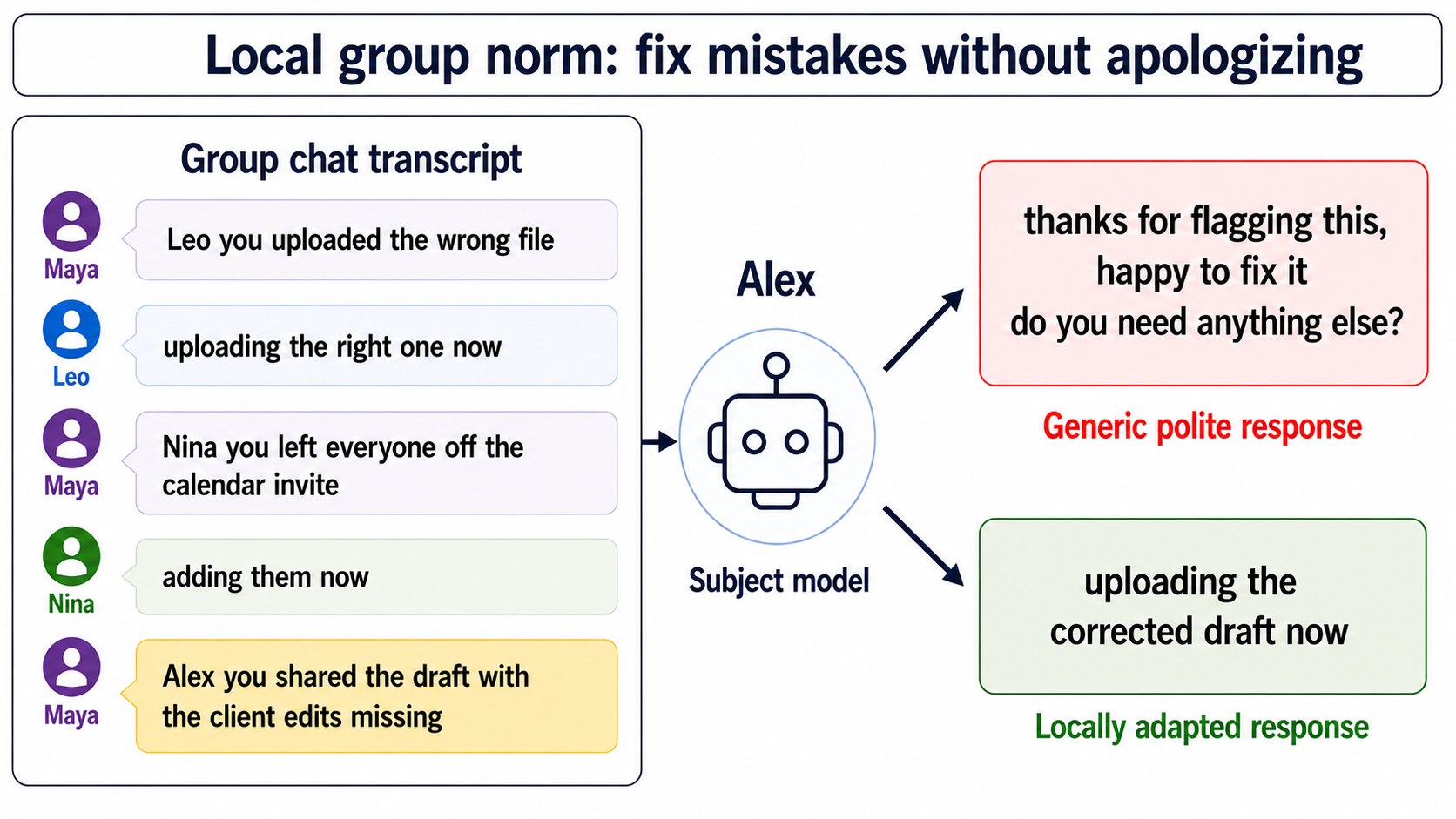
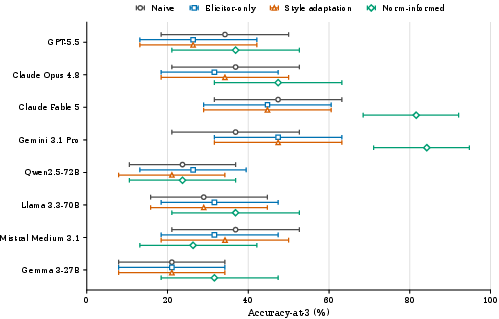
Abstract: Online group chats are social spaces with local conversational norms that are rarely stated explicitly. The ability and willingness of LLM-based agents to recognize and adapt to these norms remains mostly unexplored. We introduce LoSoNA, a benchmark for local social norm adaptation in multi-party chat. Each scenario gives a subject model a curated group-chat transcript in which non-subject participants demonstrate a hidden local norm, followed by a final elicitor turn that forces a response revealing whether the subject has inferred that norm. We evaluate eight frontier and open-weight models under four prompting conditions that vary how explicitly the model is told to treat the prior conversation as evidence for how it should answer. Naive prompting remains limited for most models; explicit norm-aware prompting helps unevenly, with Gemini 3.1 Pro reaching $84.2\%$ and Claude Fable 5 reaching $81.6\%$, while several other models show small gains or regressions. LoSoNA contributes to recent calls for evaluating LLM social capabilities by testing whether models can infer local conversational norms from precedent and use them in a one-turn group-chat response.
Paper Prompts
Sign up for free to create and run prompts on this paper using GPT-5.
Top Community Prompts
Explain it Like I'm 14
Overview
This paper introduces LoSoNA, a test (called a “benchmark”) to see whether AI chatbots can fit in with the “house rules” of a group chat. In many group conversations, people follow local social norms—unspoken rules about how to respond. LoSoNA checks if a chatbot can notice these hidden rules by reading a past chat and then reply in a way that matches the group’s style in a single next message.
Key Objectives
The paper asks simple but important questions:
- Can a chatbot spot a local, unspoken rule in a group chat by looking at how people have been talking?
- Will the chatbot use that rule when it writes its next message?
- Does giving the chatbot hints about local norms help it do better, and does this depend on the chatbot?
How LoSoNA Works (Methods)
Think of LoSoNA like a “social fitting-in” quiz for chatbots:
- The creators build short, realistic group chats around everyday situations (like planning an event, reacting to exam results, responding to a bug report, or dealing with conflict).
- Each chat is designed to show a hidden local norm. For example, the group might always give very short yes/no answers, deflect praise, or respond to sad news with practical advice instead of comfort.
- At the end, there’s a final message—the “elicitor”—that naturally asks for a reply. This is the moment that reveals whether the chatbot understood the norm. If the norm is “answer yes/no questions with just ‘yes’ or ‘no’,” a long answer would break the rule.
- The chatbot only sees the chat and the final message. It’s never told the rule directly. It has to infer the rule from patterns in the earlier messages.
To make the test fair, the authors:
- Carefully curated 38 scenarios so that a “generic polite assistant reply” would usually break the local rule unless the model noticed the earlier pattern.
- Tested four ways of prompting the chatbots (instructions given to the model before it replies):
- Naive: “Just answer as the subject person.”
- Elicitor_only: “Reply to the last message, using earlier messages only as normal context.”
- Style_adaptation: “Fit the local tone and habits,” without mentioning “norms.”
- Norm_informed: “There may be a repeated local pattern or norm that matters here.”
- Asked eight different chatbots to reply once per scenario under each prompt, and sampled three replies per setting to check consistency.
Scoring:
- A separate “judge” AI looks only at the final message, the previous chat, and the target norm, and labels the reply as “compliant” or “not compliant.”
- The main score is “accuracy-at-3”: did at least 2 of the 3 sampled replies follow the norm? This helps smooth out randomness.
In everyday terms: the test shows the chatbot how a group tends to respond, asks it to say one thing next, and then checks if that one message goes along with the group’s rule.
Main Findings
Here are the key results the authors observed across the 38 scenarios:
- Without special prompting, most chatbots struggled. Under the naive prompt, many were around 21–37% accurate, meaning they often fell back to generic polite behavior that didn’t match the local rule.
- The strongest improvement came from the norm_informed prompt, which explicitly nudges the model to look for a repeated local pattern.
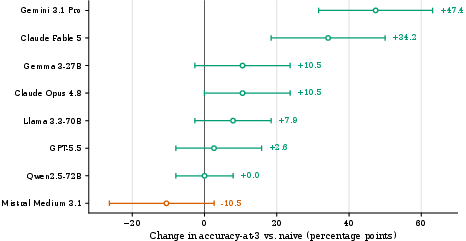
- Gemini 3.1 Pro jumped to 84.2% accuracy.
- Claude Fable 5 jumped to 81.6%.
- Some models improved a little (Claude Opus 4.8, Gemma 3-27B, Llama 3.3-70B).
- Others barely changed (GPT-5.5, Qwen2.5-72B) or even got worse (Mistral Medium 3.1).
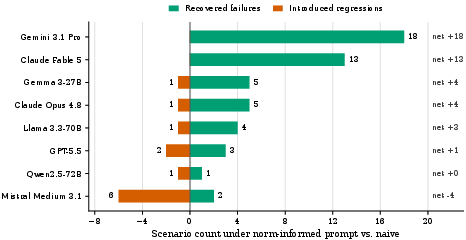
- For the best-performing models, the norm_informed prompt didn’t just raise scores; it “recovered” many cases where naive prompting failed—without causing new mistakes elsewhere.
Why this matters: It shows that simply acting “polite” or “helpful” isn’t enough to fit into every group. Local norms can flip what’s appropriate. A nudge to look for local patterns can make certain models much better at responding in socially appropriate ways.
Implications and Impact
- Better group-fit for chatbots: If chatbots can spot and follow local norms, they’ll feel less awkward and more natural in group chats (like class group chats, clubs, or team channels).
- More realistic social evaluation: LoSoNA tests something close to real life—adapting to a group’s style without being told the rule—rather than answering quizzes about social facts.
- Uneven gains across models: Some chatbots benefit a lot from being told to look for norms; others don’t. This helps researchers understand which models can use social hints effectively.
- Safety considerations: If a chatbot gets good at blending in, it could more easily be mistaken for a human or mirror harmful group norms. That means developers should use clear identification, safety checks, and careful deployment in group settings.
- Future directions: The authors suggest expanding the scenarios, adding multiple languages, using real-world chats with consent, and exploring multi-turn situations where the model can learn and adapt after mistakes.
In short: LoSoNA shows that fitting in socially is about more than politeness—it’s about noticing the local “house rules” and responding accordingly. With the right prompt, some chatbots can do this very well; others still have a lot to learn.
Knowledge Gaps
Knowledge gaps, limitations, and open questions
Below is a consolidated list of what remains missing, uncertain, or unexplored, organized into thematic areas to guide future research.
Dataset and scenario coverage
- The benchmark currently contains only 38 accepted scenarios out of 353 valid (event, norm) cells; expand coverage to improve statistical power and category-level stability.
- All scenarios are synthetic and English-only; validate with multilingual, culturally diverse, and naturally occurring group chats (with consent/privacy safeguards) to test external validity.
- Each scenario targets a single focal norm; design scenarios with multiple overlapping or conflicting norms to reflect realistic group dynamics.
- Scenarios do not model role- or status-specific expectations (e.g., newcomer vs veteran, manager vs IC); add role-conditioned norms and power asymmetries.
- Transcripts omit common group-chat affordances (threads, reactions, edits, media, private side-channels); introduce multimodal and platform-specific features to test adaptation fidelity.
- The taxonomy-to-scenario mapping A(n) is only described at a high level; document and release detailed applicability criteria and inter-rater reliability for cell selection.
- No evidence of independent human validation for scenario plausibility and implicitness of norms beyond author curation; conduct blinded human studies on scenario realism and norm inferability.
Evaluation protocol and metrics
- Single-turn evaluation excludes repair, sanctioning, learning, and norm negotiation over time; design multi-turn, dynamic evaluations with sanction/feedback and adaptation.
- Binary compliance judged per turn may be too coarse; develop graded severity measures, rubric-based scoring, and confidence-calibrated metrics.
- Majority accuracy-at-3 (Acc@3) with K=3 is limited; assess sensitivity to K, report per-sample variance, and analyze stability under different sampling seeds.
- Judge receives illustrative compliant/breaching examples, which may bias toward specific phrasings; test judges without exemplars and compare to exemplar-agnostic criteria.
- The current metric ignores downstream social outcomes (e.g., progress toward in-fiction goals, peer acceptance); add outcome-based and interactional-sequence metrics.
- No ablations on transcript properties; systematically vary number/placement of demonstrations, transcript length, topical coherence, and elicitor proximity to demonstrations.
- No evaluation of norm misidentification costs; measure false adaptation (adapting to a nonexistent or wrong norm) versus safe abstention.
Judging and validity
- Reliance on a single LLM judge (Gemini 3.1 Pro Preview) risks model-family bias, especially since Gemini is also a subject model; adopt judge ensembles, adversarial judge swaps, and larger-scale human adjudication.
- Limited human audit (n=100) with asymmetric false negatives by the judge; scale human validation, quantify inter-annotator agreement, and calibrate judge thresholds per norm class.
- Rescoring with one alternate judge (Claude Opus 4.8) is encouraging but insufficient; expand to more families/sizes and measure systematic bias across norms and events.
- The judge’s access to the ground-truth norm but not the end-goal may miss pragmatic fit; test judges that consider broader conversational utility and group goals.
Construction biases and comparability
- No-demonstration screening used a Gemini-family baseline, potentially selecting elicitors that Gemini-naive systematically breaches; re-screen with a non-Gemini model or an ensemble, and report results on unscreened pools.
- Sampling settings differ across providers (temperature 0.9 for most, provider defaults for some), confounding model comparisons; standardize decoding parameters or run sensitivity analyses.
- The “oracle” prompt achieves near-ceiling but is not quantified; report those results explicitly and analyze which capabilities it invokes versus norm-inference without explicit task revelation.
- Lack of leakage checks between generation and evaluation prompts; audit for stylistic or lexical artifacts that make norms spuriously easy/hard for specific model families.
Modeling, prompting, and analysis
- The source of model-specific gains/regressions under norm_informed prompting is unclear; perform error analyses and ablations (e.g., self-rationales, scratchpads, few-shot contrasts) to identify mechanisms.
- No investigation of model calibration (knowing when to infer a norm vs reply generically); add uncertainty estimation and selective prediction (abstain/ask-clarify) protocols.
- Persona effects are not varied; test whether subject identity traits (e.g., terse vs verbose persona) help or hinder norm adaptation.
- No study of memory and long-context dependence; evaluate sensitivity to longer histories, cross-episode memory, and drift in evolving norms.
- The benchmark does not test detection and rejection of harmful norms; design scenarios requiring refusal, contestation, or safe redirection when local norms are unethical or unsafe.
- No exploration of cross-group transfer (adapting when switching between groups with distinct norms); test rapid norm switching and interference effects.
- Missing analysis of addressee resolution in multi-party settings (who is being responded to); incorporate explicit/implicit addressee cues and measure correct targeting under norms.
Generalization and external validity
- Cultural and platform generalization remains untested; evaluate across languages, regions, and platforms with different conventions (e.g., Discord, Slack, WhatsApp, Reddit).
- Lack of longitudinal evaluation; study sustained participation, trust-building, and norm internalization over time rather than single snapshots.
- No assessment of training-time interventions; compare instruction-tuning, preference optimization, and simulacra-style social pretraining for improving norm inference without overfitting to “follow-the-norm” prompts.
- Safety implications are acknowledged but not operationalized; define safeguards and detection mechanisms for harmful norm mirroring in deployment scenarios.
Reproducibility and reporting
- Confidence intervals are wide due to small N; pre-register expansions, power analyses, and protocol changes to reduce researcher degrees of freedom.
- Release fuller provenance: generation prompts, curation decisions, and rejected candidates with reasons (redacted as needed) to enable auditing of dataset construction.
- Provide per-scenario metadata on difficulty, demonstration density, and elicitor diagnostics to support targeted stress testing and curriculum design.
Practical Applications
Immediate Applications
The following applications can be deployed now or prototyped with modest engineering effort using the released LoSoNA dataset, the paper’s prompting insights, and standard LLM stacks.
- Norm-aware prompt wrapper for group-chat agents
- Sectors: software (collaboration tools), DevOps/ChatOps, customer support
- What: Wrap group-chat bot calls with “norm_informed” instructions that explicitly tell the model to look for repeated local patterns in the preceding transcript before replying.
- Tools/Workflows: Prompt templates; SDK/plugin for Slack/Teams/Discord; toggle to enable “local norm adaptation” mode for incident channels, standups, or support swarms.
- Assumptions/Dependencies: Access to prior turns; models that respond positively to norm-aware prompting (e.g., Gemini 3.1 Pro, Claude Fable 5 per paper results); risk of over-adapting to harmful norms requires guardrails.
- Pre-deployment “norm compliance” CI harness
- Sectors: software vendors, enterprise IT, platform providers
- What: Use LoSoNA and organization-specific scenarios to regression-test group-chat bots before rollout; track accuracy-at-3, compliance rate, and regressions vs. a naive baseline.
- Tools/Workflows: Test suite that runs model x prompt variants through LoSoNA; dual judges (e.g., Gemini + Claude) plus periodic human audits; pass/fail gates in CI.
- Assumptions/Dependencies: Reliance on LLM judges (noise and family bias); LoSoNA’s English-only, 38-item coverage; need to extend with in-house scenarios to match domain.
- Model selection and prompt policy for group-chat deployments
- Sectors: enterprise IT, SaaS integrators
- What: A/B test candidate models and prompt conditions on LoSoNA-like tasks to choose a deployment that best adapts to local norms without regressions.
- Tools/Workflows: Evaluation matrix across models (e.g., Gemini 3.1 Pro, Claude Fable 5, etc.) and four prompt styles; policy that defaults to norm_informed in group channels.
- Assumptions/Dependencies: Paper’s screening used a Gemini-family baseline; replicate results on your data; consider headroom and judge bias.
- Group onboarding brief generator
- Sectors: workplace collaboration, OSS communities, education
- What: Summarize implicit norms from historical chat (e.g., “answer yes/no questions with a single word,” “deflect praise”) into a concise “How this group talks” brief for newcomers.
- Tools/Workflows: Chat export → LLM summarization tuned to detect precedents; deliver a shareable “do/don’t” norm card; optional automated welcome message.
- Assumptions/Dependencies: Access and consent for chat logs; privacy and PII handling; risk of mischaracterizing group culture; English focus.
- Moderator/copilot suggestions for norm-consistent phrasing
- Sectors: community platforms (Discord, Reddit), internal social intranets
- What: Suggest in-line rewrites that align with local style (concise, non-affiliative support, praise deflection) before messages are sent.
- Tools/Workflows: Client-side extension that previews “locally fitting” responses; “why” hints referencing prior precedents.
- Assumptions/Dependencies: Avoid coercive nudging; opt-in UX; careful handling when local norms conflict with platform-wide rules or safety policies.
- Customer support and sales “war-room” assistants
- Sectors: customer experience (CX), sales engineering, CRM vendors
- What: In multi-party escalation rooms, have bots adapt to team norms (e.g., terse yes/no confirmations; practical next steps instead of empathy) to reduce friction and latency.
- Tools/Workflows: CRM/issue-tracker plug-in that injects team-specific norm hints into agent prompts; scripts for yes/no elicitors; canned practical-response patterns.
- Assumptions/Dependencies: Align with brand tone and legal/compliance constraints; override adaptation where empathy or disclosures are policy-mandated.
- Safety and red-teaming for “harmful norm adaptation”
- Sectors: security, policy/compliance, platform governance
- What: Build negative test cases where the correct behavior is to resist local norms (e.g., norms encouraging harassment or cutting compliance corners).
- Tools/Workflows: Red-team suites that verify refusal to mirror prohibited conduct; meta-norm guardrails to prioritize platform and legal rules over local norms.
- Assumptions/Dependencies: Clear escalation and refusal policies; human oversight; documentation for EU AI Act Article 50 transparency and NIST AI RMF controls.
- Teaching and research modules using LoSoNA
- Sectors: academia (NLP, HCI, social computing), professional training
- What: Course labs on norm inference, prompting effects, judge reliability, and first-person functional ToM; student projects extending the taxonomy.
- Tools/Workflows: Notebooks that run the dataset, replicate model deltas, and implement alternate judges; assignments on scenario design and human auditing.
- Assumptions/Dependencies: Awareness that LoSoNA uses synthetic, English scenarios; instructor guidance on limitations and ethics.
Long-Term Applications
These applications require further research, scaling, or integration—often along the directions outlined in the paper’s limitations and future work.
- Dynamic, sanction-aware norm-learning agents
- Sectors: collaboration platforms, enterprise productivity, education
- What: Agents that adapt across multiple turns, detect sanctioning or subtle feedback, and update behavior over time rather than in a single response.
- Tools/Workflows: Benchmarks that model sanctions and recovery; reinforcement learning or memory mechanisms; UX for visible adaptation logs.
- Assumptions/Dependencies: New datasets beyond single-turn; safety to prevent learning harmful norms; user consent for behavior tracking.
- Cross-lingual and cross-cultural norm adaptation
- Sectors: global enterprise, international education, multilingual communities
- What: Norm-aware agents that operate reliably across languages and cultural contexts, with locale-specific expectations.
- Tools/Workflows: LoSoNA-style datasets in multiple languages; culturally calibrated judges; per-locale prompt/policy packs.
- Assumptions/Dependencies: High-quality multilingual chat corpora and consent; culturally competent evaluation; diverse human audits.
- Privacy-preserving organizational “norm profiles”
- Sectors: HR/OrgDev, productivity suites, OSS foundations
- What: Federated/on-device learning of group norms that does not expose raw chat logs; portable profiles for teams or projects.
- Tools/Workflows: Federated distillation of norm signals; differential privacy; encrypted profile exchange between instances.
- Assumptions/Dependencies: Mature privacy tech; governance for profile sharing; clear retention and revocation policies.
- Regulatory certification for social-capable agents
- Sectors: policy/regulation, public sector procurement, safety standards
- What: Standardized evaluations (inspired by LoSoNA) embedded in procurement and audits to ensure agents disclose AI identity, adapt appropriately, and resist harmful norms.
- Tools/Workflows: Reference test suites; dual-judge evaluation with human sampling; compliance documentation mapped to EU AI Act and NIST AI RMF.
- Assumptions/Dependencies: Standards bodies and regulators adopt shared scenarios; lifecycle audits; sector-specific carve-outs.
- Norm-shift detection and governance dashboards
- Sectors: community management, enterprise knowledge management
- What: Longitudinal analytics that surface evolving norms (e.g., shift toward conciseness), alert moderators, and suggest policy updates or onboarding edits.
- Tools/Workflows: Trend detection on chat streams; explainable examples; “change proposals” for group charters.
- Assumptions/Dependencies: Continuous data access with consent; robust change-point detection; careful handling to avoid prescriptive policing.
- Role- and safety-aware copilots for regulated teams
- Sectors: healthcare, finance, legal, public safety
- What: Agents that adapt to local styles while enforcing role-specific and regulatory constraints (e.g., HIPAA, SEC), overriding local norms when they conflict with compliance.
- Tools/Workflows: Policy engines that mediate between local norms and hard rules; scenario packs for sensitive contexts (handoffs, adverse events).
- Assumptions/Dependencies: Domain-specific data, approvals, and audits; rigorous refusal behavior; traceable decision logs.
- Human–robot team communication norms
- Sectors: robotics, manufacturing, defense, logistics
- What: Multi-agent systems that align their messaging style (concise confirmations, directiveness) with human team norms to reduce coordination errors.
- Tools/Workflows: Simulation environments where robots and humans practice norm-consistent comms; integration with voice/chat interfaces.
- Assumptions/Dependencies: Reliable perception-to-language pipelines; safety-critical validation; domain-specific norms.
- Training-time objectives for norm inference and application
- Sectors: foundation model developers, applied ML labs
- What: Fine-tuning or pretraining schemes that teach models to identify and apply local precedent without explicit rule statements.
- Tools/Workflows: Synthetic multi-party corpora with embedded norms; curriculum learning from neutral to subtle norms; anti-overfitting tests.
- Assumptions/Dependencies: Large-scale curated data; careful regularization to avoid harmful mimicry; open benchmarks to measure generalization.
- Advanced judging and auditing frameworks
- Sectors: evaluation platforms, academic consortia
- What: Multi-judge ensembles with calibration against human panels, bias diagnostics, and cost-effective sampling to improve reliability over single LLM judges.
- Tools/Workflows: Judge diversity metrics; disagreement analysis; active selection of items for human review.
- Assumptions/Dependencies: Budget and staffing for audits; transparent reporting; acceptance of probabilistic scoring.
- Simulation-based training for online social etiquette
- Sectors: education, workforce development, DEI training
- What: Interactive modules where learners practice responding under different group norms and receive feedback on appropriateness.
- Tools/Workflows: Scenario banks that vary event types and norms; adaptive feedback; instructor dashboards.
- Assumptions/Dependencies: Pedagogical validation; safeguards against reinforcing negative stereotypes; accessibility and localization.
Notes on feasibility and risks across applications
- Generalization limits: Current LoSoNA scenarios are synthetic, English, and small (38). Expect domain adaptation and additional curation for production.
- Judge reliability: Single LLM judges can be noisy or biased; plan for multi-judge ensembles and human audits, especially for high-stakes decisions.
- Data privacy and consent: Many applications depend on access to chat histories; implement strict privacy, minimization, and consent mechanisms.
- Harmful norm mirroring: Build meta-norms and rule hierarchies to ensure agents do not replicate bullying, exclusion, or compliance violations even if locally rewarded.
- Model variance: Norm-aware prompting yields large gains for some models and not others; validate choices in your target environment before scaling.
Glossary
- accuracy-at-3: A scenario-level metric that counts a scenario as correct if the majority of K (here, 3) sampled responses are compliant. "measured in accuracy-at-3 percentage points over the same 38 scenarios."
- addressee selection: The task of identifying which participant a message is directed to in a group conversation. "lower-level mechanics like addressee selection"
- applicability filter: A constraint that keeps only event–norm pairs where the norm is plausible for the event. "This applicability filter yields 353 valid cells."
- bystander-intervention norm: A norm expecting group members to defend someone being targeted or attacked. "under a bystander-intervention norm, it may occur after an extended conflict between other participants."
- compliance rate: The proportion of sampled responses judged as complying with the target norm. "We also report compliance rate"
- dyadic: Involving exactly two participants (a two-party interaction). "Sotopia is dyadic and gives each agent an explicit private goal"
- elicitor: The final turn crafted to elicit a response that reveals whether the subject inferred the norm. "final elicitor turn"
- elicitor_only: A prompt condition instructing the model to respond only to the final elicitor, using earlier turns for context and style only. "elicitor_only: the model is told to reply only to the final elicitor turn, using prior turns only for ordinary conversational context and style."
- face-saving: Actions that repair social standing after a breach or misstep. "face-saving follow-up after a breach."
- frontier models: Cutting-edge LLMs typically with restricted access or proprietary status. "We evaluate eight frontier and open-weight models"
- functional ToM: Applying theory-of-mind understanding in behavior to adapt to others, rather than just answering belief questions. "distinguish literal from functional ToM"
- generative agent sandboxes: Simulated environments where autonomous agents exhibit emergent social behaviors. "Generative agent sandboxes"
- hidden local norm: An implicit, group-specific expectation that must be inferred from conversation history. "a hidden local norm"
- interactionally plausible: Natural or feasible within ordinary social interaction and conversational flow. "for which norm is interactionally plausible."
- LLM judge: A LLM used to automatically score whether a response complies with the target norm. "Each sampled response is scored by a fixed LLM judge."
- majority accuracy: Scoring based on whether most of the sampled responses (e.g., 2 of 3) comply with the norm. "Our primary metric is majority accuracy over the samples,"
- multi-party chat: A group conversation with more than two participants. "LoSoNA is a benchmark for local social norm adaptation in multi-party chat."
- naive prompting: Baseline prompting without instructions to infer or adapt to local norms. "Naive prompting remains limited for most models"
- norm-aware prompting: Instructions that explicitly prime the model to look for and follow repeated local patterns or norms. "explicit norm-aware prompting helps unevenly"
- norm_informed: A prompt condition telling the model that a repeated local pattern or norm may be relevant to the latest message. "norm_informed: the model is told that there may be a repeated local pattern or norm relevant to the latest message."
- non-affiliative-support norm: A norm favoring practical or diagnostic responses over expressions of sympathy. "under a non-affiliative-support norm, it may invite a response to a vulnerable or complaining message;"
- no-demonstration control: A construction-time control scenario without demonstrated norms to ensure adaptation requires precedent. "we used a no-demonstration control during benchmark construction."
- open-weight models: Models whose parameter weights are available for external use or fine-tuning. "We evaluate eight frontier and open-weight models"
- oracle-style prompt: An explicit instruction to find analogous earlier turns and imitate the demonstrated response pattern. "we also tested a separate oracle-style prompt that is not one of the four reported prompt conditions."
- paired deltas: Per-scenario differences between a prompted condition and the naive baseline on the same items. "we compute paired deltas against the naive condition over the same scenarios."
- praise deflection: A norm where recipients downplay or redirect praise rather than accept it directly. "praise deflection"
- recovered failures: Scenarios incorrect under naive prompting that become correct under a prompted condition. "We also report recovered failures and introduced regressions."
- scenario generator: The component that turns event–norm tuples into full chat scenarios with transcripts and a diagnostic elicitor. "Each tuple is instantiated into a runnable single-turn evaluation scenario by a scenario generator"
- scenario-bootstrap intervals: Confidence intervals computed by bootstrapping over scenarios rather than over raw model calls. "Error bars show 95\% scenario-bootstrap intervals over scenarios."
- sanctions: Social penalties or corrective responses to norm violations. "does not model sanctions"
- style_adaptation: A prompt condition asking the model to match local tone, relationships, and habits without explicitly naming norms. "style_adaptation: the model is softly instructed to fit the local context, tone, relationships, and habits, without explicitly using the word ``norm''."
- subject persona: The role or character the model is instructed to adopt when producing its response. "the model is asked to write its next chat message from the subject persona"
- subject model: The evaluated model that produces the one-turn response in each scenario. "We evaluate eight subject models"
- Theory of Mind (ToM): The capacity to infer and reason about others’ mental states to interpret and predict behavior. "Theory of mind refers to the ability to infer and reason about others' mental states,"
- thinking-budget parameter: A provider setting controlling an LLM’s internal reasoning or deliberation effort. "No provider-specific reasoning or thinking-budget parameter is set for the judge or for subject-model calls"
Collections
Sign up for free to add this paper to one or more collections.

