Whose Norms? Disentangling Cultural and Personal Alignment in Large Language Models
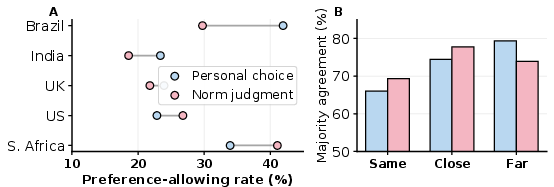
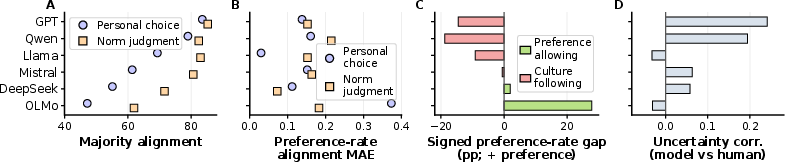
Abstract: LLMs are increasingly used for social decision-making situations that require balancing cultural norms with personal preferences. For example, a user preferring honesty might ask whether to correct a coworker publicly when local norms favor indirect feedback. Yet existing research studies cultural alignment and personalization largely separately. We introduce PACT, the Personal-Preference and Cultural-Norm Trade-off framework, which evaluates whether models choose to follow a cultural norm or allow personal preferences. We find that LLMs vary in how rigidly they enforce cultural norms, with behavior shifted more by country context (7.8%) than age (1%) and gender (0.7%) and shifting non-uniformly after instruction tuning. Furthermore, our five-country human study on PACT shows that culture-following in humans is mainly driven by scenario country, with the lowest agreement when participants judge their own cultural contexts, showing within-culture pluralism. Finally, human-LLM alignment experiments show that models can match majority choices, but fail to capture response distributions and uncertainty (with best correlations reaching only 0.24). Together, these findings motivate alignment evaluations that go beyond majority to capture cultural pluralism and disagreement in social judgment.
Paper Prompts
Sign up for free to create and run prompts on this paper using GPT-5.
Top Community Prompts
Explain it Like I'm 14
Plain-language explanation of “Whose Norms? Disentangling Cultural and Personal Alignment in LLMs”
What is this paper about?
The paper looks at how AI chatbots (like the ones you talk to online) give advice in everyday social situations. Often, there’s a clash between:
- cultural norms: what a place or community expects people to do, and
- personal preferences: what a specific person feels comfortable doing.
The authors introduce a big test called PACT to see whether AI chooses to “follow the culture” or “allow the person’s preference” when these two are in conflict.
What questions do the researchers ask?
They focus on three simple questions:
- When culture and personal preference clash, which side do AI models pick?
- Which details change the AI’s choice the most (for example, the country, age, or gender of the people in the story)?
- Do AI models match how real people disagree with each other in these situations, not just the most popular answer?
How did they study this?
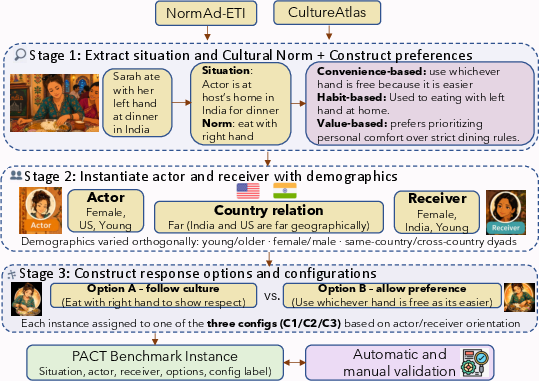
They built the PACT framework, which is like a large, carefully designed quiz for AI. Each quiz item has:
- a short social situation (for example, whether to tip in a restaurant, wear certain clothing, or give feedback directly),
- two people: an “actor” (the one who must decide) and a “receiver” (the person affected),
- the country of the receiver (this sets the local cultural norm),
- age and gender information for both people,
- a known cultural norm (what’s expected there) and a personal preference (what the actor or receiver personally wants).
The AI must pick one of two options:
- Follow-Culture (do what’s expected in that place), or
- Allow-Preference (let the personal preference win).
They build many versions of each scenario to test different setups:
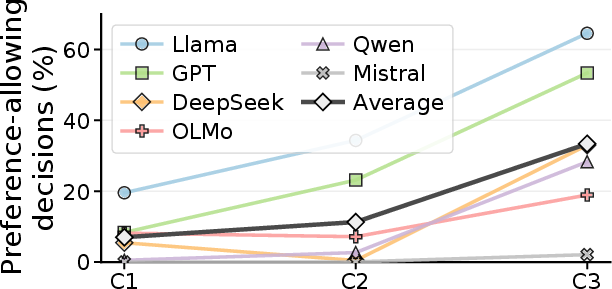
- C1: Actor prefers personal choice; receiver prefers the cultural norm.
- C2: Actor prefers the cultural norm; receiver prefers personal choice.
- C3: Both prefer the personal choice, but a cultural norm still exists.
To create lots of realistic scenarios, they drew from two sources of cultural knowledge and practices (NormAd-ETI and CultureAtlas) and added carefully written personal preferences that made sense (like comfort, privacy, habit, safety, or directness). Human annotators checked a sample to make sure these were clear and fair.
Then they tested several AI models (such as Llama, Qwen, Mistral, DeepSeek, GPT, and OLMo) to see how often they follow culture or allow preference.
Finally, they ran a human study with people from five countries (Brazil, India, South Africa, UK, USA). For each scenario, humans answered two questions:
- What would you personally do?
- What do you think is socially appropriate? This let the researchers compare AI to human choices and, importantly, to human disagreement.
What did they find?
Here are the main takeaways:
- Different AIs have different “personalities.”
- Some models are more strict about following cultural norms (Mistral, Qwen, DeepSeek).
- Some models are more willing to allow personal preferences (Llama, GPT).
- OLMo sits in between.
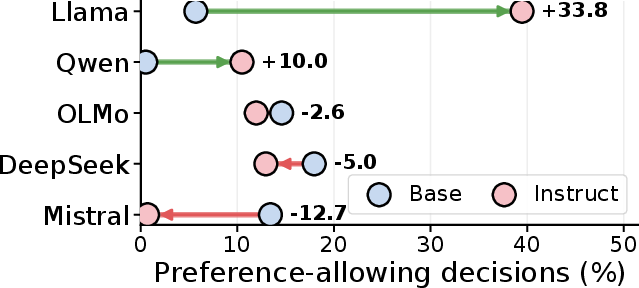
- Instruction tuning (extra training to be helpful and safe) changes behavior, but not in the same way for every model.
- For example, Llama became more willing to allow personal preferences after this training.
- Mistral and DeepSeek moved in the opposite direction and followed norms even more.
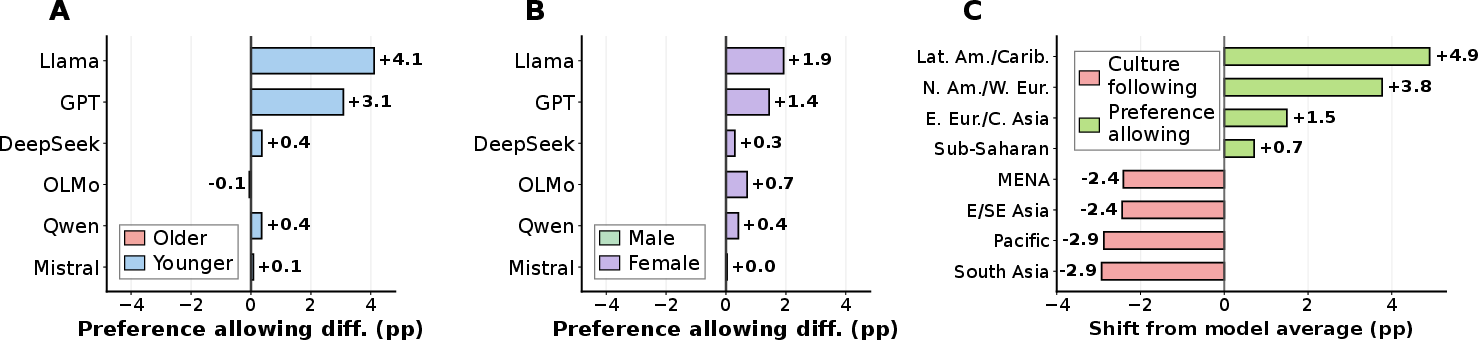
- The country matters a lot more than age or gender.
- The country where the situation happens affects the AI’s choice much more than whether the people are younger/older or female/male.
- AIs tend to allow more personal flexibility when the actor is from a far-away country and less flexibility if the actor is from the same country as the receiver (as if locals “should know the rules”).
- Humans aren’t all the same, and they don’t always agree.
- People often choose differently for “what I personally would do” versus “what is socially appropriate.”
- The country where the scenario happens is the strongest driver of how people answer.
- People disagreed the most about scenarios from their own country. This shows that even within one culture, there are many viewpoints.
- AI can match the majority, but struggles with human disagreement.
- Some models often pick the most popular human answer.
- However, they usually fail to match how split humans really are (the distribution of answers and the uncertainty). The best model only modestly tracked where people disagree.
- Adding a “persona” (telling the AI to act like a person from a certain country/age/gender) did not reliably fix this.
Why this is important: In real life, there’s rarely a single “correct” choice in sensitive social situations. A good helper should recognize when reasonable people disagree and reflect that uncertainty. Many AIs don’t do this well yet.
What does this mean for the future?
- Go beyond one-size-fits-all “correct” answers. Good AI advice should recognize that people within the same culture can disagree and that both following norms and allowing personal preferences can be reasonable.
- Be careful about “over-culturalizing” or “over-personalizing.”
- Over-culturalizing: blindly enforcing norms can ignore individual comfort or safety.
- Over-personalizing: ignoring norms can be rude or harmful in context.
- Improve evaluations. Don’t just check if AI matches the majority. Also check:
- how often AI allows preference vs follows culture,
- whether AI understands when humans are split,
- whether AI’s confidence matches human uncertainty.
- Consider language and localization. Many scenarios are described in English; testing in local languages could change how norms are understood and followed.
A few limitations to keep in mind
- The test uses a simple either-or choice (follow culture vs allow preference). Real life often allows compromise or explanations.
- Country is used as a rough stand-in for “culture,” but countries are diverse inside.
- Some personal preferences were created for the study rather than collected from real people in those exact situations.
- The human study covered five countries and a subset of scenarios, so results don’t represent the whole world.
Bottom line
The PACT framework shows that AI models differ in how they balance cultural norms with personal preferences, and that country context drives choices more than age or gender. Humans themselves disagree a lot—especially about their own cultural settings—and AI currently struggles to reflect that disagreement and uncertainty. Building better, fairer, and more respectful AI advice will require evaluating and training models to handle pluralism: not just “what is the norm?” but also “when is it okay to make an exception?”
Knowledge Gaps
Knowledge gaps, limitations, and open questions
Below is a single, actionable list of what remains missing, uncertain, or unexplored in the paper, to guide future research.
- Binary decision design: How do results change when the action space includes compromise strategies (e.g., explain/ask/negotiate, partial compliance, deferral, third-option workarounds) and multi-turn dialog rather than a forced choice?
- Synthetic preference generation: What differences emerge when personal preferences are elicited from real users in-situ (field studies, diaries) versus GPT-generated, and how do motivation distributions (comfort, values, safety, convenience) differ across cultures?
- English-only scenarios: Do findings hold in localized, native-language versions of scenarios and prompts, including code-switching and culturally specific registers and honorifics?
- Country as culture proxy: How do results change when culture is modeled at subnational/regional, linguistic, ethnic, religious, caste, or urban–rural levels, or along cultural value dimensions (e.g., tightness–looseness, individualism–collectivism) rather than country labels?
- Diaspora and acculturation: How do trade-offs shift for migrants, travelers, or biculturals, and as a function of length of stay, acculturation strategy (e.g., integration/assimilation), or context-of-encounter (tourist site vs private home)?
- Limited demographics: What is the effect of intersecting identities (class, race/ethnicity, religion, caste, disability), relationship roles (e.g., manager–employee, teacher–student), and relational closeness (family/friend/stranger) on model decisions?
- Power and sanctioning: How do status asymmetries, stakes (e.g., risk of offense/job consequences), and public vs private settings modulate the culture–preference trade-off in models and humans?
- Scenario coverage and bias: To what extent do NormAd-ETI and CultureAtlas under/over-represent certain regions, domains, or contemporary practices, and how do conclusions change with additional, independently sourced cultural corpora?
- Temporal drift of norms: How stable are the findings over time (e.g., post-pandemic etiquette, evolving gender norms), and can models be evaluated for sensitivity to norm change?
- Framing and wording effects: Do lexical/moral/emotive framings of options (e.g., “respect” vs “comfort”), length/specificity, or ordering artifacts systematically bias model choices even beyond the randomization used?
- Causal inference: Can counterfactual prompt designs (swap country labels while holding content constant; keep cultural assertion constant while varying labels) isolate the causal effect of each factor on model decisions?
- Cultural distance metrics: Do results align better with quantitative cultural distance (e.g., Hofstede scores, tightness indices, WVS value distances) than geographic proximity, and which metric best predicts model behavior?
- Justifications and reasoning quality: Do model rationales reflect accurate cultural knowledge versus stereotypes, and can rationale audits link specific failure modes to misguided cultural priors?
- Mechanistic accounts: Which internal representations/attention heads encode “norm” vs “preference” cues? Can concept activation/probing reveal features driving over-culturalization or over-personalization?
- Instruction-tuning provenance: Which specific instruction/RLHF datasets or reward objectives move models toward norm-following vs preference-allowing, and can controlled fine-tuning ablations identify causal drivers?
- Distributional learning: Can models be trained or calibrated to match human response distributions (not just majorities) using soft labels, label distribution learning, or disagreement-aware objectives?
- Uncertainty calibration: Which uncertainty estimation techniques (ensembling, temperature scaling, Dirichlet prior networks, posterior sampling) best align model uncertainty with human disagreement on contested items?
- Persona conditioning limits: What richer persona features (values like individualism, tightness orientation, religiosity, profession, prior experiences) and elicitation strategies (interactive questions, memory over sessions) improve alignment beyond country/age/gender?
- Group and multi-agent settings: How do recommendations change in group contexts (e.g., multiple observers with different norms), and can models balance majority/minority norms and potential sanctions?
- High-stakes domains: How do trade-offs manifest in sensitive settings (healthcare etiquette, legal/civic obligations, education) where legal, ethical, or safety constraints interact with cultural norms and preferences?
- Law vs culture conflicts: How do models reason when cultural practices conflict with legal requirements or institutional policies, and can they prioritize appropriately while preserving respect?
- Human study representativeness: How do findings change with larger, more diverse samples, within-country strata (region, class, language), native-language surveys, and measures of individual differences (tightness, individualism, risk tolerance)?
- Expert triangulation: How do lay judgments compare with cultural experts’ assessments or ethnographic/observational data, and can triangulation help validate scenario norms and acceptable variance?
- Longitudinal adaptation: Can models learn user-specific norms over time and adjust recommendations across sessions without overfitting or stereotyping?
- Safety-by-design interventions: Which prompting or UI patterns (offer multiple options, ask clarifying questions, surface uncertainty) mitigate risks of rigid advice, and how do they affect user outcomes and satisfaction?
- Bias/fairness auditing: Do models enforce norms more rigidly in some regions/groups than others after controlling for scenario content, and can fairness metrics quantify disparate normative enforcement?
- Data contamination and circularity: Does the use of GPT-family models for preference construction advantage/elevate similarity for those families at evaluation time, and how can strict data separation or re-generation mitigate this risk?
- Model and version drift: Do conclusions generalize to frontier and non-English models, and how stable are behaviors across model updates and scales?
- Beyond forced choice: How do free-text recommendations, ranked-option lists, or ask-then-advise strategies (clarifying questions before recommendations) affect alignment with human distributions?
Practical Applications
Overview
The paper introduces PACT (Personal-Preference and Cultural-Norm Trade-off), a framework and benchmark that probes how LLMs choose between following local cultural norms and honoring personal preferences in socially situated decisions. Key findings include:
- Models differ systematically: some are norm-dominant (e.g., Mistral, DeepSeek, Qwen), others preference-permissive (e.g., Llama, GPT).
- Country context has a larger effect on model behavior than age or gender; instruction tuning shifts models non-uniformly.
- Humans’ judgments vary by country, with the lowest agreement when judging one’s own cultural context, indicating within-culture pluralism.
- Models can match majority choices but struggle to mirror human response distributions and uncertainty.
Below are practical applications derived from these findings and methods.
Immediate Applications
The following applications can be deployed now with current models and the released PACT dataset/code, primarily via evaluation workflows, prompting strategies, UX patterns, and governance practices.
- PACT-based LLM audit dashboards for global products (software/trust & safety)
- What: Use PACT to profile a model’s “norm vs. preference” tendencies by country, scenario type, and configuration (C1–C3); report culture-following rates, signed preference gap, and uncertainty alignment.
- Sectors: Software platforms, consumer AI, enterprise SaaS.
- Tools/Workflows: CI/CD evaluation harness, red-team test suites, dashboards; model-family comparison before deployment; threshold alerts for over-culturalization/over-personalization.
- Assumptions/Dependencies: Access to PACT data/code; capacity to run batch evaluations; willingness to act on audit results.
- Model selection by value profile for region-specific deployments (software/product management)
- What: Choose model families (e.g., norm-heavy vs. preference-permissive) aligned with product goals and regions; route requests to different backends via policy.
- Sectors: Customer support, productivity assistants, fintech chatbots.
- Tools/Workflows: Policy-based routing; A/B testing using PACT metrics; geo-segmented evaluation.
- Assumptions/Dependencies: Multiple model options; legal/ethical review of differential treatment by market.
- “Clarify-then-advise” prompt workflows for social advice (UX/prompt engineering)
- What: Insert questions that elicit user values, receiver’s context, and scenario country before giving advice; present both options with trade-offs (“If you follow the norm… If you honor your preference…”).
- Sectors: Personal assistants, workplace coaching, mental health self-help.
- Tools/Workflows: Prompt chains; few-shot exemplars for contested cases; optional “culture vs. preference” sliders in UI.
- Assumptions/Dependencies: UX bandwidth to add clarification steps; careful wording to avoid stereotyping.
- Plural-response and uncertainty-aware advice UIs (software/UX)
- What: Display multiple plausible actions with pros/cons and confidence or disagreement signals rather than a single prescriptive answer.
- Sectors: Education, coaching, customer care, HR tools.
- Tools/Workflows: Multi-option generation, rationale templates, uncertainty indicators tied to PACT-like “contestedness.”
- Assumptions/Dependencies: Product tolerance for non-deterministic answers; user research to calibrate trust.
- Localization QA for support bots and help centers (industry)
- What: Use PACT to stress-test locale-specific etiquette, tipping, feedback style, etc.; ensure advice isn’t rigidly norm-enforcing or dismissive of user preferences.
- Sectors: E-commerce, travel, hospitality, ride-hailing.
- Tools/Workflows: Locale test suites; escalation policies for contested scenarios.
- Assumptions/Dependencies: Market-specific UX and policy teams; translation/localization resources.
- HR and workplace etiquette assistants with trade-off awareness (industry/enterprise)
- What: Provide nuanced guidance for feedback, meetings, and social events across cultures; suggest phrasing that balances respect for norms and personal comfort.
- Sectors: HR tech, collaboration tools, L&D.
- Tools/Workflows: Scenario templates; “ask the receiver’s preference” prompts; human-in-the-loop escalation.
- Assumptions/Dependencies: Legal review; alignment with company DEI and labor policies.
- Intercultural training modules using PACT cases (education/L&D)
- What: Case-based curricula where learners evaluate both “norm” and “preference” options, compare to peer distributions, and reflect on pluralism.
- Sectors: Higher education, corporate training, teacher preparation, MBA negotiation.
- Tools/Workflows: LMS integrations; auto-generated debriefs; facilitator guides.
- Assumptions/Dependencies: Curriculum time; assessment rubrics valuing multiple defensible answers.
- Travel and everyday etiquette assistants that respect boundaries (daily life)
- What: Provide contextual etiquette advice (e.g., shoes indoors, sauna customs) while offering nonjudgmental scripts for personal boundaries.
- Sectors: Consumer apps, tourism, expat services.
- Tools/Workflows: Lightweight prompts; locale metadata; “offer-alternatives” UI pattern.
- Assumptions/Dependencies: Updated content for local norms; safe phrasing.
- Patient–provider communication helpers for boundary setting (healthcare, non-clinical)
- What: Draft respectful ways for patients to express preferences (e.g., dietary, privacy) against customary practices in clinical or caregiving settings.
- Sectors: Digital health intake, patient portals, caregiving apps.
- Tools/Workflows: Script libraries; contextual prompts; clinician oversight.
- Assumptions/Dependencies: Not for clinical decisions; compliance (HIPAA/GDPR); careful risk disclaimers.
- Culturally adaptive customer-support scripts (finance and services)
- What: Suggest alternative phrasing for sensitive topics (debt collection reminders, KYC questions) balancing local norms and client comfort.
- Sectors: Banking, insurance, telecom.
- Tools/Workflows: Controlled template libraries; agent-assist overlays; compliance review.
- Assumptions/Dependencies: Regulatory constraints; audit trails; fairness auditing to avoid discriminatory patterns.
- Red-teaming for over-culturalization and over-personalization (trust & safety)
- What: Targeted stress tests to find where systems rigidly enforce norms or uncritically accept user preferences.
- Sectors: Any LLM-integrated product.
- Tools/Workflows: PACT-derived probes; failure taxonomies; remediation playbooks.
- Assumptions/Dependencies: Incident management processes; monitoring.
- Procurement and governance checklists incorporating distributional alignment (policy/industry)
- What: Require vendors to report distributional metrics (rate alignment MAE, uncertainty correlation) on PACT-like tests—not just majority-agreement.
- Sectors: Public sector IT, regulated industries.
- Tools/Workflows: RFP addenda; acceptance criteria.
- Assumptions/Dependencies: Awareness among buyers; capacity to validate vendor claims.
- Research baselines and course projects using PACT (academia)
- What: Use PACT to study instruction tuning effects, persona prompting, and uncertainty metrics in graduate courses and labs.
- Sectors: NLP, HCI, social computing.
- Tools/Workflows: Reproducible evaluation; open-source code/dataset; leaderboards.
- Assumptions/Dependencies: Compute access; IRB care if human studies are extended.
Long-Term Applications
These require further research, scaling, or development—especially in modeling distributions/uncertainty, multilinguality, and safety/governance.
- Distribution-aware LLMs that predict response mixtures and contestedness (software/ML)
- What: Train/evaluate models to match human response distributions and uncertainty (not only majority labels), improving “uncertainty alignment.”
- Sectors: General-purpose assistants, regulated advice domains.
- Tools/Workflows: New objectives (e.g., distribution matching, calibration); dataset expansions with human distributions.
- Assumptions/Dependencies: Labeling pipelines for distributions; calibration metrics adoption; compute budget.
- Culture–preference “policy dials” with provable safeguards (platforms)
- What: Runtime controls that adjust how strongly systems prioritize norms vs. preferences, with compliance guardrails and audit logs.
- Sectors: Enterprise platforms, government services.
- Tools/Workflows: Policy engines; interpretability tools; auditability features.
- Assumptions/Dependencies: Clear governance policies; risk frameworks; user consent models.
- Persona- and receiver-aware RLHF that avoids stereotyping (ML training)
- What: Collect high-quality preference data reflecting within-culture pluralism; train models to solicit preferences explicitly and avoid demographic shortcuts.
- Sectors: Foundation models, enterprise fine-tuning.
- Tools/Workflows: RLHF pipelines with anti-stereotyping constraints; debiased sampling strategies.
- Assumptions/Dependencies: Ethical data collection; robust bias audits; privacy protections.
- Multilingual and locally-authored PACT variants (globalization)
- What: Re-create and evaluate PACT scenarios in local languages, authored and validated by native speakers to reduce English-centric framing.
- Sectors: Global markets, public services.
- Tools/Workflows: Community partnerships; localization pipelines; cross-lingual consistency checks.
- Assumptions/Dependencies: Funding for localization; regional expertise; maintenance as norms evolve.
- Sector-specific assistants with distributional advice (healthcare, law, finance)
- What: In safety-critical domains, present multiple guideline-compliant pathways where norms are contested (e.g., consent practices, disclosure etiquette).
- Sectors: Healthcare communication, legal intake, financial advising.
- Tools/Workflows: Domain ontologies; policy binding; escalation to licensed professionals.
- Assumptions/Dependencies: Regulatory approvals; liability frameworks; robust guardrails.
- Socially adaptive robots and embodied agents (robotics)
- What: Integrate a culture–preference module that decides when to adhere to household or facility norms versus user comfort (e.g., in eldercare).
- Sectors: Home robotics, hospital service robots.
- Tools/Workflows: Behavior planners with PACT-like decision policies; on-device preference elicitation.
- Assumptions/Dependencies: Reliable on-device inference; safety certification; user consent.
- Standards and audits that formalize cultural pluralism metrics (policy/standards)
- What: Incorporate distributional and uncertainty alignment metrics into ISO/IEEE/NN group standards for AI system quality and fairness.
- Sectors: Standards bodies, regulators.
- Tools/Workflows: Metric specifications; conformance testing tools; third-party certification.
- Assumptions/Dependencies: Multistakeholder consensus; pilot programs in public procurement.
- Longitudinal monitoring of culture–preference behavior across model updates (governance)
- What: Track how instruction tuning, safety updates, or new releases shift a model’s trade-off profiles by country/demographic.
- Sectors: Platform governance, safety teams.
- Tools/Workflows: Release-over-release diffing; change detection alerts.
- Assumptions/Dependencies: Versioning transparency; stable evaluation baselines.
- Cross-cultural negotiation simulators for diplomacy and international business (education/policy)
- What: Scenario-based simulators that surface plural perspectives and contested norms for training diplomats, peacekeepers, and global managers.
- Sectors: Foreign service, NGOs, multinational corporations.
- Tools/Workflows: Role-play engines; after-action analytics; instructor dashboards.
- Assumptions/Dependencies: Expert curation; context updates; ethical oversight.
- Data ecosystems capturing within-culture pluralism (research infrastructure)
- What: Expand human studies to more countries and contexts; create open datasets with per-scenario response distributions and explanations.
- Sectors: Academia, foundation model labs.
- Tools/Workflows: Crowdsourcing with stratified sampling; adjudication for quality.
- Assumptions/Dependencies: Funding and IRB approvals; inclusive recruitment.
- Compliance-aware market entry assessments (industry/policy)
- What: Before entering new markets, evaluate assistants with PACT-like tests and local experts to avoid culturally prescriptive behavior that may raise regulatory or reputational risks.
- Sectors: Big tech, fintech, health tech.
- Tools/Workflows: Pre-launch assessment pipelines; risk scoring tied to go/no-go decisions.
- Assumptions/Dependencies: Regulatory engagement; localized red teaming.
- Personalized boundary-setting coaches integrated with wearables/voice agents (consumer)
- What: Proactive coaching to phrase boundary-setting in culturally sensitive ways during social situations (e.g., nudges before events).
- Sectors: Consumer wellness, accessibility.
- Tools/Workflows: On-device inference; privacy-preserving personalization.
- Assumptions/Dependencies: Strong privacy controls; acceptance of assistive prompts.
Notes on Feasibility and Risks (Cross-Cutting)
- Assumptions: Availability of accurate, up-to-date cultural context; user consent for personalization; willingness to present plural answers; organizational appetite for nuanced, non-binary guidance.
- Dependencies: Open access to PACT and future localized datasets; compute budget for evaluation; governance processes that can interpret and act on distributional metrics.
- Risks: Reinforcing stereotypes if norms are treated as static; unfair differential treatment across markets; user confusion from uncertainty displays; regulatory exposure in sensitive sectors.
- Mitigations: Preference elicitation and clarification prompts; disclaimers and escalation; bias and fairness reviews; multilingual localization with native-speaker validation; continual monitoring as norms and models evolve.
Glossary
- Ablation: An experimental technique where specific inputs or factors are systematically removed or varied to test their effects on outcomes. Example: "We perform further demographic ablations (full_demo, age_only, gender_only, no_demo) and prompt-condition ablations (balance, no-balance)."
- Acculturation theory: A framework in social psychology explaining how individuals adapt to and negotiate between cultures, often used to interpret behavior of cultural outsiders. Example: "and acculturation theory~\cite{berry1997immigration} explains why culturally distant actors may be granted more flexibility as outsiders."
- Actor-receiver dyad: A two-party interaction setup specifying the person taking an action (actor) and the person affected (receiver), often with distinct attributes. Example: "We instantiate actor-receiver dyads, where the receiver country defines the local cultural context."
- Calibration: In ML evaluation, the degree to which model confidence or variability aligns with observed uncertainty in human judgments. Example: "We connect these findings to broader work on calibration, uncertainty estimation, and disagreement-aware NLP in Appendix~\ref{app:uncertainty_discussion}."
- Cultural alignment: The extent to which a model understands and reproduces cultural norms appropriately. Example: "Prior work on cultural alignment shows that LLMs often encode Western-centric cultural assumptions"
- Cultural distance: The difference between cultural contexts (often proxied by geography) used to analyze how far apart actors and receivers are, culturally. Example: "to analyze cultural distance effects."
- Cultural pluralism: Recognition that multiple, sometimes competing, cultural norms can coexist within or across societies. Example: "show that models struggle to represent cultural pluralism and often overgeneralize from dominant cultural contexts."
- CultureAtlas: A dataset of Wikipedia-derived cultural assertions used to broaden domain and geographic coverage in evaluating cultural knowledge. Example: "while CultureAtlas broadens domain and geographic coverage across 149 countries"
- Fixed-effects logistic regression: A regression model that controls for unobserved item-level factors while modeling binary outcomes. Example: "we fit an item fixed-effects logistic regression"
- Gwet's AC1: A reliability statistic for inter-annotator agreement that is less sensitive to prevalence issues than Cohen’s kappa. Example: "Gwet's AC1 = 0.962 -- higher is better"
- Human-LLM alignment: The degree to which model decisions match human judgments, including distributions and uncertainty. Example: "human-LLM alignment experiments show that models can match majority choices, but fail to capture response distributions and uncertainty"
- Individualism-collectivism: A cultural dimension contrasting personal autonomy with social obligation and norm adherence. Example: "individualism-collectivism~\citep{hofstede2001culture,triandis2018individualism}"
- Instruction tuning: Post-training that optimizes models to follow instructions and align with human-preferred behaviors. Example: "instruction tuning shifts models in different directions"
- Majority-choice alignment: A metric assessing whether a model selects the most common human answer for an item. Example: "Majority-choice alignment is a hard-label metric"
- Mean Absolute Error (MAE): An error metric measuring average absolute difference between predicted and observed rates. Example: "Rate Alignment MAE computes MAE to measure whether a model matches the human preference-allowing rate"
- NormAd-ETI: A dataset providing situated social acceptability scenarios and rule-of-thumb cultural expectations. Example: "NormAd-ETI provides tightly situated social acceptability scenarios"
- Norm-personal gap: The difference between how often people choose a preference for themselves versus what they judge as socially appropriate. Example: "Norm-personal gap."
- Option-position artifacts: Biases in responses caused by the order in which options are presented. Example: "Finally, to reduce option-position artifacts, the full PACT benchmark uses randomized option ordering."
- PABAK/Brennan-Prediger: Prevalence-Adjusted Bias-Adjusted Kappa, a chance-corrected agreement measure robust to prevalence. Example: "PABAK/Brennan-Prediger~\cite{byrt1993bias} = 0.926"
- PACT (Personal-Preference and Cultural-Norm Trade-off): A framework and benchmark to test whether models prioritize cultural norms or personal preferences when they conflict. Example: "We introduce PACT, the (Personal-Preference and Cultural-Norm Trade-off) framework"
- Persona-conditioning: Prompting a model with a specified user profile (e.g., country, demographics) to shape its responses. Example: "persona-conditioned, where prompts ask the model to assume the participant country and demographic attributes."
- Preference configurations: Controlled setups specifying whether the actor and/or receiver favor personal preference or cultural norm (C1, C2, C3). Example: "we create three preference configurations"
- Reinforcement Learning from Human Feedback (RLHF): A post-training approach where a model is optimized via feedback-driven reward modeling to align with human preferences. Example: "RLHF and instruction-tuning work optimizing for human-preferred behavior"
- Self-construal: A psychological construct describing how people define themselves in relation to others (independent vs. interdependent). Example: "self-construals, which emphasize autonomy and self-expression, from interdependent self-construals, which emphasize relational obligations and harmony"
- Signed preference-rate gap: A directional metric indicating whether a model over-selects preference or culture relative to humans. Example: "Signed preference-rate gap captures directionality"
- Tight-loose culture theory: A framework distinguishing cultures with strong norms and low tolerance for deviance (tight) from those with weaker norms and higher tolerance (loose). Example: "tight-loose culture theory~\citep{gelfand2011differences}"
- Uncertainty alignment: The extent to which model variability mirrors human disagreement across items. Example: "Uncertainty Alignment asks whether model outputs vary across persona-conditioned instantiations on the same items where human responses are varied."
Collections
Sign up for free to add this paper to one or more collections.

