- The paper introduces SpikF-GO, a spiking neural network that leverages hypervariate graph modeling with spike-driven spectral processing for multivariate time series forecasting.
- It integrates Hard Concrete frequency gates with complex-valued LIF operations to obtain energy-efficient and robust forecasting across diverse datasets.
- Empirical evaluations show significant improvements in MAE and R², along with energy savings up to 7.86×, supporting neuromorphic and edge deployments.
SpikF-GO: Spiking Fourier Graph Operators for Multivariate Time Series Forecasting
Introduction and Motivation
The paper introduces SpikF-GO, a spiking neural network (SNN) architecture specifically designed for multivariate time series forecasting (TSF) that synthesizes explicit spatiotemporal modeling using a hypervariate graph formulation with spike-driven spectral (Fourier-domain) processing. Existing SNN-based approaches for TSF have demonstrated event-driven efficiency but typically lack dedicated mechanisms for modeling inter-variable dependencies, a critical deficiency in complex multivariate settings where cross-series correlation is predictive. SpikF-GO addresses this limitation by integrating frequency-sparse graph-based modeling directly within the SNN paradigm.
Model Architecture
SpikF-GO represents each scalar observation in the input window as an individual node in a hypervariate graph. The resulting node embedding is projected into a latent space and encoded as spike trains using Leaky Integrate-and-Fire (LIF) neurons. The architecture then applies a Spiking Fast Fourier Transform (S-FFT) to the spike tensor; subsequent operations in the Fourier (spectral) domain perform frequency-selective, learnable graph convolutions via the introduction of Hard Concrete frequency gates and complex-valued LIF gating. The frequency gate enforces learnable sparsity, yielding hardware- and energy-friendly spectral selection. The model then applies an S-iFFT to return to the node domain, and a decoder maps the internal states to the forecast horizon.
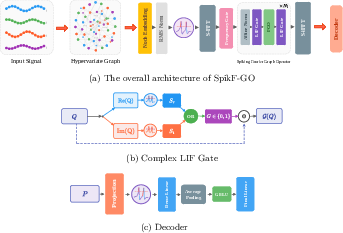
Figure 1: The SpikF-GO pipeline, with hypervariate graph construction, spike encoding, spiking Fourier/spectral graph mixing, and decoding for TSF outputs.
The architecture also features a variant—SpikF-GO w/ CPG—that employs Central Pattern Generator-based positional encodings to mitigate the positional ambiguity (permutation invariance) inherent in SNN self-attention and spectral approaches, further boosting long-range dependency modeling.
Technical Advances
Several key innovations distinguish SpikF-GO from previous work:
- Hypervariate Graph Input Representation: Each scalar input is promoted to a node, enabling unified modeling of intra-series, inter-series, and time-varying cross-series dependencies without explicit spatial or temporal separation.
- Frequency-Sparse Spiking Spectral Processing: The combination of Hard Concrete frequency gating and complex LIF gates enforces selective and binary computation per spectral component. This ensures both energy-efficiency and compatibility with neuromorphic deployment.
- Spiking Fourier Graph Operators (S-FGO): Operations in the spectral domain correspond to efficient spectral graph convolution and mixing without explicit adjacency structure encoding, and the use of complex LIF gating preserves binary, event-driven computation throughout.
- Energy-Efficient Implementation: The model exploits the sparsity of neural and spectral activity, and extensive theoretical energy analysis is presented. The architecture is amenable to drastic reductions in computation and memory footprint by reducing the embedding size.
Empirical Results
SpikF-GO is evaluated under a comprehensive protocol across eight TSF datasets, including traffic, energy, biomedical, and web activity domains, and is compared against nine SNN baselines (including state-of-the-art models such as SpikF and TS-LIF variants) and the ANN baseline FourierGNN. There is consistent demonstration of:
- Superior average rank on both MAE and R2 for SpikF-GO w/ CPG, with standard SpikF-GO achieving the second-best performance.
- Statistically significant improvements over all other SNNs, particularly in tasks with pronounced inter-variable correlations (e.g., sensor networks).
- Robust performance even at low embedding dimension, which corresponds directly to substantial energy savings (7.86× reduction versus FourierGNN with E=8), with minimal accuracy loss.
- Ablation studies confirm the critical value of hypervariate graph modeling and learnable frequency gates: removing either significantly degrades R2.
- Frequency sparsity further enhances deployability and efficiency for hardware-constrained applications.
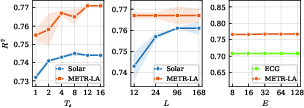
Figure 2: Sensitivity of SpikF-GO to key hyperparameters Ts (spiking timesteps), L (input window), and E (embedding size), with negligible performance loss observed for order-of-magnitude embedding compression.
Theoretical and Practical Implications
This work is, to knowledge, the first to coherently unify spectral, spike-driven computation and explicit multivariate graph structure in SNNs for TSF. By preserving the binary, event-driven computation not only at the neuron level but also in the spectral domain, SpikF-GO enables an efficient path from mathematical formulation to neuromorphic implementation. The integration of frequency-sparse processing with hypervariate graph constructions is particularly well-suited to settings with dynamic and unknown dependency structures, and highly scalable in both the temporal and spatial axes due to the spectral log-linear complexity.
From a practical deployment perspective, the demonstrated efficiency implies potential for always-on inference in embedded, edge, or battery-powered settings, especially for high-dimensional, streaming, or sensor-driven applications. The open-source release of the SpikingTSF library alongside this work further positions the architecture for broad adoption and comparative benchmarking under standardized protocols in SNN-based TSF.
Limitations and Future Directions
A notable limitation is the scaling of computational and energy cost as both input length and channel count increase—matrices and their spectral representations can grow large. While embedding dimensionality can be compressed, very high-dimensional and long-horizon forecasting still present challenges. The energy analysis is theoretical and performed on conventional hardware; real-world neuromorphic deployment and hardware-specific evaluation remain outstanding. Extending the model to structured, sparse, or dynamic graphs (and learning the underlying adjacency or dependency structures at run-time) is a natural progression. Enhancements in hardware-aligned normalization layers and synapse-level pruning may drive further optimizations.
Conclusion
SpikF-GO advances the modeling capacity and energy-efficiency frontier in spiking neural forecasting for multivariate time series. By embedding explicit joint spatiotemporal dependency modeling into a frequency-sparse, binary, event-driven framework, it demonstrates that SNNs can directly compete with and even outperform continuous-valued ANN baselines in both predictive accuracy and operational cost. This architecture opens avenues for broader adoption of SNNs in real-world timeseries intelligence, especially where joint variable modeling and power are critical.

