Approximability limits for bounded-degree max-LINSAT and implications for decoded quantum interferometry
Published 11 Jun 2026 in quant-ph, cs.CC, and cs.DS | (2606.13570v1)
Abstract: For general max-k-XORSAT with $k \geq 3$, no polynomial-time algorithm can do substantially better than random guessing on worst-case instances unless $\mathsf{P} = \mathsf{NP}$: approximating beyond the random-assignment value of $1/2$ is $\mathsf{NP}$-hard. The picture changes when each variable appears in at most $D$ constraints. In that bounded-degree setting, polynomial-time algorithms can provably beat the random baseline by an additive amount of order $1/\sqrt{D}$. For Boolean instances, this scaling is known to be optimal: the matching hardness result is due to Trevisan, while the corresponding algorithmic guarantee was established by Barak et al. Whether the same holds over general finite fields, and what it implies for quantum algorithms, has not been established. We make this connection explicit and extend the hardness to max-E$k$-LINSAT$(q,r)$ with bounded degree $D$ and over arbitrary finite fields $\mathbb{F}q$, proving that it is $\mathsf{NP}$-hard to exceed $r/q + \mathcal{O}{q,r}(1/\sqrt{D})$. These results provide the complexity-theoretic benchmark for the bounded-degree instances targeted by decoded quantum interferometry (DQI), QAOA, and classical heuristics. Any quantum advantage on bounded-degree instances is therefore confined to the constant prefactor. We further show that in the context of DQI and on $(k,D)$-regular instances, this prefactor is sensitive to the nature of the decoder: DQI with classical decoders faces an information-theoretic $1/\sqrt{D \log D}$ barrier that prevents it from matching the hardness scaling, while DQI with quantum decoders is compatible with the $1/\sqrt{D}$ scaling -- identifying quantum decoding as the key ingredient for matching the complexity-theoretic scaling with DQI.
The paper proves NP-hardness of approximating bounded-degree Max-LINSAT beyond r/q + Θ(1/√D) across general finite fields.
The paper transfers classical hardness results to the quantum setting, showing decoded quantum interferometry is limited to constant-factor improvements.
The paper demonstrates that quantum decoding is essential for reaching the optimal 1/√D scaling, setting a clear barrier for both classical and quantum strategies.
Approximability Barriers for Bounded-Degree max-LINSAT and Quantum Optimization
Introduction and Problem Setting
The paper "Approximability limits for bounded-degree max-LINSAT and implications for decoded quantum interferometry" (2606.13570) rigorously analyzes the approximability landscape of bounded-degree Max-LINSAT problems, a broad class of constraint satisfaction problems (CSPs) with algebraic structure. The study also examines profound consequences for quantum optimization methods, notably Decoded Quantum Interferometry (DQI).
Max-LINSAT encapsulates optimization over systems of linear constraints Bx∈F with variables in Fq, where each constraint is satisfied if a linear combination of variables lands in a designated acceptance set F⊆Fq. The computational regime of interest is the bounded-degree setup: each variable appears in at most D constraints. Historically, such bounded-degree settings interpolate between pathological, PCP-style intractable worst-case instances and highly structured instances where advanced algorithms, including quantum algorithms, may yield improvement.
In the Boolean case (q=2), it has been established that the maximum fraction of satisfiable constraints in bounded-degree Max-k-XORSAT, achievable by polynomial-time algorithms, is limited to 1/2+Θk(1/D). However, the generalization of these limits to non-Boolean alphabets, their precise tightness, and their import for quantum heuristics—especially DQI—were open. This work closes this gap.
Main Technical Contributions
The central contributions are:
Tight Bounded-Degree Hardness for General Finite Fields: The paper proves that for Max-Ek-LINSAT over any finite field Fq and acceptance set size r, it is Fq0-hard to approximate beyond Fq1 for degree bound Fq2 (Theorem 1). This matches (up to constants) the best-known classical algorithmic guarantees and generalizes the Fq3 result to all Fq4 and Fq5.
Transfer to Quantum Context: The result establishes that any quantum advantage for bounded-degree Max-LINSAT, when invoking generic quantum strategies such as DQI or QAOA, is limited to constant factors: the asymptotics in Fq6 cannot be improved absent a breakthrough in complexity theory.
Necessity of Quantum Decoding in DQI: For DQI in the bounded-degree setting, the information-theoretic performance bound for classical decoders is Fq7, while quantum decoders alone can saturate the Fq8 hardness ceiling. Thus, quantum decoding is essential for achieving the best theoretically permissible scaling.
The work further elucidates algorithmic techniques and complexity-theoretic reductions, extending Trevisan's degree-reduction and recent hardness results for non-Boolean CSPs, making these implications explicit for both theoretical computer science and the quantum algorithms community.
Bounded-Degree Approximability Landscape
PCP-Based Inapproximability and Degree Reduction
Unbounded-degree Max-EFq9-LINSAT is, as Håstad showed, robustly F⊆Fq0-hard to approximate beyond the random assignment baseline F⊆Fq1. Trevisan's randomized degree-reduction ensures that even when the degree is bounded by F⊆Fq2, the advantage over random assignment cannot surpass F⊆Fq3 unless F⊆Fq4. This is established for Boolean predicates and, in this work, extended to arbitrary fields and arbitrary acceptance-set sizes F⊆Fq5 via explicit reductions:
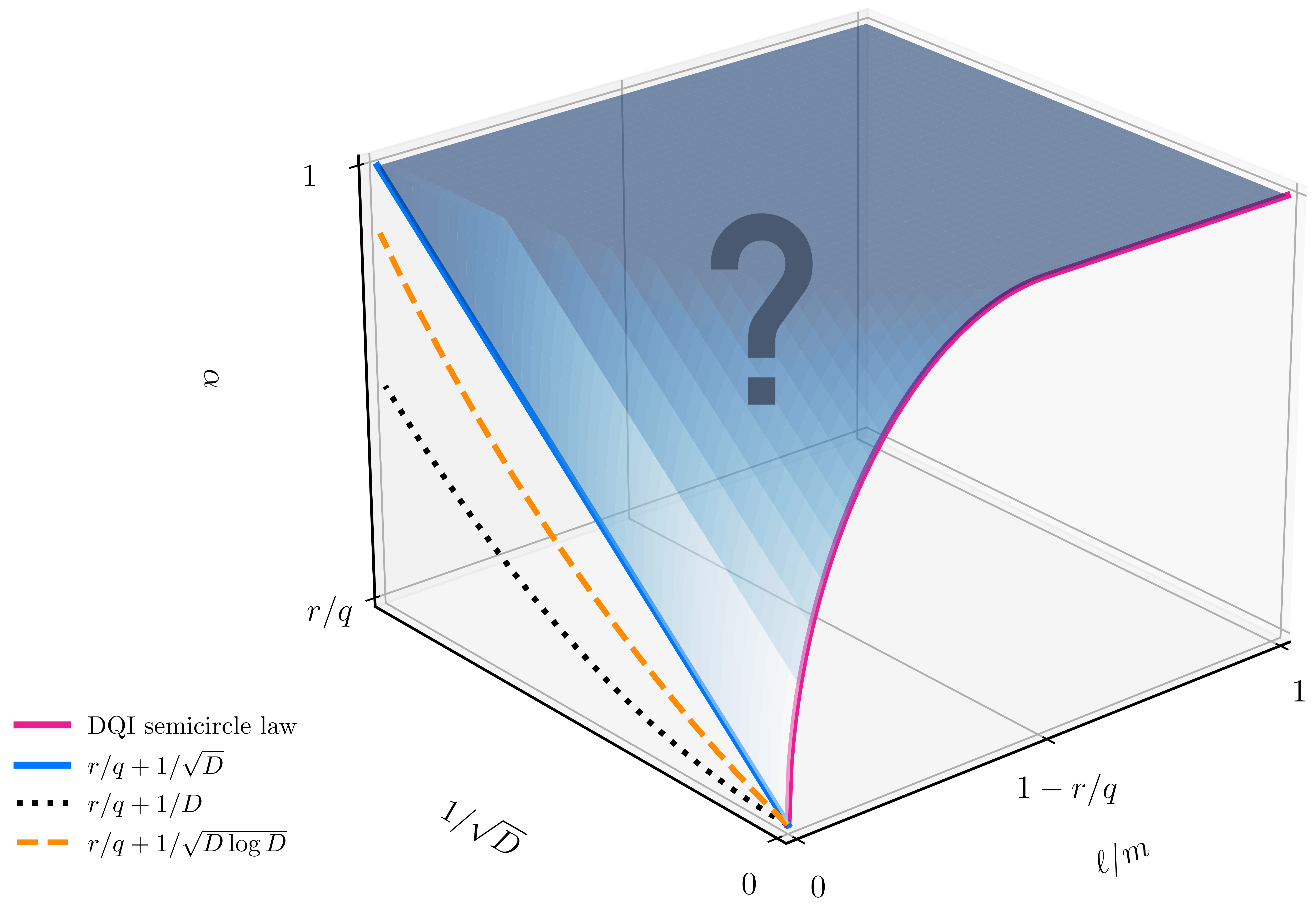
Figure 1: Approximability landscape for bounded-degree max-E{F⊆Fq6}-LINSAT, showing the F⊆Fq7 ceiling as a function of bounded degree F⊆Fq8 and coding-structure parameters in DQI.
For any F⊆Fq9, D0, and D1, the optimal worst-case, polynomial-time achievable approximation ratio is
D2
and any improvement is D3-hard. This both unifies and generalizes prior results, sharply pinning down the frontier for both classical and quantum frameworks.
Algorithmic Achievability and Constants
For bounded-degree Boolean Max-ED4 (i.e., XORSAT), Barak et al. showed an algorithm attaining D5 for odd D6 [Barak et al., APPROX/RANDOM 2015]. On random D7-regular instances, the best quantum and classical heuristics (QAOA, DQI, Turbo Prange) achieve this scaling with explicit leading constants in D8. However, for D9, the best algorithm remains a basic greedy method giving an advantage only of order q=20 (Håstad), exposing a quadratic gap in q=21 compared to the hardness result.
Table: Algorithmic Approximability for Max-Eq=22 (Selected Algorithms)
Algorithm
Advantage over q=23
Quantum/Classical
Barak et al. (odd q=24 or triangle-free)
q=25
Classical
QAOA (depth q=26)
q=27 [numerical]
Quantum
DQI + quantum decoder (theoretical limit)
q=28
Quantum
Håstad greedy (any q=29)
k0
Classical
Average-case analysis (e.g. for Gallager's ensemble) indicates that DQI and well-tuned classical decoders can achieve advantage constants matching each other.
Quantum Algorithms and the DQI Framework
DQI operates by mapping Max-LINSAT instances into code decoding problems, leveraging a quantum circuit that implements a quantum Fourier transform over k1, then extracting a solution via an appropriate decoder—classical or quantum. The semicircle law governs the analytic upper bound on DQI's performance, with the achievable approximation ratio determined by the minimum distance and rate properties of the dual code of the instance's constraints.
The crucial distinction, as revealed by the paper, is that:
DQI with classical decoders: Information-theoretically bounded to an advantage of order k2, unable to saturate the hardness ceiling.
DQI with (ideal) quantum decoders: Achieves rate and distance parameters sufficient to reach advantage k3, matching the proven inapproximability frontier.
Therefore, the full potential of DQI in bounded-degree Max-LINSAT requires efficient, practical quantum decoding algorithms capable of leveraging the full quantum channel structure given by the DQI reduction. Without these, there can be no asymptotic quantum algorithmic advantage in this regime (any advantage must be reflected in subleading constant factors).
Implications for Quantum Advantage and Future Directions
The implications are multiple and direct for both classical complexity theory and the burgeoning field of quantum algorithms for optimization:
Hard Barriers for Quantum Speedup: Quantum advantage for bounded-degree Max-LINSAT—under all current complexity assumptions—cannot outstrip k4. Instances with more structure (e.g. larger minimum distance in the dual code) allow for better performance, but these are not worst-case in the complexity-theoretic sense.
Necessity of Quantum Decoding: The k5 versus k6 scaling gap between quantum and classical decoding within DQI pinpoints the necessity of quantum decoding algorithms to realize the full theoretically permissible quantum advantage on structured CSPs. This places efficient quantum message-passing and quantum belief propagation as critical research objectives [Renes2017, BMP2022, mandal2026beliefpropagationquantummessages].
Gaps for Non-Boolean Alphabets: While the inapproximability result is tight for all k7, algorithmic techniques to match k8 scaling for k9 are undeveloped. Extending the analysis and techniques of Barak et al., particularly those relying on Boolean hypercontractivity and invariance principles, to general finite fields is an important open problem. Alternatively, quantum decoders (if discovered) may directly provoke such an improvement.
Average-Case vs. Worst-Case: On random ensembles (e.g., Gallager), constant factors are empirically higher, and both classical and quantum methods nearly saturate optimal bounds. If quantum tools outperform classical methods on these ensembles, it will likely be through constant-factor improvements, not asymptotic scaling.
Open Problems and Future Work
The paper concludes with several explicit questions for further investigation:
Characterizing the tightest constant 1/2+Θk(1/D)0 such that 1/2+Θk(1/D)1 is algorithmically achievable and hard to beat.
Closing the quadratic gap in algorithmic bounds for non-Boolean Max-LINSAT at bounded degree.
Identifying or constructing efficient quantum decoding approaches that achieve the 1/2+Θk(1/D)2 ceiling in practice.
Understanding whether random instance ensembles (Gallager) truly admit easier average-case algorithms due to their structure or if the worst-case constants are pessimistic.
A systematization of quantum-classical constant-factor competitions, and the delineation of quantum advantage in these regimes, is pointed to as a crucial direction—especially with operational significance for quantum optimization proposals.
Conclusion
This paper solidifies that the bounded-degree Max-LINSAT approximability frontier is set at 1/2+Θk(1/D)3 for both classical and quantum computation. Any hope for broad, fully generic quantum advantage in CSP-structured combinatorial optimization must therefore focus on constant factors at best, unless complexity-theoretic foundations are upended. Quantum decoding emerges as the essential algorithmic primitive for unlocking such advantages in DQI and related frameworks, with open questions remaining about their realization and the transfer of techniques across different finite fields.
Figure 1: The 1/2+Θk(1/D)4 approximability ceiling for bounded-degree max-E{1/2+Θk(1/D)5}-LINSAT, with comparison to DQI algorithmic regimes as a function of degree bound and instance structure.
“Emergent Mind helps me see which AI papers have caught fire online.”
Philip
Creator, AI Explained on YouTube
Sign up for free to explore the frontiers of research
Discover trending papers, chat with arXiv, and track the latest research shaping the future of science and technology.Discover trending papers, chat with arXiv, and more.