- The paper shows that worst-case optimal polynomial intersection can exceed the classical semicircle law bound, notably achieving asymptotically perfect solutions when n/m ≥ 0.7496.
- Methodologically, it leverages Fourier-analytic bounds and secret sharing leakage resilience to reframe and surpass standard moment-based analysis.
- The work identifies key phase transitions and thresholds that redefine performance limits for coding theory, cryptographic protocols, and quantum algorithms.
Optimal Polynomial Intersection: Going Beyond the Semicircle Law (2604.09533)
Problem Statement and Background
The core question addressed is the Optimal Polynomial Intersection (OPI) problem: given m sets S1,…,Sm⊂F and evaluation points a1,…,am, maximizing the satisfaction ratio s(Q) of a polynomial Q of degree less than n such that Q(ai)∈Si for as many i as possible. The analysis primarily focuses on the large field regime (∣F∣ large, notably prime fields).
This question is central to coding theory (list recovery of RS codes), cryptography (noisy polynomial reconstruction), and especially quantum computing, where state-of-the-art quantum algorithms such as Decoded Quantum Interferometry (DQI) solve OPI with guarantees adhering to a semicircle law bound on satisfiability, outperforming classical heuristics like Prange’s algorithm. A theoretical gap remained: is the DQI bound (semicircle law) optimal on worst-case instances, or can better solutions exist? Prior existential and algorithmic bounds coincided at the semicircle law threshold.
Main Contributions
Exceeding the Semicircle Law
The authors demonstrate the semicircle law is fundamentally not tight for worst-case OPI over prime fields. They provide existential results establishing strictly better satisfaction ratios than those predicted by DQI and the semicircle law, for a wide set of parameters. For instance, in the balanced case (∣Si∣/p∼1/2):
- If S1,…,Sm⊂F0, there exist solutions outperforming the semicircle law.
- If S1,…,Sm⊂F1, asymptotically perfect solutions (satisfying all constraints) exist.
These results extend to Max-LINSAT with any MDS generator matrix, and further to arbitrary densities S1,…,Sm⊂F2.
The proof architecture utilizes a deep connection to the local leakage resilience property of secret sharing schemes—especially linking the analysis of OPI to controlling Fourier-analytic proxies studied in secret sharing. Along the way, multiple classical re-proofs for the semicircle law are presented, highlighting structural origins of the "barrier" and avenues for its circumvention.
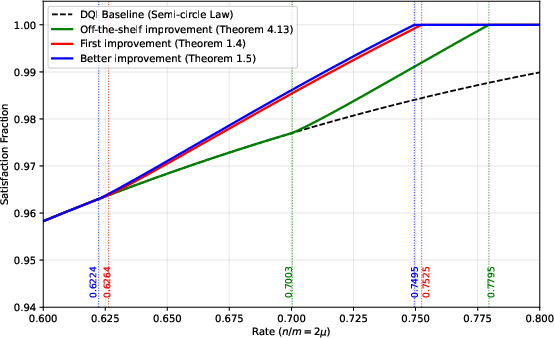
Figure 1: Three improvements on the semicircle law in the balanced case S1,…,Sm⊂F3, showing the new existential bounds (blue/red curves) versus DQI (black dashed).
Quantitative and Phase Transition Results
Two important threshold rates are defined:
- Improvement threshold S1,…,Sm⊂F4: the minimal normalized degree for which improvement over the semicircle law can be achieved for inputs of density S1,…,Sm⊂F5.
- Saturation threshold S1,…,Sm⊂F6: the minimal normalized degree for which perfect solutions exist for any input of density S1,…,Sm⊂F7.
In the balanced case, their main theorems (see Theorem 1 and 2 in the paper) yield the following phase transition:
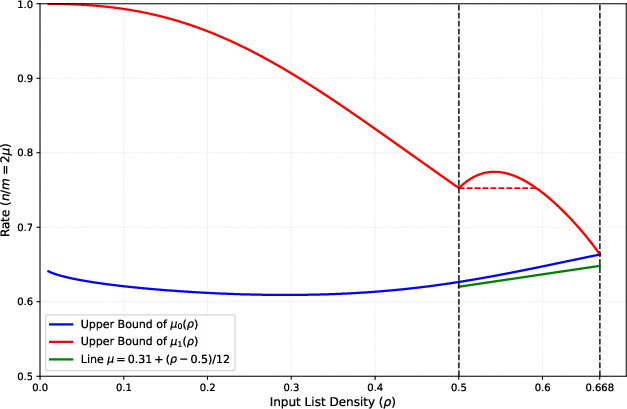
Figure 2: Phase diagram for upper bounds from Theorem 3 on improvement and saturation thresholds as a function of list density S1,…,Sm⊂F8.
Beyond S1,…,Sm⊂F9, improvements over the semicircle law do not hold under the methods used; improvement is strictly monotonic in a1,…,am0 (barring technical artifacts). The paper further provides detailed asymptotics and explicit expressions for the improvement and saturation boundaries, supported by robust entropy calculations and code-theoretic combinatorics.
Technical Architecture
Re-Proofs and the “Semicircle Law Barrier”
Two classical, combinatorial re-proofs for the semicircle law are presented:
- Moments Method: The first a1,…,am1 moments of the satisfaction random variable for random a1,…,am2 match those of the appropriate Binomial, producing a Kravchuk polynomial structure whose extremal roots generate the semicircle law bound.
- Discrepancy/Fourier Method: Sampling is modified via a1,…,am3-wise discrepancies, expressing higher moment structure for a1,…,am4 via code duals and analyzing their effect with respect to code minimum distance.
Both approaches elucidate why all existing techniques (classical or DQI) "get stuck" at the semicircle barrier: analytical frameworks (moment matching, degree of polynomial certificates, or a1,…,am5-wise independence) do not distinguish objects exceeding semicircle value—thus breaking this wall fundamentally requires new ideas.
Secret Sharing and Leakage Resilience Connection
A pivotal insight is relating the controlling of large-discrepancy events to Fourier-analytic bounds for leakage-resilient secret sharing (notably, Shamir/Massey schemes over prime fields). This relationship enables adaptation and sharpening of techniques used in that literature (e.g., bounding per-transcript Fourier-proxy terms) for OPI. The main technical advance is in partitioning coordinates flexibly (via many "buckets") to ensure a large number of coordinates land in a "good" configuration for any support set, enhancing exponential decay factors in satisfaction probabilities and exceeding previous (leakage-resilience) existential thresholds.
Numerical and Phase Results
A family of optimization problems, parameterized by target density and code rate, is formulated for establishing improvement and saturation limits. The numerical consequences include the explicit closed-form entropy expressions for the critical rates, and the demonstration that the maximal feasible improvement arises from selecting optimal partitions and balancing trade-offs between the number of buckets and their intersection properties.
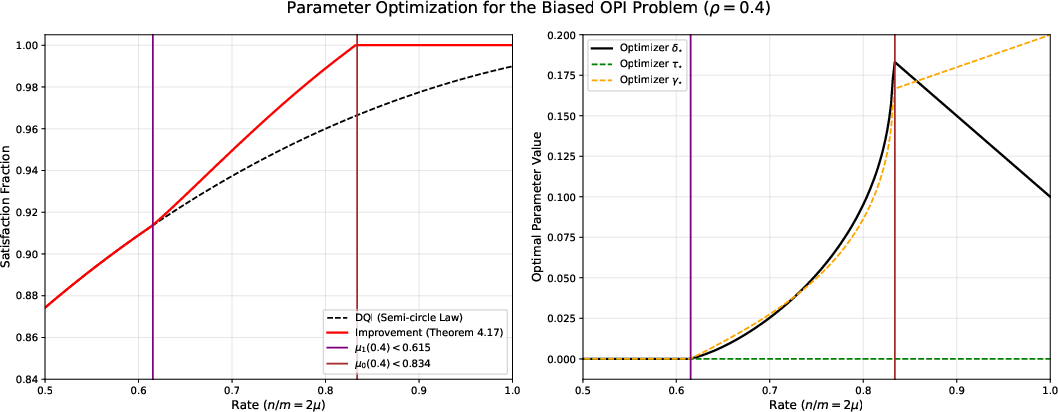
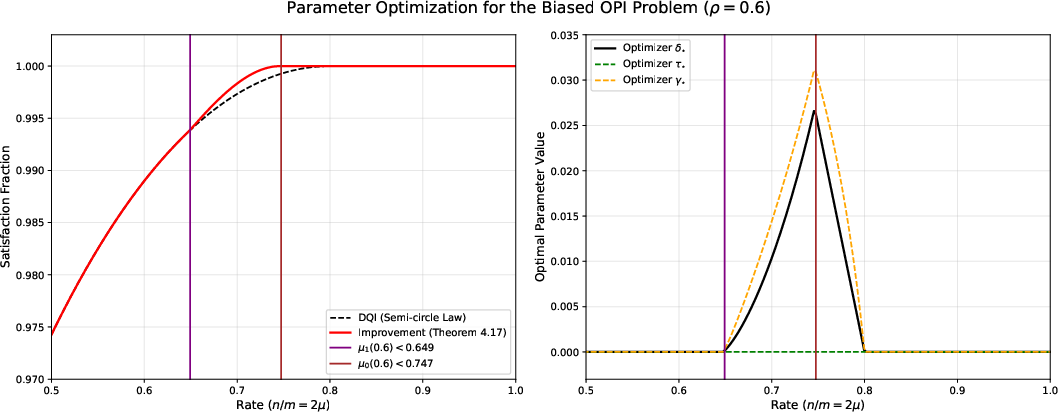
Figure 3: For two values a1,…,am6, plots of optimizing parameters and the improvement over the semicircle law as a function of code rate.
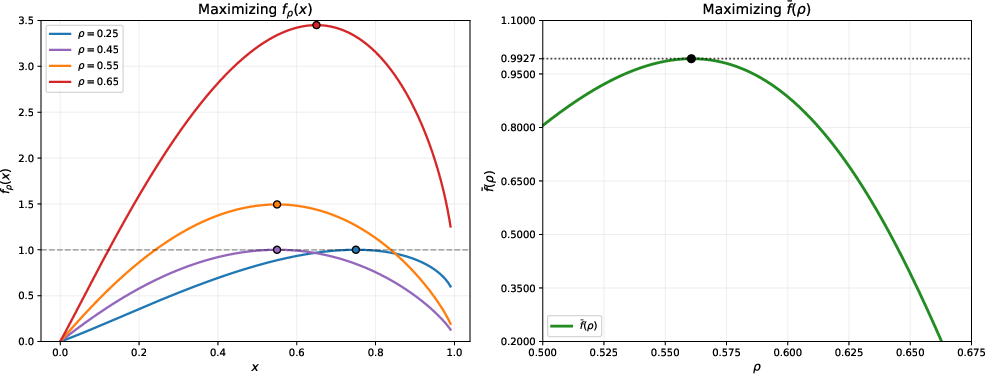
Figure 4: a1,…,am7, measuring monotonicity and optimality of the improvement as a function of the coded intersection parameter a1,…,am8.
Implications and Future Directions
Theoretical Impact
- Disproving previous optimality conjectures: DQI and its semicircle law are not optimal on worst-case instances—quantum quantum speedups are not capped by this bound.
- Establishes new barriers at higher rates: The new thresholds for perfect satisfaction tie OPI performance to the best-known (and recently improved) bounds in the secret sharing leakage resilience literature.
- Opens fertile ground for algorithmic improvements: While these results are existential, the connection to quantum and classical coding algorithms could inform future algorithmic breakthroughs exceeding DQI performance, particularly exploiting the probabilistic structure in the worst case.
Practical Relevance
- Coding theory: Guidance for the design of list recovery and reconstruction algorithms for RS and more generally MDS codes well beyond traditional derandomized bounds.
- Cryptography: Hardness assumptions and list-decoding-type cryptosystems may need to revise their security arguments, as new existential solutions could provide weaker noise-hardness than currently believed.
- Quantum computing: Potential for quantum and classical hybrid algorithms able to exploit analytic properties disclosed by this work.
Open Problems
- Algorithmic realization: Is there an efficient quantum algorithm that matches the new existential bounds?
- Leakage resilience: Can the techniques break the "Fourier-proxy barrier" in leakage-resilient secret sharing, or are there fundamentally new methods required for further progress?
- Extension fields: Can similar phenomena be established for non-prime fields, or is there a prime-field/non-prime-field dichotomy as in leakage resilience?
- Closing the gap: What is the true optimal rate for worst-case OPI satisfaction, especially in the region beyond current saturation thresholds?
Conclusion
This paper advances the understanding of the OPI problem, proving that the classical and quantum semicircle law bound is not fundamental for worst-case inputs over prime fields. The intricate connection to secret sharing schemes and Fourier analysis both reframes the analytic landscape of OPI and anchors its extremal behavior within well-studied cryptographic questions. The new existential thresholds and phase transitions encourage both practical and foundational reconsiderations in error correction, quantum algorithm design, and cryptographic security, and prompt challenging open problems in combinatorics and theoretical computer science.

