- The paper demonstrates that Decoded Quantum Interferometry’s mechanism extends beyond Hamming metrics by leveraging rank-metric and translation association schemes.
- It employs advanced Fourier analysis and tridiagonal Jacobi matrices to rigorously analyze quantum interference and spectral bias in matrix spaces.
- The study integrates Gabidulin codes with explicit shell state preparations to highlight both the potential advantages and limitations in achieving quantum advantage.
Decoded Quantum Interferometry Beyond Hamming: Rank-Metric and Translation Association Schemes – An Expert Summary
Introduction and Background
The paper "Decoded Quantum Interferometry Beyond Hamming: Rank-Metric and Translation Association Schemes" (2606.04843) generalizes the core structural mechanism of Decoded Quantum Interferometry (DQI) from the Hamming metric to more general translation association schemes, focusing especially on the rank metric. DQI is a quantum algorithmic framework for approximately solving structured optimization problems via the quantum preparation and interference of code-encoded states, with constructive bias toward solutions optimizing some combinatorial objective. Advanced DQI analyses fundamentally exploit shell structures and distance transitivity, as realized in association schemes.
The paper deeply investigates metrics and geometries beyond the Hamming case—specifically, translation association schemes over finite fields, with a central application to the rank metric on matrix spaces. At a high level, the results show that the mechanism of DQI—coherent shell-state preparation, dual code syndrome decoding, finite-field Fourier interference, and performance analysis via orthogonal polynomials—extends to cases like the rank metric, and is governed structurally by the properties of P-polynomial association schemes, tridiagonal Jacobi operators, and their spectral theory.
Translation Association Schemes and Radial Structure
The analysis of DQI is phrased in terms of translation association schemes, which generalize metric properties crucial for the original Hamming-based DQI. For a translation-invariant metric d on the additive group $\X$, distance shells Γi (sets of points at distance i from a basepoint) enable a radial reduction: quantum states and operators can be described at the level of shells, with the key adjacency operator A1 acting tridiagonally in this basis due to the P-polynomial property.
Shell Dicke states (uniform superpositions over shell elements) manifest the radial symmetry relevant to both quantum preparation and performance analysis. The adjacency action reduces to a symmetric tridiagonal Jacobi matrix A~ on the shell amplitudes (the radial sector). The spectral theory of this matrix controls the interference and thus the bias toward high-quality solutions.
(Figure 1)
Figure 1: The shell structure and radial walk induced by the adjacency operator in a P-polynomial translation association scheme. The walk mixes points only within a shell and its nearest neighbors, ensuring tridiagonal dynamics for DQI.
Fourier Analysis, Code Duality, and Orthogonal Polynomials
The quantum Fourier transform on $\X$ plays a central role in mapping shell Dicke states to "dual" radial superpositions. For translation association schemes satisfying sufficient symmetry and transitivity conditions, the distance matrices are diagonalizable in the Fourier basis, and the eigenvalues d0 (character sums over shells) depend only on the shell index.
This structure guarantees that DQI, after preparing a state supported on low shells (small-distance errors/syndromes), decodes and Fourier-transforms into a state where amplitudes depend only on the shell (distance from target solution). The interference pattern is analytically tractable via radial eigenvalue polynomials that satisfy three-term recurrences. In classical schemes (Hamming, Rank), these are Krawtchouk and d1-Krawtchouk polynomials respectively.
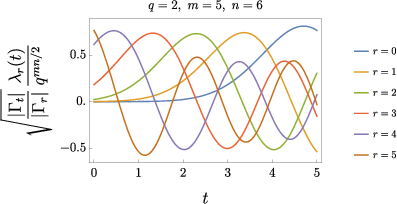
Figure 2: Plot of the rescaled d2-Krawtchouk polynomial d3, which controls the amplitude distribution across shells after the Fourier transform in the rank-metric setting.
The duality properties are enforced by code structure: the code average enforces a dual constraint, and dual codes with high minimum distance guarantee unique syndrome decoding within low shells—a prerequisite for efficient and reversible syndrome decoding in DQI.
Rank-Metric Specialization: Shells, Codes, and the DQI Protocol
Rank-Metric Geometry and Shells
For d4 with the rank metric (d5), the shells comprise matrices of fixed rank. The group actions and trace pairing ensure the radial and spectral structure required for shell-based analysis; the Jacobi parameters (recursion coefficients) and shell sizes have exact combinatorial forms involving Gaussian binomials and the d6-Pochhammer symbol.
Coding: Gabidulin and MRD Codes
Dual-syndrome reversible decoding is realized through Gabidulin codes, the rank-metric analogues of Reed–Solomon codes. These codes saturate the Singleton bound and support efficient decoding—critically, their duals also are Gabidulin, preserving tractability of dual syndrome decoding up to half the minimum distance.
Rank-Metric DQI Protocol
The DQI protocol in the rank-metric setting constructs weighted superpositions over shells up to cutoff d7, applies target-dependent Fourier phases, coherent unique dual syndrome decoding, and the quantum Fourier transform. For each candidate d8, the final amplitude depends solely on the residual rank d9; sampling is quadratically biased towards lower-rank solutions according to the (optimized) amplitude profile, which is analyzable entirely in terms of $\X$0-Krawtchouk polynomials and the truncated Jacobi matrix for the shell weights.
Strong results include explicit circuit constructions for clean preparation of rank-shell Dicke states (by factoring into Grassmannian, GL, and gauge state preparations) and an explicit mapping of the sampling distribution to a finite tridiagonal eigenvalue problem.
The central performance proxy is the normalised objective $\X$1, a monotonic function of the residual rank. For shell weights $\X$2, the expected score of the DQI output coincides with the top eigenvalue (and eigenvector) of the truncated radial Jacobi matrix, after suitable normalization. The optimal shell weights maximize this expectation, and their variance is also computable via the matrix square, furnishing tight bounds on sample concentration.
A spectral analysis demonstrates that, in the large-system regime ($\X$3 with fixed aspect ratio), the optimal shell weights concentrate on a narrow boundary window beneath the cutoff, and the effective-rank proxy concentrates near $\X$4 (where $\X$5). The bias toward low rank is dictated by the $\X$6-geometric nature of the recurrence, not by a semicircle law as in the Hamming case. The tail bounds (via Paley–Zygmund inequalities) for sampled rank are quantitatively controlled; with appropriately optimized weights, one can ensure a nontrivial probability of outputting a matrix with residual rank within $\X$7 of $\X$8.
Notably, for Gabidulin codes, a covering-radius argument shows a structural obstruction: the dual unique-decoding radius does not suffice for an additive approximation guarantee to the true optimum (which is determined by the primal code's covering radius). Thus, the protocol does not, for natural code families, achieve quantum advantage in the strongest sense for the singleton-target rank-metric decoding objective.
Theoretical and Practical Implications
This work precisely articulates the role of the association scheme structure for DQI, conclusively demonstrating that the DQI quantum interference mechanism, performance analysis via tridiagonalization, and optimization via orthogonal polynomials are not artifacts of Hamming geometry, but hold uniformly across a broad swathe of translation-invariant metrics with shell structure and transitive symmetry. The explicit character of the construction in the rank-metric case strongly ties quantum approximate optimization to advanced combinatorial and coding-theoretic structures (e.g., Gabidulin codes, $\X$9-Krawtchouk polynomials).
The generalized protocol supports:
- Clean initial state preparation across non-Hamming geometries (with explicit shallow circuits),
- Tractable and optimal amplitude biasing governed by finite-dimensional spectral problems,
- The possibility (given sufficiently structured codes and objectives) of sampling high-quality solutions for non-binary, matrix-valued optimization problems.
However, it reveals that quantum advantage for code-centered optimization via DQI is conditioned not only on quantum speed but on structural properties of the code and its dual: in rank-metric (and potentially other) cases, the covering radius explicitly constrains what can be guaranteed, even with perfect quantum interference.
Outlook and Future Directions
The framework provided invites several directions for further exploration:
- Sum-rank metric and product targets: Extending DQI to sum-rank association schemes (interpolating between Hamming and rank) and to more general product- or set-valued constraint targets is a natural avenue, possibly affording richer optimization structures closer to combinatorial Max-LINSAT or CSPs.
- Non-translation geometries: Further generalization to Johnson and Grassmannian association schemes could extend the utility of DQI algorithms to projective-space problems and modular CSPs.
- Hamiltonian and Gibbs state preparation: The spectral tridiagonal structure provides algorithms and analysis for ground-state and Gibbs state sampling in commuting Hamiltonians, as in Hamiltonian DQI extensions.
- Code family selection and ensemble design: New code constructions balancing dual unique decoding and large covering radius may bridge the gap exposed in the rank-metric singleton case.
- Soft- and quantum-enhanced decoders: Incorporating recent advances from quantum decoding and soft-decision decoders expands the domain of tractable DQI applications.
Conclusion
The extension of DQI to rank-metric and general translation association schemes establishes a comprehensive algebraic and quantum-semiclassical foundation for code-based quantum optimization, organized via the commutant structure and spectral decomposition of association schemes. While quantum advantage for code-based combinatorial optimization awaits further breakthroughs in code design or decoder capabilities, this work solidly positions DQI as a general mechanism deeply rooted in the interplay between algebraic combinatorics, quantum computation, and coding theory.

