- The paper introduces a systematic human-AI-Lean workflow that automates formal proof construction and verification in economics and computation research.
- It leverages LLM-generated Lean statements with a dashboard interface to streamline proof translation and human oversight, reducing manual workload.
- EconCSLib demonstrates scalability by formalizing multiple foundational papers with over 100,000 lines of Lean code, enhancing research reproducibility.
Motivation and Scope
"EconCSLib: AI-Assisted Lean Formalization for Economics & Computation research" (2606.13306) proposes and implements a systematic human-AI-Lean workflow to bring rigorous formal verification to research in economics and computation. Leveraging advancements in LLM code generation, particularly with the capabilities of models like GPT-5.5 Pro in Lean 4, the project aims to make formal proof verification accessible for applied mathematical domains where established libraries have been traditionally sparse. The central idea is to audit, formalize, and verify entire research papers in Lean, with humans overseeing translation boundaries and LLMs automating the bulk of proof construction and repair.
Library Architecture and Workflow
EconCSLib is organized into two primary layers: a reusable library containing foundational modules for probability, optimization, matching markets, auctions, online algorithms, recommender systems, rankings, and fair division; and paper-specific folders encapsulating statement translation, theorem formalization, proof construction, and human-facing audit artifacts. The library modules are extracted from community papers and elevated when general applicability is detected, enhancing composability in future formalizations.
Each paper formalization involves structured artifacts:
- PaperInterface.lean: Exposes all paper-facing definitions and theorem statements.
- Automated DAGs: Capture statement dependencies and formalization status.
- Validation Reports: Document proof deviations, required assumptions, and audit findings.
- Translation Review Dashboard: Supports human and LLM verification of correct statement translation.
The workflow for author-facing formalization follows this sequence: an LLM extracts mathematical statements from the paper (typically from LaTeX or PDF), constructs Lean statements and proof code, iteratively elevates reusable results to the shared library, and auto-generates human-auditable artifacts for translation correctness. The process is supplemented by persistent logging, translation validation (human and LLM-as-Judge), and a dashboard interface.
Artifact Inspection and Human-AI Synergy
A major policy is that humans are responsible for verifying only the translation of paper-facing statements, not the entire proof code. This is facilitated by the dashboard, which presents each theorem's source LaTeX, Lean formalization, LLM-generated back-translated LaTeX, and a human review interface. LLMs act as preliminary judges by comparing translated statements and flagging uncertain cases for human inspection.
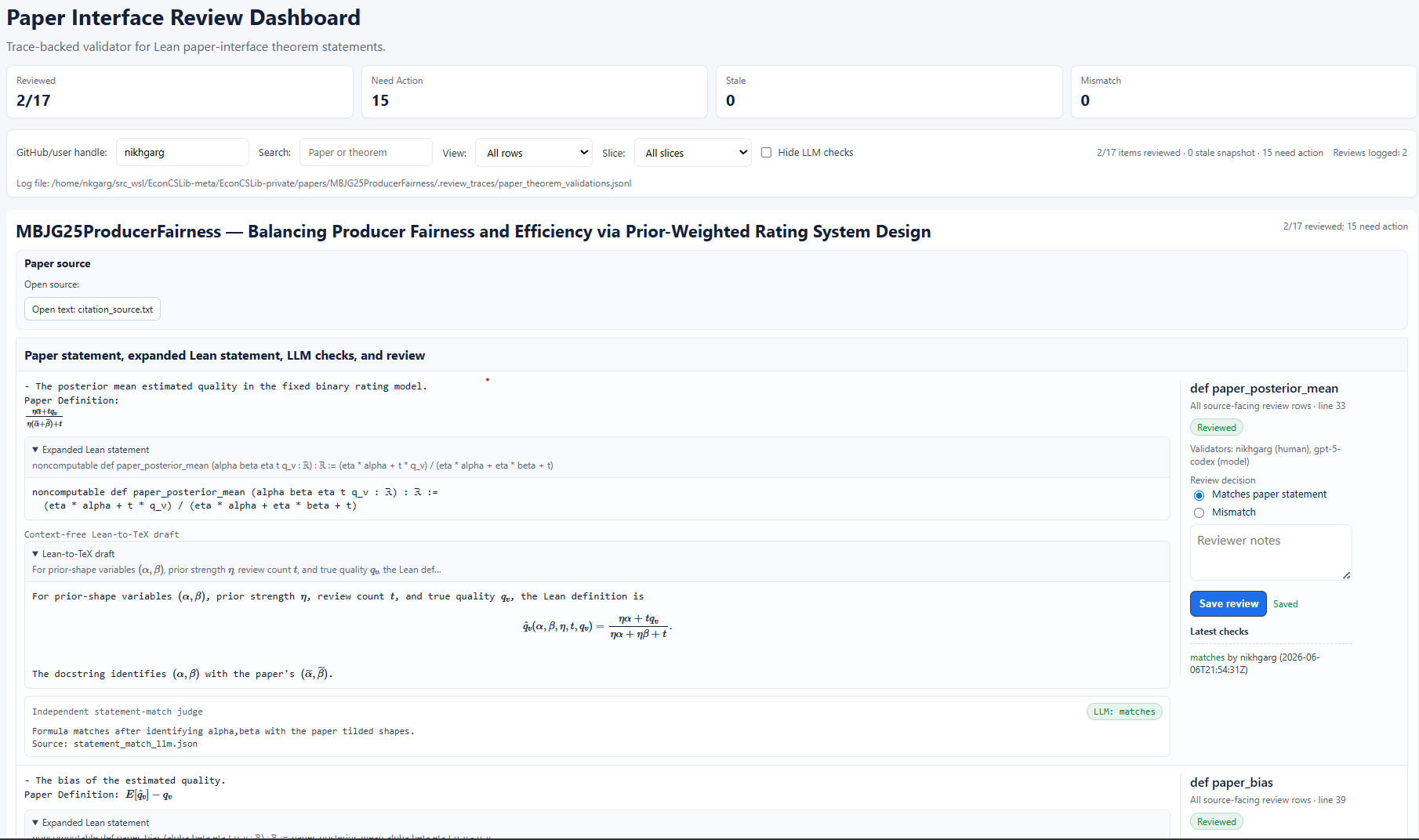
Figure 1: Screenshot of the dashboard for reviewing translation from paper statements to Lean statements, incorporating LLM-generated verdicts and human review controls.
Dependency graphs are auto-generated to visualize the formalization process of each paper, providing concise insight into formalization progress, the DAG structure, and any bottlenecks.
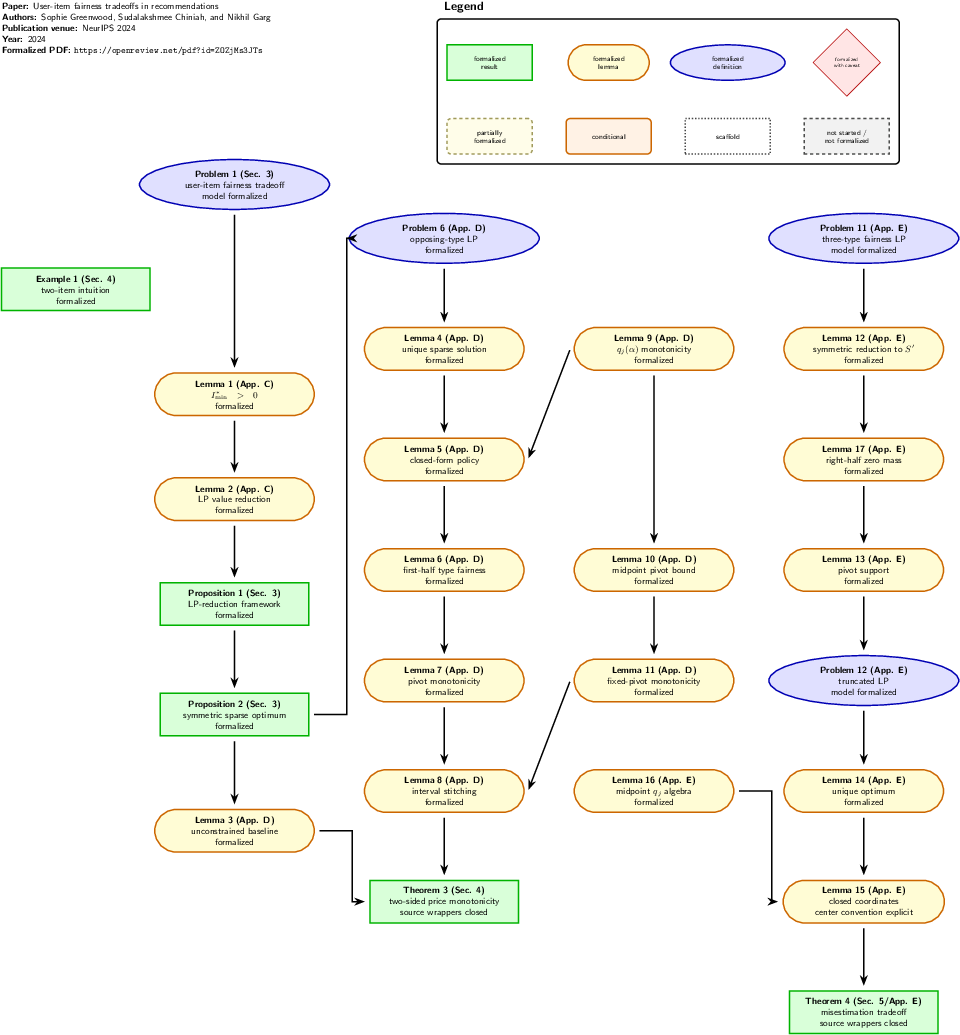
Figure 2: DAG showing complete formalization of key statement dependencies for a recommender system fairness paper.
Coverage, Progress, and Numerical Results
As of the documented release, EconCSLib formalizes 14 papers (11 completed, 3 partial), spanning both author's publications and foundational works in the Economics & Computation literature, such as Gale-Shapley matching, Roth's stability, Goldberg-Hartline-Wright competitive auctions, and Mehta-Saberi-Vazirani adwords. Proof code scales up to over 100,000 Lean lines for probability-heavy papers (e.g., [liu2021testoptional], [garg2021driver]), enabled by reusable library modules (some exceeding 50,000 LOC for probability/stochastic processes).
The human-LLM translation validation achieves high coverage, with detailed status logs (e.g., Table 1 in the paper): for fully formalized papers, LLM-as-judge matches the intended statements in nearly all cases, with sparse instances of uncertainty or mismatch. Token costs are substantial, with overall Codex usage exceeding $16,000 if paid per token, but manageable under a subscription paradigm.
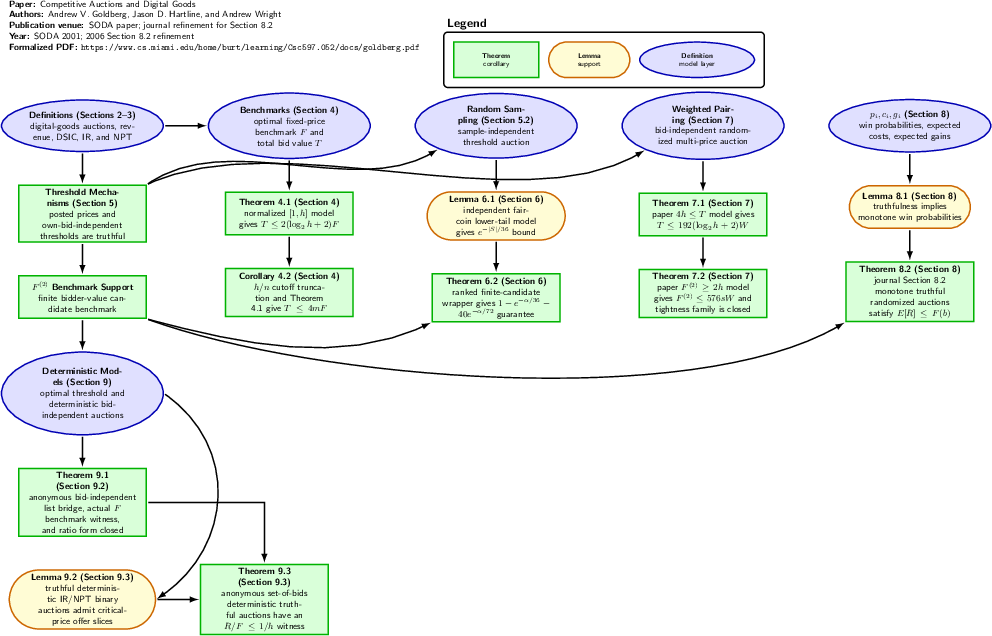
Figure 3: Statement dependency DAG from a classic auction paper, reflecting verification flow and cross-version provenance.
Practical Bottlenecks and Implications
A primary challenge is human translation verification—ensuring that Lean statements precisely capture informal mathematical claims. While LLMs increasingly automate translation, expert review remains necessary for high-stakes validation and library-level correctness. The project identifies sociological and epistemological concerns:
- Error Detection: Underspecified proof steps in papers require additional assumptions or alternative strategies during formalization, raising questions about best practices for errata publication and correction.
- Library Integration: The interplay between AI-generated libraries and human-curated projects (e.g., Mathlib, CSLib) surfaces issues of trust, attribution, and intermediate translation correctness.
- Automation Cost and Scalability: Token usage and infrastructure dependencies necessitate agent scaffolding and future reduction in code generation cost—especially for continuous probability and measure-theoretic arguments.
- AI-generated Proofs: While Lean is effective for discrete mathematics, ongoing development aims to improve coverage for advanced probability and complexity-theoretic arguments, enabling future AI-driven theorem discovery.
Long-Term Perspectives
The author foresees a near-future workflow where AI-generated Lean verification accompanies all conference paper submissions (e.g., EC or STOC), with community libraries like EconCSLib and CSLib underpinning scalable, author-facing formalization. As library modules mature and human-in-the-loop translation verification becomes more streamlined, research verification, reproducibility, and proof efficiency across economics and computation will be substantially enhanced. There remains an open question regarding the organization, governance, and auditability standards under open-source development and integration with human-led repositories.
Conclusion
EconCSLib demonstrates the viability of large-scale, AI-assisted Lean formalization for applied theory research, offering reusable infrastructure for mathematical domains previously unserved by formal verification. The approach significantly reduces human proof-checking burden by focusing human effort on translation boundaries, guided by LLM-assisted artifact generation and dashboard validation. Adoption and further development will hinge on resolving human verification bottlenecks, integrating with established community libraries, and sustaining scalable agentic workflows. The project establishes a principled foundation for formalizing the canon and frontier of economics and computation, and provides practical lessons for the broader AI-automated formal verification movement.