- The paper presents faust2clap, a system enabling static binary generation and dynamic hot-reloading for Faust DSP code in CLAP plugins.
- It introduces unified parameter binding with address-based mapping to maintain automation-safe parameter identity during real-time DSP mutations.
- Evaluation demonstrates hot-reload latencies between 5–60 ms and minimal audio processing overhead, affirming its practical use in interactive audio plugin development.
A Dual-Mode Faust-to-CLAP Compilation System: Technical Analysis
System Overview and Motivation
The paper "A Dual-Mode Faust-to-CLAP Compilation System" (2606.13193) presents faust2clap, a compilation and runtime framework enabling both static binary generation and dynamic hot-reloading of Digital Signal Processing (DSP) algorithms written in Faust for the CLAP (CLever Audio Plugin) standard. The design addresses a fundamental tension in audio plugin development: real-time efficiency achievable via native compilation, versus rapid iterative design necessitating minimized edit/compile/load cycle latency. Existing Faust toolchains support VST, AU, and LV2 via static architectures, but lack a robust, officially maintained CLAP backend or a mode supporting runtime DSP mutation while preserving host mappings.
This system introduces two tightly integrated pathways—static and dynamic—each leveraging unified parameter binding and address-based mapping to guarantee both computational efficiency and iterative agility. It is the first system to integrate dynamic, runtime compilation for Faust-to-CLAP with automation-safe parameter identity, facilitating modern workflow requirements in audio plugin development.
Architecture: Static and Dynamic Compilation Pathways
The proposed framework offers two distinct compilation modalities:
Static Pathway: Employs ahead-of-time (AOT) compilation, transforming high-level Faust DSP code into statically linked, native CLAP binaries. The Python-based orchestrator invokes the Faust compiler with a dedicated CLAP architecture layer, and CMake handles final binary generation. This pathway achieves zero runtime interpretation penalty.
Dynamic Pathway: Implements live hot-reloading using the libfaust interpreter and real-time file monitoring (via efsw), recompiling modified Faust DSP code on-the-fly to virtual machine bytecode. The VM executes in the plugin context, enabling DSP mutation during host operation while maintaining DSP state and automation mappings through a robust bookkeeping system.
The architecture for both modes ensures parameter mapping infrastructure is shared to maximize consistency and minimize code duplication. Importantly, the dynamic pathway currently supports only monophonic operation, while the static pathway accommodates polyphony by default for instrument-classified DSPs.
Algorithms: Parameter Identity and Automation-Safe Reloading
A core problem in interactive DSP mutation environments is preserving host automation bindings and current parameter values through potentially disruptive reload cycles. The framework addresses this with an address-based identity matching algorithm and a stable slot allocation scheme.
Address-based Value Preservation
Rather than mapping host automation to parameter indices, parameters are referenced by their hierarchical address strings (e.g., /Effect1/Decay), which remain stable across code mutations as long as the signal path semantics are unchanged. Upon reload, a two-pass algorithm hashes old parameter values by address and reinstates them to matching new parameters, clamping as needed to new value bounds. Renaming or structurally removing a parameter severs this mapping by design, guaranteeing deterministic and predictable host behavior.
Stable Slot Mapping for Host Automation
To maintain automation safety, parameters are mapped to a fixed number (k=12) of static slots, with the mapping algorithm designed to preserve slot-parameter assignments across reloads if the parameter address persists. This technique, borrowed conceptually from Surge XT Effects, decouples host-exposed parameter slots from underlying DSP parameter count and order. Parameters beyond k are exposed for internal modulation but not for host automation, a conscious trade-off balancing predictable automation mapping with manageable host complexity.
Heuristic DSP Classification
Automated detection of processor/instrument dichotomy facilitates appropriate resource allocation (e.g., polyphony). The framework implements a hierarchical heuristic based on: declared Faust metadata, file name lexical analysis, and DSP structural compilation output. Edge cases where input/output symmetry is ambiguous require explicit override by the developer via first-level metadata.
Implementation and Evaluation
The faust2clap implementation integrates approximately 2,400 lines of C++ and supporting Python, with the dynamic interpreter machinery incurring a hot-reload latency of 5–60 ms across a range of DSP sizes, as measured on an Apple M2 platform.
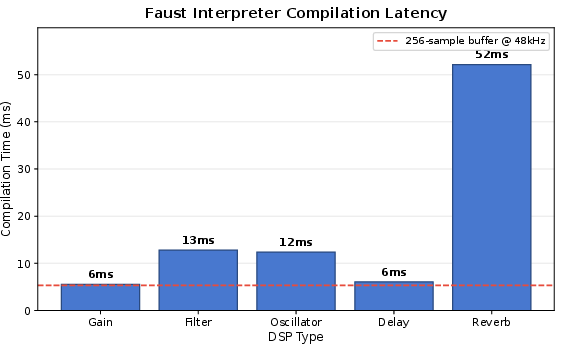
Figure 2: Interpreter compilation latency as a function of DSP complexity, all within 60 ms and well below interactive usability thresholds.
Importantly, parameter preservation and automation mapping robustness were validated across a spectrum of DSP topologies, with consistent value and automation slot survival on reloads where parameter addresses remained static. The framework’s interpreter exhibits substantial real-time headroom, even for computationally intensive DSPs; processing time for the heaviest tested topology (stereo reverb) remained at 0.27 ms per audio block, offering 20× real-time capacity.
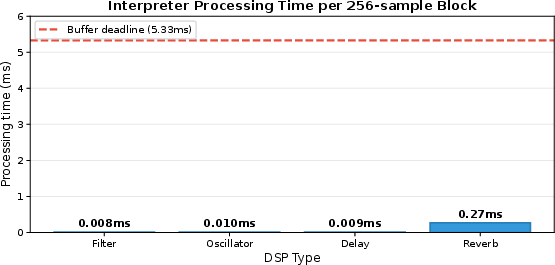
Figure 1: Dynamic interpreter processing time per buffer block compared to the real-time deadline at 48kHz, confirming practical viability for development cycles.
Host buffer format adaptation is handled at runtime, allowing seamless operation with both 32- and 64-bit floating-point host DAWs.
A notable limitation is the brief (non-realtime-safe) discontinuity during hot-reload, accepted as a developer-centric design compromise. Future work targets asynchronous recompilation and memory-double-buffering to fully preserve real-time audio constraints.
Implications and Future Directions
Practical Impacts: This system enhances Faust’s usability in interactive plugin prototyping, providing frictionless DSP iteration and robust deployment for CLAP plugin development. The address-based and slot-stable parameter identity algorithms ameliorate a long-standing hindrance, enabling persistent automation through mutable DSP structures without compromising host integrity.
Theoretical Implications: The adoption of semantic, address-based parameter identity suggests a shift away from positional dependency in host-plugin interfaces, a pattern potentially generalizable to other plugin APIs and DSL-based toolchains for broader reproducibility and workflow resilience.
Future Prospects: Incorporating an LLVM-based backend for the dynamic pathway would likely collapse the performance overhead gap between interpreter and static code, making dynamic mutation feasible in production use. Extending dynamic hot-reload to true polyphonic processing also opens avenues for rapid iteration in instrument plugin development. The formalization of address/slot mapping could inform future extensible host-plugin API standards.
Conclusion
The faust2clap system establishes a versatile, automation-safe bridge between the Faust DSP language and the CLAP standard. By addressing both efficiency (via static compilation) and highly interactive, rapid development (via dynamic hot-reload), while introducing robust parameter identity guarantees, it supports modern creative and production workflows without sacrificing host reliability or developer flexibility. This bi-modal architecture and its supporting algorithms set a technical precedent for future DSP language integrations with next-generation plugin standards.