- The paper introduces a Python-native game engine that integrates a C++17/Vulkan core with a Python authoring layer, using batch data transfers and JIT compilation to enhance real-time performance.
- It demonstrates significant performance gains in editor scenarios and compute-intensive tasks through auto-parallelization and optimized cross-language communication.
- The engine’s design offers practical benefits for simulation, robotics, and embodied AI by reducing Python-C++ interaction overhead and enabling efficient, deterministic update cycles.
Infernux: A Python-Native Game Engine with JIT-Accelerated Scripting
Introduction
Infernux presents a Python-first architecture for real-time game engines, diverging from industry standards that tether the core authoring experience to C# or C++. The engine pairs a C++17/Vulkan core with a Python authoring layer that handles all gameplay scripting, editor tooling, and render-pipeline definition. This approach addresses persistent impedance mismatches in simulation, robotics, and embodied AI workflows, where Python dominates but commercial engines remain inaccessible or inefficient via bindings and IPC mechanisms.
The technical strategy revolves around two primary mechanisms: (1) a batch data transfer bridge enabling efficient crossing between the CPython interpreter and native code, and (2) an optional Just-In-Time (JIT) compilation path leveraging Numba to auto-parallelize and JIT-compile critical logic. The design is deliberately cohesive, integrating both batch and JIT paths at the engine level, with a consistent fallback and hot-reload strategy. Benchmark comparisons with Unity 6 quantify throughput and isolate confounding contributions from shading complexity, draw-call dispatch, and editor-layer overhead.
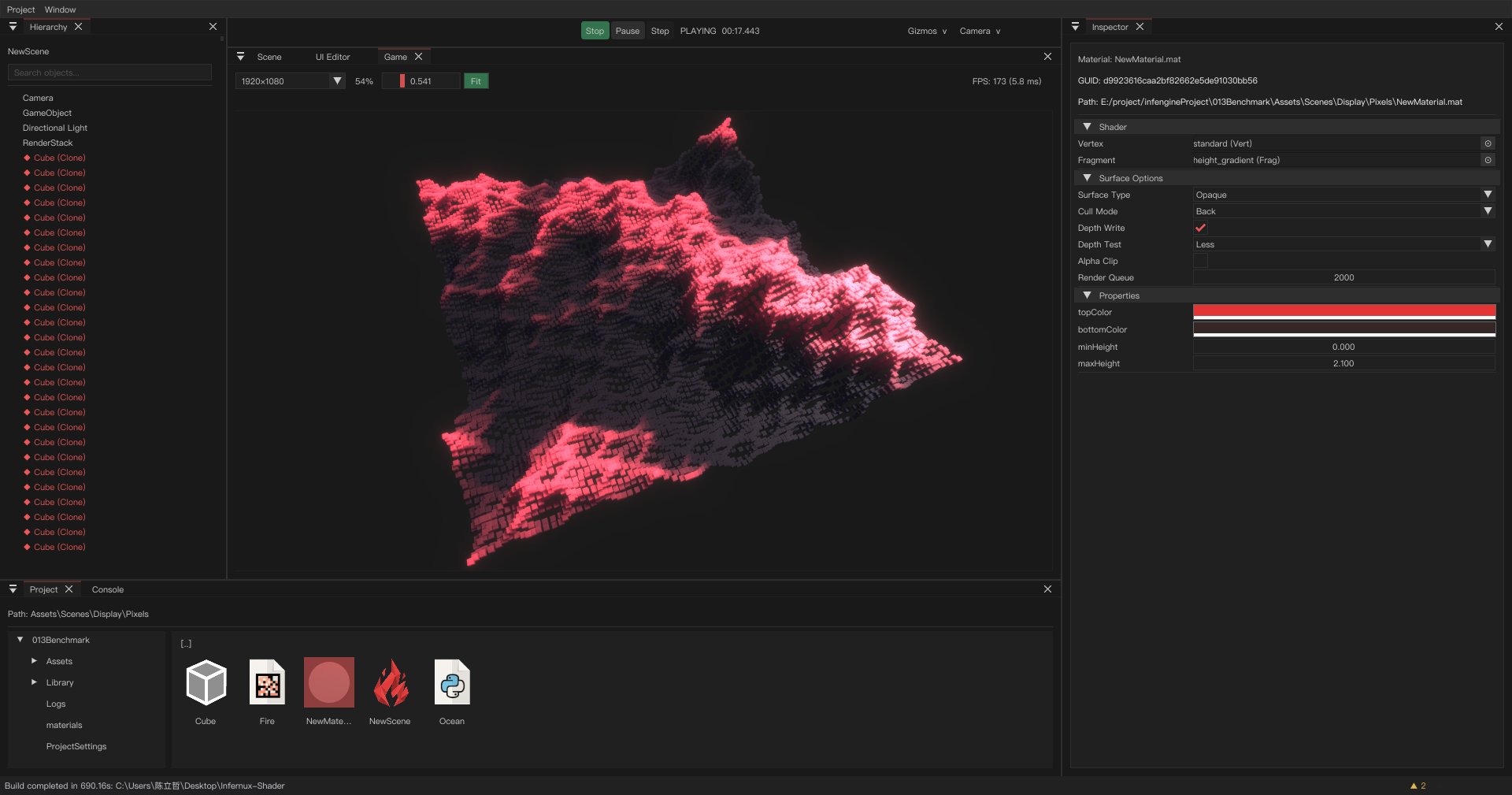
Figure 1: The Infernux editor running a 10,000-cube ocean-FFT demo written entirely in Python. All scripting, editor and render-pipeline logic reside in Python; the C++17/Vulkan core performs rendering and physics.
System Architecture
The Infernux engine comprises three distinct strata:
- The C++17/Vulkan core encapsulates latency-sensitive tasks, including rendering, physics, audio, and resource management.
- A thin pybind11 binding layer exposes native APIs to Python, serving as the exclusive cross-language boundary.
- The Python production layer handles gameplay logic, editor panels, render graph specification, and asset workflows.
The main loop enforces a deterministic initialization order and a fixed-cadence update rhythm independent of display rate or framerate, with gameplay logic and physics updated via a fixed-timestep accumulator, and rendering/audio updated per frame. The scene graph is organized as forests of game objects, supporting predictable lifecycle management and both native and Python-authored components.
Python gameplay components are built as subclasses using mixins for lifecycle, physics, and serialization. Strong emphasis is placed on efficient cross-language interaction via SoA stores and generational handles, supporting robust serialization and proxying for mirrored object management.
Rendering: Python-Defined Render Graph and Shader Composition
The rendering pipeline targets Vulkan 1.3 and is distinguished by three properties: Python-topology definitions, generalized post-processing insertion, and an annotation-driven shader composition system.
A declarative render graph API allows Python-side control over pass ordering, resources, and action types; the native C++ core performs DAG-based graph optimization, pass culling, and synchronization/barrier insertion. Injection points within the render graph permit extensible insertion of effects and post-processing passes without recompilation.
Post-processing effects are treated as decoupled units that attach via injection contracts at various graph points. Built-in and user-defined passes engage with a resource bus for consistent texture and data management. This model allows complex multi-pass effects, such as bloom, to be composed and managed with clear, explicit resource lifetimes.
The shader subsystem is annotation-driven, parsing inline directives in GLSL to automatically compose per-target (forward, shadow, G-buffer) variants, handling complex import DAGs, and guaranteeing deduplication and cycle detection. This yields human-readable, reflection-free GLSL and unifies material and global state resolution.
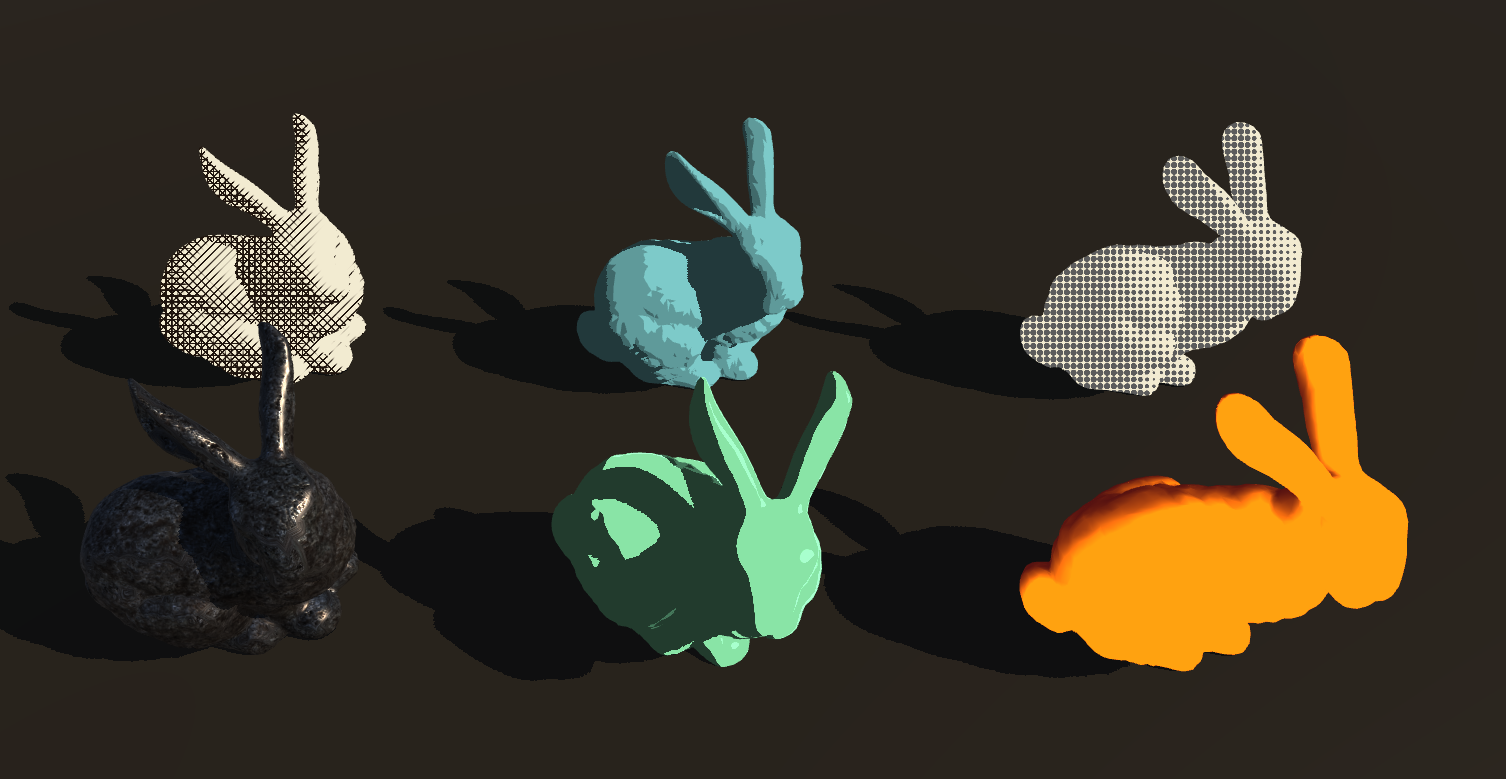
Figure 2: Stylized cel-shading with a custom annotation-driven surface shader specifying an unlit toon model, diffuse ramp, rim lighting, and outline passes in a single GLSL source.
Physics Integration
Jolt Physics is leveraged for rigid-body simulation, with the binding infrastructure exposing all collision shapes, force application modes, spatial queries, and callback mechanisms to Python. The fixed-timestep accumulator isolates simulation behavior from GPU frame rate fluctuations. Engine-native and Python-authored components receive physics events through a unified proxying system, and extensive layer-based filtering is provided for robust spatial query semantics.
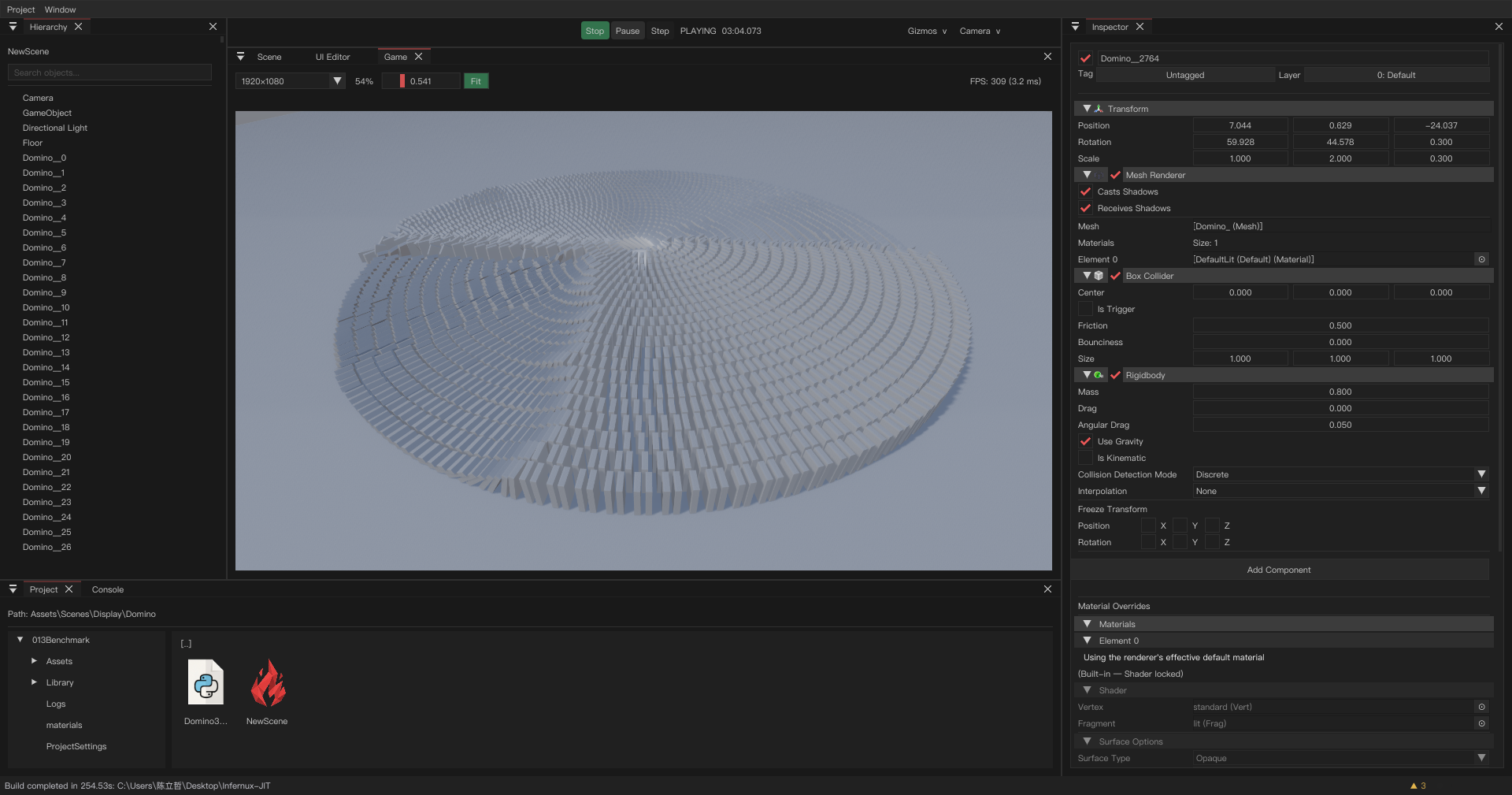
Figure 3: Domino-chain simulation with over 500 rigid bodies using Jolt Physics via Infernux bindings; the accumulator and speculative collision detection ensure simulation stability.
The primary bottleneck in Python-native game development is typically the cost of per-frame, per-entity script execution, exacerbated by language-bound calls (GIL acquisition/release, type marshalling). Infernux employs two solutions:
- Batch Data Bridge: Data for N entities are packed and transferred across the pybind11 boundary in a single shot, avoiding the multiplicative cost of per-object proxy access. A three-tier dispatch selects the most direct data path (native SoA, per-class SoA, or fallback property access).
- JIT Compilation with Auto-Parallelization: An engine-embedded Numba decorator enables auto-parallelization of numerically intensive for-loops (via AST rewriting of range→prange constructs when data dependencies permit), producing thread-parallel LLVM machine code. The system maintains both serial and parallel compiled variants for runtime reliability, supports hot-reload resiliency, and degrades gracefully to pure Python where required. The typical workflow involves reading SoA structures into NumPy arrays, JIT-processing with the GIL released, and writing back in bulk.
Experimental Evaluation
Three benchmark suites were used to evaluate performance relative to Unity 6 (IL2CPP):
Experiment 1: High-frequency Scripting Throughput (Single Material)
A grid of up to 10,000 cubes each executes an animated sin-wave position update per frame, stressing the scripting interface.
- In runtime, Infernux and Unity reach similar FPS as GPU bottlenecks dominate; at high densities, Unity's advantage is approximately 9%.
- Editor scenarios favor Infernux by a wide margin (>2× higher FPS at maximum density), attributed to lighter editor overhead compared to Unity.
Experiment 2: Draw-call Batching Overhead (Multiple Materials)
With M=10 and M=100 materials, per-material dispatch costs are isolated.
- Unity's SRP Batcher effectively eliminates draw-call overhead due to material count, while Infernux’ grouping approach accrues moderate overhead (up to -11% FPS at M=100).
- In editor contexts, Infernux continues to outperform Unity as overhead compounds in the latter's richer tooling stack.
Experiment 3: Pure-Compute Kernel Benchmark
NumPy/Numba kernels are executed in-memory without GPU or scene-object involvement.
- Numba JIT auto-parallelization yields a 6.9× runtime throughput advantage over Unity (123 FPS vs. 848 FPS at $1$M elements), and a 10.5× advantage versus non-parallel NumPy.
- The GIL and cross-language communication remain the principal bottlenecks, accounting for 8–12% of the remaining per-frame overhead at high entity counts.
Discussion and Implications
The results indicate that with a batch data bridge plus JIT auto-parallelization, Python can sustain frame rates comparable to or surpassing native C#/C++ workflows in numerically intensive real-time applications, provided language-bound crossing cost is aggressively amortized.
Bottlenecks:
The principal limiting factor is pybind11-based Python↔C++ communication. Each call triggers GIL acquisition, pointer marshalling, and SoA disambiguation. As native kernel speed increases, this fixed per-call overhead determines maximum throughput.
Roadmap:
Proposed solutions include a lock-free, wait-free single-producer single-consumer (SPSC) command ring buffer to decouple GIL-bound Python threads from C++ executors, anticipated to reduce crossing cost by at least an order of magnitude. The emergence of PEP 703 (free-threaded CPython) could further remove GIL-induced serialization. Additional plans cover draw-call grouping similar to SRP Batcher, arena-based memory management, and platform broadening (Linux/Mac), as well as tight ML integration for RL and simulation-centric workloads.
Opportunities for AI and Scientific Computing
The Infernux model directly supports rapid prototyping for embodied AI, simulation environments, and reinforcement learning ecosystems (e.g., Gym-compatible wrappers) by providing high-throughput access to native, real-time graphics and physics. The deterministic main loop and efficient state serialization are suited to parallelized environment rollouts and hybrid workflows incorporating PyTorch or other scientific stacks. The fully Python-exposed render graph and shader pipeline opens the door to ML-driven rendering, differentiable rendering research, and tight coupling of Python-based optimization/control with low-level visual environments.
Conclusion
Infernux demonstrates that a real-time game engine architecture with a Python-native production layer, enabled by batch-optimized cross-language transfer and JIT-accelerated scripting with auto-parallelism, can sustain performance on par with established C#/C++ engines on desktop-class hardware. The main residual bottleneck—cross-language communication overhead—is tractable via lock-free command queues and continuous progress toward GIL-free Python. Infernux’s open design and MIT license catalyze integration between scientific Python and real-time environments, lowering the barrier for AI research, education, and prototyping while maintaining deterministic and high-performance execution expected in game and simulation engines.
Availability and ongoing roadmap initiatives suggest continued relevance for both practical game development and research in simulation-intensive domains.
Reference:
"Infernux: A Python-Native Game Engine with JIT-Accelerated Scripting" (2604.10263)

