- The paper introduces a three-stage pipeline that uses pretrained 2D diffusion and 3D reconstruction models to produce simulation-labeled 3D engineering data.
- It employs precise domain-specific fine-tuning and a semantic quality classifier to ensure high-fidelity geometry and robust physical labeling.
- The approach scales 380 seed designs to over 15,000 models while maintaining strong distributional consistency and accurate simulation predictions.
DeepJEB++: Foundation Model-Driven Expansion of Simulation-Labeled 3D Engineering Data via Cross-Dimensional Latent Space Augmentation
Motivation and Problem Setting
Label-rich, large-scale 3D engineering datasets are a prerequisite for effective application of deep generative models and surrogate learning in computational design. Unlike natural image domains, 3D CAD datasets pairing geometry and physics-based simulation labels remain prohibitively small due to the resource intensity of expert modeling and FEA. Even state-of-the-art benchmarks such as SimJEB and DeepJEB are limited to low thousands of designs, bottlenecking data-centric engineering AI. Prior augmentation approaches based on domain-specific implicit networks (e.g., DeepSDF) are vulnerable to geometric mode collapse and lack the generative diversity required by modern model architectures.
DeepJEB++ addresses this data scarcity by proposing a transferable, scalable pipeline that exploits foundation models in both 2D and 3D. The key technical insight is to perform data augmentation in the data-rich 2D latent space—using a diffusion model pre-trained on O(109) images—and subsequently reconstruct into 3D, thus inheriting strong geometric priors unattainable directly from limited 3D datasets.
Methodology: Three-Stage Foundation Model Pipeline
The architecture follows a three-stage pipeline.
Stage 1: 2D Latent Space Interpolation for Augmentation
A Stable Diffusion model, pre-trained on natural images and subsequently fine-tuned on multi-view renders from the SimJEB bracket dataset, is utilized for interpolation in its latent space. Pairs of seed multi-view images are encoded and interpolated via a weighted mixing operation, and decoding yields novel view-conditioned images that retain the bracket domain topology and interface regularities—achievable only with domain-adaptive fine-tuning.
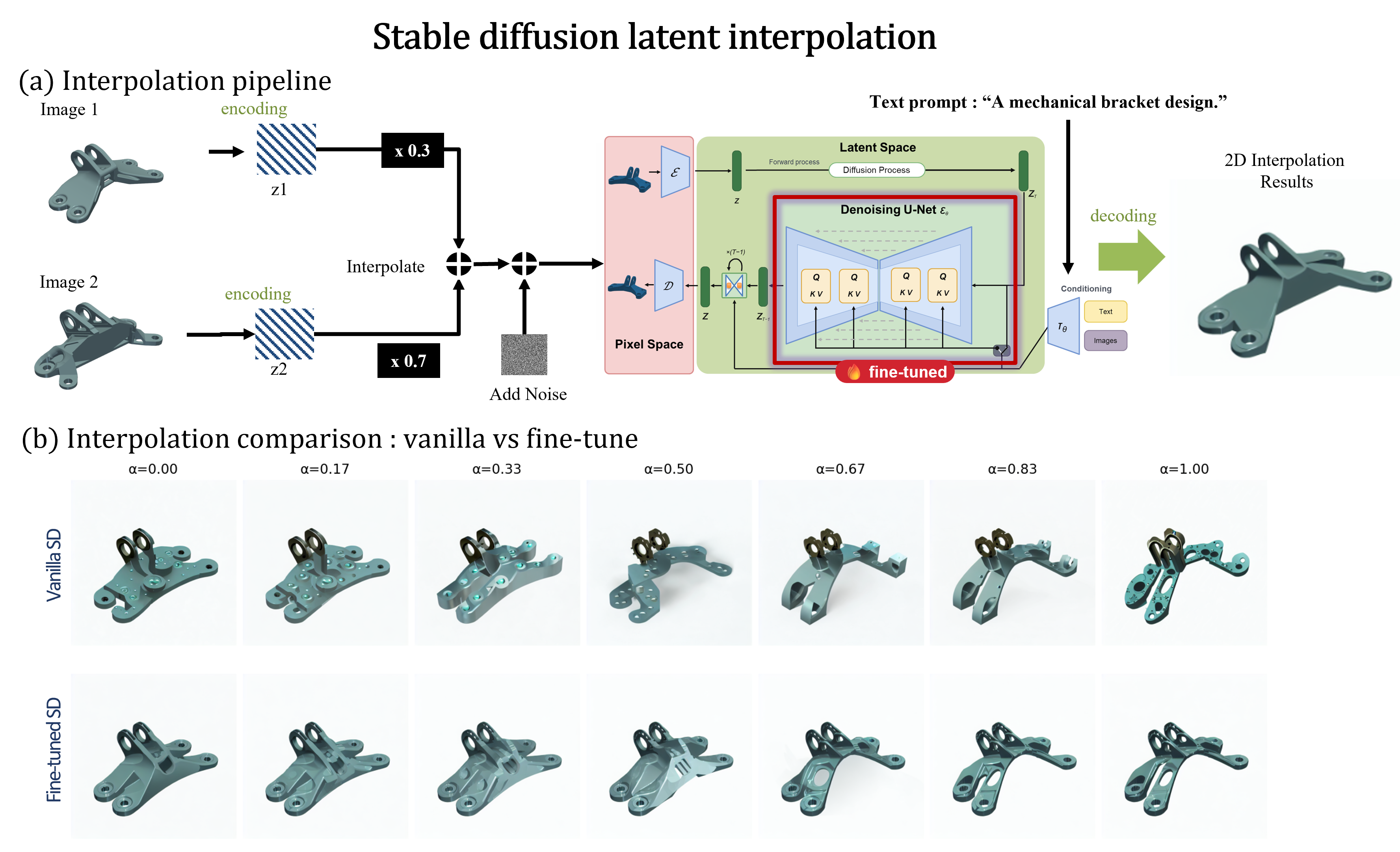
Figure 1: Domain-aware latent space interpolation is shown to be viable only after domain-specific fine-tuning; the vanilla backbone distorts geometry beyond manufacturing feasibility.
A semantic quality classifier based on LLaVA (a vision-LLM) discards defective samples, utilizing cosine similarity between generated image descriptions and a learned defect vocabulary. Addressing a key failure mode—the Negative Words Negation (NWN) issue where defect words (e.g., "scratched") in negations are misclassified—the prompt is explicitly engineered to only elicit affirmative descriptions.
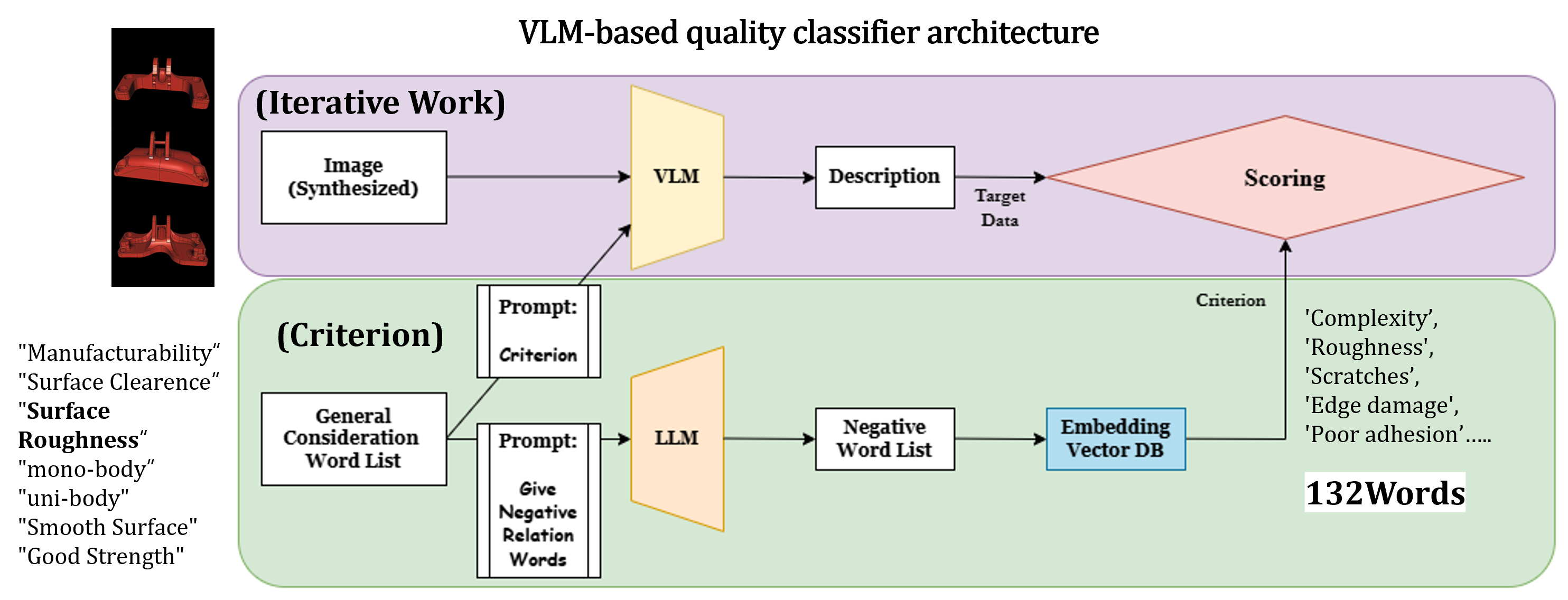
Figure 2: The VLM-based quality classifier relies on semantic distances between generated descriptions and a negative-defect vocabulary for filtering prior to 3D lifting.
Stage 2: 3D Geometric Reconstruction via Domain-Adapted Foundation Models
Validated 2D images are converted to 3D meshes using TRELLIS, a state-of-the-art structured 3D latent model originally trained on 500k+ general assets. Crucially, only lightweight fine-tuning (n=300) is needed for the engineering domain, which is sufficient for the model to robustly reconstruct complex multi-interface bracket geometries.
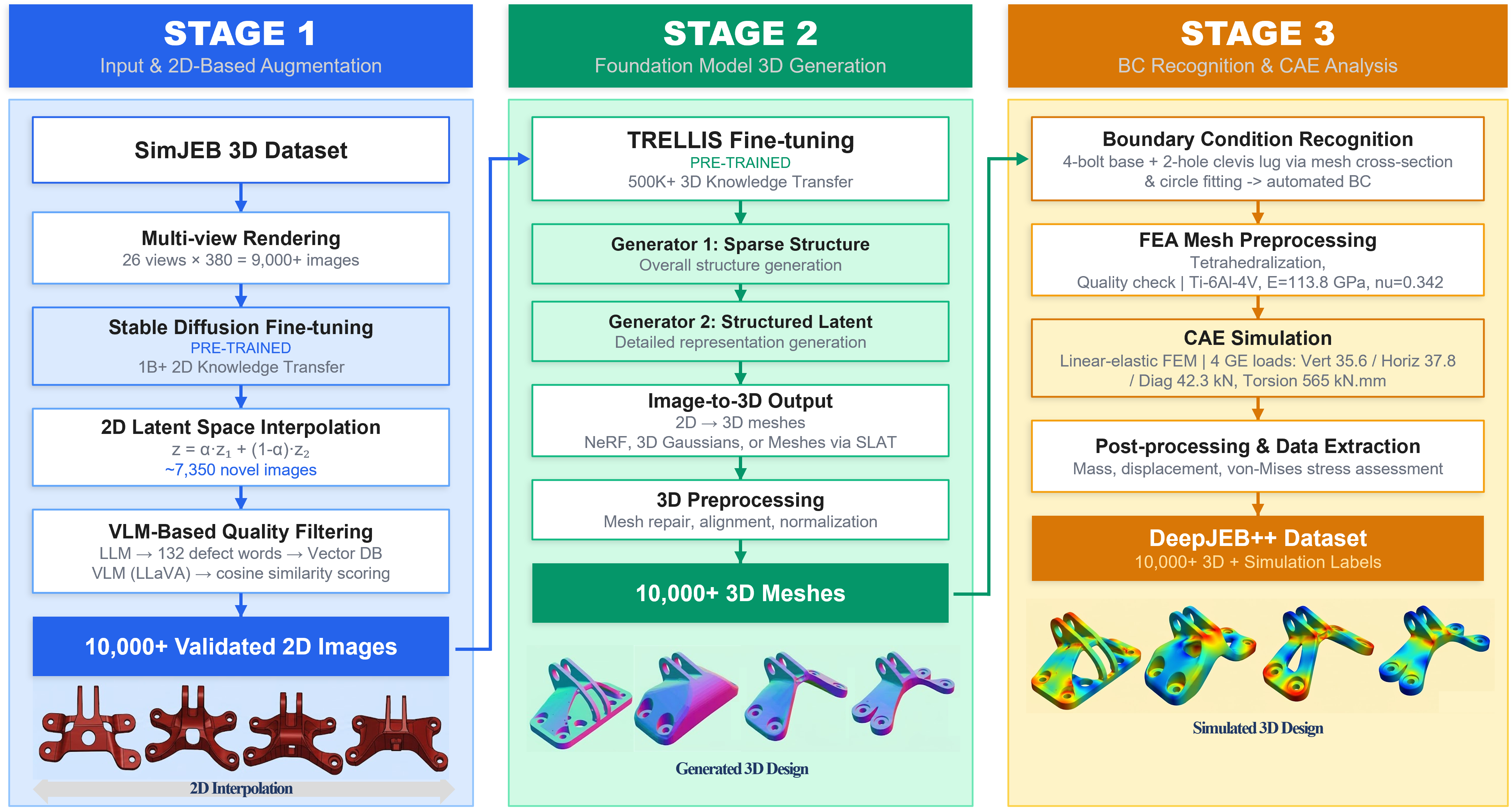
Figure 3: The overview of the pipeline, with 2D latent space augmentation, VLM-based filtering, 3D mesh generation with TRELLIS, and automated FEA-based labeling.
Empirical assessment demonstrates that multi-view conditioning saturates after a few optimal views, but even single carefully chosen diagonal renders suffice to match multi-view performance.
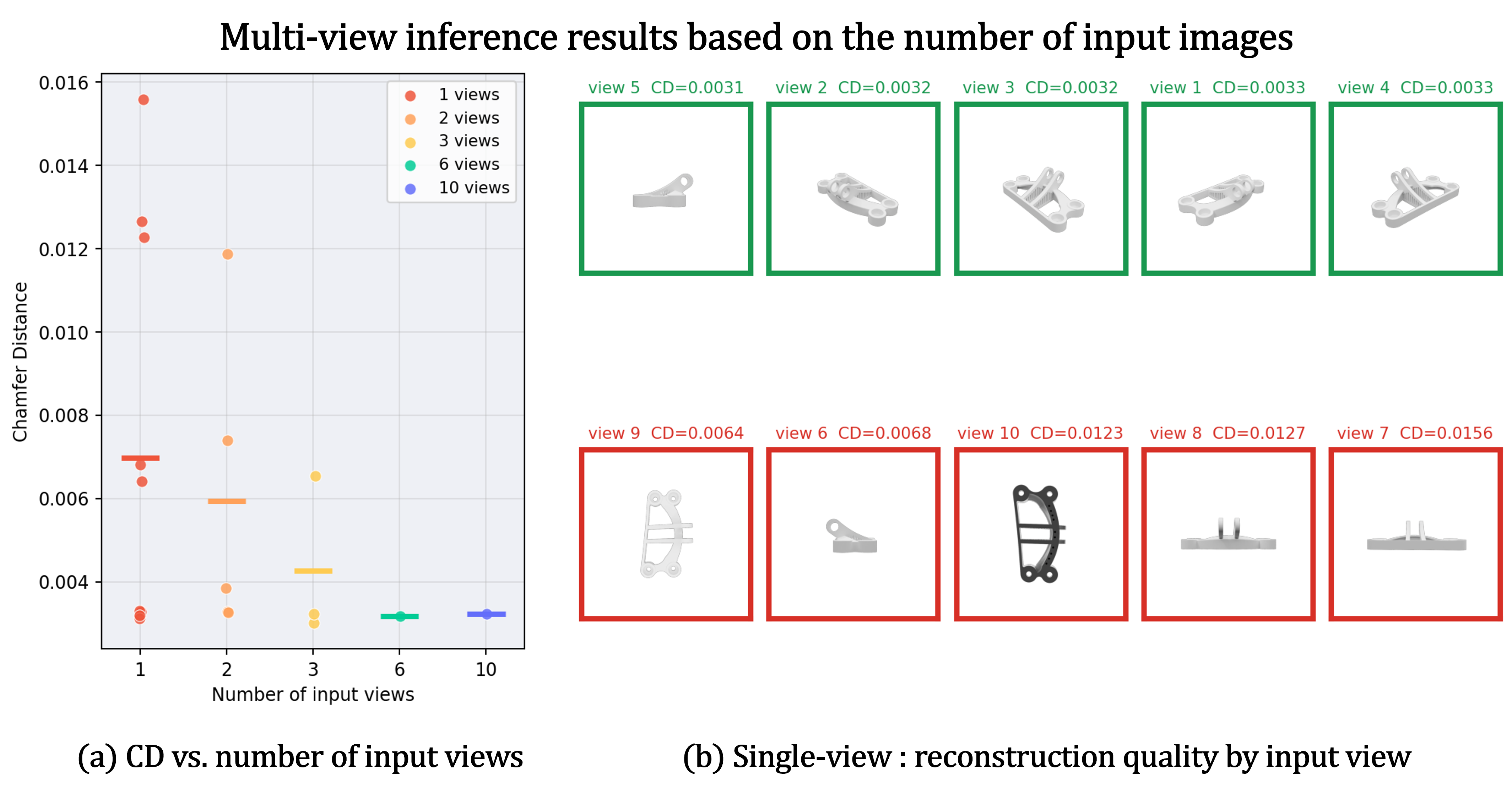
Figure 4: TRELLIS 3D reconstruction quality as a function of input view multiplicity; a single diagonal view achieves near-saturating Chamfer Distance.
Stage 3: Automated Boundary Condition Recognition and CAE Labeling
Each generated mesh is subjected to bolt/lug–clevis interface detection to automatically assign physically meaningful boundary conditions for downstream FEA, yielding consistent, mesh-robust simulation labels (displacement and von Mises stress under four standard load cases) in a fully automated fashion.
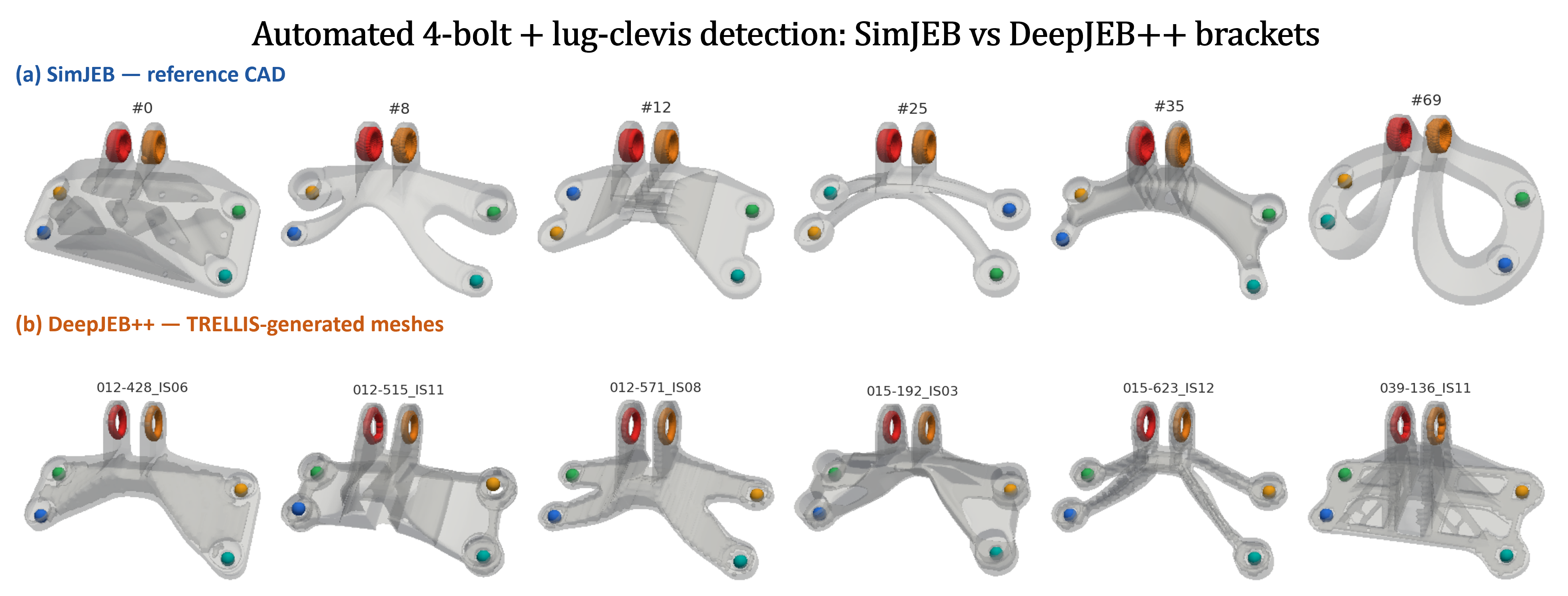
Figure 5: The geometry-aware interface detector consistently identifies load/bolt regions across both original CAD and generated meshes, enabling automated BCs for FEA.
Mass and stress labels closely reproduce reference SimJEB CAD values, with mass error <0.1% and node-level FEA field correlation exceeding R2=0.9 in the vast majority of cases.
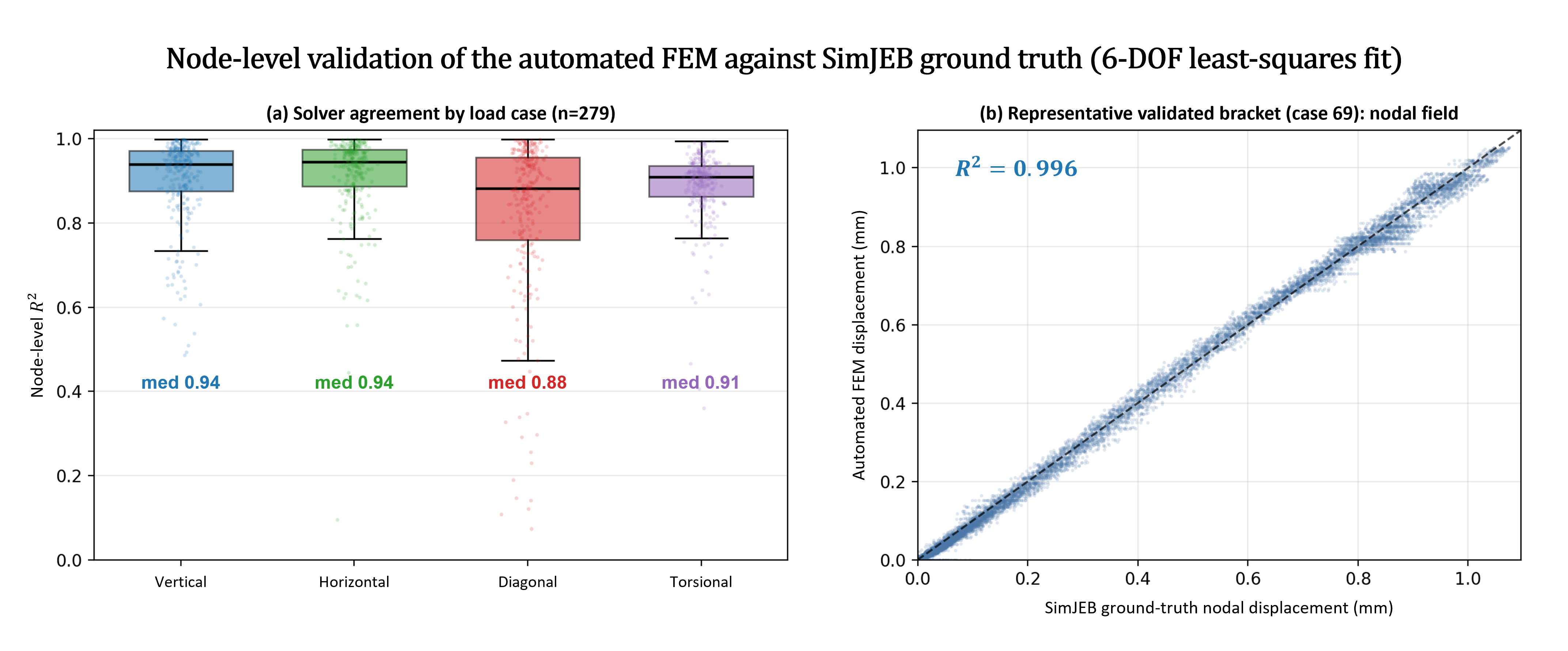
Figure 6: The node-level validation of the automated solver against ground truth demonstrates high agreement across nearly all reference brackets.
Empirical Results
Dataset Scale and Quality:
DeepJEB++ expands 380 seed designs to 15,360 simulation-labeled 3D brackets, a 40× increase, produced with modest computational resource (one GPU per stage).
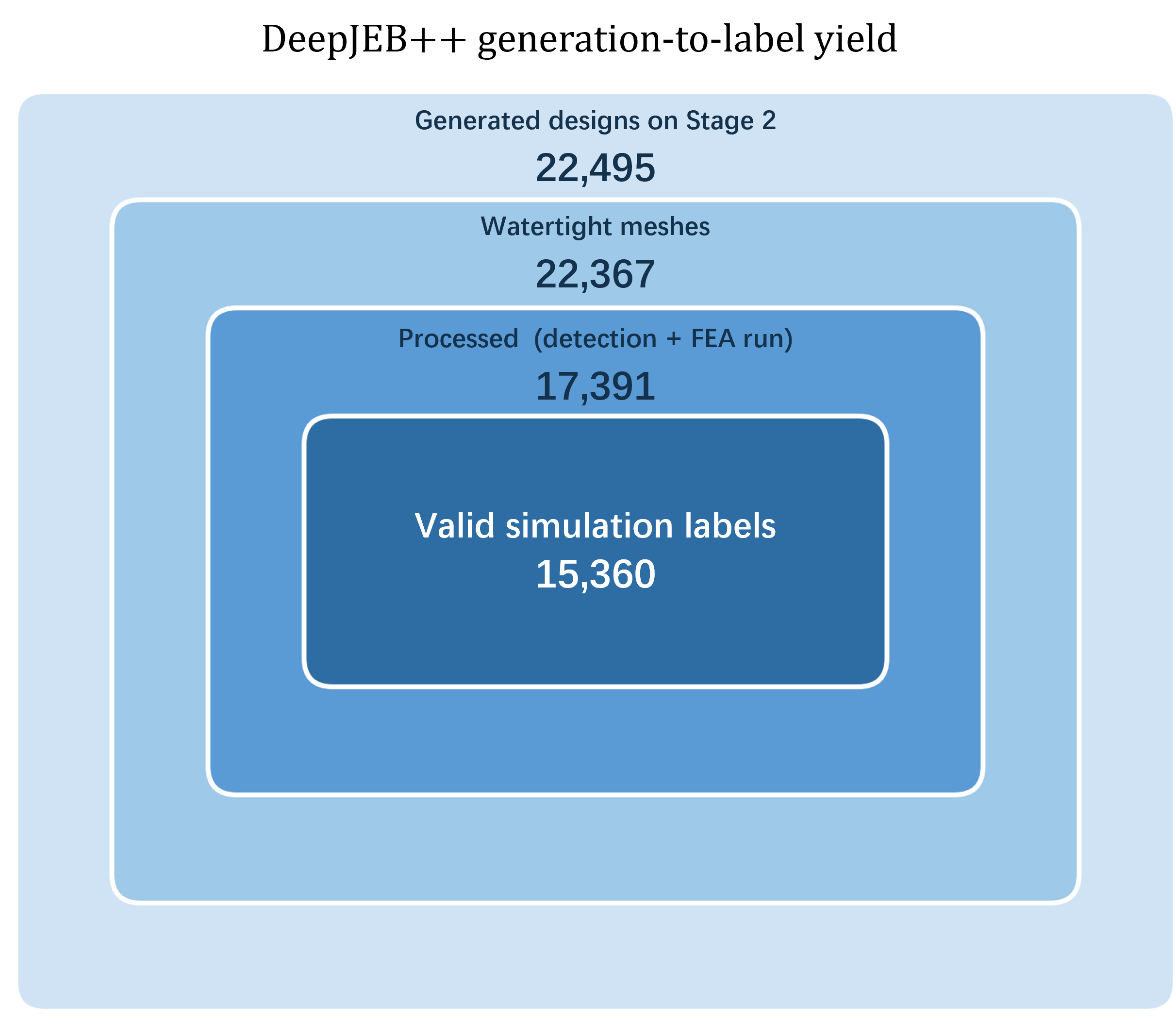
Figure 7: Funnel diagram illustrating per-stage yields; the pipeline maintains strong label fidelity with minimal attrition from mesh or interface detection steps.
Distributional Consistency and Coverage:
The generated dataset covers and modestly extends the SimJEB and DeepJEB latent manifold, as verified by pose-normalized appearance PCA, without floating into out-of-distribution geometry.
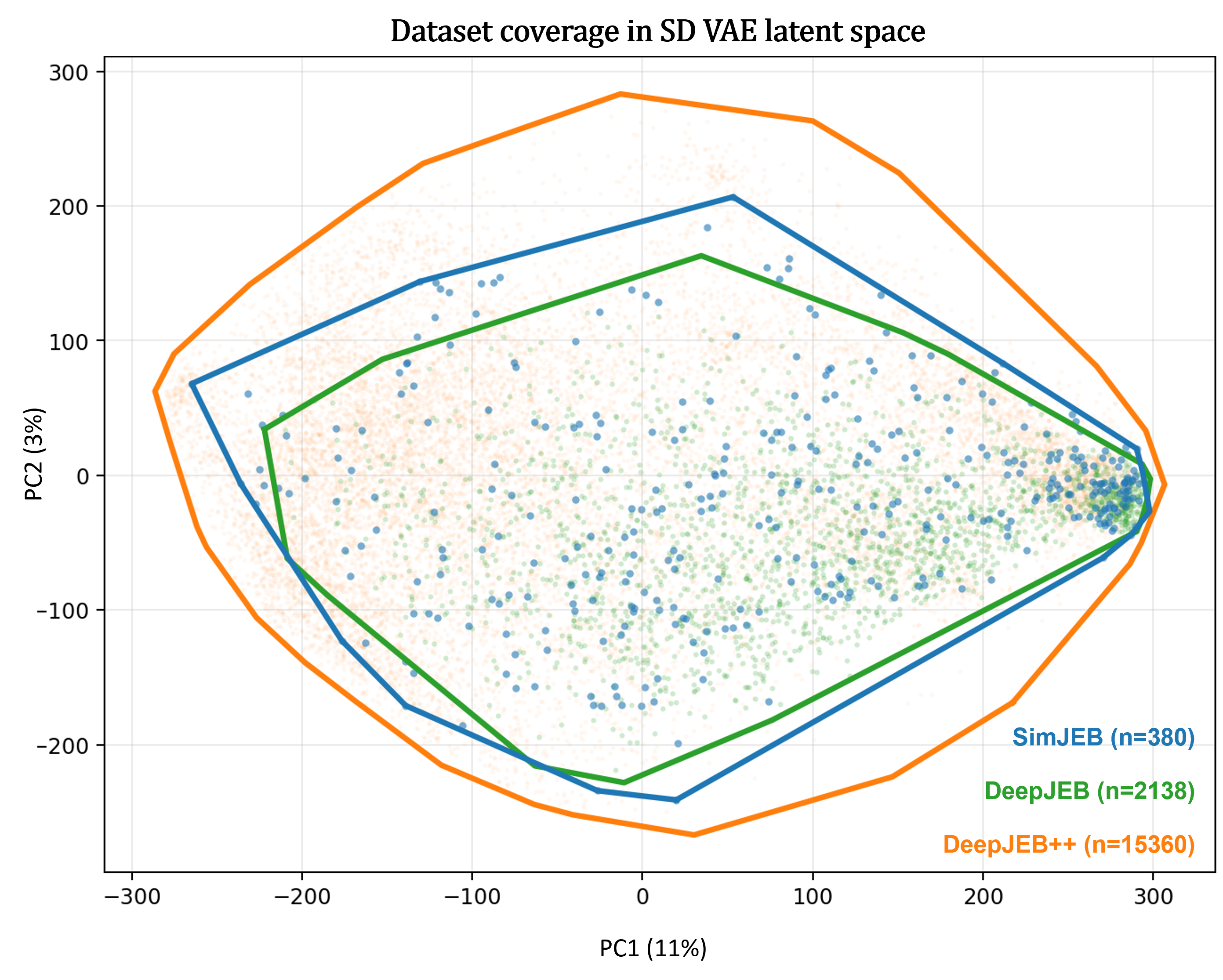
Figure 8: Projection onto the SD-VAE latent appearance space confirms that DeepJEB++ augmentation fully covers SimJEB/DeepJEB support without mode collapse.
Label Fidelity and Physical Consistency:
Self-normalized distributions for peak displacement and von Mises stress under all load cases agree with SimJEB reference labels. Mass–stress Pareto curves follow expected structural trends, with DeepJEB++ extending toward thinner, more compliant designs.
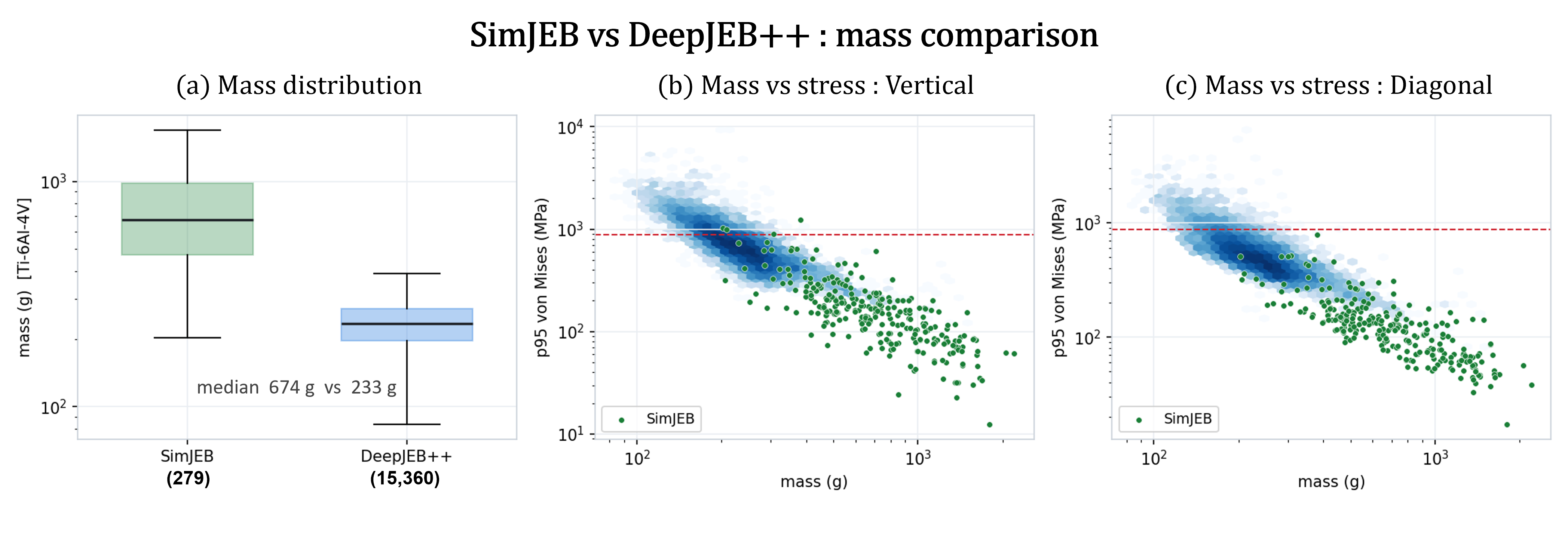
Figure 9: DeepJEB++ populates the low-mass, higher-stress regime while replicating the qualitative SimJEB mass–performance envelope.
Theoretical and Practical Implications
This work empirically validates that pretrained diffusion and SLAT-based 3D models can be rapidly adapted for domain-specific engineering augmentation, yielding physically labeled, simulation-ready data at scales previously unattainable under academic resource constraints. Augmentation in 2D latent space, combined with VLM-based quality gating and automated physics-based labeling, shifts dataset curation from manual artisan work to semi-automated, foundation model-driven practice.
Practically, this enables democratization of generative engineering workflows outside of industry-scale compute settings, as high-fidelity datasets for supervised learning, surrogate modeling, or RL-based design no longer require full-stack CAD expertise or massive FEA compute.
Theoretically, this confirms that web-scale visual priors in foundation models (diffusion, VLMs) are sufficiently general to encompass structured engineering domains after minimal adaptation, opening cross-domain transfer as a feasible direction.
Limitations and Future Directions
- The VLM classifier, though improved with NWN mitigation, still achieves modest accuracy (72-76%) and may be further enhanced via fine-tuning or incorporation of domain-specific contrastive data.
- The boundary condition identification relies on geometric heuristics; robust handling of topological anomalies and broader generalization will require hybrid or learned approaches.
- The pipeline is demonstrated here for jet engine brackets; validation across automotive, aerospace, and medical engineering domains remains essential for establishing true generality.
- Downstream efficacy—i.e., the impact of training surrogate models or generative agents on these datasets—should be quantified to complete the assessment.
Conclusion
DeepJEB++ presents a validated, reproducible pipeline for foundation model-driven simulation-labeled 3D data augmentation in structural engineering. By combining 2D latent space generative priors, VLM-based semantic filtering, high-fidelity SLAT-based 3D reconstruction, and automated simulation labeling, it delivers the first domain-adaptable, physically consistent, and large-scale bracket dataset with minimal human intervention.
This enables a new paradigm for dataset construction in engineering-AI, where cross-domain transfer, resource efficiency, and automation become systematically achievable. The architecture is broadly applicable, with clear extension paths to diverse engineering structures and integration with next-generation autonomous design agents. The dataset and codebase will support reproducibility and further innovation in data-driven engineering research.

