- The paper shows that a reader's selection identity operates as a stable trait, not a transient state, evidenced by a persistent own-vs-other advantage up to 24+ months.
- The methodology involves using embedding centroids and fine-layer negative sampling to quantify predictive advantages across various time gaps.
- Implications suggest that recommender systems can benefit from long-term personalized profiles, as the durable reading identity enhances prediction accuracy.
Durability of Reading Identity in Social Highlighting
Introduction and Context
This paper investigates a fundamental question in longitudinal behavioral analysis: whether an individual's digital reading selection identity is best characterized as a stable “trait” or a shifting “state.” Using timestamped highlight data from the Glasp platform—an engagement-verified, browser-extension-based social web highlighter—the authors address temporal stability in reader individuality. Prior work established that individuality is prominent in document selection rather than within-document highlighting (Nakayashiki et al., 8 Jun 2026, Nakayashiki et al., 9 Jun 2026), but these measurements were strictly cross-sectional. This study innovates by freezing each reader’s selection profile after their first six months and then quantifying its predictive advantage over controls (matched in interest and time) at varying temporal distances up to and beyond 24 months.
Methodological Design
Participants were drawn from uniformly sampled Glasp user records, filtered for heavy, long-tenured activity (≥60 documents over ≥12 months). For each qualifying reader, the first six months constituted their “profile” window, with up to 20 sampled documents represented as embedding centroids. Later selections of the reader served as positives, systematically binned by time gap. Negatives were sampled from other users’ selections in the identical calendar period to decouple content supply drift from personal drift.
Two competitive regimes were specified:
- Coarse Layer (easy): global negatives and controls, providing broad topical discrimination.
- Fine Layer (hard, primary): negatives and controls drawn from the user’s 25 most similar peers, requiring the method to detect subtle, within-neighborhood identity.
The principal metric is own-vs-other advantage in average precision (AP) when the frozen profile ranks the candidate set for each bin, with statistical inference performed via 3,000-iteration bootstrap clustered by user. The pre-registered primary test was the paired difference in advantage at 6–12 months versus the immediate 0–1 month post-profile window.
Empirical Results
Profile Signal Durability
At the immediate post-profile evaluation point (anchor), the primary regime (fine layer) exhibits an own-vs-other AP advantage of +0.188 ([+0.160,+0.216]), matching previous cross-sectional findings and thus validating the measurement harness.
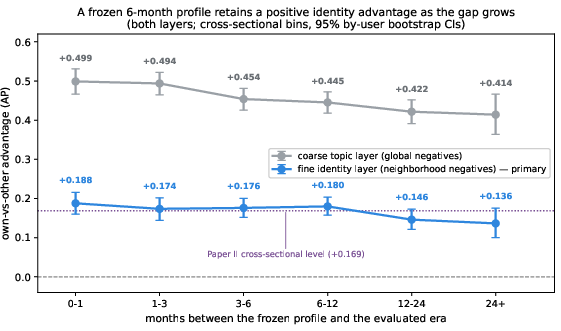
Figure 1: The identity decay curve. A profile frozen at month 6 retains a positive own-vs-other advantage as the gap to the evaluated era grows, at both difficulty layers (cross-sectional bins; 95% by-user bootstrap CIs). The fine layer's anchor (+0.188) lands on the prior cross-sectional estimate (+0.169, dotted).
Advantage persists at remarkably stable levels across all gap bins. Even at 24+ months, the fine-layer advantage remains +0.136, with every bin's confidence interval far above zero. Notably, domain repetition is not the main contributor: recomputing the analysis with all profile domains excluded retains ~90% of the advantage, confirming that granular, semantic identity is not reducible to simple habit.
Paired Retention and Absence of Detectable Decay
The principal paired contrast at 6–12 months returns a retention ratio of R=1.003 ([0.854,1.184]), with a paired difference d=+0.001 ([−0.031,+0.032]), indicating no significant decline. This pattern holds true through 12–24 months (R=0.893) and 24+ months (R=0.826), albeit with wider intervals in the latter due to smaller samples.
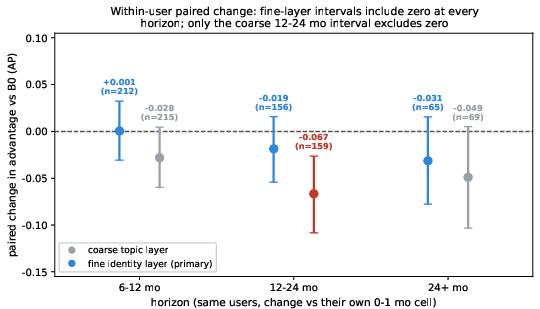
Figure 2: Within-user paired change in advantage vs. the same user's 0–1 month cell. The fine identity layer (blue, primary) has an interval including zero at every horizon; the only interval excluding zero is the coarse layer at 12–24 months (red).
The only statistically significant decay occurs in the coarse regime at 12–24 months (–0.067), representing about 13% of its magnitude. This result underscores the operational definition of "trait": a stable, person-specific signature under sustained engagement.
Within-Person Drift and Prospective Model Utility
Assessing recency, a profile formed from the recent half of a reader’s timeline outperforms the old half by +0.042 AP, but the old profile retains approximately 91% of the recent score, indicating slow drift layered over a stable base.
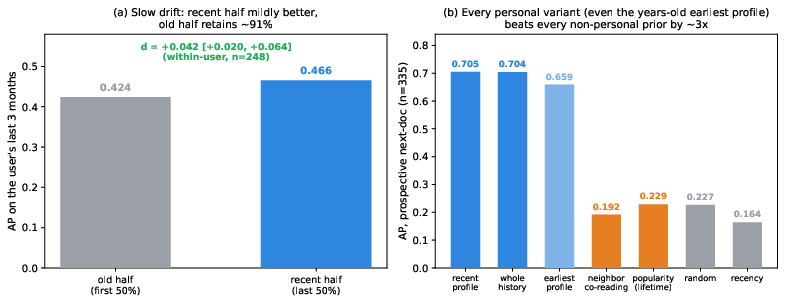
Figure 3: (a) Volume-matched halves of the same history: the recent half predicts the reader's current selections slightly better than the old half (+0.042 within-user), but the old half retains ~91%. (b) All personal profile variants prospectively beat all non-personal priors by a large margin.
When tested prospectively—ranking upcoming reads among time-matched candidates—personal profiles (including those built from the user’s earliest documents, median 20 months prior) achieve roughly triple the AP of any non-personalized prior (popularity, neighborhood, or recency-based), which themselves are at or below random in this long-tail candidate context.
Implications
Practical Implications for Recommender Systems
These results have immediate consequences for the design of recommendation algorithms. Standard industry practice often emphasizes recency-weighted models or session-based collaborative filtering [koren2009, hidasi2016, kang2018]. The demonstrated stability of selection identity in this setting argues for the retention and leverage of durable, long-term personal profiles in reading and content selection recommenders. Aggressive data "forgetting" is not substantiated by the observed temporal dynamics in identity. While moderate adaptation to recent themes provides a measurable, though small, gain, the majority of the predictive signal is persistent.
Theoretical and Future Directions
The finding that reading identity is predominantly a trait raises questions about the granularity and dimensions of digital behavioral identity. The results suggest that the embedding-based, semantic selection signal is stable over timeframes that substantially outstrip the half-lives presumed in current session-based models. Future extensions could examine expression-level or stance-level features and their decay rates, or replicate the methodology across different reading/recommender platforms to examine population-level generality. Furthermore, the disentanglement of exposure effects (algorithmic and social feedback loops) and true choice remains an open area, especially given the limitations of observational data vis-à-vis impression logs.
Limitations
The study engages exclusively with engaged, long-tenure users on a single platform and relies on observable highlighting behavior, potentially conflating exposure and pure preference. Profiles are constructed from static representations (title/span embeddings) and thus may underestimate higher-order drifts not captured at this level of granularity. Cohort composition, platform population, and negative sampling regimes further bound the interpretability and generalizability of the results. The paired retention metric avoids survivor bias in part, yet claims are inherently conditional on sustained engagement.
Conclusion
This work provides strong evidence that individual reading selection signatures in a social highlighting context are operationally trait-like: stable, durable, and largely transferable across time and content domains. Practical applications in personalization should exploit this resilience, as long-horizon profiles retain substantial predictive power over both short and extended intervals. Theoretical distinctions between trait/state models are sharpened: the stable selection signal documented here stands in contrast to the ephemeral signals observed in lower-level engagement layers such as within-document salience. Gradual within-person drift is observable, but does not erase core identity. Future research should address cohort and platform generality, finer behavioral signals, and the complex relationships among exposure, engagement, and identity.

