- The paper introduces a method to quantify routine persistence using multimodal data and Gaussian Mixture Models to identify latent routine types.
- It finds that dominant routines account for over 57% of daily activities, and that routine transitions exhibit robust temporal stability.
- The study demonstrates that individual routine signatures are highly distinctive, offering insights for personalized health monitoring and privacy concerns.
Quantitative Analysis of Routine Persistence in Human Behavior
Introduction
"Quantifying the Persistence of Daily Routines" (2604.23638) presents a data-driven framework for characterizing the temporal stability and individual distinctiveness of daily behavioral routines. Using large-scale multimodal datasets across diverse cohorts, the authors employ unsupervised clustering and information-theoretic metrics to reveal that daily life can be described by a compact set of latent routine types, with individuals exhibiting highly distinctive and temporally persistent distributions—termed "routine signatures"—over these types. The analysis transcends domain-specific regularities, generalizing routine persistence across mobility, sleep, and device usage, while further exploring individual differences based on demographic and personality factors.
Methodological Framework and Datasets
Three independent longitudinal datasets, comprising 1,086 participants and over 153,000 person-days, underpin this study:
- Tesserae: 592 U.S. information workers observed for one year.
- MoMo-Mood: 164 clinical and control subjects (Finland) monitored for one year.
- GLOBEM: 497 U.S. college students tracked over four academic years.
Each day’s behavioral profile is constructed from summary features across sleep, physical activity, and digital device use. Gaussian Mixture Models (GMMs) cluster these day-level vectors into K=8 latent routine types per cohort. Days are categorized by membership in these cluster-defined routines, and temporal sequencing of routines is retained via transition matrices.
The modeling pipeline for computing individual routine signatures is depicted in the schematic below:
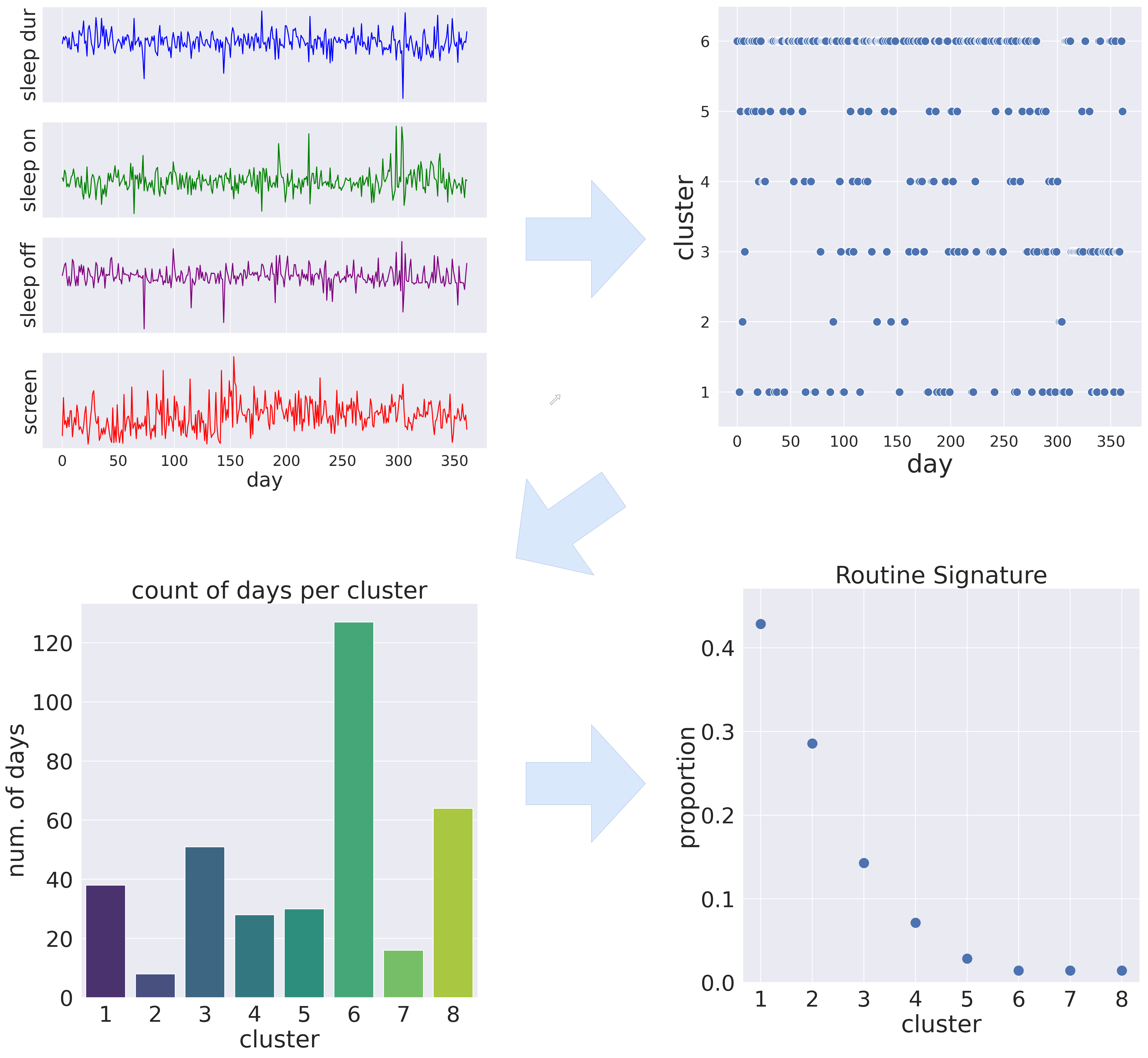
Figure 1: The routine signature workflow processes raw daily features through GMM clustering, aggregates cluster participation per participant, then ranks normalized routine proportions for signature construction.
Compact Structure of Daily Behaviors
The clustering consistently reveals that daily behaviors coalesce into a small set of recurring types. In Tesserae, the dominant cluster corresponds to normative workday behavior, while others encapsulate leisure or atypical patterns, with clear distinctions between weekdays and weekends—extracted purely from behavioral features without explicit calendar input.
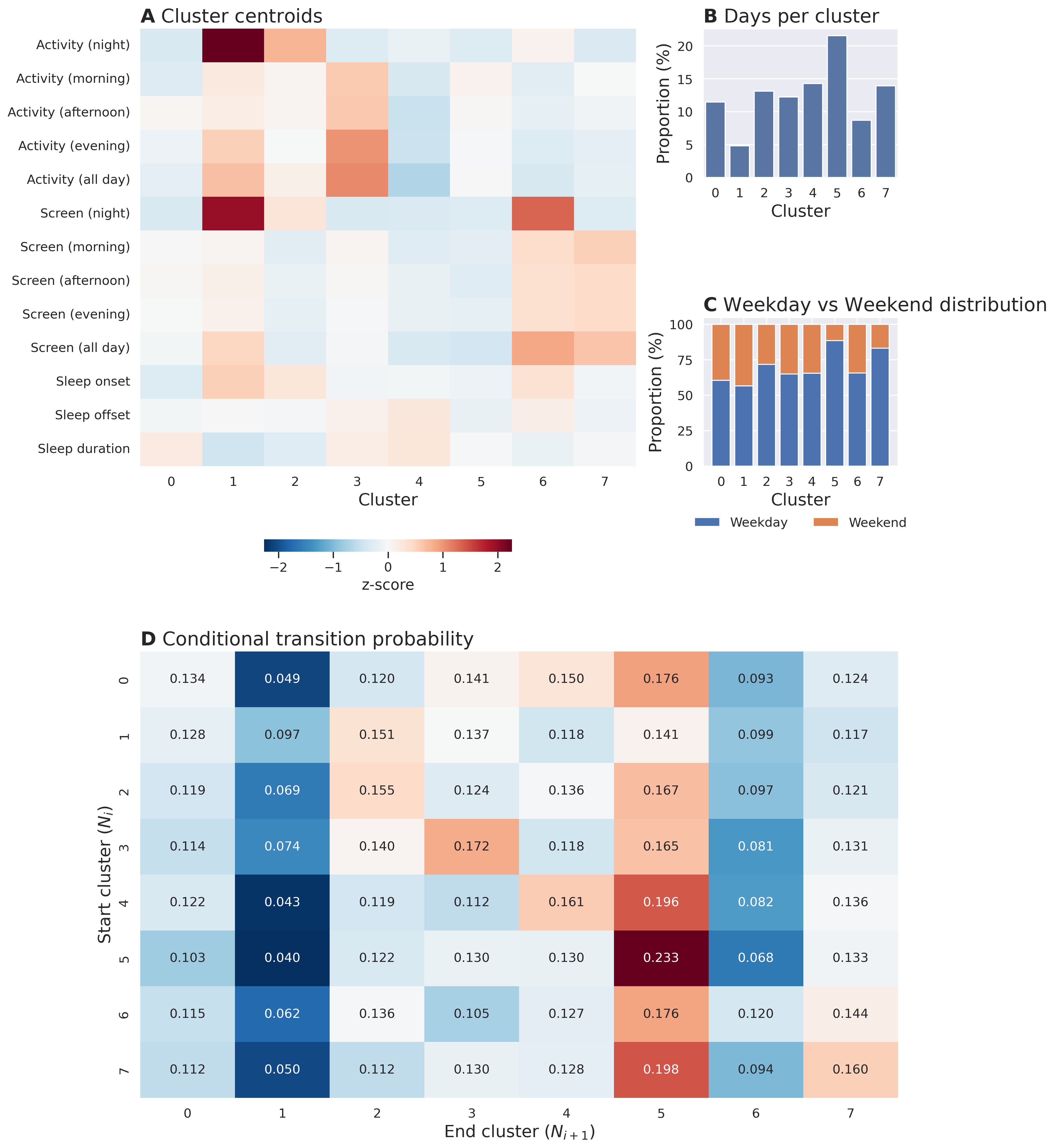
Figure 2: Panel (A) presents standardized feature deviations for each cluster, (B) the empirical frequency distribution of routine types, (C) weekday/weekend composition per cluster, and (D) average transition probabilities among clusters for the Tesserae cohort.
Notably, transition matrices do not exhibit strict self-adherence but favor transitions towards a dominant workday cluster, consistent with periodic modulation of routine by social schedules. This diffusivity of transitions is seen across all studies, indicating structured cycling among routine types rather than random alternation or rigid routine locking.
Distinctiveness and Temporal Stability of Routine Signatures
For each individual, the "routine signature" is the rank-ordered distribution of time allocation across clusters. The authors partitioned each participant's record into two segments to compute:
- Self-distance: Divergence between an individual's routine signatures across segments.
- Reference-distance: Divergence between an individual's signature and those of their peers.
Results show that the two most dominant routines account for over 57% of all days per person, while within-person distances (JSD and cosine) are consistently and significantly lower than between-person (population reference) distances across all cohorts. This demonstrates high temporal stability and individual distinctiveness.
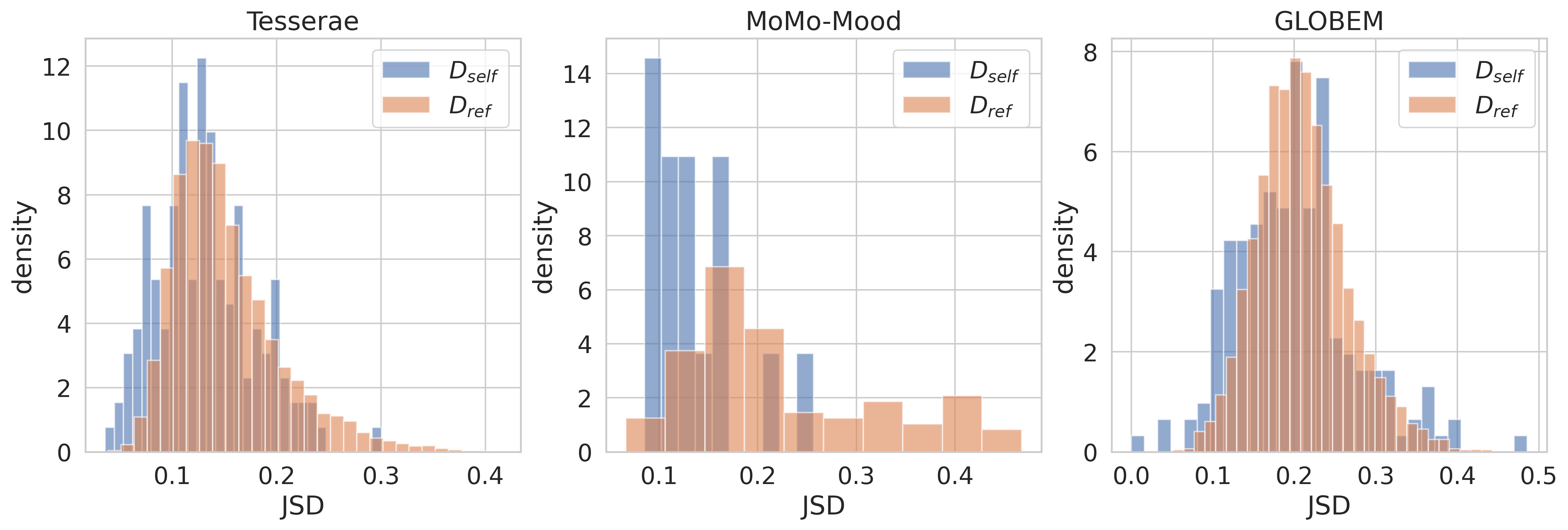
Figure 3: Distributions of self-distance and reference-distance metrics across all datasets, with robust separation between within- and between-subject comparisons.
The structure of routine signatures across multiple values of K supports the core finding: a small number of routines account for most of the variance, with a steep decay beyond the top ranks and stability with respect to model parameterization.
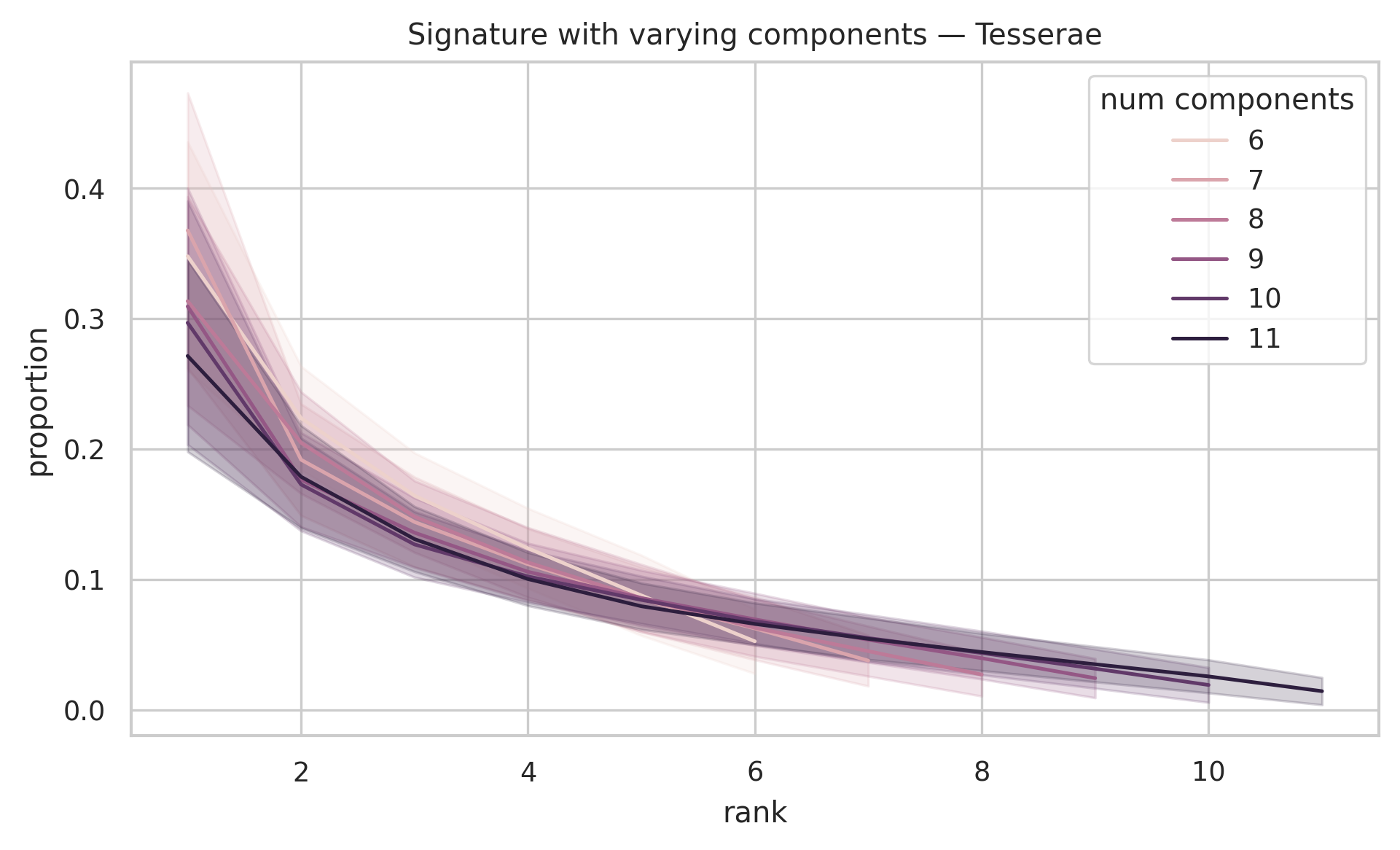
Figure 4: Proportion of days by rank-ordered routine for various K in Tesserae—confirming the dominance of two to three routines across parameter settings.
Persistence in Routine Transition Dynamics
Beyond time allocation, the sequential dynamics (transition probabilities between routines) also yield individually stable patterns. Transition signature persistence—evaluated analogously to routine signature persistence—shows smaller within-person divergence than between-person divergence, even in short (30-day) windows, supporting the signature paradigm at the level of behavioral dynamics as well as marginal distributions.
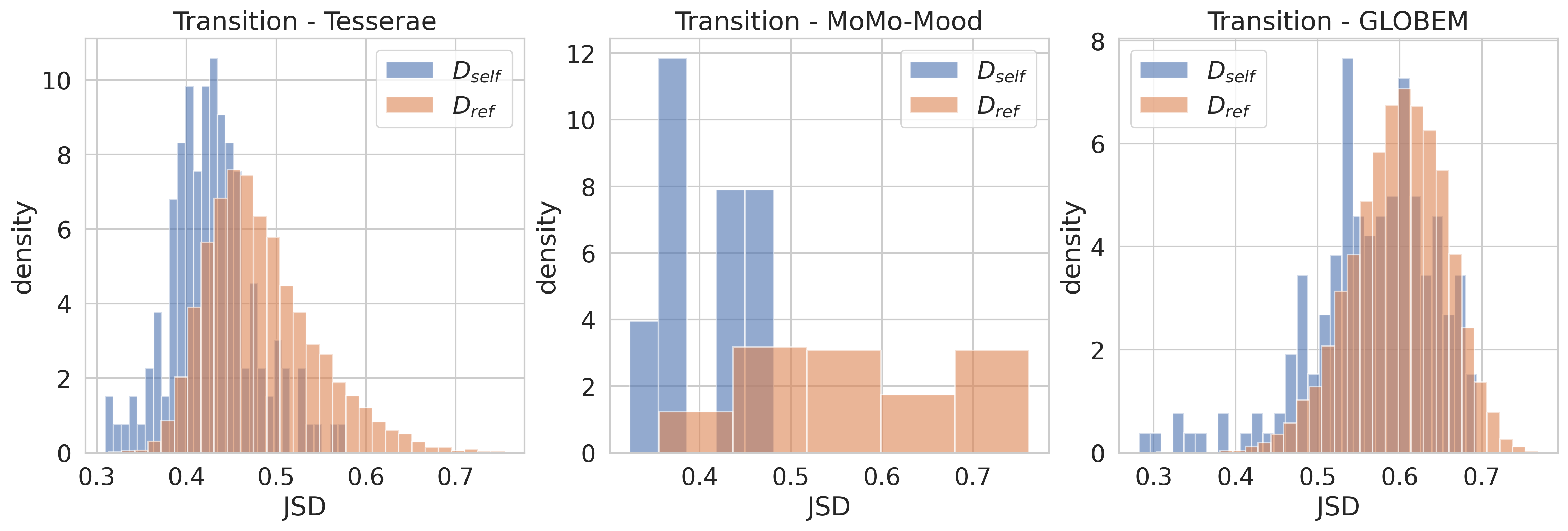
Figure 5: Comparison of self- and reference-distances for transition signatures, again showing pronounced within-individual stability across all studies.
Predictors of Signature Stability
Regression analyses reveal that demographic factors (age, gender) do not systematically predict the stability of routine signatures. However, conscientiousness exhibits positive association with signature instability (contrary to potential expectations of higher regularity among more conscientious individuals), and neuroticism shows a smaller effect. These associations are consistent across short and long observational windows but are modest in effect size.
Theoretical and Practical Implications
The results extend the social signature and behavioral fingerprint literature by demonstrating that the persistence observed in communication or mobility generalizes to composite daily routines assembled from heterogeneous activity domains. The signatures' robustness and distinctiveness have several implications:
- Privacy: Distinctive signature patterns elevate re-identification risks, even in de-identified behavioral data. Combining modalities exacerbates uniqueness beyond that of single behavior domains.
- Clinical Monitoring & Intervention: Person-specific baselines can be established for digital phenotyping, enabling detection of aberrant routine changes as individual-specific markers of health/wellbeing shifts rather than deviation from group norms.
- Modeling Human Behavior: The latent class structure and signature-centric perspective inform the design of personalized, adaptive computational models for predicting or simulating human routines.
- Methodological Advances: The unsupervised, information-theoretic, and multimodal approach provides a blueprint for future behavioral modeling.
Potential future developments include integration of additional behavioral modalities, temporal models attuned to periodicity (e.g., HMMs), and adaptive personalization in health AI systems. The observed uniqueness and persistence also provide a challenge and opportunity for privacy-preserving computation and federated analytics.
Conclusion
This study establishes that daily human behavior—across sleep, mobility, and device usage—can be reduced to a small number of recurring, interpretable routine types. Routine signatures, defined by time allocation and transition dynamics over these types, are highly distinctive and temporally stable within individuals, persisting across months and across population subgroups. The general principle of routine persistence unites domain-specific findings and offers new directions for personalized health monitoring, computational modeling of behavior, and the ethical management of behavioral data.

