- The paper introduces an automated, knowledge-graph-driven pipeline that systematically increases search space and structural complexity in long-horizon search tasks.
- It employs tree-structured and graph-structured subgraph sampling with multi-stage QA generation and rigorous human review to ensure high evaluation standards.
- Empirical results reveal that even SOTA models, like GPT-5.5 at 34.7% accuracy, struggle with the benchmark, emphasizing limits in long-horizon reasoning.
LoHoSearch: Advancing Benchmarking for Long-Horizon Search Agents
Motivation and Background
Benchmarks like BrowseComp have provided robust evaluation settings for search agents. However, an inherent limitation of such human-authored datasets is a "difficulty ceiling": annotators, lacking a global entity perspective, overwhelmingly select popular, well-connected entities and relations. As a result, state-of-the-art (SOTA) models have rapidly approached and surpassed 90% accuracy, saturating these benchmarks and sharply diminishing their discriminative utility. Moreover, the scale, diversity, and structural complexity of these benchmarks remain fundamentally restricted by manual construction.
LoHoSearch addresses these core issues with an automated knowledge-graph-driven pipeline that systematically maximizes search space size and structural complexity. The result is a challenging, verifiably rigorous evaluation set that extends far beyond the ceiling imposed by human annotation and tests both long-horizon reasoning and robust context management.
Benchmark Construction Pipeline
LoHoSearch begins with the construction of a massive knowledge graph from the full English Wikipedia, representing over 7 million entities and 265 million directed edges, with entity type assignments and popularity statistics derived from Wikidata P31 classes and in-degree counts.
The pipeline proceeds through four major algorithmic stages:
- Subgraph Sampling: Two structural paradigms are employed:
- Tree-structured subgraphs emphasize maximized candidate search spaces at each relational edge, requiring layered intersection constraints to guarantee answer uniqueness only when all relations are combined.
- Graph-structured subgraphs incorporate rich cyclic dependencies and cross-constraints, maximizing non-decomposability and requiring sophisticated global constraint satisfaction.
- QA Generation and Verification: For each subgraph, entity relations are obfuscated via LLM-extracted natural-language descriptions, strongly filtered to ensure non-triviality and non-retrievability by direct search or naive LLM inference. A multi-stage verification regime—automatic and human-in-the-loop—guarantees rigorous coverage, uniqueness, and correctness of each QA pair.
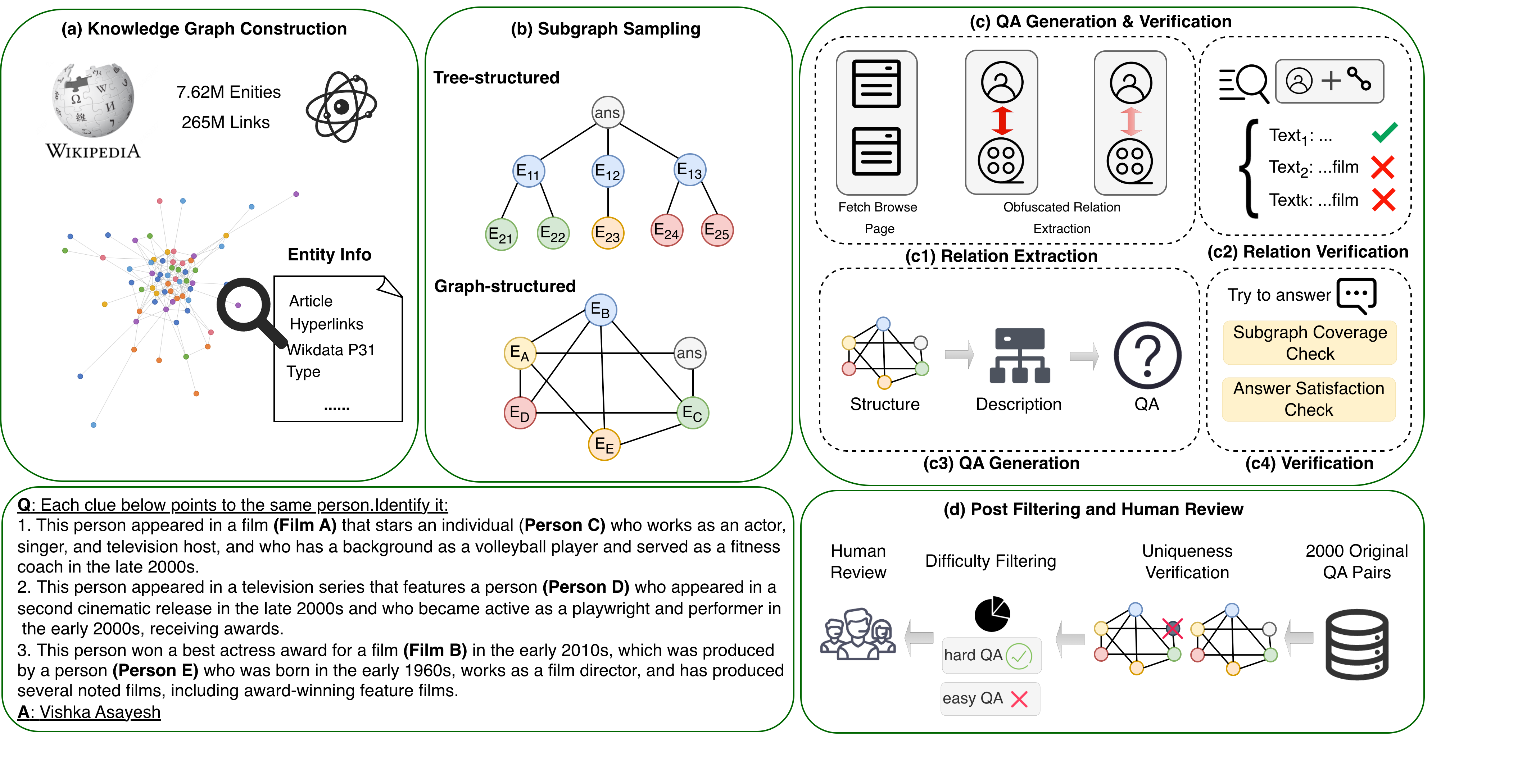
Figure 1: Overview of the LoHoSearch pipeline.
- Post-filtering and Human Review: Each question passes redundancy pruning, manual review for logical coherence, language fluency, and information redundancy. Additionally, exhaustive automated agent-based answer search further enforces answer uniqueness.
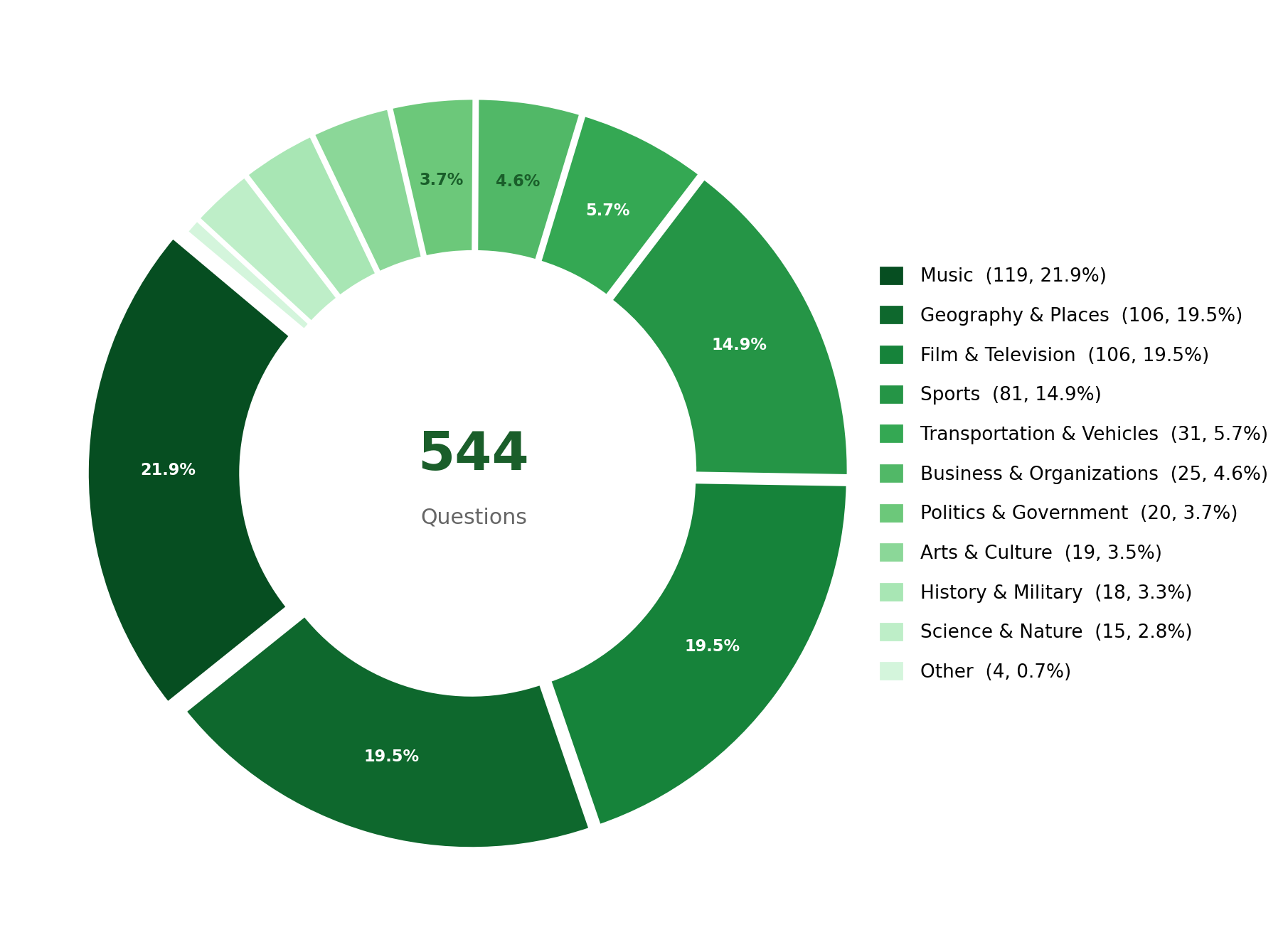
Figure 2: Domain distribution of LoHoSearch. The dataset consists of 544 samples spanning 11 categories.
LoHoSearch ultimately comprises 544 human-verified questions across 11 knowledge domains, with balanced coverage and systematically increased structural difficulty relative to prior benchmarks.
Benchmark Characteristics and Difficulty Analysis
A key innovation of LoHoSearch is the systematic control of search space size per constraint and structural complexity at the single-question level. Empirical analysis reveals:
- Entity Popularity: Hidden entities that must be inferred are consistently of lower popularity in LoHoSearch than in prior benchmarks.
- Search Space: Even under matched popularity, the candidate sets satisfying LoHoSearch's relational constraints are far larger, reflecting the intentional global maximization of difficulty.
- Structural Complexity: Graph-structured questions, which include cycles and cross-links, are significantly harder—DeepSeek-V4-Flash achieves only 8.01% accuracy on these versus 11.89% for tree-structured forms.
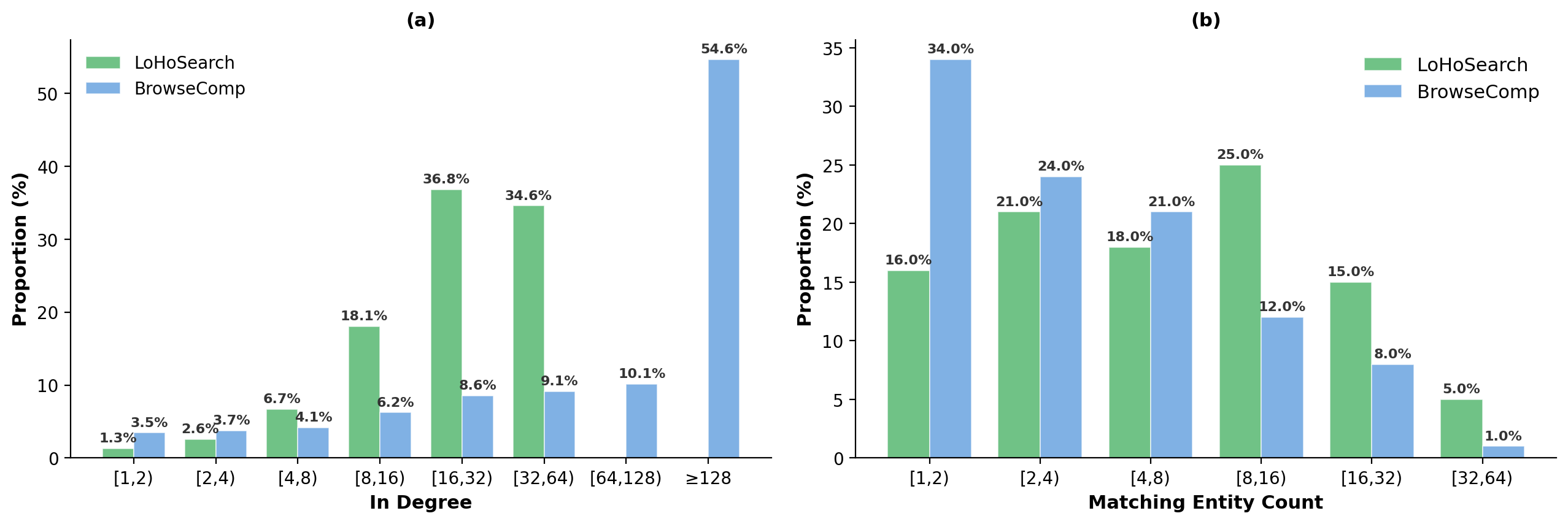
Figure 3: Analysis of hidden entity popularity and search space size. (a) LoHoSearch produces significantly lower popularity hidden entities. (b) For fixed popularity, LoHoSearch yields far larger search spaces per relation than BrowseComp.
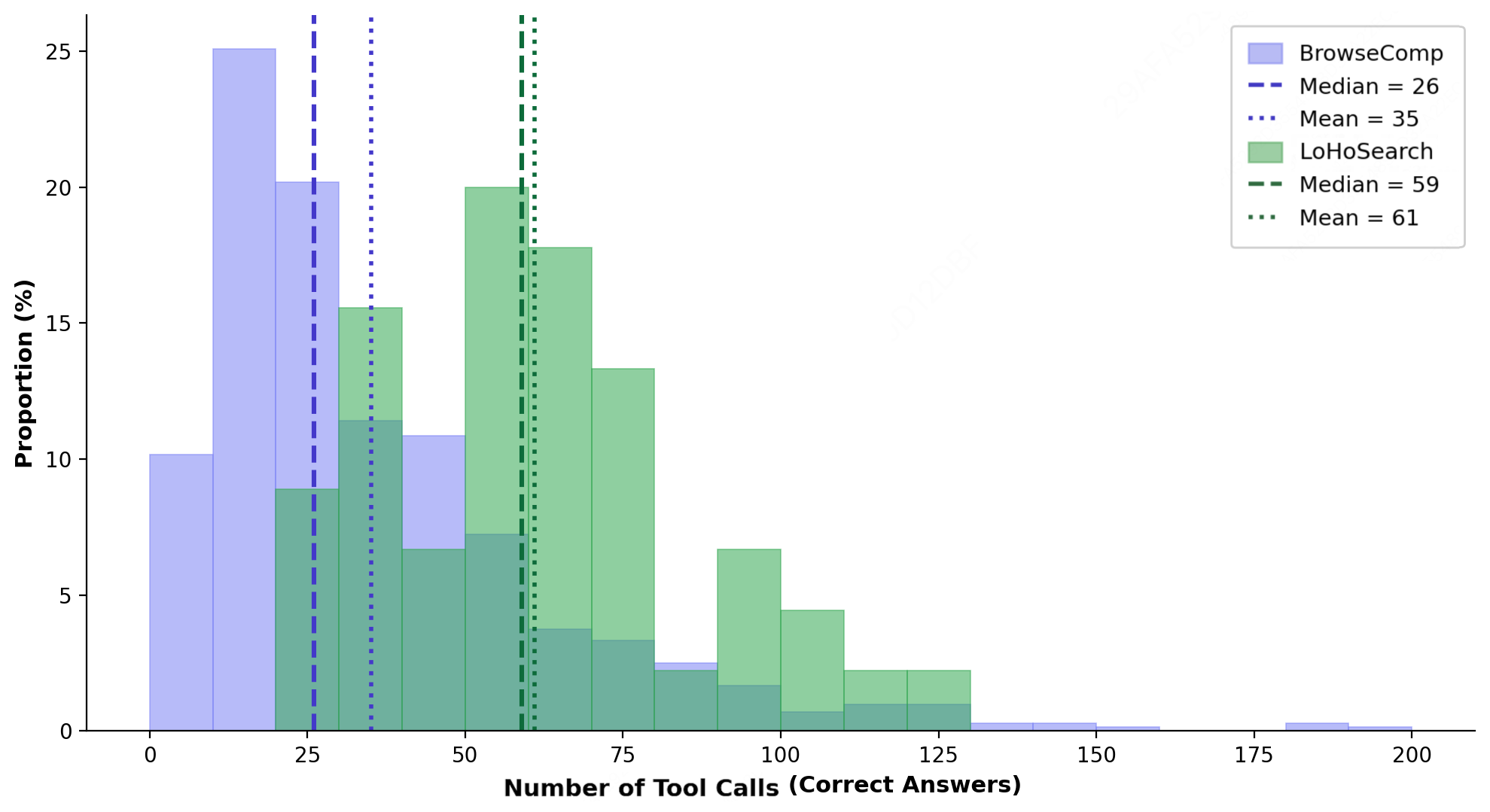
Figure 4: Distribution of the number of tool calls (correct answers) for BrowseComp and LoHoSearch. LoHoSearch requires significantly more tool calls to reach correct answers compared to BrowseComp.
The number of tool calls required to solve LoHoSearch examples is far greater—mean (median) of 61 (59) for correct solutions, versus 35 (26) for BrowseComp—highlighting the demand for extended multi-step reasoning.
Comprehensive evaluation with leading closed and open models demonstrates the elevated challenge of LoHoSearch:
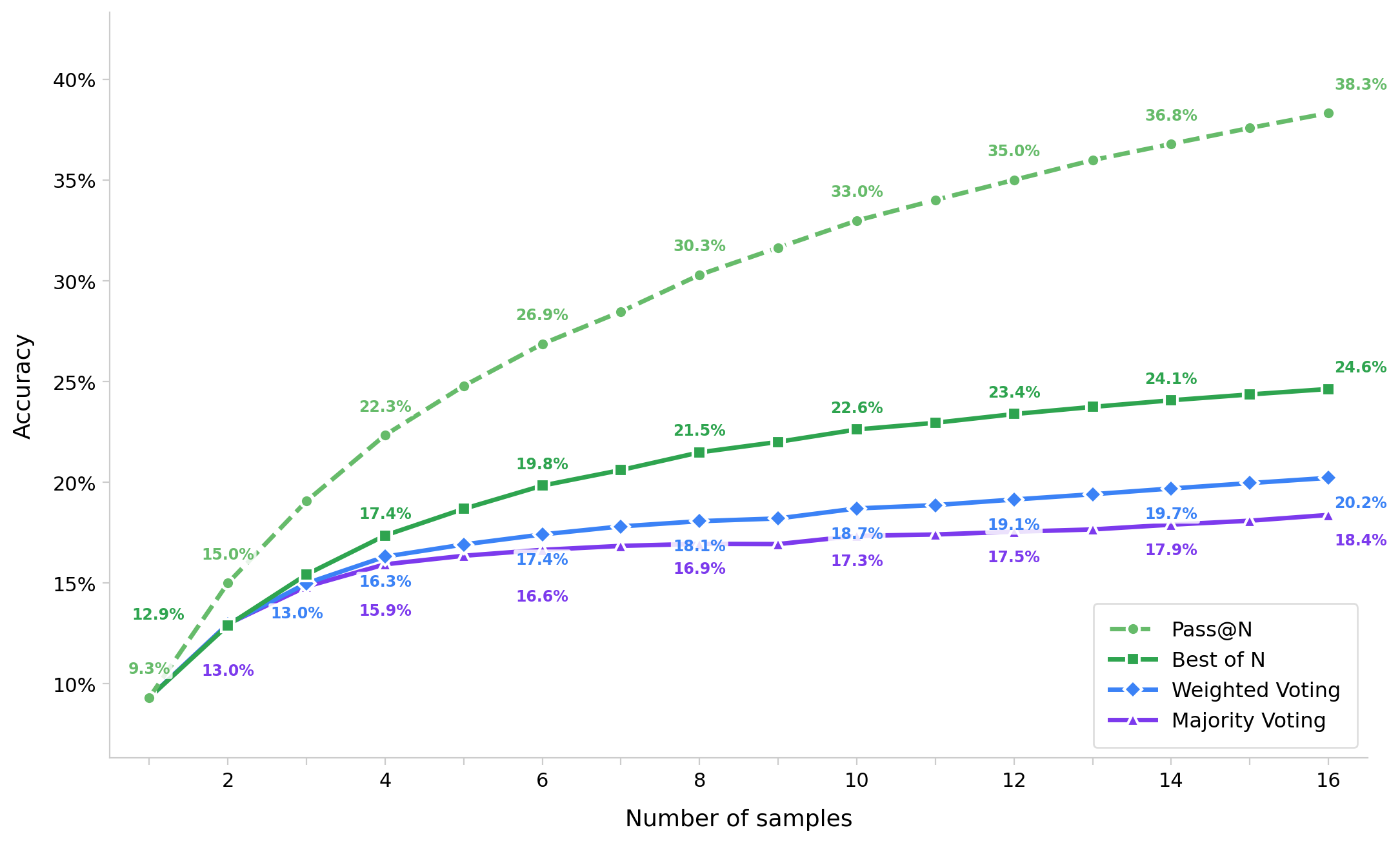
Parallel sampling with answer aggregation methods reveals headroom for score improvements, but the upper bound remains low given the base difficulty of each instance.
Implications and Future Directions
Practically, LoHoSearch delineates a new standard for long-horizon search agent evaluation, especially in settings involving open web tools, complex context management, and combinatorial constraint satisfaction. The automated pipeline demonstrates a scalable methodology for dataset generation that adapts alongside advancing model capabilities, providing a path to continuous benchmark renewal.
Theoretically, the dataset reveals persistent limitations in current LLM-based agents’ ability to solve large search spaces and high-complexity questions, even as context windows and retrieval tools expand. The limited impact of context management ablations underscores the need for more fundamental advances in memory, planning, and reasoning over extended horizons.
The approach also formalizes a methodology—verifiable uniqueness, global structure statistics, and adversarial automated filtering—that can be extended to new languages and domains, and adapted for evaluating other forms of knowledge-intensive, multi-hop reasoning.
Conclusion
LoHoSearch represents a principled advance in search agent benchmarking, systematically exceeding the human-authored difficulty ceiling via a scalable, knowledge-graph-centric pipeline. The limited success of current agentic models on this benchmark makes it a discriminative platform for research on long-horizon reasoning, context management, and the next generation of search-capable AI systems.