- The paper demonstrates that an offline-trained reinforcement learning policy can dramatically reduce decision latency in Hamiltonian learning, achieving up to 72.6× speedup.
- It employs sequential Monte Carlo filtering combined with graph encoders and a transformer, preserving near-optimal Bayesian estimation for TFIM tasks.
- Experimental results on five- to twelve-qubit systems show scalability and potential for microsecond-latency, paving the way for real-time quantum device calibration.
SymQNet: Amortized Reinforcement Learning for Fast Adaptive Hamiltonian Learning
Problem Context and Motivation
Accurate Hamiltonian learning is a cornerstone of quantum device calibration, providing the parameter estimation necessary for device characterization and algorithm deployment. Adaptive experiment design, wherein measurement choices are iteratively conditioned on the posterior belief, is preferred for its statistical efficiency. However, the computational cost associated with classical Bayesian design—specifically, the posterior-dependent scoring of candidate measurements—imposes substantial wall-clock latency, hindering low-latency adaptive control on quantum hardware.
SymQNet addresses this bottleneck by introducing a reinforcement-learning-based amortized acquisition strategy. Rather than recomputing Bayesian design rules (e.g., Fisher information or BALD) online for each posterior update, the policy is trained offline over a distribution of related tasks and then deployed for fast real-time measurement selection. The system maintains Bayesian sequential Monte Carlo (SMC) filtering for posterior updates, preserving statistical optimality while shifting the costly acquisition computation offline.
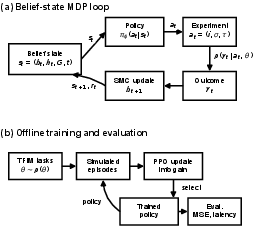
Figure 1: Belief-state Markov decision process (MDP) for Hamiltonian learning, detailing the flow from belief update through action selection and acquisition via a reinforcement learning policy.
The SymQNet policy operates within a belief-state MDP framework designed for adaptive learning of transverse-field Ising model (TFIM) Hamiltonians. The agent's state comprises the current SMC posterior, measurement history, qubit-chain graph, and decision step. Actions correspond to the choice of qubit, measurement basis, and evolution time, yielding an action space that scales linearly with qubit number.
Posterior updates are performed via SMC, with particle filtering and systematic resampling to maintain non-degenerate weights. The reward function is defined as the information gain between successive posteriors, based on the Kullback–Leibler divergence, providing dense local feedback unlinked to the latent parameter vector.
SymQNet's architecture integrates graph encoding for the qubit topology, a variational autoencoder (VAE) for compressed measurement history, and a transformer module for temporal summarization. During offline training (using PPO), the policy is optimized for cumulative information gain. In deployment, only a policy forward pass is required for acquisition, drastically reducing latency compared to recomputing acquisition scores for each decision.
Baselines and Experimental Protocol
Multiple baselines benchmark SymQNet's performance:
- Optimized Fixed and Cyclic Schedules: Evaluate the value of adaptivity under non-posterior-dependent designs.
- DAD-Style Transformer: A sequential-design transformer observing only experiment history, omitting explicit graph or posterior summary features.
- Random Selection: Assesses the value derived from structured policy over random acquisition.
- Bounded Fisher-Information and BALD: Online Bayesian acquisition methods, with capped candidate sets to render tractable comparisons as the system scales.
Experiments use exact statevector simulation or matrix-product-state methods for larger chains, consistent shot budgets, and matched posterior updates, decoupling acquisition cost from simulation cost.
Empirical Results and Numerical Claims
On five-qubit TFIM benchmarks, SymQNet achieves decision latency reductions of 47.1× (against bounded two-step BALD) and 72.6× (against bounded Fisher-information search) at a 128-shot budget. The speedup increases with shot budget and qubit number due to the scaling action space. For twelve qubits, the acquisition step requires only 2.09 ms per decision for SymQNet, compared to over 13 s for bounded two-step BALD and over 22 s for bounded Fisher information, representing several orders of magnitude acceleration.
MSE-accuracies are held within 1.32× (worst case) of the most accurate bounded Bayesian baseline at small N, and as low as 0.94× at larger system sizes, establishing that amortized acquisition does not strongly compromise estimation efficiency for the TFIM task distribution considered.
Detailed ablations show marginal gains from the inclusion of graph encoders and VAEs, with the transformer contributing most substantially, while lighter policies further reduce inference time, enabling prospective microsecond-latency controllers.
Theoretical and Practical Implications
The results demonstrate the feasibility and efficacy of offline amortization for adaptive Bayesian experiment design in quantum settings, particularly when the action space scales combinatorially and online computation incurs prohibitive latency. This establishes a scalable pathway for adaptive quantum metrology, control, and calibration where traditional Bayesian optimization is infeasible in real time.
Online adaptation with explicit Bayesian acquisition (e.g., full Fisher or BALD search) fails to scale as N increases, motivating learned, hardware-deployable policies. While the five-qubit fixed schedule is most accurate in a controlled training distribution, the learned posterior-aware SymQNet should generalize better in settings with shifted priors, variable connectivity, or non-chain couplings—regimes of practical importance for future hardware.
(Figure 2)
Figure 2: Main latency and accuracy results across 8-, 10-, and 12-qubit TFIM tasks for SymQNet and Bayesian acquisition baselines (not shown, reference main evidence figure in the paper).
Future Directions
Several avenues for extension are identified:
- Policy Compression: Further architectural pruning may reduce latency to the microsecond regime, directly supporting fast feedback in real-world quantum processors.
- Reward Shaping: Training with end-to-end MSE-aligned or hardware-aware objectives may better close the surrogate gap observed with pure information-gain reward.
- Generalization Tests: Larger-scale evaluation on graphs with nontrivial connectivity, shifted priors, or experimental hardware (with physical noise) are necessary to validate the general utility of the approach.
- Hardware Integration: Implementation of trained policies on real control stacks, benchmarking against classical optimization in live deployments.
Conclusion
SymQNet demonstrates that amortized reinforcement learning provides a scalable and statistically near-optimal acquisition strategy for adaptive Hamiltonian learning, replacing computational bottlenecks of classical Bayesian design with fast policy inference. The approach is compelling for quantum device calibration at scale and presents a practical solution as action spaces and posterior update costs continue to grow with hardware capabilities. Further development is warranted to optimize policy generalization, reward alignment, and full-stack quantum integration.
Reference: "SymQNet: Amortized Acquisition for Low-Latency Adaptive Hamiltonian Learning" (2606.12808)