- The paper introduces HAML, a meta-learning framework that outperforms traditional SWPT in reducing effective Hamiltonians for superconducting qubits.
- HAML employs offline supervised training on simulated ensembles and sample-efficient online adaptation using minimal, informative measurement sets.
- The method achieves up to a 40× reduction in excess infidelity, enabling rapid calibration and improved control in strong-coupling regimes.
Introduction and Motivation
Bridging the gap between complex physical models and operationally relevant effective Hamiltonians is a persistent challenge in the modeling and control of superconducting quantum devices. The work "Data-Driven Hamiltonian Reduction for Superconducting Qubits via Meta-Learning" (2604.24912) introduces HAML—a meta-learning approach for rapidly adapting effective Hamiltonian models in superconducting qubit architectures, specifically addressing sample efficiency and accuracy in regimes where perturbative analytic tools break down.
Conventional approaches such as Schrieffer-Wolff perturbation theory (SWPT) are limited by stringent convergence conditions and rapidly escalating algebraic complexity for multimode systems. HAML addresses these fundamental bottlenecks by leveraging supervised offline training on simulated device ensembles and information-theoretically optimized online adaptation from restricted hardware-accessible measurement sets.
System Architecture and Physical Model
The study focuses on a canonical transmon-coupler-transmon circuit architecture: two frequency-tunable transmon qubits coupled capacitively via a tunable intermediate coupler. In hardware, only the qubits are directly measured, while the coupler's properties must be inferred indirectly, imposing additional constraints on system identification and calibration.
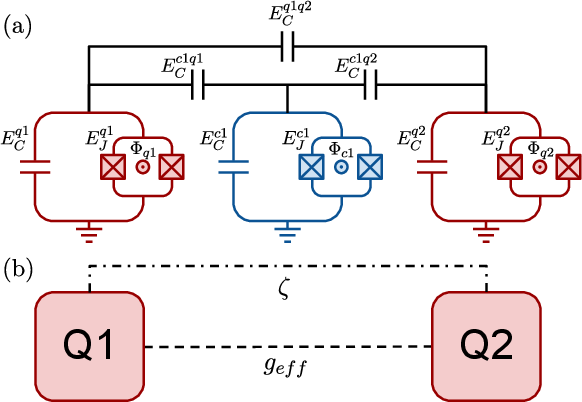
Figure 1: Circuit diagram of the transmon-coupler-transmon architecture comprising two tunable qubits (red) capacitively coupled to a flux-tunable coupler (blue).
A full multi-mode Hamiltonian captures both qubit and coupler modes, but analytical block-diagonalization (e.g., via SWPT) relies on moderate-to-large detuning and becomes unreliable as the coupler frequency approaches qubit frequencies—exactly the operating regime for fast two-qubit gates.
HAML (Hamiltonian Adaptation via Meta-Learning) proceeds through two principal phases: (1) offline supervised training on an ensemble of simulated devices; (2) sample-efficient device adaptation via hardware measurements.
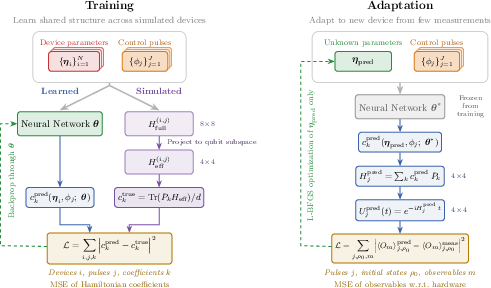
Figure 2: The HAML pipeline—offline supervised training and online device-level adaptation.
Offline Training: Learning Parametric Hamiltonian Maps
A parameterized neural network is trained to map control inputs and static device parameters (e.g., Josephson and capacitive energies) to the effective Hamiltonian coefficients spanning the qubit subspace. This map is learned directly from projected multi-mode simulations, producing effective coefficients not constrained by perturbative expansion.
Key design choices:
- The parameterization follows the CAVIA meta-learning paradigm, partitioning parameters into shared network weights (trained offline) and per-device latent context vectors (adapted online).
- Training labels are generated by projecting full three-mode Hamiltonians onto the qubit subspace using symmetric orthogonalization and refining to maximize projected-unitary process fidelity at a fixed evolution time.
Online Adaptation: System Identification via Greedy Measurement Selection
Upon exposure to a new device, HAML freezes the shared network and fits the latent context vector using a minimal, variance-maximizing set of (initial state, observable) measurement outcomes. This set is constructed by maximizing marginal informativeness in expectation over the training distribution.
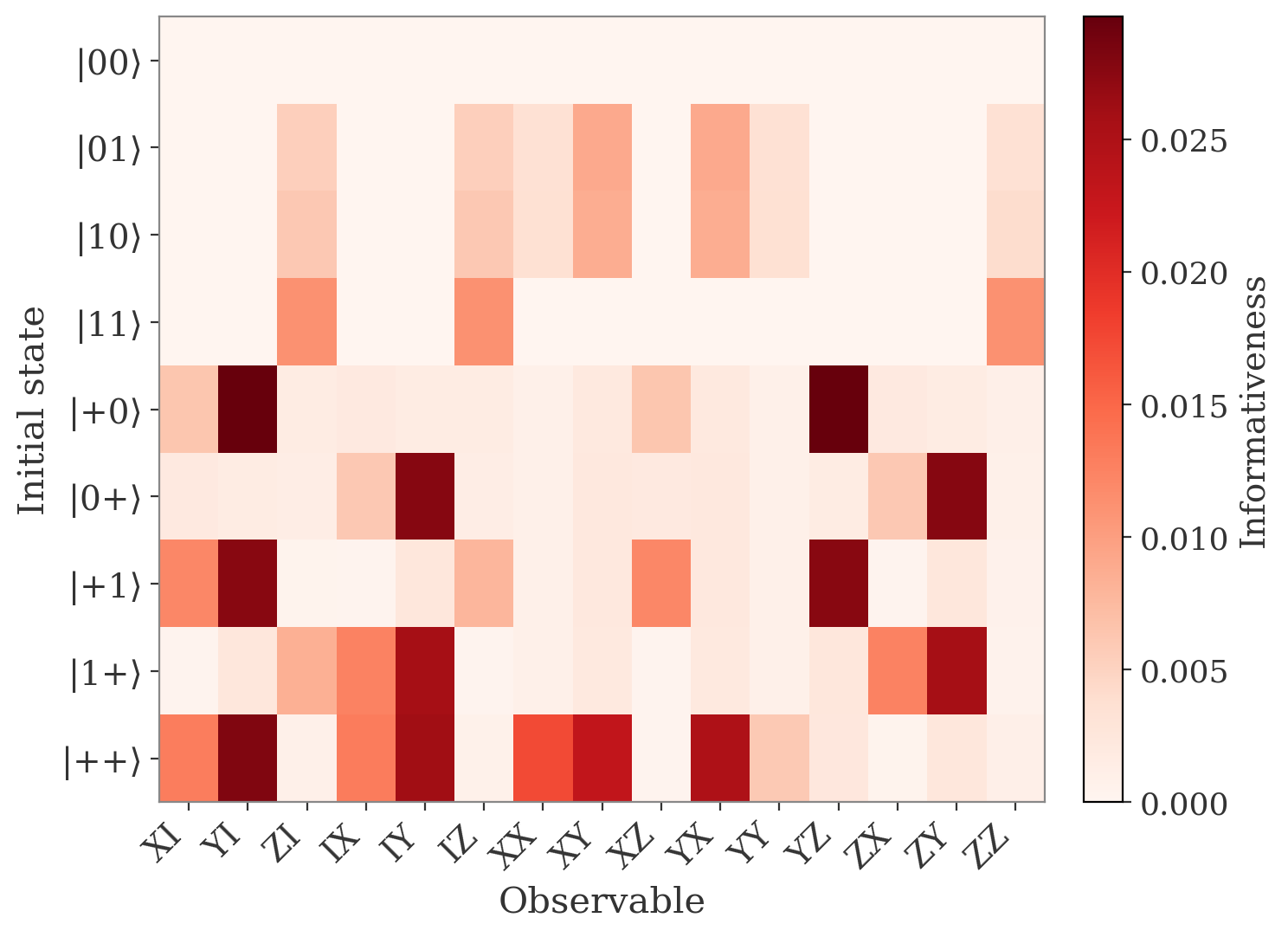
Figure 3: Informativeness heatmap for candidate (initial state, observable) pairs, computed via variance across simulated measurement outcomes.
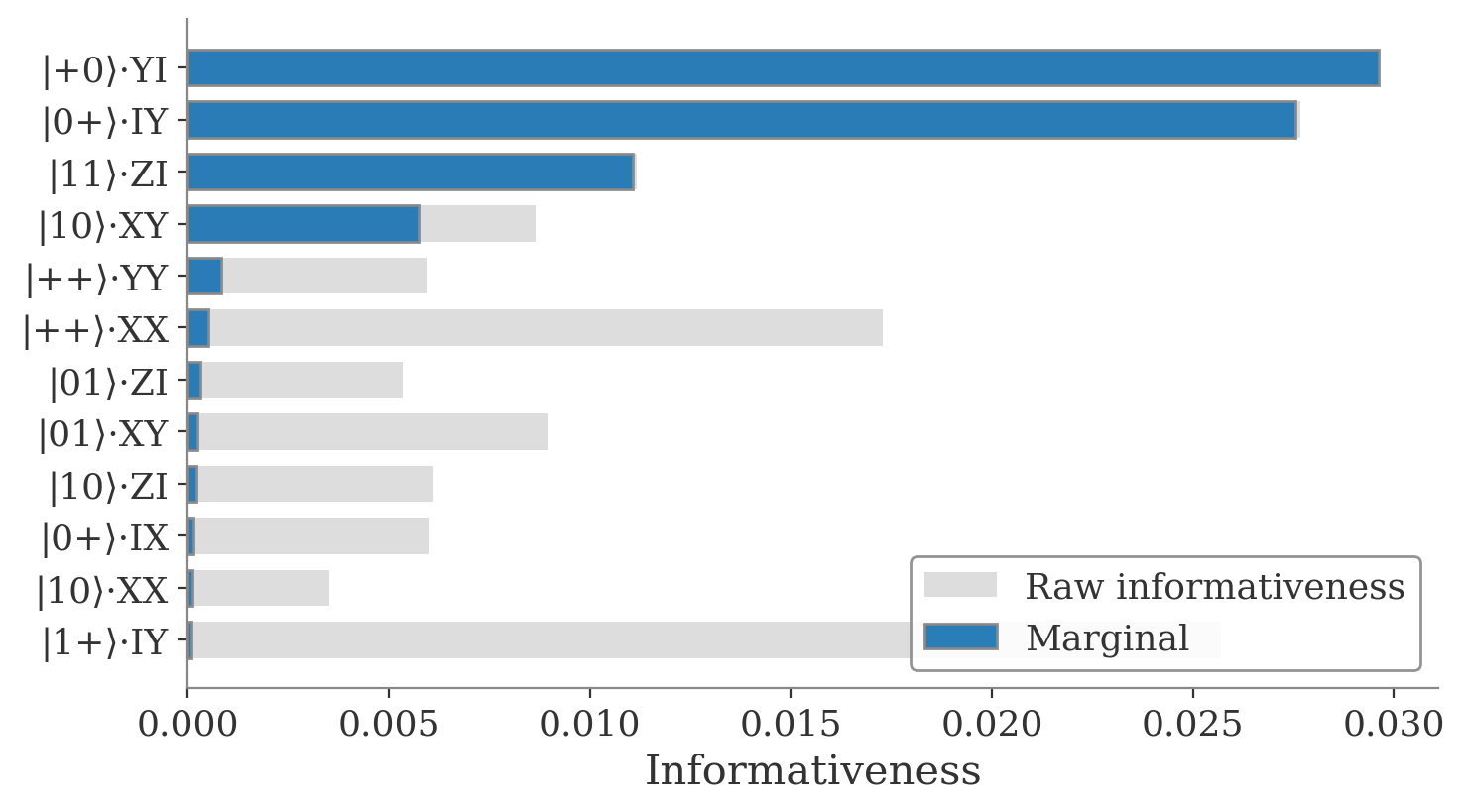
Figure 4: Greedy selection trajectory for the measurement set, illustrating diminishing marginal informativeness.
Numerical Results and Comparison to Perturbation Theory
Evaluation is performed on a set of held-out devices not present in the training ensemble. For each, the model predicts the effective Hamiltonian coefficients at dense control points, adapting with a measurement budget of just 140 expectation values per device.
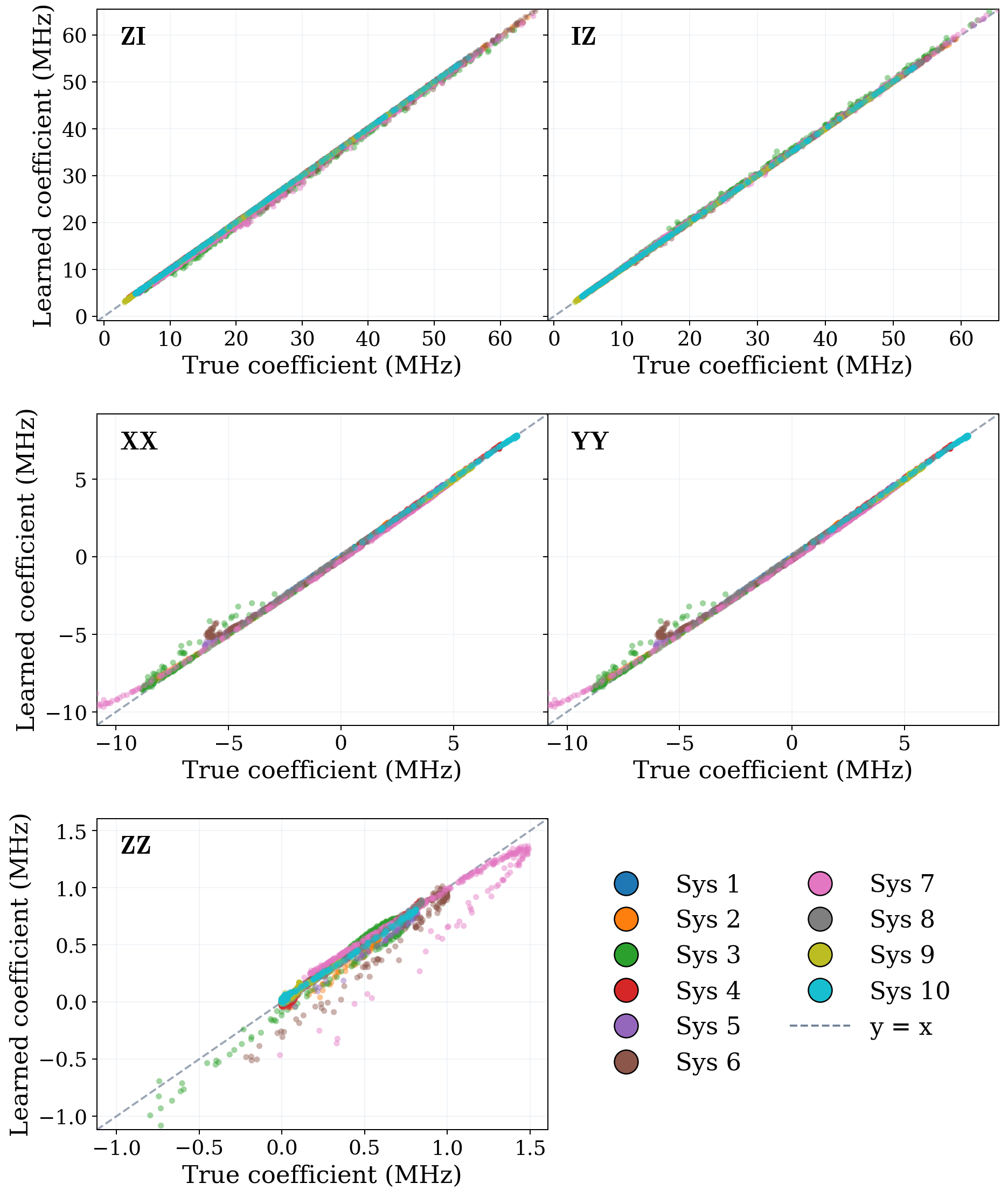
Figure 5: Predicted versus ground-truth projected Pauli coefficients for 10 held-out devices, across 300 random control configurations per device.
HAML consistently tracks ground truth across all effective qubit terms, including residual ZZ interactions omitted by second-order SWPT. Aggregate results:
| Term |
HAML MAE (MHz) |
HAML Rel. (%) |
SWPT MAE (MHz) |
SWPT Rel. (%) |
| ZI |
0.259 |
0.39 |
0.872 |
1.32 |
| IZ |
0.170 |
0.26 |
0.865 |
1.33 |
| XX |
0.108 |
0.57 |
0.916 |
4.82 |
| YY |
0.107 |
0.56 |
0.916 |
4.82 |
| ZZ |
0.036 |
1.13 |
0.362 |
11.32 |
| All |
0.136 |
0.58 |
0.786 |
4.72 |
The improvement in mean absolute error is most pronounced (∼10×) for the residual ZZ interaction. SWPT yields zero for ZZ by construction, whereas HAML reconstructs it directly from qubit-accessible observables.
The test set spans a broad range of coupling-to-detuning ratios, including extreme hybridization inaccessible to order-by-order SWPT.
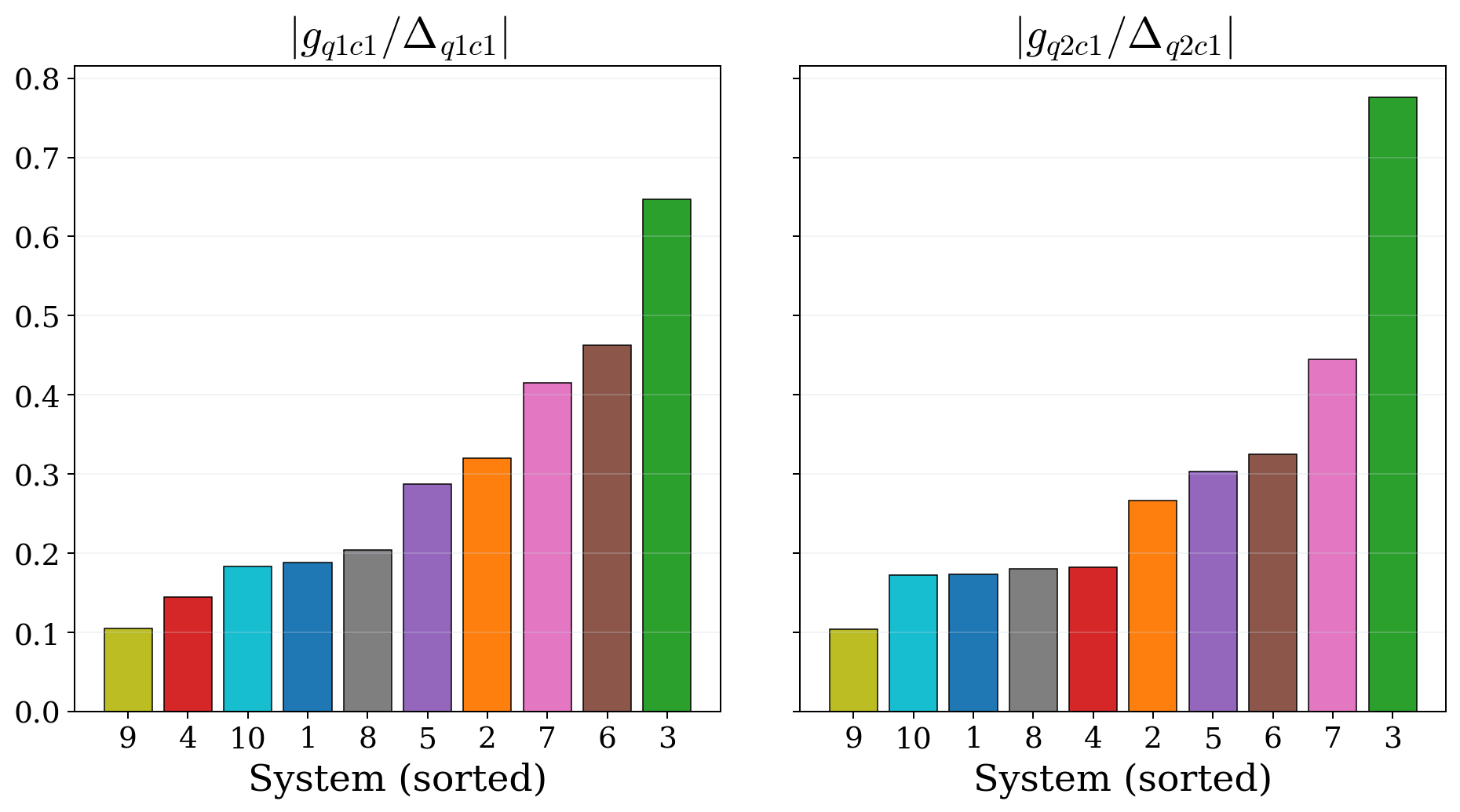
Figure 6: SWPT perturbative expansion ratio ∣gqc/Δqc∣ for the test ensemble, sorted ascending.
HAML reaches the irreducible infidelity floor set by projection to the qubit subspace, closely matching the projected unitary dynamics, while SWPT diverges rapidly as the perturbative parameter increases.
Fidelity Analysis
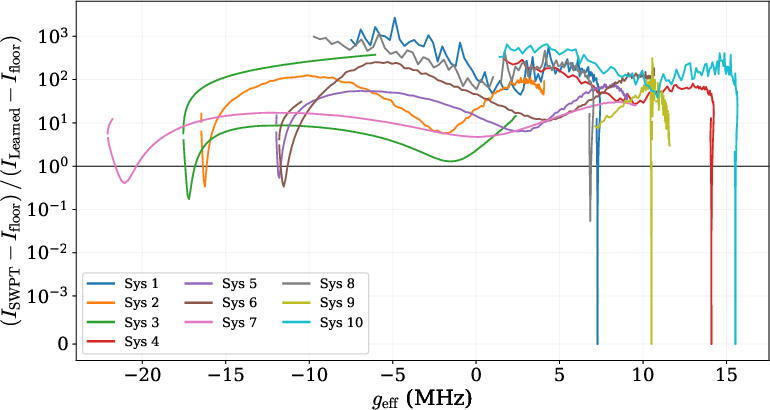
Figure 7: Infidelity gain of HAML over SWPT across operating range, plotted as the ratio of excess infidelities after subtracting the irreducible leakage floor.
HAML exhibits a 40× reduction in model-induced excess infidelity relative to SWPT, particularly in the strong-coupling regime fundamental for fast two-qubit gates.
Adaptation and Training Efficiency
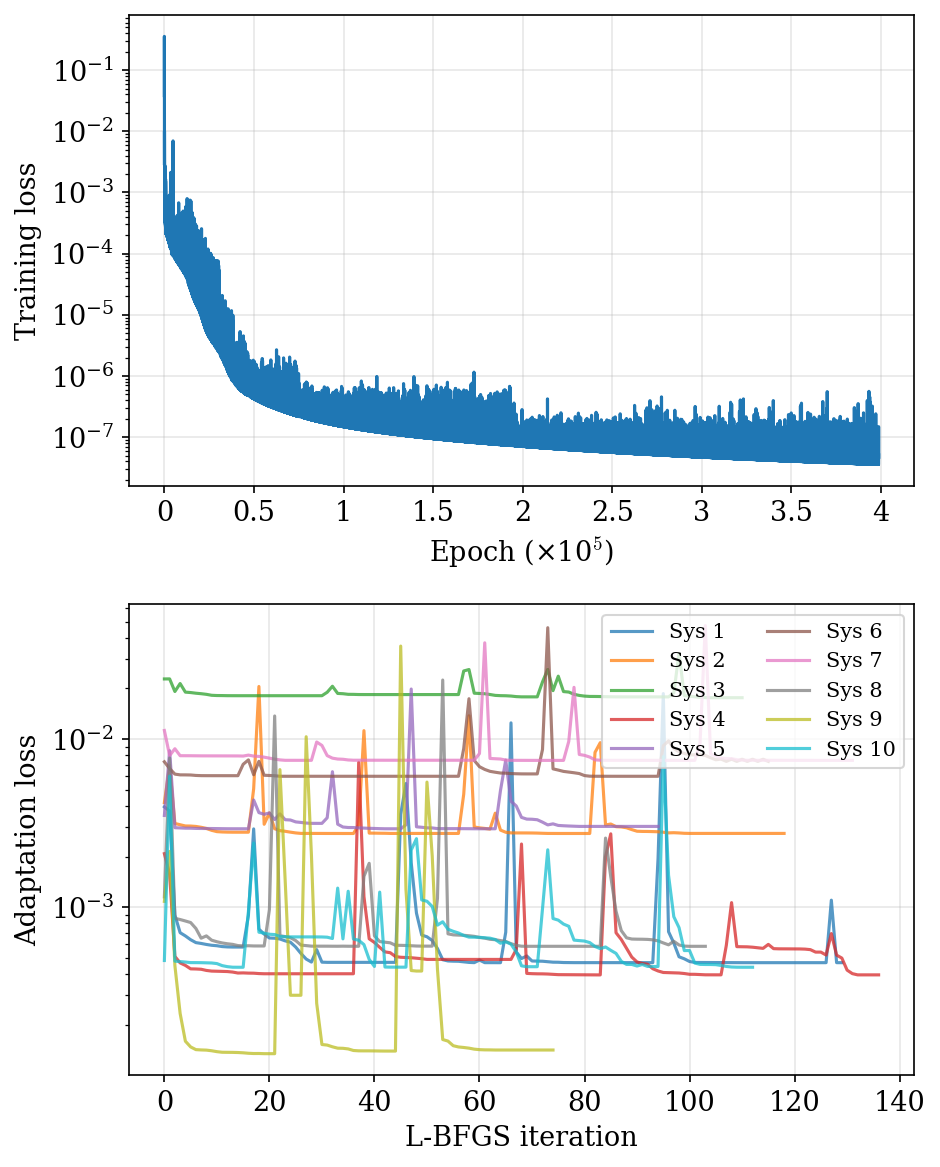
Figure 8: Convergence of HAML: training loss versus epochs and per-device adaptation loss across L-BFGS iterations.
Wall-clock adaptation to a new device completes in seconds on a CPU, given a previously trained model.
Theoretical and Practical Implications
HAML demonstrates that a meta-learned Hamiltonian reduction can supplant symbolic perturbative methods for qubit-subspace modeling in superconducting devices, with implications for:
- Automated, scalable Hamiltonian identification and calibration workflows, even when auxiliary modes are not directly measurable.
- Accelerated inner-loop procedures for quantum optimal control, calibration, and error mitigation tasks, as no symbolic reduction or indirect bare-parameter inversion is needed.
- Sample-efficient, robust adaptation to hardware variability and parameter drift using a minimal number of informative measurements, aligning with the realities of large-scale, modular quantum processor deployment.
The approach is extensible in multiple directions:
- Extension to three-level (qutrit and higher) mode truncations to capture more realistic leakage and higher-order interactions.
- Online adaptation in time-dependent scenarios (e.g., calibration drift, pulse distortion).
- Scaling to larger, more complex architectures where perturbative analytic reductions are infeasible due to rapidly growing Hamiltonian dimension and coupling graph complexity.
Conclusion
HAML achieves high-accuracy, sample-efficient Hamiltonian reduction for superconducting qubit systems, outperforming SWPT especially in the fast-gate, strong-hybridization regime. Meta-learning based approaches for physical model reduction represent a robust path forward, able to generalize across device variability and accommodate more complex hardware configurations without analytic overhead. As superconducting quantum devices scale, such data-driven frameworks are poised to become essential tools for characterization, calibration, and control in quantum engineering (2604.24912).