- The paper introduces a two-stage PFN approach that bypasses traditional Monte Carlo sampling, achieving over 50x speed-ups in entropy search for Bayesian Optimization.
- It utilizes a base PFN for posterior predictive estimation and an α-PFN to directly compute acquisition values via a single transformer forward pass.
- Empirical evaluations on synthetic and real-world benchmarks show that the method matches state-of-the-art ES techniques while robustly generalizing to higher dimensions.
Fast Amortization of Entropy Search in Bayesian Optimization via In-Context Prior-Fitted Networks
Introduction and Motivation
α-PFN ("α-PFN: Fast Entropy Search via In-Context Learning" (2606.07134)) addresses the computational bottlenecks inherent in information-theoretic acquisition functions for Bayesian Optimization (BO) such as Entropy Search (ES) and its variants (Predictive Entropy Search, Max-value Entropy Search, Joint Entropy Search). Traditional ES-based BO incurs substantial runtime due to expensive Monte Carlo (MC) or similarly manual, sampling-based estimation of information gain—especially problematic for fully Bayesian Gaussian Processes (GPs) and when optimizing GPs' hyperparameters.
The fundamental contribution of this work is the design of a two-stage, meta-learned approximation of ES-based BO acquisition using Prior-data Fitted Networks (PFNs). By mapping the computation of acquisition values directly to a single forward pass of a transformer trained on millions of GP sample datasets, the authors decouple ES from MC-based inference. This achieves over 50x speed-ups, while empirically matching the performance of state-of-the-art handcrafted ES approximations on synthetic and real-world benchmarks. The PFN-based architecture amortizes the computation across acquisition functions, contexts, and prior settings, supporting flexible and efficient BO with surrogate uncertainty propagation.
Classical BO with GPs generally employs acquisition functions such as Expected Improvement (EI), which are myopic and suboptimal on noisy or multi-modal objective landscapes. In contrast, ES-based acquisition functions maximize the expected reduction in uncertainty (entropy) regarding the optimum's location x∗ or value f∗ after a (potential) observation at x—formally, the mutual information between x∗ or f∗ and the observation y. ES, MES, and JES involve nested expectations and conditional entropies over posteriors, requiring expensive sampling (e.g., MC or RFF-based function path optimization) for both current context and GP hyperparameters. Fully Bayesian variants require sampling over kernel hyperparameters, further compounding computational overhead.
Prior-data Fitted Networks: Amortized Posterior and Acquisition Inference
PFNs are transformer-based conditional neural processes, trained on massive synthetic datasets sampled from a GP (or other surrogate) prior. A PFN, through in-context learning, outputs the posterior predictive distribution (PPD) conditioned on context points and queried locations, in a single forward pass. This work extends the PFN paradigm in two stages:
- Base PFN: Trained to provide the PPD q(y∣x,D,I), optionally conditioned on information I about the optimum (i.e., on α0, α1, or both). The base PFN can thus simulate the entropy terms under conditioning required by ES, MES, or JES objectives.
- α2-PFN (Acquisition PFN): Trained on the difference of entropies (using the base PFN)—specifically, on α3, across massive precomputed datasets where the true optimum is brute-force approximated using Random Fourier Features and global optimization heuristics (see Algorithm~\ref{algo:cluster}).
Rather than sampling α4 for each evaluation, this meta-learned α5-PFN directly predicts the distribution of information gain. The mean of this distribution corresponds to the ES-based acquisition function, removing runtime MC estimation at test time.
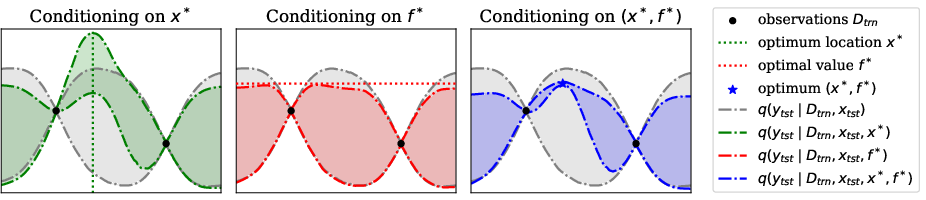
Figure 1: The base PFN models the PPD for a candidate query, optionally conditioned on true optimum information (α6, α7, or both) to enable analytic entropy difference computation for the acquisition.
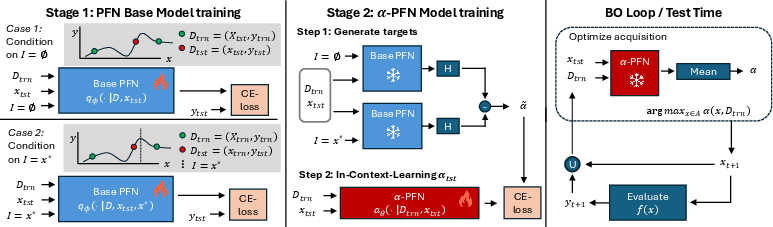
Figure 2: Left—base PFN is trained on multiple conditional regimes; Middle—inducing PES acquisition as a meta-learning objective; Right—at inference, a single forward pass of the α8-PFN yields the acquisition function for BO.
Training Pipeline and Generalization
Training utilizes synthetic datasets from GP priors, for dimensions α9 and context sizes up to x∗0. Maximization of GP sample paths (for ground-truth x∗1) is performed via efficient global and local search ensembles. To prevent distributional shift due to clustering of context points in BO traces, a trace generation heuristic models exploration-exploitation in the context distribution; this is crucial for high-dimensional generalization.
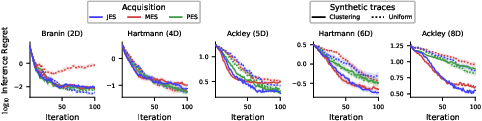
Figure 3: Clustered trace generation matches BO context distribution and is critical for performance beyond toy settings.
Fully Bayesian coverage is provided by sampling GP hyperparameters, allowing the base PFN and x∗2-PFN to properly integrate posterior uncertainty, in contrast to the per-hyperparameter averaging typical of GP-MCMC approaches.
Empirical Results
Synthetic Function Benchmarks
Evaluation on classic benchmarks (Branin, Hartmann, Ackley) demonstrates that x∗3-PFN's inference regret is highly competitive with conventional GP-based ES, PES, MES, and JES—in many cases, nearly indistinguishable. Variance across traces and dimensionality is well-handled, indicating robust amortization and generalization.
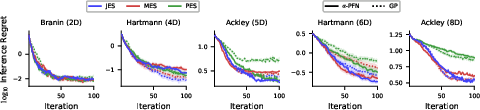


Figure 4: PFN-based ES variants yield low inference regret, matching GP-based MC approximations.
Real-World HPO Benchmarks
On surrogate HPO datasets (LCBench, HPO-B)—with higher dimensionality and discrete domains—the x∗4-PFN consistently achieves predicted-best accuracy and mean regret similar to or better than GP-MCMC-based ES, across ES, PES, and JES variants.
Out-of-Distribution and Robustness
In OOD experiments with higher observation noise, x∗5-PFN precision degrades at parity with non-amortized methods, confirming faithful approximation rather than overconfident extrapolation.
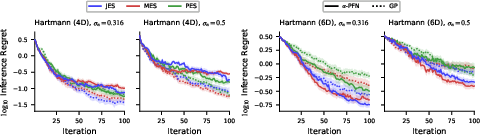
Figure 5: In high-noise settings, x∗6-PFN’s performance and degradation mirror GP-based ES, indicating robust generalization.
Ablation and Qualitative Analysis
The dependence on clustered context distributions is significant; training with uniform contexts yields poor BO performance in higher dimensions, confirming the necessity of synthetic trace generation.
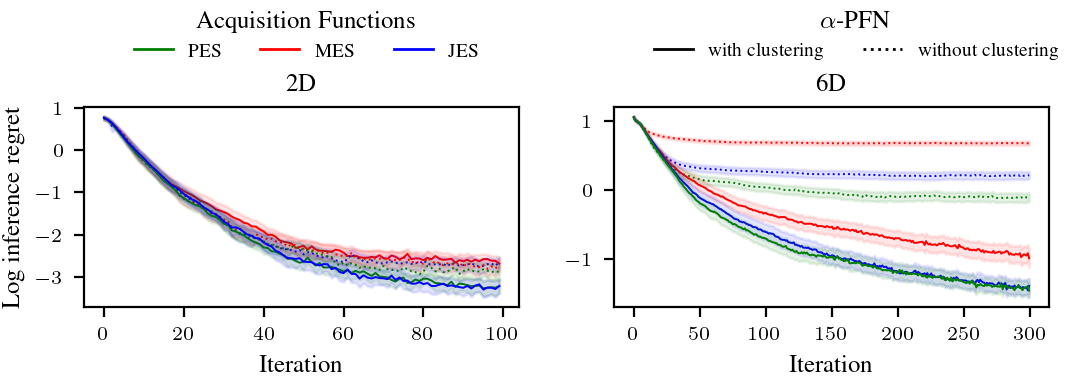
Figure 6: Context trace ablation underscores the importance of matching the true BO context distribution during PFN training.
Qualitative acquisition comparisons in 1D demonstrate close correlation between MC-estimated and direct PFN-acquisition mappings, with PFN-based approaches showing less variance in regions of high acquisition uncertainty.
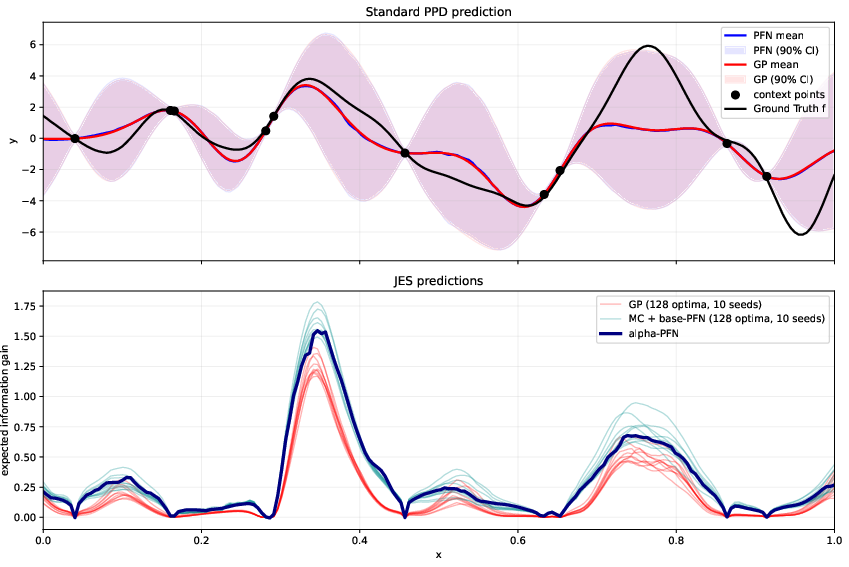
Figure 7: JES acquisition function estimates by GP, base-PFN + MC sampling, and x∗7-PFN for a 1D function; PFN-based estimation exhibits reduced variance.
Runtime Comparison
x∗8-PFN achieves substantial practical runtime savings. Across all experimental settings, speedups range from 2x up to 72x, with the typical reduction 10x-50x for challenging settings (e.g., fully Bayesian HPO-B).
Theoretical Analysis
The authors prove that the x∗9-PFN’s mean corresponds to the required expectation of the information gain as in PES/MES/JES acquisition functions, leveraging the law of the unconscious statistician and KL-divergence minimization under cross-entropy loss. This justifies using the learned f∗0-PFN for direct single-pass acquisition evaluation without any MC or sampling stage at test time.
Discussion, Limitations, and Future Directions
The results demonstrate that amortized, PFN-based acquisition function prediction matches the empirical utility of classic Monte Carlo or sampling-based methods, at a fraction of runtime and compute. The flexibility of PFN-based amortization supports rapid evaluation on unseen tasks, domain shifts, higher-dimensional spaces, and arbitrary priors.
However, retraining distinct f∗1-PFNs is required per prior family or class of surrogates; broader-coverage, adaptive prior families and domain adaptation methods (such as distribution transformers) might resolve this. Current scaling is evaluated up to 16D at test time; leveraging recent PFN scaling results to 500D is a promising avenue for further extension. There is also clear scope for amortizing additional sophisticated acquisition functions, e.g., batch/parallel and constrained settings, or BO for active experimentation.
Conclusion
The f∗2-PFN framework provides a practical, flexible, and highly efficient amortized solution for Bayesian optimization acquisition in both synthetic and real-world contexts. Its single-pass, meta-learned architecture supplants sampling-based MC approximations without sacrificing informativeness or quality of acquisition. This paradigm invites investigation into foundation models for optimization acquisition, adaptive prior generalization, and large-scale, real-time active learning.
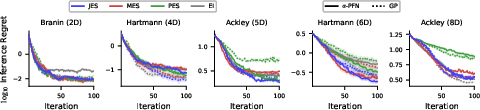


Figure 8: Examples of synthetic functions used in the large-scale empirical evaluation.
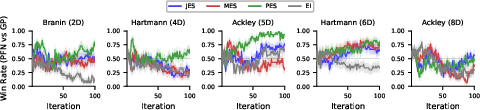
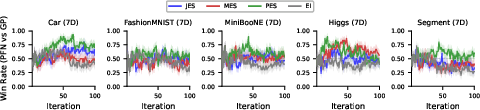
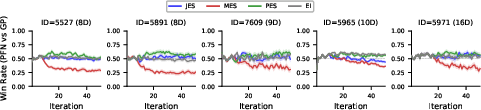
Figure 9: Additional synthetic function landscapes further exposing the generality of the PFN framework.
References
The analysis above is based on "f∗3-PFN: Fast Entropy Search via In-Context Learning" (2606.07134) and its cited works therein.