- The paper introduces a 3B-parameter, fully open text-to-image diffusion model that achieves parity or outperforms state-of-the-art models across key benchmarks.
- The paper employs extensive ablations to reveal that adapter expressivity and strategic data composition, including long captions, are critical for performance gains.
- The paper demonstrates that simplified conditioning and a dual-stream backbone with long skip connections yield superior parameter efficiency and visual fidelity.
i1: A Robust and Fully Open Recipe for High-Performance Text-to-Image Diffusion Models
Motivation and Context
The rapid evolution of text-to-image diffusion models has resulted in highly capable generative systems; however, the precise attribution of progress to specific architectural, training, and data choices remains opaque. This lack of clarity is perpetuated by the incomplete release of weights, code, and especially data recipes from leading models, hindering reproducibility and informed ablation-driven research. Prior fully open models have existed, but consistently underperform compared to their partially open or closed-source counterparts, leaving a performance gap that impedes both practical deployment and foundational research.
The i1 project addresses this by performing an exhaustive empirical exploration across modeling and data axes, executing over 300 controlled experiments and accruing 700K+ TPU v6e hours. The culmination is i1—a 3B-parameter, fully open text-to-image diffusion model trained exclusively on public datasets, with code, weights, and data processing pipelines all released. i1 achieves parity or outperforms leading open-weight-only systems on key benchmarks, setting a new standard for open generative modeling.
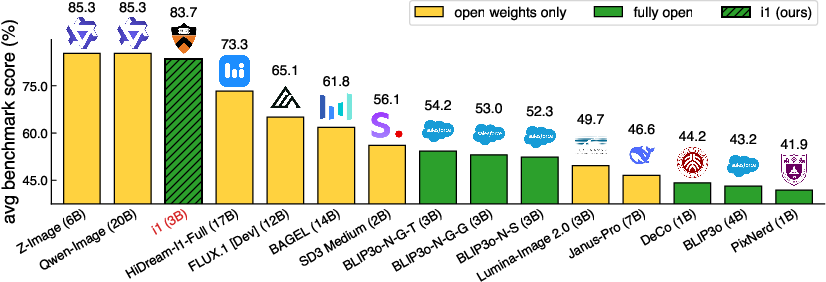
Figure 1: i1 explores the space of modeling and data choices, achieving performance competitive with SOTA closed/open-weight-only systems at 1024-resolution across five representative benchmarks, and is fully open-source.
Methodological Design and Ablation Insights
The experimental approach begins from a strong vision transformer-based diffusion baseline, derived from LightningDiT-XL/2, incorporating modern components (RoPE, RMSNorm, SwiGLU, QK-norm) as well as the underused long skip connections to facilitate representational flow.
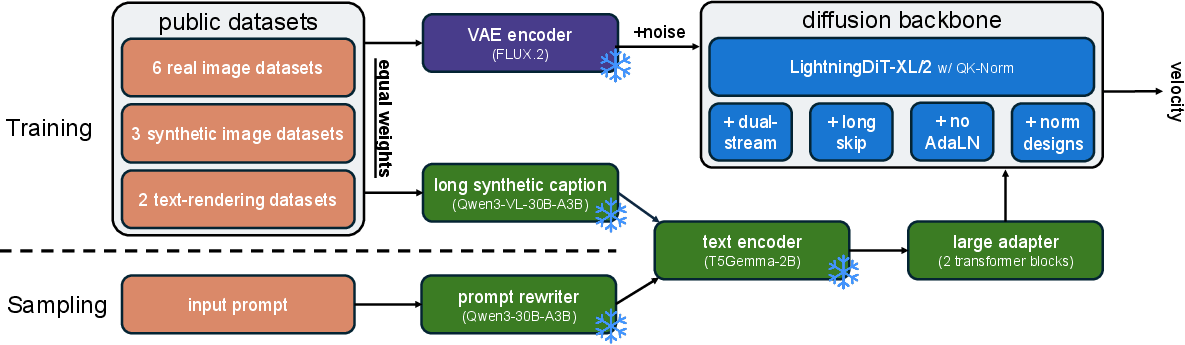
Figure 3: High-level diagram of i1, highlighting its methodological simplicity—no novel modules, but careful selection and refinement of model and data choices.
Text Encoder Architecture and Adaptation
Contrary to the prevailing trend of concatenating multiple text encoders, the study demonstrates that a single, high-capacity encoder-decoder (T5Gemma-2B) paired with an expressive adapter block outperforms more entangled multi-encoder schemes. Empirical findings reveal that performance enhancement when stacking encoders is primarily due to increased adapter parameters rather than genuine feature diversity. This is evidenced by equivalent improvements attained by duplicating a single encoder with separate adapters, while shared adapters fail to yield the same advantage. The addition of transformer-based adapters (vs. lightweight MLPs) yields consistent gains, especially plateauing after 2 blocks, enabling maximal expressivity at minimal parameter cost.
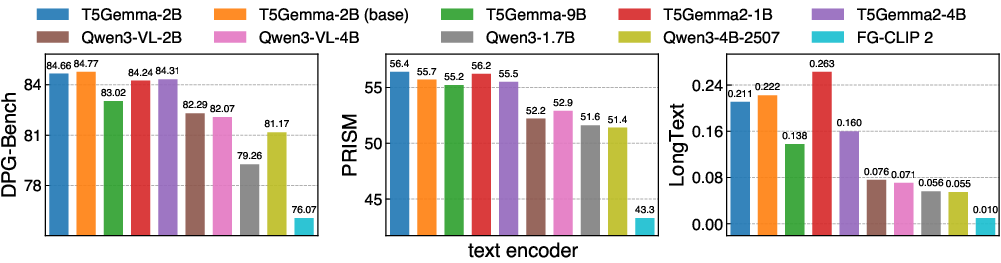
Figure 5: Encoder-decoder models (T5Gemma variants) outperform decoder-only LLMs/VLMs and CLIP-style encoders across all benchmarks given the i1 modeling context.
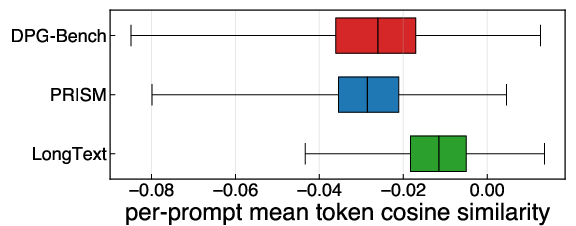
Figure 2: Adapter ablation: duplicating adapters learns distinct features, affirming the primary role of adapter expressivity over encoder heterogeneity.

Figure 8: Enlarging text encoder adapters monotonically boosts performance, with diminishing returns above two transformer blocks.
Conditioning Mechanisms
Another notable discovery is the marginal utility of AdaLN-based noise and pooled text conditioning: eliminating these components does not perceptibly harm performance when sufficient adapter expressivity is present, and in some configurations, slightly enhances it. This finding contravenes common practice, leading to simpler and more parameter-efficient designs.
Backbone Variants and Connectionality
Backbone experiments show dual-stream DiT architectures deliver optimal parameter-performance scaling compared to cross-attention and single-stream approaches. Systematic addition of long skip connections is essential for improved model expressivity and performance, especially in larger models.

Figure 10: Dual-stream backbones consistently dominate the cross-attention and single-stream alternatives for a given parameter budget.

Figure 12: Long skip connections substantially improve the parameter-efficiency trade-off, validating their integration into the i1 backbone.
Data Selection, Mixing, and Captioning
The choice of synthetic captioner is a primary driver of downstream capability; Qwen3-VL-30B-A3B is selected for its superior performance in generating long, descriptive captions. It is demonstrated that training on long captions produces stronger generalization, particularly when prompts at inference are expanded—either by repetition or LLM-based rewriting—mitigating the underperformance observed on short-prompt benchmarks like GenEval.
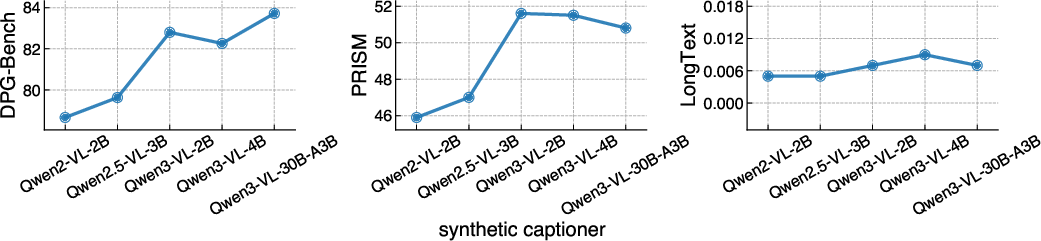
Figure 4: Performance is sensitive to the VLM used for synthetic annotation—captioner selection is critical to downstream model quality.







Figure 6: Models trained on long captions exhibit weak short-prompt performance, which can be rectified at inference via prompt expansion or rewriting.
Equally weighted dataset mixing emerges as a dominant strategy even in the presence of large, imbalanced datasets (e.g., YFCC). Removing specialized data components—real, synthetic, or text-rendering—leads to measurable regression on at least one benchmark, affirming the importance of heterogeneous composition. Subsampling reveals that repeating images incurs only slight degradation until extreme reductions are made, highlighting the sufficiency of repeated exposure in the regime of diverse data for text-to-image diffusion.

Figure 7: Each data type—real, synthetic, rendered text—acts as a necessary ingredient for optimal performance across downstream tasks.

Figure 11: Cap-and-balance data mixing (lower thresholds) yields superior performance compared to naive, scale-based dataset sampling.
Final i1 Model: Training, High-Resolution Scaling, and Evaluation
The distilled syllabus of modeling and data strategies is then assembled in the i1 architecture. The model embodies a dual-stream MMDiT backbone with two-block transformer adapters, no AdaLN or timestep conditioning, integrated skip connections, both sinusoidal and RoPE positional embeddings, and sandwich normalization shared across modalities.
Practical training leverages multi-stage resolution escalation: 256→512→1024, with careful subsampling to focus compute on high-quality examples. Notably, empirical evidence shows that comprehensive high-resolution data is not necessary as strong high-res generation can emerge from transferring capabilities encoded at low resolution, provided the model is exposed to modest volumes of upsampled data in fine-tuning.

Figure 9: Benchmark scores stabilize after moderate training (~2M iterations) and illustrate convergence in 256-resolution pretrain.




Figure 13: Qualitative improvement in text rendering and image fidelity emerges consistently through training, confirming alignment between benchmarks and actual generation quality.
Inference employs a classifier-free guidance (CFG) scale of 12 and universal prompt rewriting to harmonize prompt lengths, maximizing semantic alignment.
i1 delivers an average improvement of 29.5 percentage points over the best prior fully open model across five representative benchmarks (GenEval, DPG-Bench, PRISM, CVTG-2K, LongText), and even outperforms larger open-weight-only baselines such as HiDream-I1 (17B) and FLUX.1 Dev in aggregate prompt-following and text rendering.
Practical and Theoretical Implications
i1 stands as a clear demonstration that modern, high-performing text-to-image models do not intrinsically require opaque or proprietary components. Rather, thorough and systematic empirical analysis of the design space—particularly the interplay between adapter size, conditioning mechanisms, and data compositionality—can yield models that are competitive not just for open research but for production and real-world applications.
The project spotlights the counterintuitive result that simpler, more unified model recipes may outperform overengineered solutions utilizing encoders or auxiliary modules of dubious marginal value. The strategy of training on long, information-rich captions—supplemented by LLM-based prompt rewriting at inference—resolves one of the principal failure modes of short-prompt evaluation.
For theory, the findings challenge the prevailing wisdom on the necessity of noise/timestep adaptive normalization for diffusion models under strong adapterization, and cast light on the sufficiency of highly repeated data in the presence of sufficient compositional and feature diversity.
Limitations and Prospects
i1, while competitive in automated evaluation regimes, does not yet achieve human-level visual preference parity with the very largest, closed SOTA systems—it inherits the persistent generative fidelity shortcomings of its parameter scale and the still-constrained quality of open data. The experiments are conducted at moderate model sizes, suggesting further validation is required at frontier parameter counts. Subsequent work will need to explore multi-aspect ratio, multi-modal fusion, advanced LLM-based deep fusion, and reinforcement learning alignment techniques for further progress.
Conclusion
The i1 framework delivers a fully open, performant, and methodologically transparent recipe for text-to-image diffusion modeling, lowering the barrier to cumulative research and robust deployment. Its empirical findings on modeling architecture, conditioning, and data selection offer crisp guidance for future open model design. This work represents a substantive foundation for continued advances in both practical diffusion tools and theoretical generative modeling research.