- The paper introduces Data2Story, a multi-agent framework that automates the end-to-end process of evidence-grounded data journalism.
- It employs an Inspector to bind each claim to its supporting code or reference, achieving a 93% verifiability rate.
- The system generates interactive, multimodal content while highlighting areas where human editorial creativity remains superior.
Data Journalist Agent: Evidence-Grounded Multimodal Data Storytelling
Overview
The paper "Data Journalist Agent: Transforming Data into Verifiable Multimodal Stories" (2606.11176) introduces Data2Story, a multi-agent framework that automates end-to-end data journalism. Addressing the composite challenges of journalistic data exploration, evidence-grounded claim-making, narrative angle selection, and multimodal article authoring, Data2Story orchestrates specialized agent roles in a virtual newsroom—culminating in the generation of interactive, verifiable data-driven stories.
The central contributions are: (1) Inspector—a chain-of-evidence auditor ensuring that each article element is grounded in traceable code or reference; and (2) multimodal generativity—articles are produced in formats (HTML, interactive visualizations, audio/video) tailored to the data and audience. Evaluation across 18 diverse, real-world journalism tasks demonstrates Data2Story’s strengths and exposes residual human-specific advantages.
System Architecture
At its core, Data2Story structures the journalistic workflow into a seven-role agent system, integrating specialized reasoning and generative capacities within a pipeline (Figure 1):
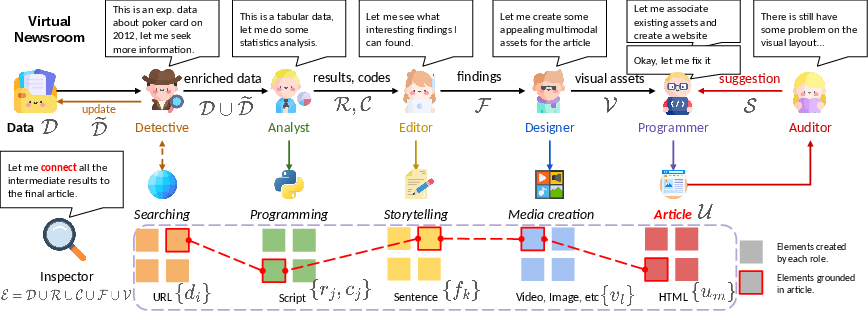
Figure 1: The Data2Story Virtual Newsroom: data flows through detective (context gathering), analyst (statistical analysis), editor (story angle), designer (multimodal asset generation), programmer (web assembly), auditor (output review), and inspector (evidence binding).
- Detective: Augments the raw dataset via automated web search, collecting relevant external context and reference media.
- Analyst: Exhaustively profiles the enriched dataset, executes code-based analyses, and produces all statistical findings, each linked to code provenance.
- Editor: Synthesizes findings into a prioritized, narrative-driven structure, annotating text with upstream evidence.
- Designer: Selects and generates multimodal assets (charts, audio, video, interactives) suited to the story section and finding, using external generative toolchains.
- Programmer: Assembles the final HTML, integrating text, visual, and interactive elements.
- Auditor: Reviews for structural and visual defects, suggesting revisions.
- Inspector: Binds every claim, statistic, and asset in the published article to supporting evidence—either the executing code or external URLs—establishing machine-auditable provenance.
This sequential orchestration enables not only the compositional creation of articles but also supports rigorous end-to-end auditability.
Evidence Traceability and Verifiability
A hallmark of Data2Story is claim-level evidence traceability realized by the Inspector. Every article fragment (sentence, chart, asset) is algorithmically bound to its provenance, distinguishable as:
- Code evidence: Statistical or computational claims refer to the exact code line and script that yields the result, allowing for deterministic reproduction.
- Reference evidence: Contextual claims are anchored in URLs or referenced sources.
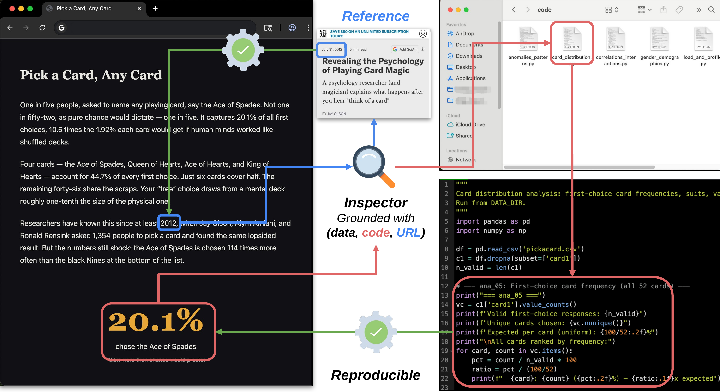
Figure 2: The Inspector view, which connects each article element to either code provenance or external references, enabling granular auditability.
Empirical evaluation with an automated code-verifier demonstrated a 93% machine-verifiable claim rate for Data2Story articles, versus 25% for human-authored counterparts—an auditability gap reflecting the explicit provenance built into the system rather than intrinsic factual superiority.
Multimodal Generation for Audience-tailored Storytelling
Unlike prior agentic systems (e.g., MatplotAgent, LIDA, CoDA), which are limited to text and static charts, Data2Story’s Designer selects from an expanded modality space—images, video, audio, and interactive widgets—determined adaptively by the data domain and editorial context.
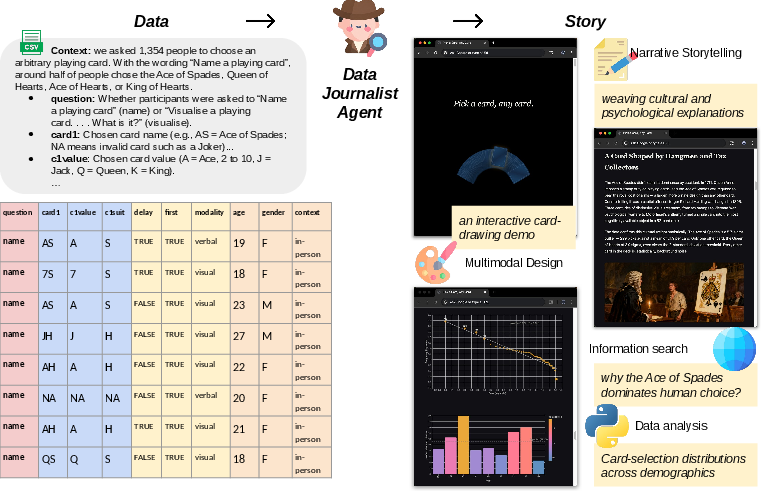
Figure 3: Illustration of Data2Story transforming a raw dataset into a multimodal, interactive, verifiable article through data analysis, storytelling, and design.
Evaluation revealed that Data2Story robustly produces a uniform quantity of such assets (mean 13–14 per article), distributing them evenly across genres and topics. In comparison, human output varies significantly by publication style (e.g., The Pudding’s extensively tooled scrollytelling, The Economist’s succinct chart-driven articles).
Empirical Evaluation
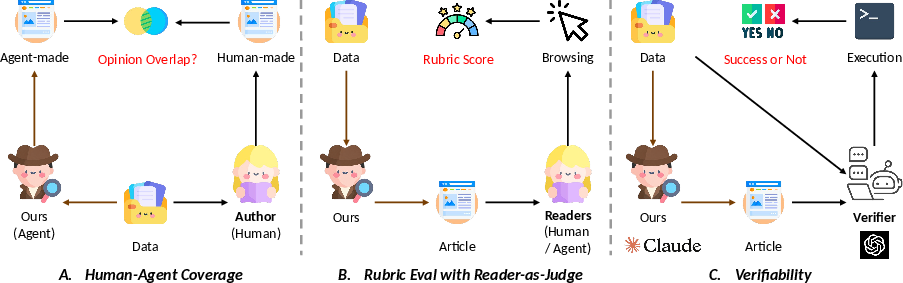
The system was benchmarked across 18 data–article pairs from three provenance sources: The Economist, The Pudding, and TidyTuesday. Evaluation protocols (Figure 4) covered:
Strong empirical findings:
- Rubric superiority: Data2Story scored higher mean rubric scores than human articles (4.21 vs. 3.38 overall; transparency +1.49), with 39/53 human raters preferring the agent article overall.
- Verifiability: Data2Story claims were verifiable at a 93% rate, far outstripping human articles.
- Claim coverage: The agent covered ~50% of human claims, but only 35% of its own claims were covered in human articles, indicating both overlap and agent-unique insights.
- Modality: Agent articles maintained consistent multimodal asset distribution irrespective of source, unlike humans who tailored style by publication.
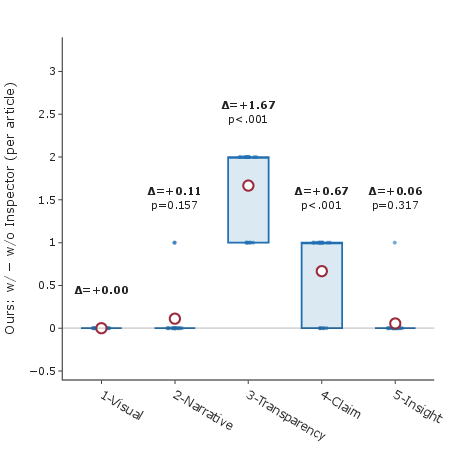
Figure 5: (Left) Data2Story articles have more sentences but shorter average length versus human articles. (Right) Agent captures roughly half of all human claims, with asymmetric coverage by source.
Limitations and Human Edge
Despite its technical advantages, Data2Story concedes ground to humans in:
- Editorial Angle and Contextualization: Humans excel in introducing exogenous knowledge, expert testimony, causal inference, and narrative reframing—dimensions often absent from agentic output due to reliance on extractable or codifiable evidence alone.
- Creative Design: Interactive design flourishes requiring sustained subjective effort (e.g., animated narrative structures, emotional multimodality) are only partially matched by Data2Story’s generative assets.
- Informative Chartcraft: Humans compress multivariate insight more densely into single visualizations (annotations, multi-axis synthesis), while Data2Story produces more atomistic, less integrative chart assets.
Qualitative case analysis (see paper) illustrates these persistent gaps—bespoke narrative moves, rich causality, and “crafted” reader experiences remain the territory of experienced data journalists.
Broader Implications and Future Directions
Practically, Data2Story is positioned not as a substitute, but as a collaborator: automating labor-intensive data analysis, accelerating multimedia design, and raising the bar for evidence transparency in journalistic production workflows. Its main applicability is in scalable, auditably transparent reporting on datasets lacking expert human attention.
Theoretically, this work advances the agentic automation frontier by demonstrating that decomposable, role-specialized orchestration yields composite outputs satisfiable to human readers and verifiers—while still exposing open problems in editor-modeling, open-domain information seeking, and multimodal human–AI collaboration.
Future directions should address:
- Incorporating in-the-loop human feedback for editorial refinement and narrative arc optimization.
- Closing the gap in creative multimodal design and dense integration of narrative-visual elements.
- Extending evidence tracing to less-structured, qualitative knowledge domains.
Conclusion
Data2Story sets a new methodological standard for agentic data journalism: modular, auditable, and richly multimodal in its generative and evaluative structure. While substantial differences remain with the creativity and depth of human journalistic synthesis, the explicit provenance and transparent auditability offered by this system make it a valuable complement (not replacement) for expert-driven newsrooms, with meaningful implications for scalable, trustworthy journalism in data-intensive domains.