- The paper introduces a continuous-time surrogate model that fuses history encoding with a graph Neural ODE for stable, long-horizon physical forecasting.
- The methodology employs a GraphSAGE encoder and Transformer blocks to establish latent dynamics, achieving a 26% reduction in RMSE compared to baselines.
- The architecture decodes residual updates from the latent trajectory, enabling arbitrary forecast queries and robust performance on irregular mesh data.
COGENT: Continuous Graph Neural ODEs for Mesh-Based Long-Term Physical Forecasting
Overview and Motivation
COGENT introduces a continuous-time surrogate modeling approach using Neural Ordinary Differential Equations (Neural ODEs) mapped onto irregular geospatial meshes. The motivation arises from the widespread use of computationally intensive numerical simulators for physical systems (e.g., ice sheet flow), particularly those with irregular spatial discretizations. In such settings, forecasting over long horizons requires emulators that are both mesh-native and stable against error accumulation, overcoming key limitations of traditional single-step and discrete multi-horizon graph-based surrogates.
COGENT leverages historical graph states and forcings, encoded via spatial and temporal models, to initialize a latent dynamical system whose evolution is realized as a graph Neural ODE. This framework enables queries at arbitrary forecast times and circumvents recursive prediction by decoding rollouts as residual corrections to the last observed state.
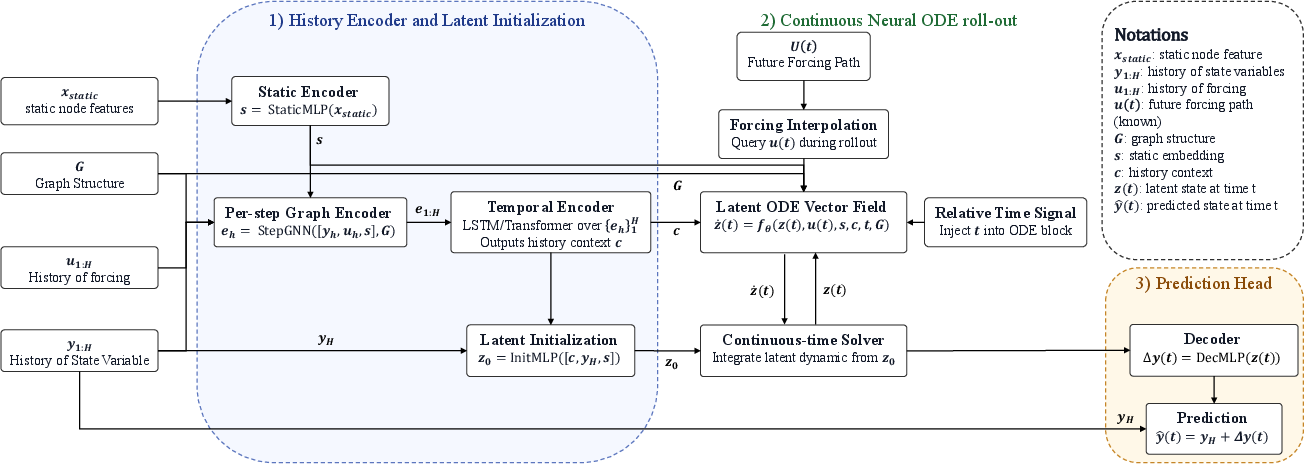
Figure 1: COGENT architecture: history is encoded graph-wise and temporally, context conditions a latent Neural ODE for continuous-time rollout, and the decoded trajectory produces residual updates to physical states.
Methodological Framework
History Encoding and Latent Initialization
COGENT encodes a finite history comprising graph-based physical states and external forcings using a shared GraphSAGE encoder operating per historical timestep. Temporal dependencies across these step-wise spatial embeddings are aggregated via Transformer blocks, yielding node-wise context vectors. The context, concatenated with the most recent state and static node properties, produces the initial latent state for ODE integration.
Neural ODE Rollout with Graph Conditioning
The latent dynamics evolve as a node-wise Neural ODE, with the ODE vector field given by a graph neural network conditioned on the encoded history, interpolated future forcing, static properties, normalized rollout time, and graph structure. Conditioning on rollout time and history context at each solver evaluation enables non-autonomous evolution reflecting both past trajectory and forecast position.
The ODE solver computes the latent trajectory at requested forecast times, decoupling decoding from recursive state feeding and inherently supporting irregular temporal queries.
Residual Decoding
COGENT’s prediction head decodes the latent trajectory as residual updates:
y^(t)=yH+Δy(t)
This residual design facilitates modeling future deviations from the last observed state and enhances training stability by focusing on state evolution rather than repeated full state reconstruction.
Experimental Design
Dataset: Pine Island Glacier, Antarctica
COGENT is evaluated on transient ice-sheet simulations for Pine Island Glacier, modeled on unstructured finite-element meshes using the ISSM framework under varying ocean-driven basal melt regimes. Each simulation trajectory provides node-wise velocity and thickness states, static features, and environmental forcings over a 20-year, monthly-resolved horizon.
Scenario splits enforce generalization to unseen forcing profiles and avoid leakage from overlapping temporal windows, with distinct melt-rate trajectories used for train, validation, and test.
Training Protocol
COGENT employs progressive rollout-horizon scheduling, gradually increasing the supervised horizon during training to stabilize ODE integration and improve long-range generalization. Effective rollout-horizon sampling further exposes the model to variable forecast lengths with a bias toward longer horizons. Baselines include single-step autoregressive and discrete multi-horizon graph neural emulators, as well as an initial-state-conditioned GCN baseline.
Results
COGENT achieves superior whole-trajectory RMSE across velocity and thickness variables compared to all baselines, notably reducing error accumulation traditionally seen in autoregressive models.
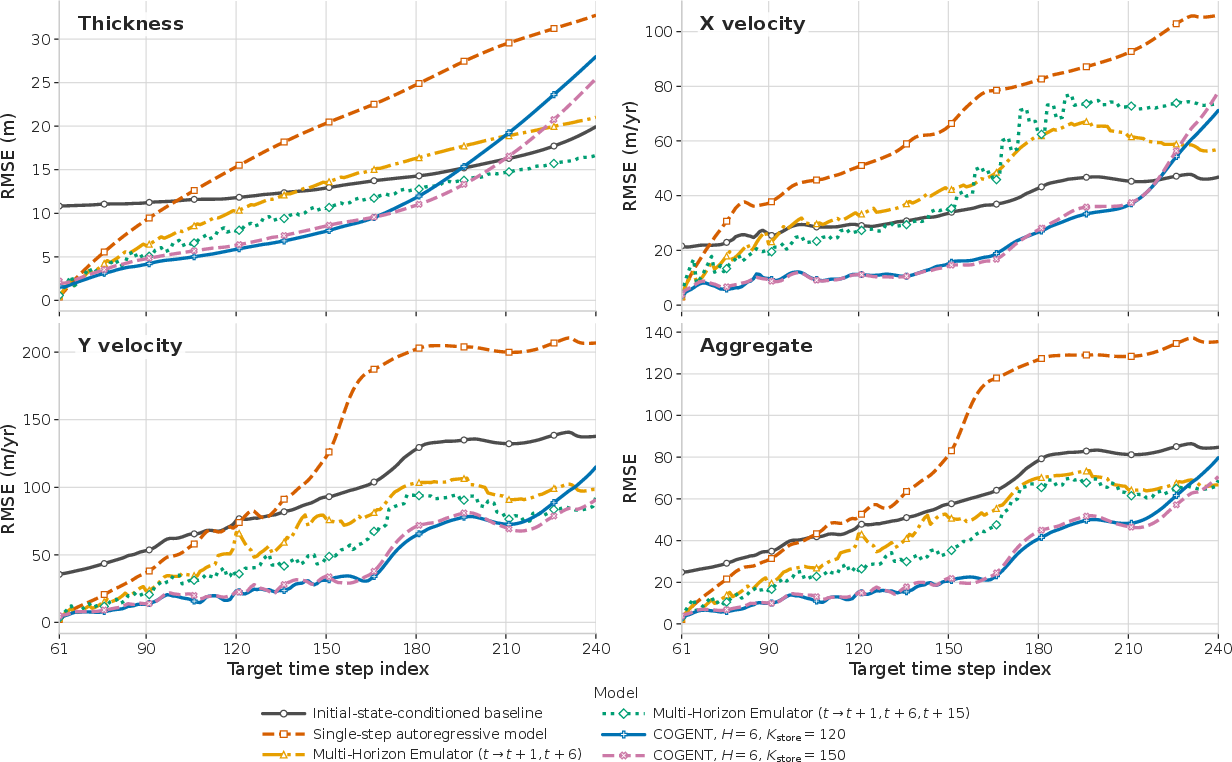
Figure 2: Lead-time-wise RMSE curves for thickness, Vx, Vy, and aggregate metric across rollout window (61–240), demonstrating error evolution and COGENT's stability.
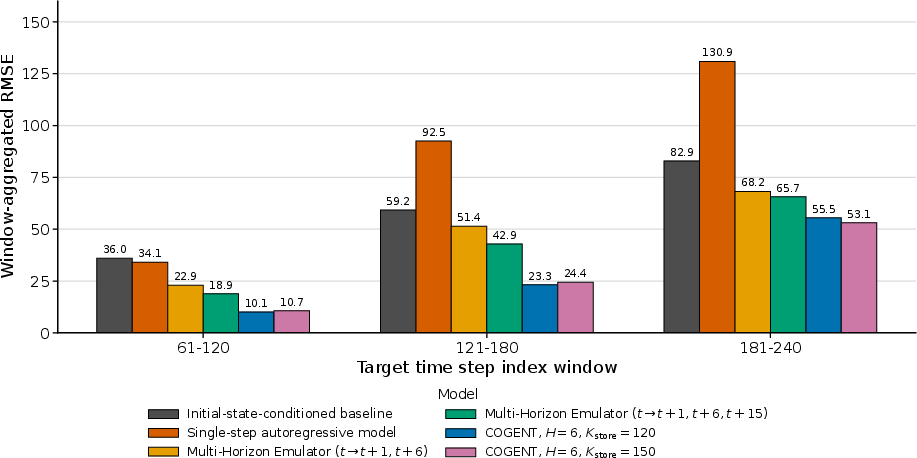
Figure 3: Window-wise aggregate RMSE in three rollout intervals, showing COGENT's error control over early, middle, and late forecast stages.
Notably, with Kstore=150, COGENT attains the lowest whole-trajectory aggregate RMSE (34.31), a 26% reduction relative to the best non-COGENT baseline. The model's continuous-time latent evolution outperforms discrete-horizon settings, benefiting from flexible temporal conditioning and rigorous history integration.
History Length Sensitivity
Optimal performance with respect to history window length H arises at H=6, balancing sufficient temporal context against redundancy and optimization difficulty associated with longer histories.
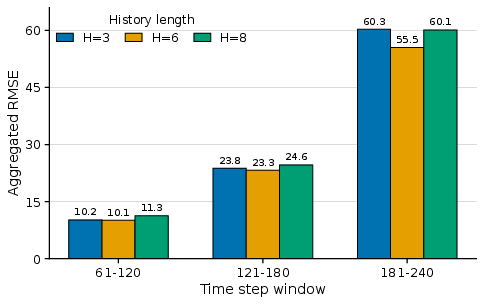
Figure 4: Horizon-wise aggregate RMSE across selected history lengths (H=3, H=6, H=8), confirming H=6 yields stable long-range forecasting.
Effect of Stored Future Horizon
Longer stored future horizons during training substantially reduce error propagation, especially for late-stage forecasts. Trade-offs arise between trajectory-average and endpoint accuracy, with Vx0 optimizing overall rollout, while Vx1 yields best endpoint stability.
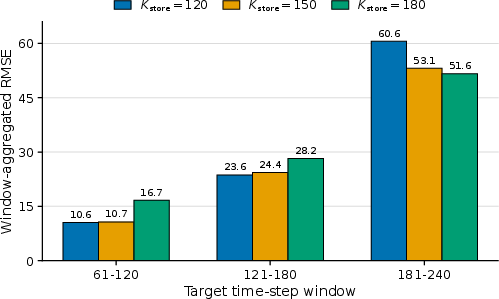
Figure 5: Window-wise aggregate RMSE for different Vx2 values across rollout intervals, illustrating late-stage error mitigation.
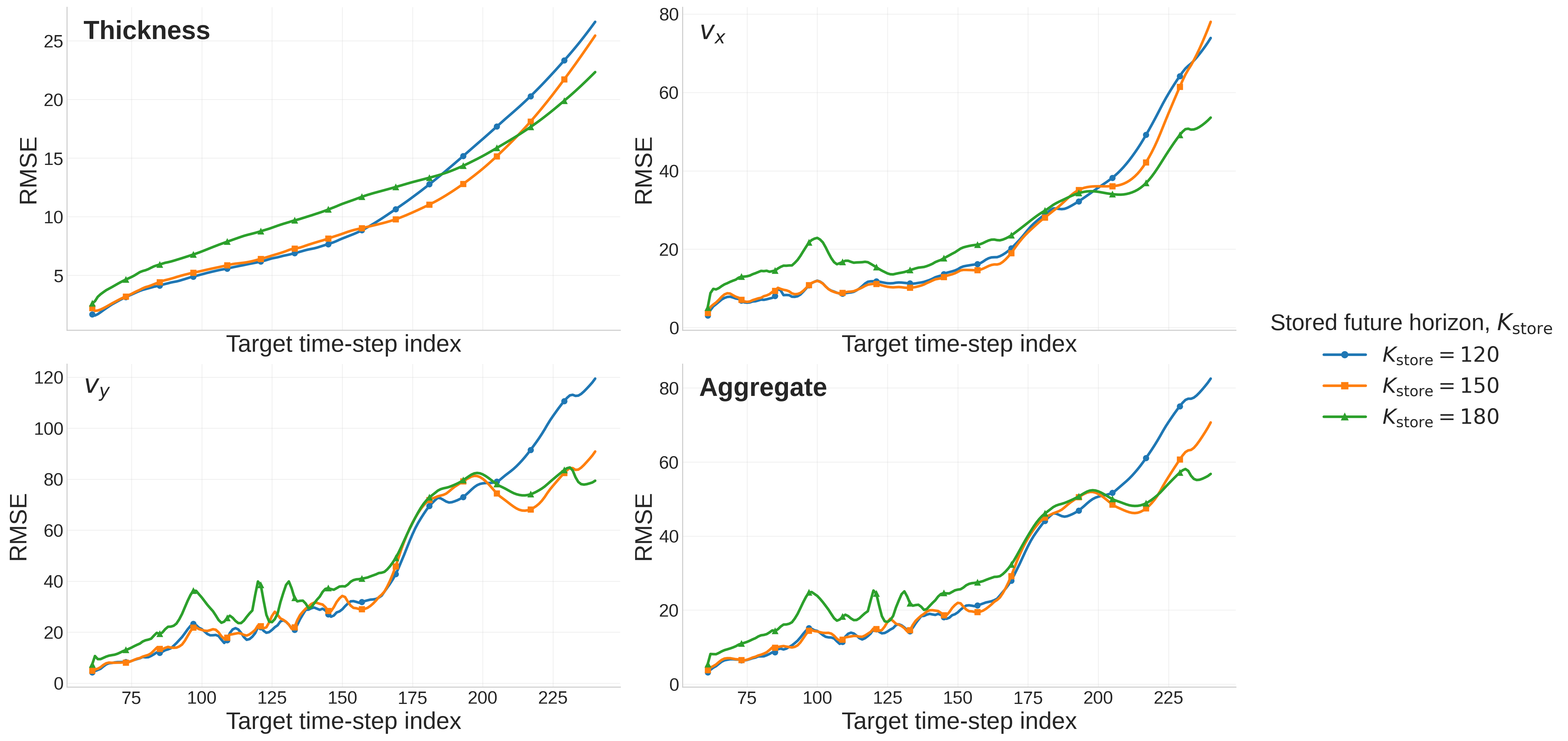
Figure 6: Lead-time-wise RMSE comparing Vx3 settings, highlighting effects on error growth.
Architectural Component Ablation
Ablation studies verify that context conditioning, explicit rollout time injection, and residual prediction are synergistic and essential for controlling error during long-term rollout.
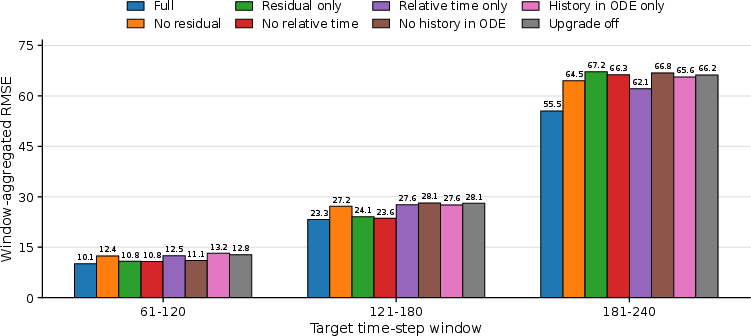
Figure 7: Window-wise ablation of main COGENT components, supporting joint inclusion for optimal rollout stability.
Implications and Future Directions
COGENT’s architecture yields significant advances in mesh-native surrogate modeling for long-horizon physical emulation. By enabling arbitrary-time queries and robust long-range dynamics, COGENT reduces reliance on discrete horizon selection and enables improved generalization across varying simulation regimes.
Practically, COGENT unlocks scalable forecasting and uncertainty quantification for physical systems where traditional simulators are prohibitively expensive. Theoretically, the fusion of history-conditioned latent ODEs and graph neural networks supports further exploration of non-autonomous latent dynamics and continuous-time learning in scientific machine learning.
Future work may extend this paradigm to adaptive graph topologies, dynamic mesh refinement, and joint uncertainty-aware forecast models. Integration of domain constraints or physics-based regularization within the ODE vector field remains an open direction, as does coupling with data assimilation in operational forecasting pipelines.
Conclusion
COGENT establishes a continuous-time graph neural surrogate for physical emulation on irregular meshes, achieving superior long-horizon forecasting performance and error stability. Its architecture—combining history encoding, context-conditioned graph ODEs, temporal injection, and residual decoding—provides robust inductive bias for mesh-based dynamical systems. The results demonstrate practical feasibility for climate and earth science applications and motivate broader adoption of continuous-time latent dynamics in AI-based surrogate modeling (2606.11162).

