- The paper introduces a multi-horizon GNN that mitigates error compounding by using horizon-conditioned training.
- It employs a greedy descending-horizon rollout to deliver stable, long-term predictions of ice velocity and thickness.
- Experimental results on Pine Island Glacier simulations demonstrate reduced RMSE, validating the model’s effectiveness.
Horizon-Aware Graph Neural Networks for Long-Horizon Forecasting of Ice Sheet Dynamics
Introduction
"From Short Histories to Long Futures: Horizon-Aware Graph Neural Networks for Long Horizon Forecasting" (2605.29952) advances the methodology of mesh-native machine learning for surrogate modeling of geophysical systems, with specific focus on long-range forecasting for Antarctic ice dynamics. The work introduces a multi-horizon, horizon-conditioned graph neural network (GNN) architecture capable of stable and accurate long-term prediction of ice velocity and thickness on unstructured finite-element meshes. Addressing the limitations of standard one-step autoregressive GNNs—namely, error compounding and instability under long rollouts—this paper proposes joint multi-horizon training and an inference strategy that capitalizes on coarse-to-fine temporal coverage. The new approach demonstrates empirically significant reduction in long-horizon forecast error and enhanced rollout stability on Pine Island Glacier (PIG) transient simulation datasets.
Methodological Framework
Multi-Horizon GNN Architecture
The core model is a GNN that respects the original finite-element mesh topology of the ice-sheet simulation domain. The state at each node comprises current physical attributes, with edges reflecting local topological adjacencies. The network employs a stack of five Graph Convolutional (GCN) layers, followed by linear output heads for predicting increments of ice velocity and thickness. The architecture is intentionally streamlined to isolate the effect of the multi-horizon training objective and rollout strategy. Compared to previous advances, such as KAN-GCN hybrids, the focus is on temporal supervision and inference rather than expanding nonlinear feature processing capacity.
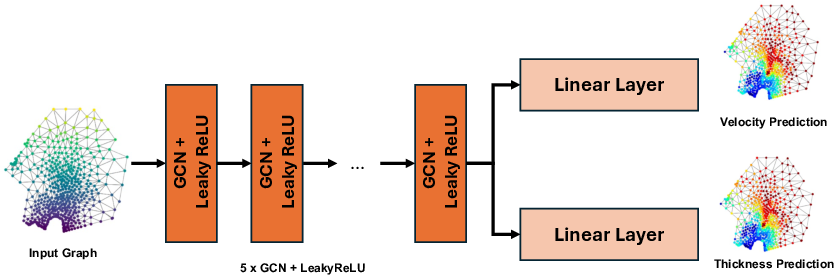
Figure 1: Graph neural network emulator architecture composed of five GCN layers and dual prediction heads for physical state increments.
Multi-Horizon Supervision
A key innovation is the transition from single-step modeling to learning a mapping from the current state at time t to a range of future states at various lead times t+h. The model is trained on supervision pairs (t,h) where h is drawn from a predefined horizon set H. Each training tuple consists of the physical state, exogenous context, and a normalized horizon encoding ψ(h). Importantly, the model outputs state residuals over these horizons, which are added to the anchor state to reconstruct each future prediction; this residual formulation supports stable incremental updates and reduces output drift.
Greedy Descending-Horizon Rollout
At inference, the model employs a greedy descending-horizon rollout: it first fills in the most distant unknown future states using the largest available horizon jump, and iteratively applies shorter horizons to refine the intermediate states. Each predicted state is filled once; known and predicted states are tracked for efficient coverage of the forecast window. This strategy greatly reduces autoregressive depth, thereby limiting opportunities for error compounding, while shorter steps provide local corrections for trajectory refinement. This approach is synergistic with horizon-aware supervision, as the model is explicitly trained to perform multi-step forecasts across a range of horizons.
Experimental Protocol and Results
Dataset and Evaluation Setup
Experiments are conducted using multi-decadal ISSM simulations of Pine Island Glacier under a diversity of basal melt scenarios and mesh resolutions (2km, 5km, and 10km nominal elements). The forecast task is to predict node-wise fields for velocity (Vx, Vy) and thickness (H) on unstructured meshes over a 15-year window given a 5-year observed prefix, under various emission/forcing scenarios. Evaluation averages RMSE metrics over nodes, channels, and rollouts. All comparative models share the same backbone, controlling for architectural confounds.
The horizon-aware GNN dramatically outperforms the single-step autoregressive baseline and the initial-state direct baseline in long-horizon prediction of both velocities and thickness. As shown in the RMSE dynamics (Figure 2), the single-step model suffers rapid degradation after short lead times, consistent with deleterious compounding of small-step biases. The initial-state baseline has competitive short-lead Vx errors, but underperforms on t+h0 and t+h1 due to its poor handling of transient dynamics.
Including even a single mid-range horizon in the supervision set (e.g., t+h2) causes a marked reduction in error on long forecasts. The effect is accentuated when more horizons are added (e.g., t+h3), leading to the lowest RMSEs on all channels. Notably, the growth of RMSE over time is greatly suppressed, illustrating improved stability under free-running rollouts.
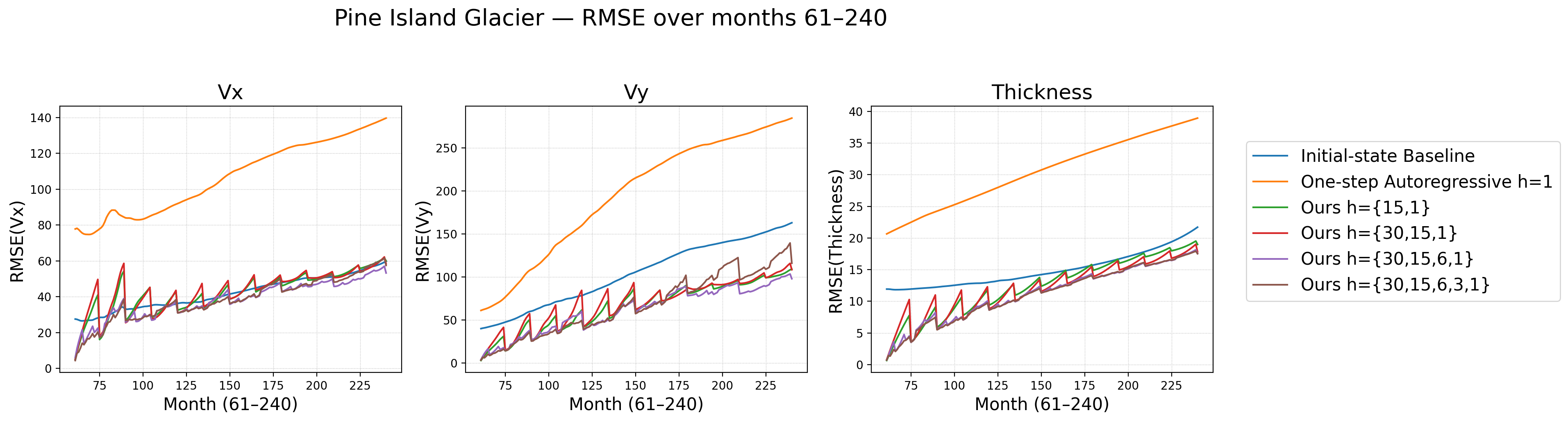
Figure 2: Time-resolved RMSE curves for long-horizon forecasts on Pine Island Glacier using different emulation strategies and horizon sets.
The table below summarizes average RMSE on the forecast window for the main models evaluated:
| Method |
RMSE(t+h4) |
RMSE(t+h5) |
RMSE(t+h6) |
| Initial-state baseline |
43.04 |
110.08 |
15.16 |
| One-step autoregressive (t+h7) |
108.77 |
207.05 |
30.91 |
| Ours (t+h8) |
43.83 |
70.85 |
13.22 |
| Ours (t+h9) |
39.57 |
66.50 |
11.99 |
Key claims in the paper are numerically substantiated by these results:
- The multi-horizon approach produces the lowest long-horizon errors and offers significant improvements in both accuracy and stability over the prior standards.
- Error growth over extensive rollouts is heavily suppressed via explicit multi-horizon training and coarse-to-fine inference.
Ablation on Horizon Sets
Further ablations show that including a moderately long horizon (e.g., (t,h)0 months) yields the largest single improvement in accuracy. Adding more horizons offers diminishing but still measurable gains, particularly for ice thickness. Extremely short or excessively long secondary horizons were found to be sub-optimal, illustrating an important design trade-off between training complexity, learnability, and target variable performance.
Implications and Future Perspectives
Practical implications of this research are immediate for the glaciological modeling community: The proposed horizon-aware GNN provides an accurate, stable, and computationally efficient surrogate model for multi-decadal scenario analysis of PIG and, by extension, other regions with complex mesh-based numerical models. This enables rapid "what-if" analyses for climate and sea-level rise projections, previously limited by the slow throughput of full-physics PDE solvers.
Theoretical implications extend to scientific machine learning and time-series modeling on graphs. The proposed approach demonstrates the impact of horizon conditioning and curriculum over time on mitigating error compounding in self-recursive predictive pipelines. Horizon-aware supervision frameworks will likely find application in other domains where long-range structure and mesh adaptivity are essential (e.g., biomechanics, climate modeling, electromagnetic dynamics).
Potential future directions include:
- Application of horizon-aware GNNs to more heterogeneous, multi-physics coupled systems.
- Exploration of continuous horizon parameterizations, rather than discrete sets, to further unify the temporal generalization capabilities.
- Integration with physics-informed loss terms or hybrid architectures (e.g., augmenting with KAN modules) to further boost long-horizon faithfulness.
- Automated selection of optimal horizon sets for joint accuracy and efficiency objectives.
Conclusion
This work establishes a robust methodology for long-horizon emulation in mesh-native geophysical models by introducing horizon-conditioned GNNs trained on multi-step residuals and deployed with coarse-to-fine rollout. The approach quantitatively improves long-term predictive fidelity, offering a scalable foundation for surrogate modeling under real-world forecasting constraints. The findings underscore the prominent role of horizon-aware supervision and scheduling as a remedy for autoregressive error compounding in scientific machine learning.

