- The paper introduces HGODE, a novel framework that couples topology and feature evolution to prevent the consensus collapse seen in standard graph ODEs.
- It applies a bistable, double-well potential and coupled ODEs to dynamically shape edge states, maintaining distinct clusters and resisting feature collapse.
- Experimental validations on synthetic and real-world graphs demonstrate HGODE's robust performance in preserving intra-cluster connectivity and mitigating noise effects.
Latent-Hysteresis Graph ODEs: A Dynamical Framework for Coupled Topology-Feature Evolution
Introduction and Motivation
Graph Neural Ordinary Differential Equations (Graph ODEs) have transformed graph learning by generalizing discrete message passing to continuous-time trajectories, thus enabling deeper, adaptive information propagation across graphs. However, this architectural flexibility is bounded by a fundamental degeneracy in standard Graph ODEs: when the propagation operator is strictly positive and irreducible (frequently induced by global attention or dense kernels), the dynamics universally converge to a single consensus attractor under long-time integration. This "monostability trap" causes feature collapse and eliminates discrimination between clusters—an obstacle for tasks requiring the retention of both long-range propagation and local structural information.
Theoretical Analysis: The Monostability Trap
The paper rigorously establishes that continuous-time diffusion dynamics on strongly connected supports with strictly positive mixing inexorably lead to a rank-one consensus, regardless of initial conditions. Even under time-varying propagation operators satisfying uniform positivity, exponential contraction toward consensus is inevitable. Explicit sparsification or masking can mitigate this effect but lacks stability and a principled mechanism for maintaining information separation at infinite depth.
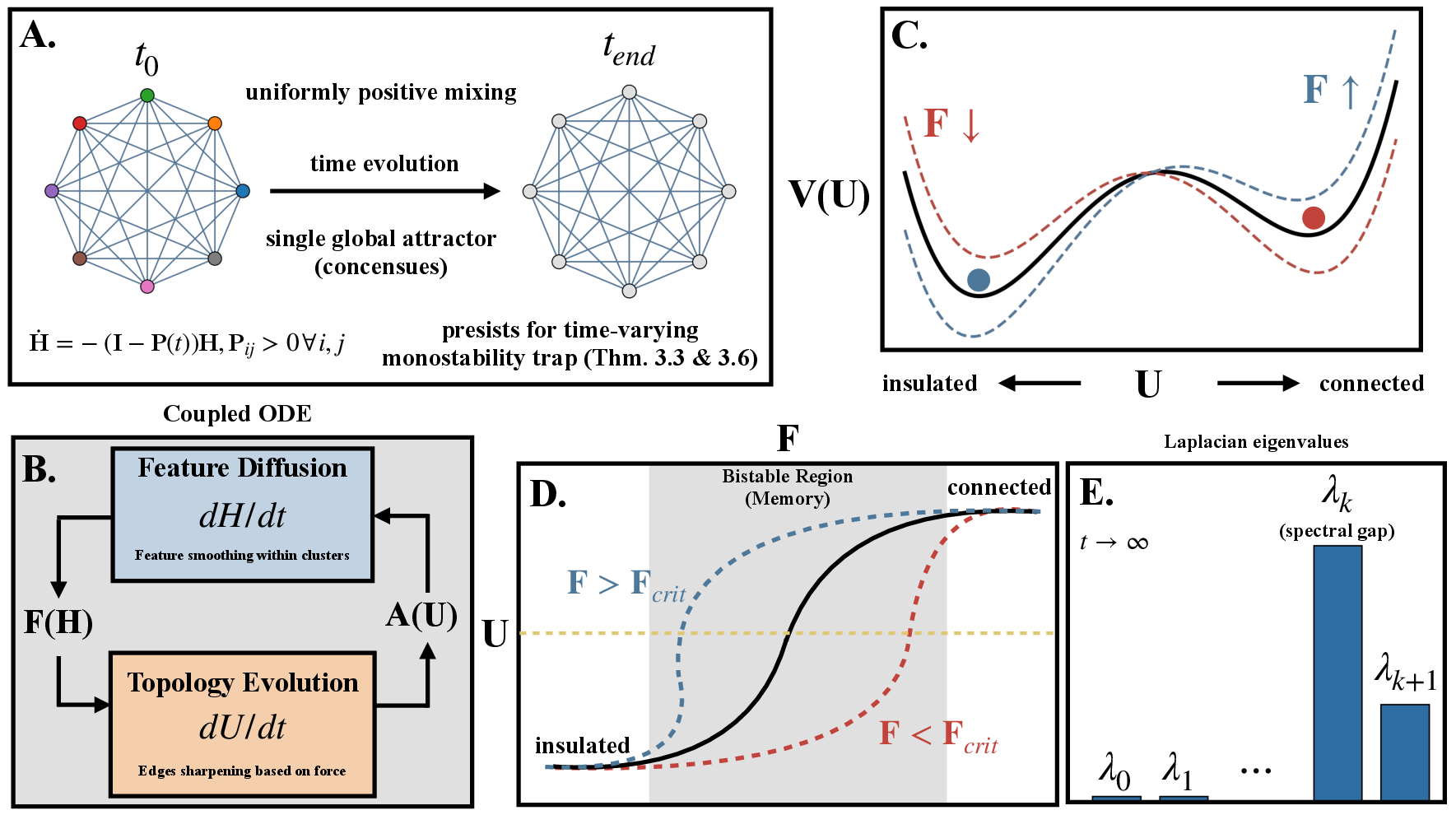
Figure 1: Hysteresis Graph ODE (HGODE) controls asymptotic mixing—contrasting the collapse of diffusion-style ODEs with controlled polarization and memory in the HGODE framework.
Hysteresis-Driven Topological Evolution
To mitigate consensus collapse, the authors propose the Hysteresis Graph ODE (HGODE) framework. Unlike prior approaches—reaction-diffusion, normalization, or residual connections—that primarily regulate feature evolution, HGODE treats the topology itself as a co-evolving, continuous latent dynamical state. Edges become latent variables whose dynamics are dictated by a double-well Landau potential parameterized by a learned, feature-driven force field. This bistable mechanism induces hysteresis: edge states possess structural memory and resist rapid-phase switching, polarizing the graph into connected and insulated phases in a differentiable and history-sensitive manner.
The edge-level phase behavior admits two regimes:
- Bistable regime: Edges traverse a double-well landscape. Small force perturbations do not flip the edge state, ensuring cluster integrity and structural memory.
- Monostable regime: Sufficiently strong forces annihilate the energy barrier, enforcing rapid deterministic transitions.
The collective outcome is a dynamical reduction in effective mixing irreducibility and the emergence of block-structured, cluster-preserving propagation—a key property for heterophilic and modular graphs.
HGODE is formalized as a system of coupled ODEs:
- Feature evolution incorporates standard graph neural operators, regularization, and decay.
- Topology evolution uses feature-induced forces to drive edge potentials uij via cubic (bistable) dynamics. The effective adjacency is derived from the potential by a temperature-annealed sigmoidal gate, supporting soft transitions and sparsification within a candidate pool of pairs.
The force field Fθ is parameterized by an MLP and trained with an explicit force-margin loss relative to the hysteresis threshold for stable separation and phase polarization. The resulting system breaks global irreducibility and enables persistent multi-cluster support, even under long integration horizons.
Empirical Validation
Synthetic Diagnostics
On Stochastic Block Model (SBM) graphs, synthetic diagnostics directly validate the theoretical predictions. A temperature sweep in soft-attention baselines reveals that increased temperature provokes accelerated consensus collapse, erasing cluster distinctions as measured by inter-cluster separation and silhouette scores.
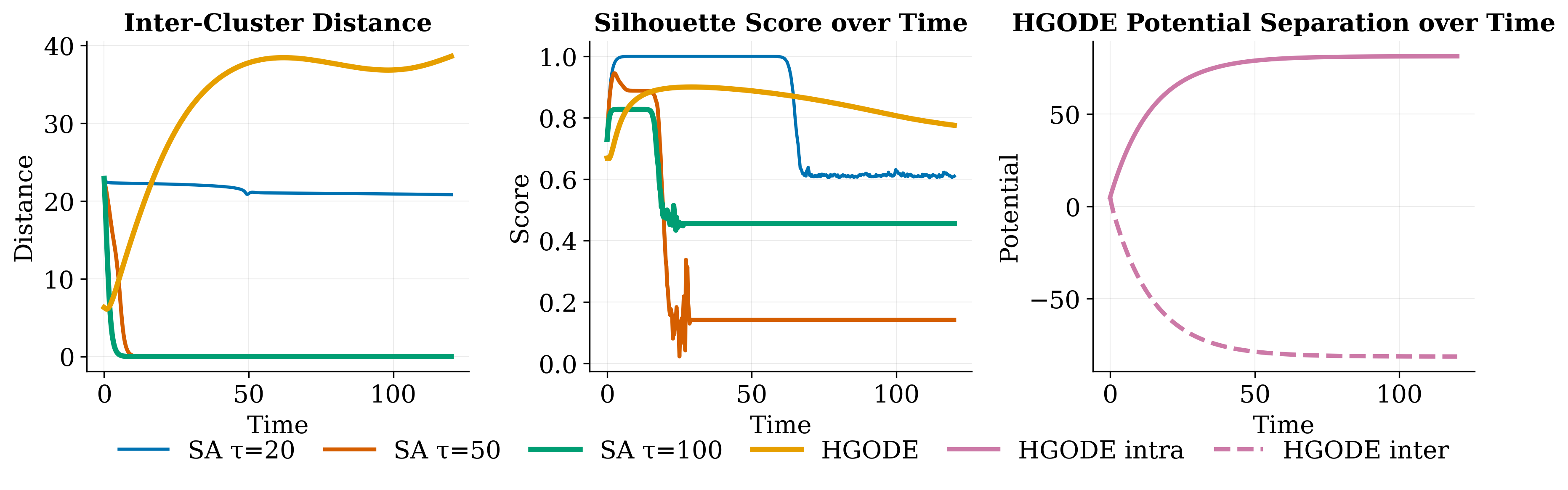
Figure 2: Inter-cluster distances under soft attention collapse as τattn increases; silhouette scores decrease, while HGODE maintains robust separation and memory at long horizons.
By contrast, HGODE demonstrates persistent polarization in edge potentials—elevated intra-cluster connectivity and suppressed inter-cluster diffusion—verified through potential trajectories. This mechanismally confirms that the topology-field hysteresis robustly prevents feature collapse and enables enduring separation.
Robustness to Feature Perturbation
Under high feature noise and increased cross-cluster connectivity, standard Graph ODE baselines rapidly degrade. HGODE displays strong resilience, retaining high accuracy and stable optimization even at low signal-to-noise ratios and high perturbation, attributable to dynamic suppression of spurious diffusion pathways.
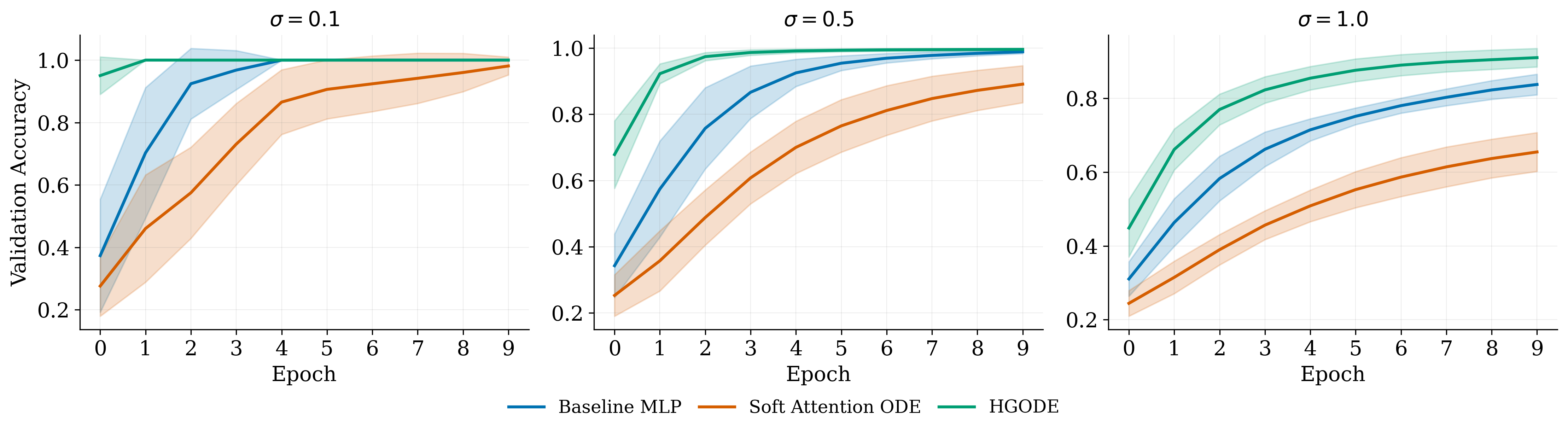
Figure 3: Validation accuracy under feature perturbations: HGODE remains robust across escalating levels of noise, consistently outperforming soft-attention and MLP baselines on SBM graphs.
Real-World Benchmarks
On heterogeneous real-world graph benchmarks (Cora, Chameleon, ogbn-proteins, ZINC, Peptides-func, ogbg-molpcba), HGODE achieves the strongest or highly competitive results across both node and graph tasks in comparison to a wide spectrum of message-passing, continuous-depth, and anti-over-smoothing baselines. The largest gains manifest in heterophilous or modular domains where naive global mixing is harmful. Ablations confirm that the hysteresis component and active topology search are critical: removing either consistently impairs performance, especially in settings demanding long-range or structurally robust propagation.
Implications and Future Directions
This work establishes that continuously evolving latent topology, equipped with physically-inspired hysteretic memory, is a principled and effective approach to stabilizing deep, continuous-depth graph learning. By dynamically reshaping the asymptotic mixing structure at runtime, HGODE circumvents both the practical and theoretical limitations imposed by the monostability trap, while maintaining differentiability, end-to-end trainability, and interpretability.
The methodology brings strong implications for heterophilic, modular, and noisy graphs—domains increasingly central in applied graph learning (fraud detection, protein interaction networks, social and neurobiological systems). Furthermore, the continuous, coupled-dynamics perspective suggests a unified direction for future research:
- Richer force parameterizations: Incorporation of domain priors or richer multi-field interactions.
- Generalized phase landscapes: Exploring alternative energy landscapes, multi-class or manifold-valued fields.
- Active candidate pooling: Dynamically evolving candidate edge pools to further enhance scalability and expressiveness.
- Integration with self-supervised objectives: Graph contrastive and spectral learning in the context of dynamically evolving support.
Conclusion
Latent-Hysteresis Graph ODEs introduce a rigorous, theoretically motivated, and empirically validated paradigm for addressing the asymptotic collapse inherent to standard Graph ODEs. By endowing the graph topology with dynamical, hysteretic memory, HGODE achieves persistent partitioning, scalable robustness to noise and heterophily, and state-of-the-art or superior efficacy on both synthetic and real-world tasks. These results position HGODE as an important step toward stable, scalable, and interpretable continuous-depth approaches for graph representation learning (2604.24293).

