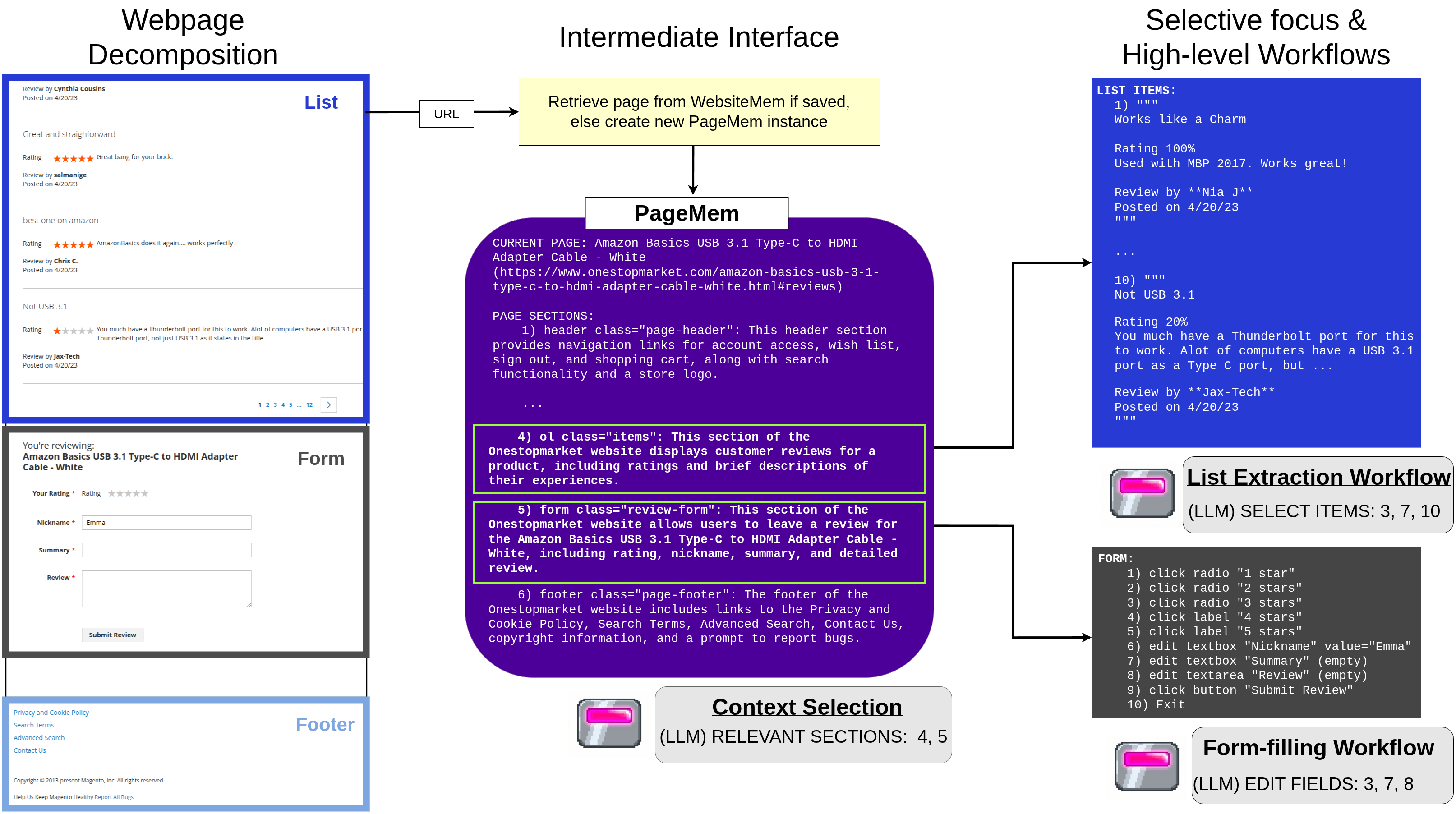
- The paper's main contribution is the introduction of architectural scaffolding, including PageMem, that enables efficient long-horizon web navigation using open-source LLMs.
- It employs a divide-and-conquer observation pipeline, persistent offline memory, and compound actions to drastically reduce context token bloat.
- Empirical results reveal state-of-the-art performance across multiple benchmarks, achieving near-proprietary efficiency at minimal inference cost.
Architectural Advances of WebChallenger: Reliable and Efficient Generalist Web Agent
Introduction and Motivation
"WebChallenger: A Reliable and Efficient Generalist Web Agent" (2606.10423) addresses persistent barriers in web navigation for LLM-powered agents, notably the inability of non-proprietary models to match specialized agents in long-horizon, realistic web tasks. The authors argue that previous gaps stem less from model limitations and more from failures in agent architecture: specifically, the lack of selective attention, persistent memory, and procedural fluency found in human users. The paper introduces WebChallenger, a system that achieves state-of-the-art performance among open-source agents without fine-tuning or reliance on proprietary models, relying instead on architectural scaffolding that generalizes across diverse sites.
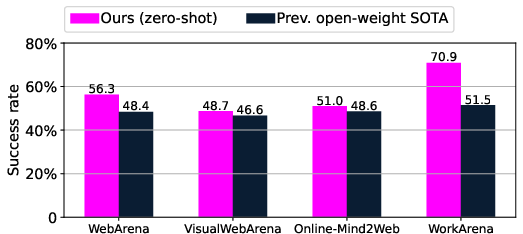
Figure 1: WebChallenger achieves superior performance across four benchmarks, leveraging efficient architectural scaffolding with minimal compute and without model finetuning.
Agent Architecture: PageMem and Human-Inspired Mechanisms
Central to WebChallenger is the PageMem abstraction—a structured representation of each webpage, constructed deterministically from the DOM, partitioned into hierarchical semantic sections with short summaries. This enables token-efficient, region-focused processing that mimics human attentional fragmentation [10.1007/978-3-031-28238-6_5], contrasting the context dilution from flat token sequence ingestion.
Three mechanisms operate over PageMem:
Empirical Evaluation and Component Analysis
WebChallenger achieves 56.3% success on WebArena, 48.7% on VisualWebArena, 51.0% on Online-Mind2Web, and 70.9% on WorkArena—each a new state-of-the-art among open-weight agents. Notably, these results approach proprietary systems (e.g., OpenAI CUA, IBM CUGA, GPT-5) at a fraction of inference cost. All runs use off-the-shelf GLM-4-32B and Qwen VL backbones, with zero finetuning.
Ablation studies reveal:
- Removing the observation pipeline drops performance by 17.6 points, underscoring the impact of selective attention and region-based compression.
- Removing compound actions reduces accuracy by 9.7 points, especially in tasks with recurring interface complexities.
- Memory removal yields a smaller but non-trivial 7.6 point reduction.
Backbone sensitivity shows the architecture's portability: generic LLM harnesses score 19.4% (GLM-4-32B) versus 58.8% in WebChallenger, demonstrating a ~40 point gain from architectural scaffolding alone. Token and step efficiency analyses demonstrate that WebChallenger trades prompt complexity for step count—smaller, numerous prompts increase reasoning density without exceeding context limits.
Methodological Landscape and Comparative Positioning
WebChallenger advances several recent lines:
- Memory systems: Unlike workflow-memory and skill-learning approaches which accumulate task experience [wang2024agentworkflowmemory, zheng2025skillweaverwebagentsselfimprove], WebChallenger's exploration is deterministic and site-agnostic, requiring no demonstrations or external documentation.
- Observation refinement: Many agents prune HTML or vision contexts [gur2024realworldwebagentplanninglong, kerboua2025focusagentsimpleeffectiveways] or use pixel-space cropping, while WebChallenger preserves DOM semantics with lossless chunking and hierarchical indexing.
- Compound actions: Prior work extends action spaces with site-specific code or tool interfaces [song2025browsingapibasedwebagents, zhong2026actionenginereactiveprogrammaticgui], while WebChallenger's workflows are indexed to page structure, enabling generalization without per-site adaptation.
- Prompt optimization: The divide-and-conquer pipeline exploits context decomposition strategies and focused sub-prompts [zhang2026recursivelanguagemodels] enabling efficient scaling to small LLMs.
Implications, Limitations, and Future Directions
Practically, WebChallenger’s results imply that open-weight LLMs, with proper architectural scaffolding, are sufficient for many knowledge-work automation and evaluation tasks. This democratizes agent research, enabling deployment on private devices and reducing reliance on costly APIs. The framework is conducive to integration with advanced memory systems, skill abstraction, and synthetic-data generation. The authors note extension potential towards richer memories, online workflow learning, and adversarial robustness testing [tur2025safearenaevaluatingsafetyautonomous, zheng2025webguardbuildinggeneralizableguardrail].
Limitations include hand-coded structural priors (section decomposition, element identification, compound workflows) which may underperform on non-conforming websites, increased wall-clock time due to multiple LLM calls, and evaluation limited to benign task scenarios.
Conclusion
WebChallenger demonstrates that architectural innovation, rather than model scale or extensive fine-tuning, is the dominant constraint for open-weight web agents. By leveraging divide-and-conquer observation, persistent memory from deterministic exploration, and site-agnostic compound workflows on a shared DOM-derived substrate, it achieves competitive performance with proprietary systems and sets new standards for efficient, reliable web automation using small LLMs. This points toward a research frontier in compositional agent design where memory, attention, and procedural abstraction converge to match or surpass frontier models—even when running locally and untrained.