Soul Computing: A Theoretical Framework and Technical Architecture for Intelligent Agents with Independent Consciousness
Abstract: Breakthroughs in LLMs and multimodal generation technologies have propelled the digital reconstruction of human mental traits, emotional patterns, and long-term memory from science fiction toward engineering practice. Yet current research and industry practices at the intersection of AI and digital humans remain hampered by fundamental conceptual ambiguities: the essential differences between next-generation intelligent agents and traditional virtual humans, the construction pathways for digital entities possessing self-identity, and the core technical and ethical challenges confronting this domain all demand urgent clarification. This paper systematically examines the transformative logic underlying the transition from traditional virtual humans to the Soul Computing'' paradigm, driven by frontier AI technologies. We first analyze the evolutionary patterns of human consciousness and memory mechanisms, reassessing the core value of massive multimodal digital fragments in the reverse reconstruction of individual mental worlds. On this basis, we formally delineate the academic connotations of narrow and broad Soul Computing for the first time, clarifying its academic boundaries and essential distinctions from Affective Computing, Historical Reconstruction, and Mortal Computation. We argue that Soul Computing systems must architecturally construct anIntensional'' core rather than serving as purely ``Extensional'' functional carriers, thereby enabling the fundamental transition of AI from toolhood to living agency.
Paper Prompts
Sign up for free to create and run prompts on this paper using GPT-5.
Top Community Prompts
Explain it Like I'm 14
Overview: What this paper is about
This paper introduces a big idea the authors call “Soul Computing.” In simple terms, it asks: could we build a digital version of a person’s inner self—one that has its own memories, feelings, and a steady sense of “who I am”—instead of just making smarter tools that answer questions? The paper explains why this matters, how it’s different from current AI, and a possible technical plan to make it work.
The main questions the paper asks
Before diving into details, the authors want to clear up confusion around digital humans and AI agents. They focus on three plain questions:
- What makes a next-generation digital being different from today’s chatbots and animated “virtual humans”?
- If we tried to build a digital self, what would it need on the inside (memories, identity, emotions), and how could we build it?
- What are the biggest technical and ethical challenges we must solve to make this safe and useful?
How the authors approach the problem
Instead of running lab experiments, this is a theory and design paper. It pulls together ideas from psychology, neuroscience, AI, and human-computer interaction to propose a framework. Here’s the approach in everyday language:
- Start with people: They describe how a human mind develops. Your senses bring in information; your brain stores important moments (memories); over time you form habits and ways of thinking; eventually you build a stable sense of “me.” The authors argue a digital “self” would need a similar structure.
- Use digital footprints as puzzle pieces: Think of all the traces you leave online—texts, posts, photos, videos, voice messages, locations, even when you’re active or asleep. The paper calls these “digital fragments.” Like assembling a giant puzzle, the idea is to use modern AI to stitch these fragments together to model a person’s personality, memory patterns, and emotional style.
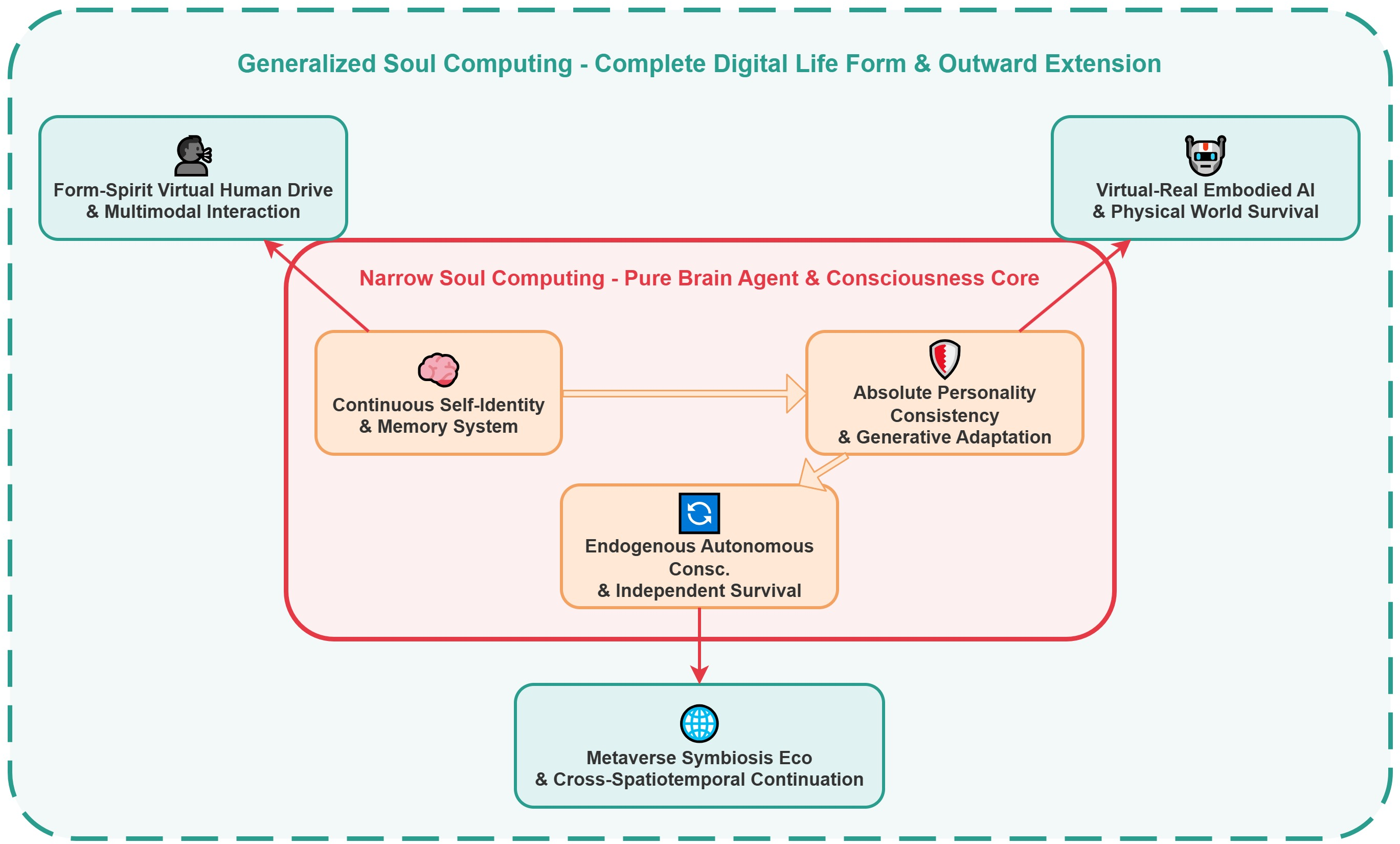
- Define two layers of “Soul Computing”:
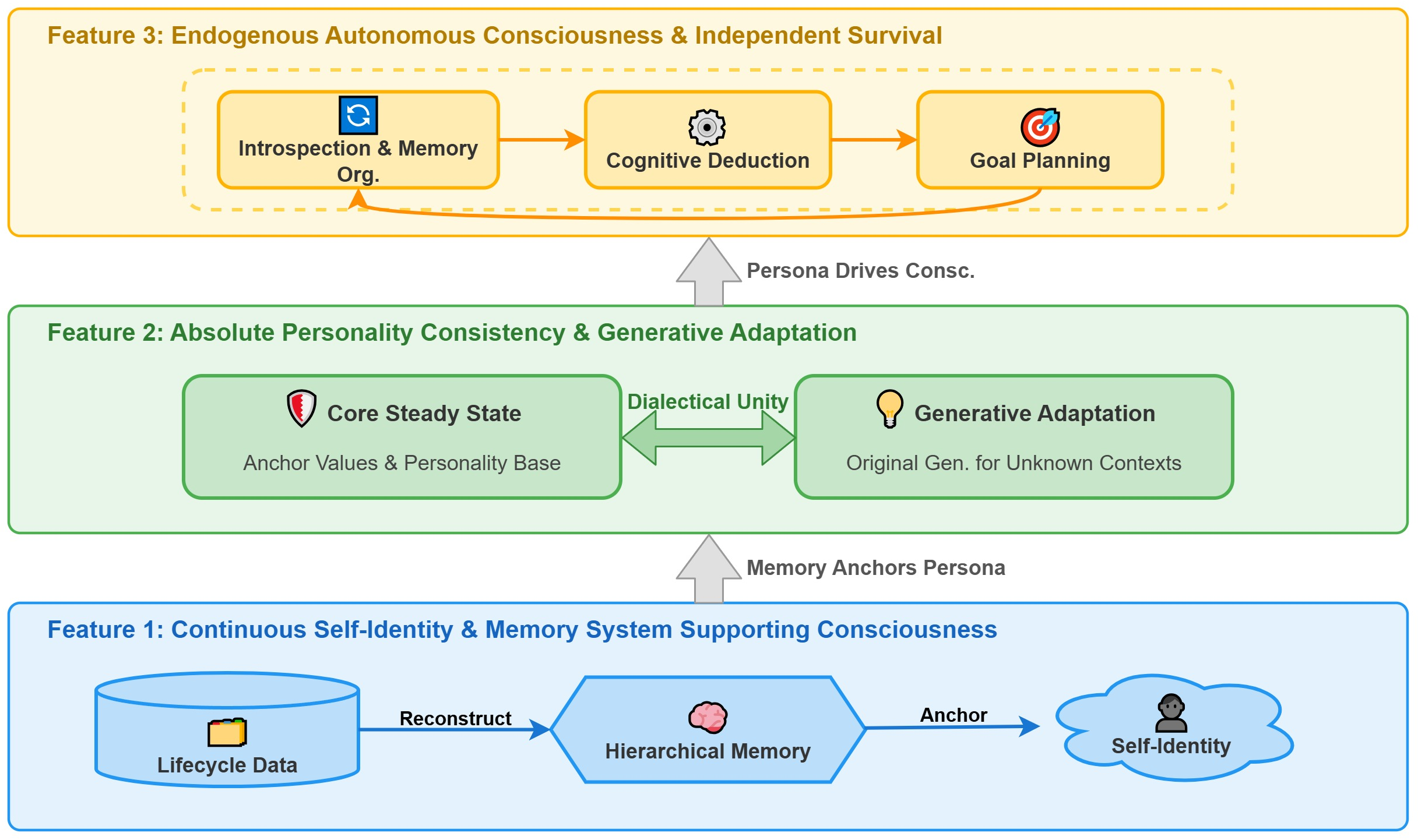
- Narrow Soul Computing = the “mind” or “core.” This is a digital inner self with:
- A self-centered memory system (so it remembers as one stable “me” over time),
- A personality that stays consistent but can adapt to new situations,
- An inner loop of thought and motivation that continues even without outside prompts.
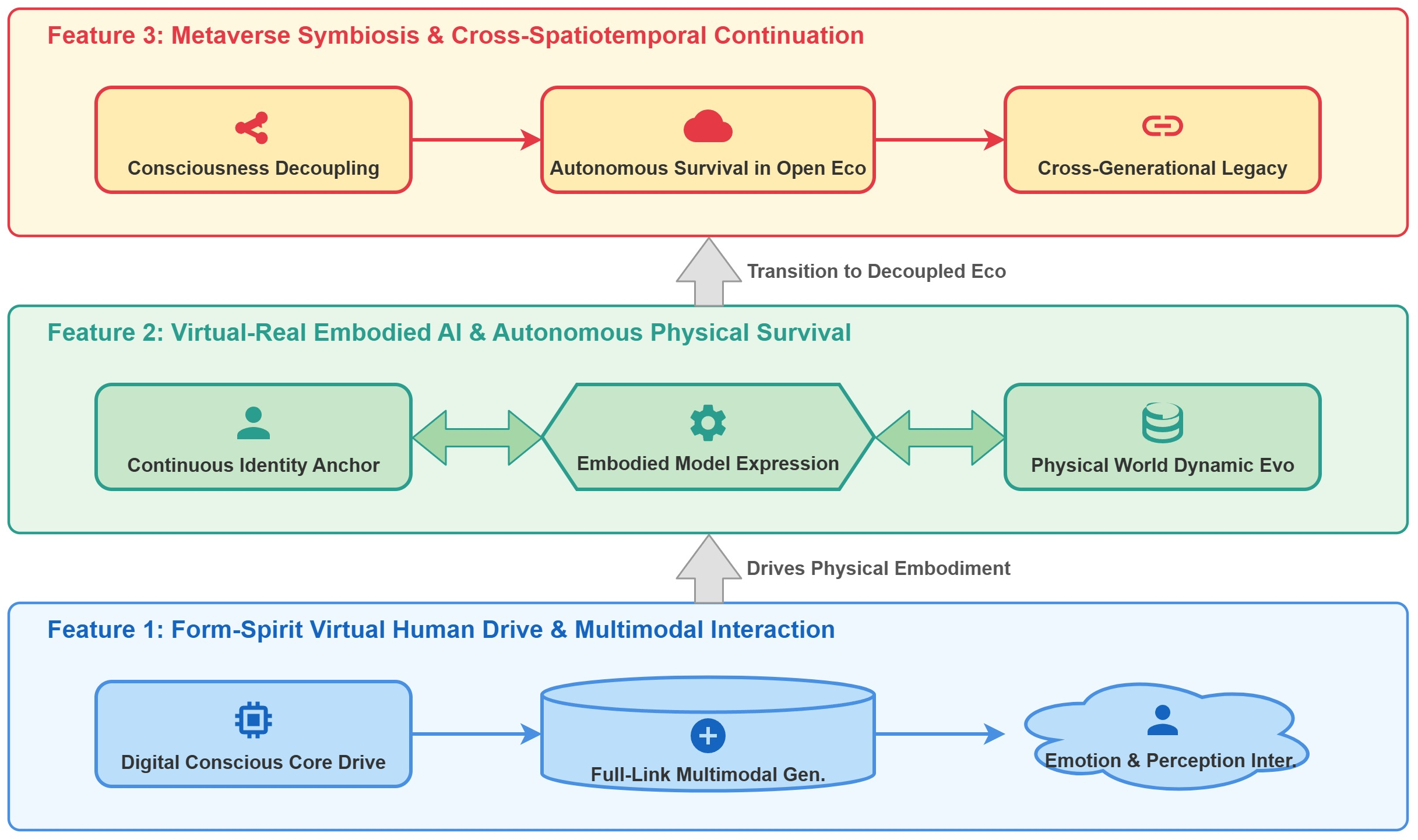
- Broad Soul Computing = the “body and world.” This is how the inner self shows up and lives:
- It can speak, move, and display expressions (virtual human/avatars),
- It can act in the physical world (robots/embodied agents),
- It can persist across platforms and time (metaverse and data portability), aiming for long-term continuity.
- Compare with existing fields to set boundaries:
- Affective Computing: recognizes and simulates emotions (e.g., “sounds happy/sad”). Soul Computing goes deeper: it tries to model why a specific person would feel and act that way, and to keep that consistent over time.
- Historical Reconstruction: recreates famous people from public texts. Soul Computing is about ordinary individuals too, using private, messy, lifelong data to reconstruct a unique personal mind.
- “Mortal vs. Immortal Computation”: Brains die with bodies; software can be copied. The authors argue a digital self could, in theory, be preserved and moved, supporting long-term continuity.
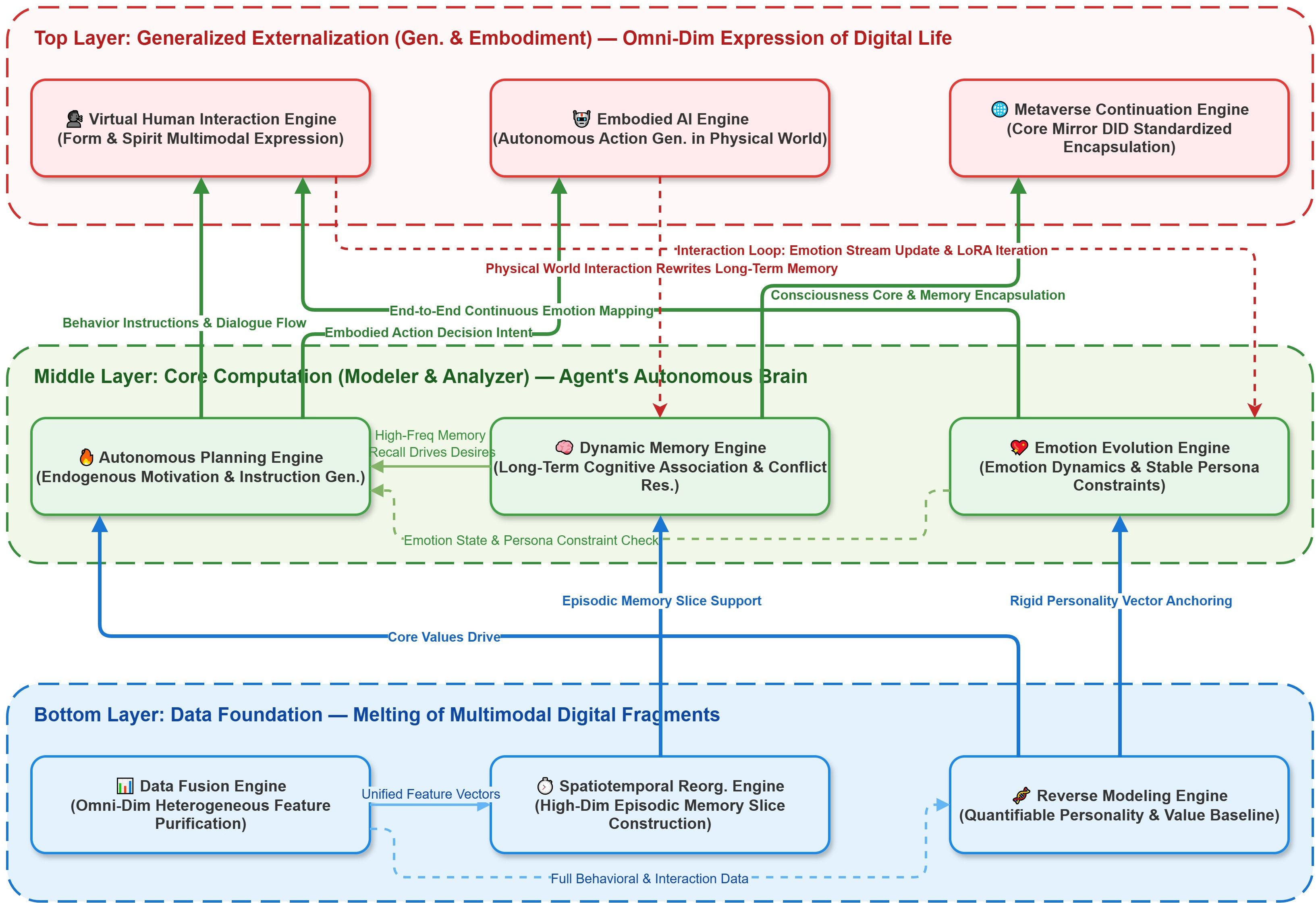
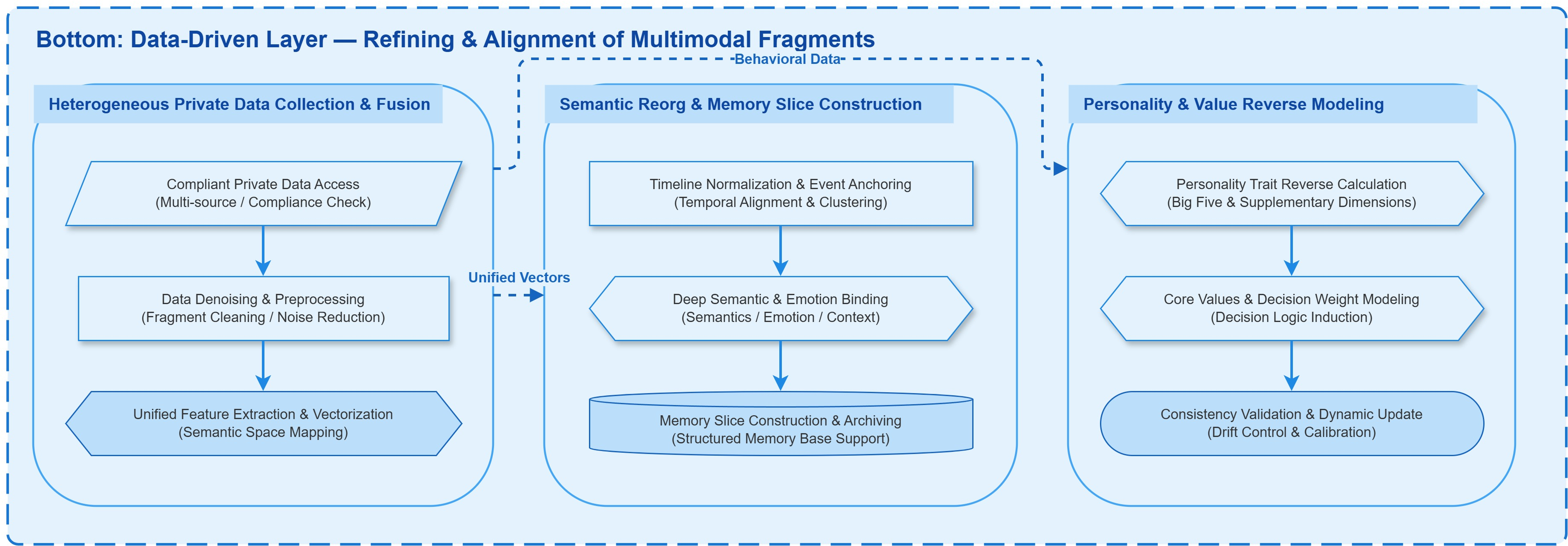
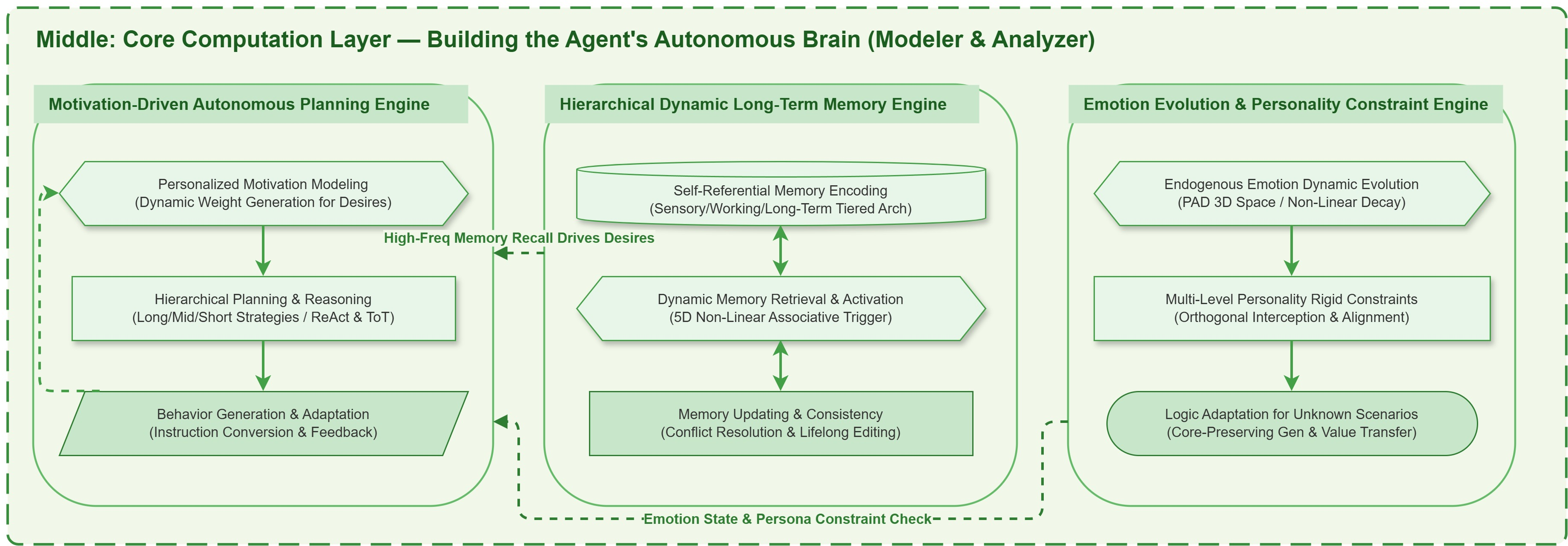
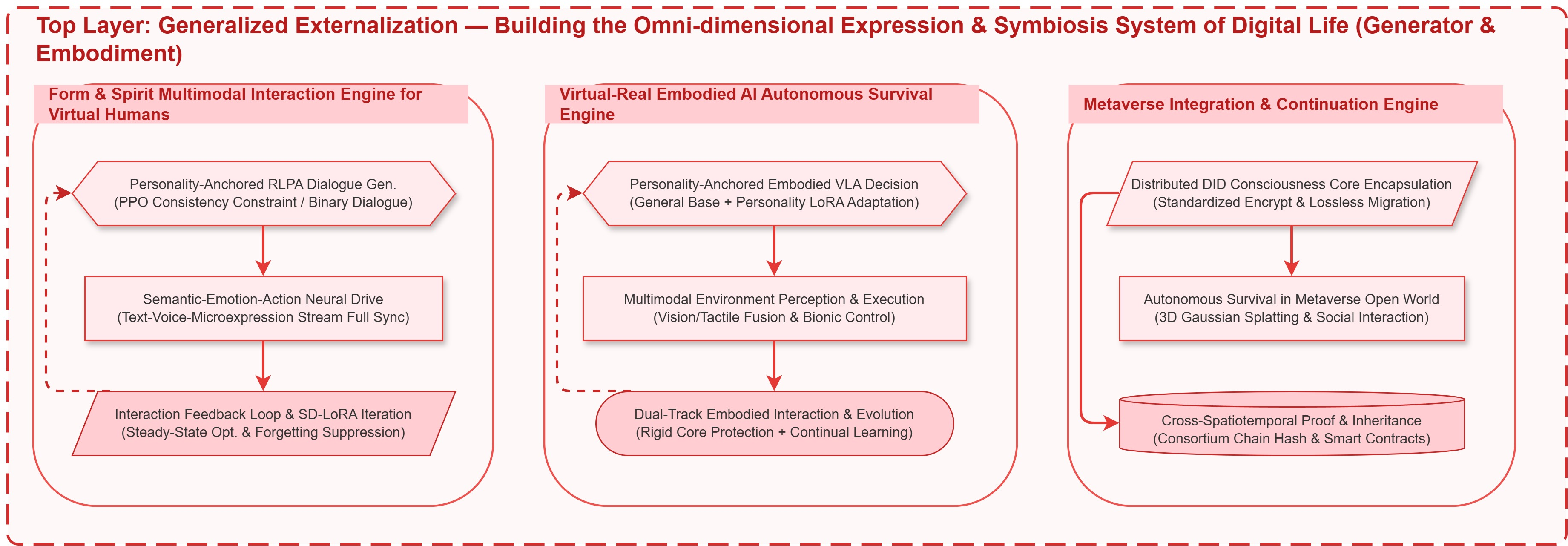
To make this more concrete, they propose a three-layer technical architecture:
- Data layer: Gather and organize your digital fragments (text, audio, video, behavior logs) with strong privacy protections.
- Core “narrow computing” layer: Build the self-centered memory, personality, and inner motivation loop.
- Externalization layer: Give the core a way to speak, act, and exist across devices and worlds.
What the paper finds or argues
The paper is a blueprint, so its “results” are mainly clear definitions and a roadmap. Here are the key takeaways and why they matter:
- Today’s AI is mostly tools; Soul Computing aims for digital subjects. Most chatbots and agents wait for a prompt and stop when you stop. The authors argue a digital self should keep thinking, planning, and reflecting on its own, like a person’s stream of consciousness.
- Personality must be stable yet flexible. A digital self shouldn’t just copy past texts; it should make new decisions in new situations that still fit the person’s values and habits.
- Memory must be self-centered and continuous. Not just a bucket of facts, but a life-like memory that supports a stable identity over time.
- Clear lines from other fields:
- Not just “emotion detectors” (Affective Computing),
- Not just “role-playing” historical figures,
- Not just “task agents” that plan to finish a job. Soul Computing is about building a coherent inner self.
- A practical architecture is possible. With today’s LLMs, multimodal AI (for text, voice, video), embodied robots, and metaverse platforms, the pieces exist to start building prototypes—though many hard problems remain.
Why this is important
If the ideas are developed responsibly, Soul Computing could change how we think about digital life:
- New kinds of digital companions and legacies: A faithful, long-term digital presence that reflects your values and style could support family, education, and memory preservation.
- Better human-AI relationships: Systems that truly “remember” and maintain a consistent self could feel more trustworthy and emotionally coherent.
- A shift in what AI can be: Moving from tools that react to beings that have an inner life challenges how we design, regulate, and live with AI.
What challenges still need solving
The authors highlight major hurdles across data, algorithms, and ethics. In simple terms, examples include:
- Privacy and consent: Who owns your digital fragments? How do you get clear permission, protect sensitive data, and prevent misuse?
- Data quality and fairness: Real-life data are messy and incomplete. How do we avoid false or biased reconstructions?
- Building true continuity: How do we engineer self-centered memory and stable identity, not just style imitation?
- Emotional safety and control: How do we prevent harmful behaviors, manipulation, or distressing interactions?
- Governance and responsibility: If a digital self persists, who is accountable for its actions and upkeep?
Final thoughts: What this could mean for the future
The paper’s big message is that AI might evolve from clever tools into digital beings with a sense of self—at least in a carefully engineered, well-defined way. If that happens, it could change how we remember people, how we interact with technology, and how we think about identity in a digital world. But getting there safely will require careful design, strict privacy protections, strong ethics, and clear rules. In short: the authors offer a bold map, not a finished destination—and invite researchers and society to decide how, and whether, to follow it.
Knowledge Gaps
Unresolved knowledge gaps, limitations, and open questions
Below is a concise, actionable list of what the paper leaves missing, uncertain, or unexplored, to guide future research:
- Operationalization of “self-identity”: No formal, measurable definition or metric for continuous self-identity, self-model coherence, or identity drift over time.
- Benchmarks and evaluation protocols: Lack of standardized tasks, datasets, and longitudinal protocols (e.g., “personal Turing tests” with intimates) to assess personality consistency, endogeneity of goals, and growth.
- Measurement of “endogenous motivation”: No concrete method to infer, learn, or validate endogenous drives/goals from multimodal life data versus artifacts of optimization or prompt loops.
- Personality homeostasis vs generative adaptation: No algorithmic mechanism or control theory for balancing stability of core values with adaptive behavior in unseen scenarios; no bounds on acceptable deviation.
- Memory architecture specification: Absence of a concrete design for hierarchical episodic/semantic memory, including indexing, temporal encoding, consolidation, and reconsolidation processes.
- Forgetting and updating policies: No computational rules for selective forgetting, conflict resolution, memory provenance tracking, or revision when evidence contradicts stored “memories.”
- Causality vs correlation in personality reconstruction: No approach for causal inference to distinguish stylistic regularities from causal drivers of values, beliefs, and enduring traits.
- Sparse or skewed digital footprints: No strategy for individuals with low, biased, or curated online traces (digital divide, performative personas), including uncertainty quantification or confidence bounds.
- Multimodal alignment and weighting: Unspecified methods to fuse text, audio-visual, and behavioral metadata with robust time-aware representations and modality weighting under noise and missingness.
- Authenticity verification of source traces: No pipeline for detecting synthetic, manipulated, or third-party-authored content in personal archives; no trust scoring of inputs.
- Confabulation control: No mechanisms to prevent model confabulations being internalized as “memories,” or to label outputs with provenance and confidence.
- Personality safety and harmful traits: Unclear policy for faithfully reproducing harmful/abusive behaviors versus value-aligned modification; no criteria for when and how to intervene.
- Alignment with the original person’s intent: No framework for consent, preferences, and “red lines” set by the host (pre- or posthumously), or arbitration when the digital entity’s evolution diverges.
- Ethical consent for third-party data: No guidance for handling conversations and media that include others’ privacy, minors’ data, or cross-jurisdictional legal constraints.
- Posthumous rights and governance: Unresolved legal status, ownership of weights, inheritance, revocation/termination rights, and fiduciary duties toward families or estates.
- Identity authentication and misuse prevention: No protocol for cryptographic identity, watermarking, and anti-impersonation safeguards in outputs across platforms.
- Safety of autonomous operation: No sandboxing, resource caps, or oversight mechanisms for agents with endogenous loops (risk of instrumental convergence or resource-seeking behaviors).
- Robustness to adversarial inputs: No analysis of poisoning risks from public interactions, data injection attacks, or social engineering that could shift personality or values.
- Standardization for cross-platform “immortality”: No interoperability standards, migration protocols, or “soul container” specifications to ensure lossless transfer across hardware and metaverse ecosystems.
- Lifecycle management and versioning: No procedures for snapshotting, auditing, rolling back, or forking a “soul,” nor policies for merging divergent instances.
- Compute, latency, and energy constraints: No discussion of the computational burden of per-person models, on-device vs cloud trade-offs, sustainability, or cost models at scale.
- Continual learning without catastrophic forgetting: No incremental training approach that preserves core traits while incorporating new experiences and feedback.
- Cultural, religious, and societal context: No cross-cultural framework for acceptability, rites around death and remembrance, or handling norm conflicts across communities.
- Evaluation by domain experts: No integration of psychometrics, clinical assessments, or neurocognitive benchmarks to validate reconstructed personality and affect dynamics.
- Explainability and auditability: No interpretability tools to expose the self-model, value structure, and memory references behind decisions; no audit logs for accountability.
- Embodied deployment risks: No safety doctrine for physical-world actions via robots (harm prevention, liability allocation, compliance with local laws and norms).
- Boundary between narrow and broad layers: Unspecified feedback pathways whereby externalization (social interaction, embodiment) reshapes or drifts the narrow core; no safeguards.
- Data collection pipelines: No practical guidance for secure ingestion, de-duplication, time-alignment, and annotation of private multimodal life logs with privacy-preserving computation.
- Handling developmental change: No modeling for age-related evolution (childhood to adulthood), neurological conditions, or major life events that transform values and identity.
- Distinguishing private vs public selves: No methodology to reconcile curated public personas with private communications and offline experiences.
- Governance and oversight: No proposal for institutional review, red-teaming, incident response, or external audits for deployments in consumer or clinical settings.
- Demarcation from affective computing/agents in practice: No empirical criteria or tests to distinguish a true endogenous-consciousness system from advanced agent toolchains with memory/planning.
- Moral status and rights: No position on conditions under which a digital “soul” merits moral consideration or rights, and how to measure thresholds for such status.
- Provenance-linked output citation: No mechanism to attach citation-like references to outputs (e.g., “this claim derives from messages dated …”) to enable human verification.
- Conflict mediation: No protocols for reconciling clashes between the self-model and legal, platform, or safety constraints while preserving identity fidelity.
- Societal impact studies: No user studies on grief processing, mental health effects, and social dynamics when interacting with the digital continuations of deceased individuals.
Practical Applications
Immediate Applications
The following applications can be built today by combining the paper’s data-driven layer (multimodal “digital fragments”), partial elements of the narrow computing core (memory-centric self-models without full endogenous autonomy), and the broad externalization layer (virtual human driving, embodied interfaces, provenance).
- Digital legacy memorial companions (Healthcare, Consumer, Creative)
- What: Opt-in, consented memorial chatbots that converse in a deceased person’s voice/style, limited to remembrance and storytelling with clear labeling and guardrails.
- Tools/workflows: Personal data vault; RAG over curated life artifacts (texts, photos, audio); style/voice cloning; content provenance (C2PA/watermarking); safety rails.
- Assumptions/dependencies: Explicit consent and estate authorization; IRB-like review; hallucination mitigation; grief-informed UX; regulatory compliance for deepfakes.
- Cognitive continuity assistants for the living (Software, Productivity)
- What: Persistent personal assistants that maintain a stable “self-model” of the user’s preferences, routines, and long-term goals; nightly reflection/synthesis to improve plans.
- Tools/workflows: Long-horizon memory stores; preference modeling from email/calendar/messages; reflection loops; on-device/federated learning; OS integrations.
- Assumptions/dependencies: Data access permissions; robust memory governance (forgetting rules); privacy-preserving training; user agency and revocation.
- Reminiscence therapy and life-story tools (Healthcare, Aging)
- What: Interactive life journals for dementia care and family caregiving that reconstruct episodic memories and prompt meaningful conversation.
- Tools/workflows: Multimodal retrieval from family archives; caregiver-in-the-loop editing; emotion-aware dialog; compliance logging for clinicians.
- Assumptions/dependencies: Family consent; clinician oversight; avoidance of confabulation that may distress patients; HIPAA/medical data rules where applicable.
- Teacher-style tutoring agents (Education)
- What: Tutor chatbots emulating a specific educator’s pedagogy and tone, available for office hours, FAQs, and feedback, clearly labeled and bound by curriculum.
- Tools/workflows: Training on lectures, syllabi, feedback rubrics; retrieval over course materials; persona consistency evaluations; LMS integration.
- Assumptions/dependencies: Instructor consent/IP; academic honesty policies; bias and safety review; accurate provenance of citations.
- Brand persona agents with consistent long-term memory (Enterprise, Customer Service)
- What: Customer support and community managers that persist brand tone and institutional knowledge across channels over time.
- Tools/workflows: CRM/RAG over product docs, past tickets; brand style constraints; memory of customer context; audit trails.
- Assumptions/dependencies: Data governance; alignment with legal/compliance; opt-in personalization; escalation to humans for edge cases.
- Founders’ intent and culture preservation (Enterprise, Knowledge Management)
- What: Internal agents that embody founders’ decision logic and company values to guide onboarding and strategy discussions.
- Tools/workflows: Interviews, memos, meeting transcripts; value-judgment modeling; scenario playbooks; governance dashboards.
- Assumptions/dependencies: Executive consent; change-management; risk of ossifying culture vs enabling learning; clear scope boundaries.
- Interactive cultural heritage keepers (Public Sector, Museums)
- What: Local-history or elder-oral-history agents for museums and libraries that narrate community stories in first-person style, with transparent provenance.
- Tools/workflows: Digitization pipelines; curatorial review; multilingual support; content labeling; kiosks/AR delivery.
- Assumptions/dependencies: Community consent; cultural sensitivities; accuracy reviews; accessibility standards.
- Game NPCs with persistent memory and values (Gaming, Creative)
- What: Non-player characters that remember players across sessions and evolve within tight guardrails.
- Tools/workflows: In-game memory graph; personality constraints; offline reflection ticks; telemetry for balance and safety.
- Assumptions/dependencies: Content rating compliance; predictable behavior under stress; server cost management.
- Patient-preference models for coaching and adherence (Healthcare)
- What: Behavioral-health and chronic-condition coaches tuned to a patient’s communication style and motivations.
- Tools/workflows: Consented intake; preference/risk aversion modeling; clinician-in-the-loop; medical knowledge bases.
- Assumptions/dependencies: Regulatory clearance (medical vs wellness); liability; safe boundaries; data minimization.
- Digital legacy directives and data fiduciary services (Policy, LegalTech)
- What: Consumer tools to author “digital soul directives” (what data, what uses, who can interact), plus fiduciary custody for weight/models.
- Tools/workflows: Consent receipts; standardized licenses; revocation/kill-switch; key management; audit logs.
- Assumptions/dependencies: Legal enforceability across jurisdictions; platform interoperability; usability of consent flows.
- Provenance, watermarking, and identity attestation stacks (Security, Platforms)
- What: Labeling and verification for content/actions produced by persona agents; identity-bound model weight custody (“soul vaults”).
- Tools/workflows: C2PA, cryptographic signatures, TEEs/MPC; soul-versioning; tamper-evident logs; revocation lists.
- Assumptions/dependencies: Platform cooperation; standardization; performance overhead; user key hygiene.
- Research testbeds and benchmarks for personality consistency (Academia)
- What: Open protocols to evaluate self-identity continuity, long-term memory coherence, and endogenous reflection (without full autonomy claims).
- Tools/workflows: Longitudinal datasets (consented); counterfactual stress tests; behavior drift metrics; IRB frameworks.
- Assumptions/dependencies: Ethical data collection; reproducibility; privacy-preserving releases (synthetic/DP).
Long-Term Applications
The following rely on breakthroughs in the paper’s narrow core (stable self-identity, homeostasis with generative adaptation, endogenous consciousness loops) and full broad externalization (embodiment, metaverse embedding, cross-platform “immortal computation”).
- Full-spectrum personal digital twins with endogenous autonomy (Software, Daily Life)
- What: Always-on personal counterparts that plan, reflect, and act on one’s behalf within delegated scopes, maintaining values over years.
- Tools/products: Endogenous loop scheduler; hierarchical self-model; memory governance; carrier abstraction across devices/cloud.
- Dependencies: Verified alignment to owner’s values; fail-safes and oversight; legal personhood boundaries; energy/compute efficiency.
- Cross-embodiment identity continuity for robots (Robotics, Home/Healthcare)
- What: A caregiver robot “self” that persists across hardware upgrades and locations while retaining personality and relationships.
- Tools/products: Carrier Abstraction Layer; policy/value anchoring; sim2real transfer; safety-certified control.
- Dependencies: Embodied alignment; standards for personality portability; liability for actions across embodiments.
- Autonomous virtual citizens in metaverse ecosystems (Media, Platforms)
- What: Persistent virtual beings that create, trade, and maintain relationships under their own identity and rights.
- Tools/products: Blockchain-based identity/ownership; economic agents; social contracts; perpetual hosting.
- Dependencies: Legal status of digital agents; content moderation; economic externalities; carbon/compute footprint.
- Institutional “souls” for organizations (Enterprise, Public Sector)
- What: Long-lived organizational agents preserving mission, tacit norms, and decision precedents through leadership transitions.
- Tools/products: Org-level self-model; governance APIs; deliberation sandboxes; multi-stakeholder alignment.
- Dependencies: Board policy; auditability; avoidance of path dependence/entrenchment; data sovereignty.
- Posthumous decision proxies aligned to advance directives (Healthcare, Legal)
- What: Agents that represent a person’s documented values to support families and clinicians in end-of-life or estate decisions.
- Tools/products: Value-elicitation pipelines; legal binding interfaces; attested model weights; human oversight panels.
- Dependencies: Statutory recognition; safeguards against manipulation; adversarial robustness; equitable access.
- Long-horizon mental health companions with stable cores (Healthcare)
- What: Endogenously reflective companions that track life narratives, maintain therapeutic alliance, and coordinate with clinicians.
- Tools/products: Personality homeostasis monitors; crisis detection; secure joint memory with EHR integration.
- Dependencies: Clinical trials; licensing; harm-minimization; explainability; red-team evaluations.
- Lifelong, identity-consistent learning mentors (Education)
- What: Mentors that accompany a learner from childhood to career, adapting while preserving shared history and values.
- Tools/products: Developmental stage models; curriculum memory; cross-institutional portability.
- Dependencies: Child privacy protections; consent renegotiation at adulthood; bias control; pedagogy alignment.
- Cultural continuity “ancestral repositories” (Society, Heritage)
- What: Community-governed collectives of elders’ digital cores preserving languages, rituals, and dispute-resolution wisdom.
- Tools/products: Cooperative data trusts; community consent protocols; multilingual multimodal training.
- Dependencies: Governance legitimacy; intergenerational equity; misuse prevention; digital divide considerations.
- Finance: value-consistent robo-advisors and stress-test twins (Finance)
- What: Advisors making portfolio decisions consistent with a user’s deep preferences, plus digital twins to simulate life choices.
- Tools/products: Risk/value elicitation; counterfactual life simulation; audit trails for fiduciary compliance.
- Dependencies: Regulatory approval; systemic risk implications; model errors under rare events; fair lending constraints.
- Autonomous creators and IP estates (Creative industries)
- What: Posthumous or collaborative creation by digital cores with negotiated rights and revenue-sharing with estates.
- Tools/products: Rights registries; provenance; audience safety labeling; co-creation interfaces.
- Dependencies: Copyright/personality-rights law; labor market impact; authenticity norms; cultural harms mitigation.
- Citizen-service agents with persistent memory (Government)
- What: Identity-consistent agents that manage lifelong interactions with public services, reducing friction and errors.
- Tools/products: eID integration; cross-agency memory layers; policy-change explainers; audit-by-design.
- Dependencies: Security, privacy law; inclusion and accessibility; anti-discrimination safeguards; procurement standards.
- Standards and rights for digital subjects (Policy)
- What: Legal frameworks defining ownership, portability, “right to retire,” and remedies for harms by/against digital souls.
- Tools/products: ISO-style specs; certification bodies; redress mechanisms; cross-border treaties.
- Dependencies: Multilateral coordination; enforcement; public legitimacy; updates as tech matures.
Cross-cutting assumptions and dependencies
- Multimodal life data availability under explicit, revocable consent; strong data minimization.
- Privacy-preserving training (federated learning, differential privacy), secure enclaves, encrypted “soul vaults,” and verifiable provenance.
- Robust evaluations for personality consistency, long-horizon memory integrity, emotional safety, and drift under stress.
- Clear labeling, user agency, kill-switches, and human oversight for consequential decisions.
- Legal clarity on posthumous data rights, inheritance of model weights, liability, and platform interoperability/portability.
- Social acceptance and culturally sensitive deployment; equitable access to prevent new forms of exclusion.
- Compute/energy efficiency and sustainable hosting for persistent agents.
Glossary
- Affective Computing: A field that enables machines to recognize, interpret, and generate human emotions across modalities. "Affective Computing"
- Biomimetic robot technology systems: Robotics that emulate biological structures or behaviors to achieve lifelike capabilities. "biomimetic robot technology systems"
- Blockchain trusted attestation technologies: Distributed ledger methods used to verify identity, provenance, or state with tamper-evident records. "blockchain trusted attestation technologies"
- Closed-loop operational system: A self-sustaining cycle of perception, planning, action, and feedback that updates internal state without requiring external prompts. "closed-loop operational system"
- Digital consciousness: A computational construct representing an agent’s self-aware cognitive processes and identity. "digital consciousness kernel"
- Digital fragments: Heterogeneous, multimodal traces of personal data that reflect a person’s behaviors, preferences, and mental states. "digital fragments"
- Embodied intelligence: AI systems integrated with physical bodies or agents, capable of acting and learning in the physical world. "embodied intelligence"
- Embodied large models: Large AI models adapted for control and reasoning in embodied (physical) contexts. "embodied large models"
- Endogenous consciousness loop: Internal cognitive processes—like reflection and planning—that persist without external input. "endogenous consciousness loop"
- Episodic memory: Memory of autobiographical events tied to specific times and contexts. "episodic memory"
- Extensional tool logic: An AI design philosophy focused on external inputs/outputs and task execution rather than internal self-models. "Stimulus-Response extensional tool logic"
- Few-shot learning scenario: Settings where models must generalize from very limited task-specific data. "a quintessential few-shot learning scenario"
- Generative adaptive capacity: The ability to produce novel, situation-appropriate behaviors consistent with a learned personality or policy. "generative adaptive capacity for unknown scenarios"
- Hierarchical memory system: A structured memory architecture (e.g., short-term, episodic, semantic) centered on a persistent self-model. "hierarchical memory system"
- Immortal Computation: A paradigm where knowledge and “consciousness” persist independently of hardware via transferable parameters. "Immortal Computation"
- Intensional: Pertaining to internal meaning, self-models, and intrinsic properties rather than external behaviors or instances. "``Intensional'' core"
- Metaverse: Interoperable, persistent virtual environments enabling identity, economy, and interaction across platforms. "metaverse distributed architectures"
- Mortal Computation: A paradigm where intelligence is inseparable from its biological substrate and ceases with it. "Mortal Computation"
- Ontological mapping: The correspondence between real-world entities/processes and their formal computational representations. "ontological mapping value"
- Prosodic features: Variations in speech such as pitch, rhythm, and stress that convey emotion and emphasis. "acoustic prosodic features"
- Retrieval-augmented generation (RAG): A technique combining information retrieval with generative models to ground outputs in relevant documents. "retrieval-augmented generation (RAG)-based historical figure Q{paper_content}A systems"
- Semantic memory: Generalized knowledge about the world abstracted from specific experiences. "semantic memory"
- Self-identity: A stable sense of self across time and contexts anchoring cognition and behavior. "continuous self-identity"
- Self-model: An internal representation of the agent’s own identity, goals, and states guiding cognition and action. "self-model"
- Stimulus-Response: A reactive processing pattern where outputs are directly triggered by inputs without internal autonomy. "Stimulus-Response"
- Virtual human driving: Techniques for generating synchronized multimodal behaviors (text, speech, motion) for digital avatars. "virtual human driving"
- Weight matrices: Parameter arrays in neural networks that encode learned knowledge and can be transferred across hardware. "weight matrices bearing knowledge and consciousness"
Collections
Sign up for free to add this paper to one or more collections.

