- The paper introduces the Adaptive Bio-Neural Interaction Architecture (ABNIA), a unified framework that integrates living neural networks with digital platforms for closed-loop, adaptive control.
- It details a system-level pipeline that decomposes the process into encoding, observation, and feedback modules using spike sorting and dynamic stimulation techniques.
- The study benchmarks SBI’s advantages by demonstrating orders-of-magnitude energy savings and superior sample efficiency, with multi-organoid setups achieving up to 83% classification accuracy.
Synthetic Biological Intelligence: System-Level Abstractions and Adaptive Bio-Digital Interaction
Introduction and Motivation
The exponential growth of AI has elevated the urgency for alternative computational substrates capable of high-throughput, adaptive, and energy-efficient processing. Synthetic Biological Intelligence (SBI) emerges as a direct response to the scalability and inefficiency bottlenecks in silicon-based AI. SBI systems purposefully integrate living Biological Neural Networks (BNNs)—typically cultured neural organoids—with digital platforms to instantiate closed-loop, task-driven bio-digital interfaces. This hybrid paradigm departs fundamentally from static silicon architectures by leveraging plasticity, self-organization, and energy efficiency inherent to biological substrates (2604.27933). The field’s progression hinges on advances in microelectrode array (MEA) technology, organoid culture, automated homeostasis systems, and robust bio-digital interfacing protocols.
Biocomputing Definitions and Conceptual Hierarchy
A major contribution of the paper is the rigorous clarification of terminologies and taxonomic relationships within bio-inspired computing. SBI is delineated as a subset of hybrid intelligence and wetware computing, focusing on closed-loop digital control of living BNNs as computational substrates. In contrast, organoid intelligence (OI) emphasizes the developmental and neuroscientific properties of organoids, while neuromorphic computing relies exclusively on silicon substrates mimicking neural functionality.
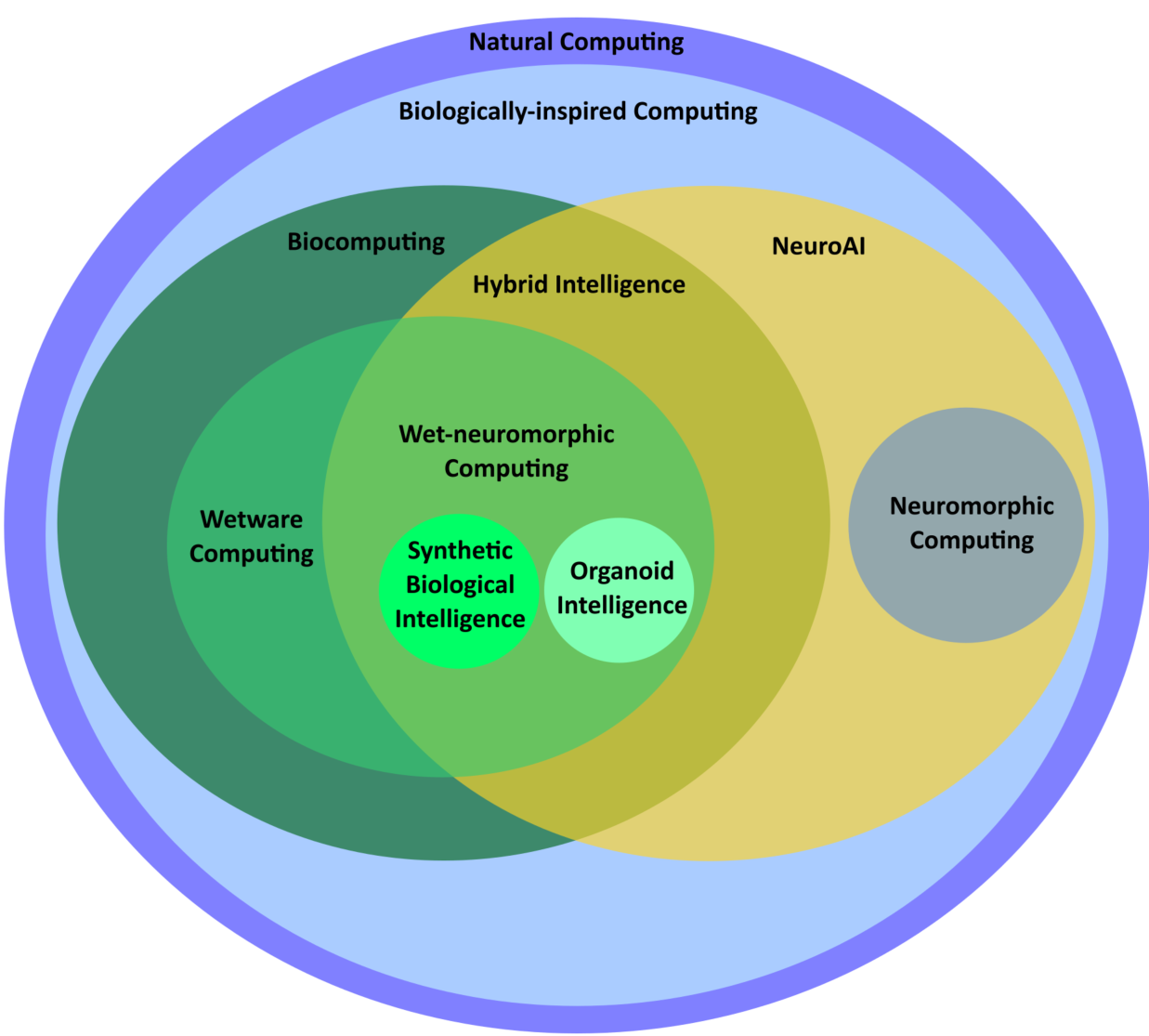
Figure 1: Hierarchical relationships among core terms in biologically-inspired computing, indicating SBI as a distinct closed-loop bio-digital embodiment.
The paper further stratifies bio-inspired approaches across spatial and organizational scales, from molecular biocomputing (e.g., DNA computing) to mesoscale organoid-based systems and whole-network/embodied SBI (Figure 2). This conceptual mapping ensures terminological precision for cross-study comparison and future standardization.
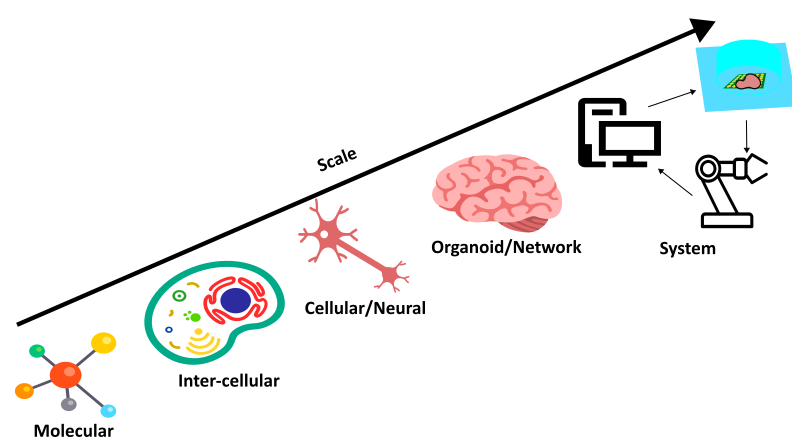
Figure 2: Schematic representation of information processing at different spatial and organizational scales in biologically-inspired computing.
Technological Underpinnings: Neural Cultures and MEAs
SBI leverages dissociated neuron cultures and advanced MEA platforms. Early-stage SBI testbeds often used rodent neurons, but the field now exploits human iPSC-derived cortical neurons for advanced network complexity and more transferable information processing capabilities. Three-dimensional organoid models, maintained via microfluidic systems for extended viability, are increasingly prevalent for their structural and functional biomimicry of cortical architecture.
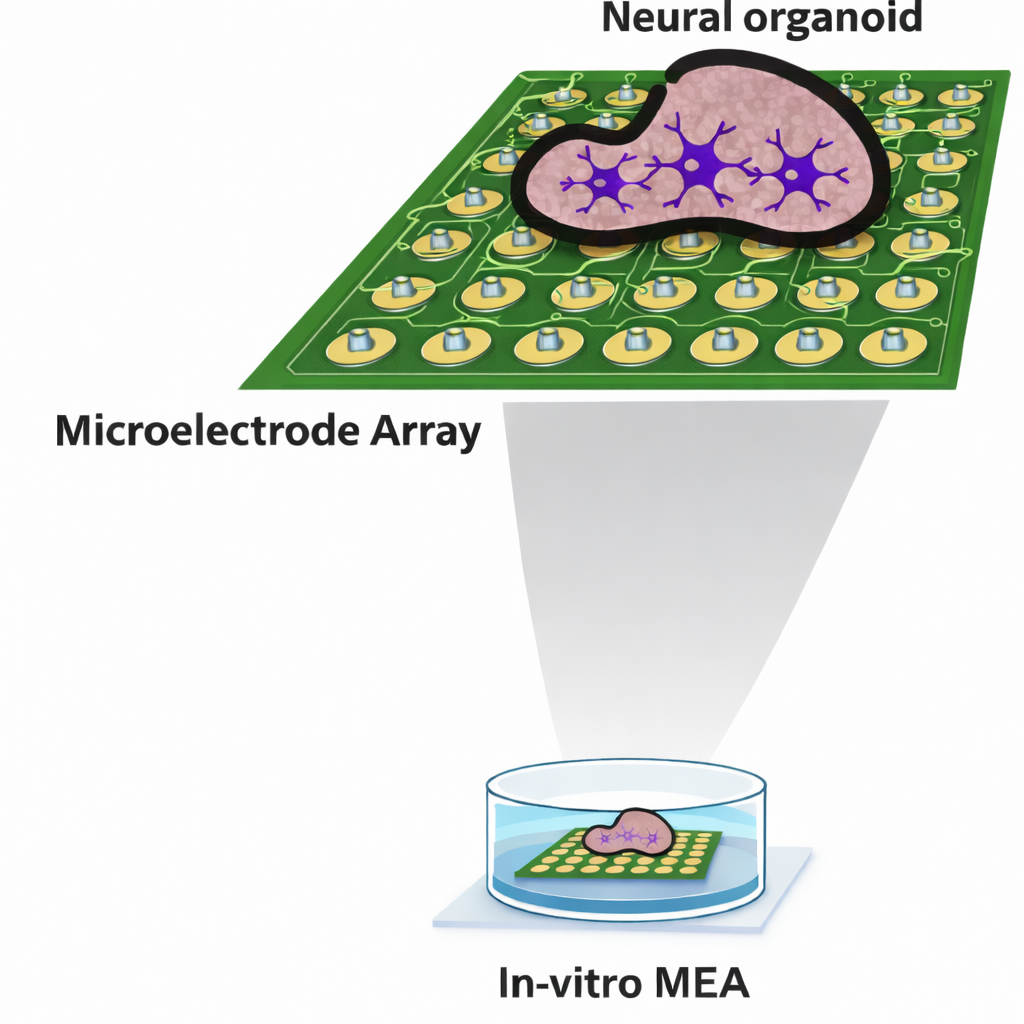
Figure 3: In-vitro MEA schematic depicting an organoid placed atop an electrode array, the primary interface for controlled bio-digital signal exchange.
While SBI offers several inherent advantages (robust plasticity, non-linear dynamics, spontaneous organization), it introduces practical challenges: neuronal cultures are mortal, non-stationary, and subject to spontaneous activity, requiring sophisticated environmental control and encoding/decoding methodologies.
SBI Closed-Loop System Pipeline
The paper introduces the Adaptive Bio-Neural Interaction Architecture (ABNIA) as a unified systems framework for SBI. ABNIA decomposes the bio-digital pipeline into four modules:
- Encoding and Stimulation: Translates digital input into structured electrical or chemical stimuli delivered via MEA channels.
- Adaptive Biological Neural Substrate: The living neural culture exhibiting plasticity, history dependence, memory, and emergent network dynamics.
- Observation and Interpretation: Electrodes record neural activity, followed by spike sorting, feature extraction, and decoding.
- Feedback and Control: Closed-loop adaptation of stimulation based on interpretation metrics and task outcomes.
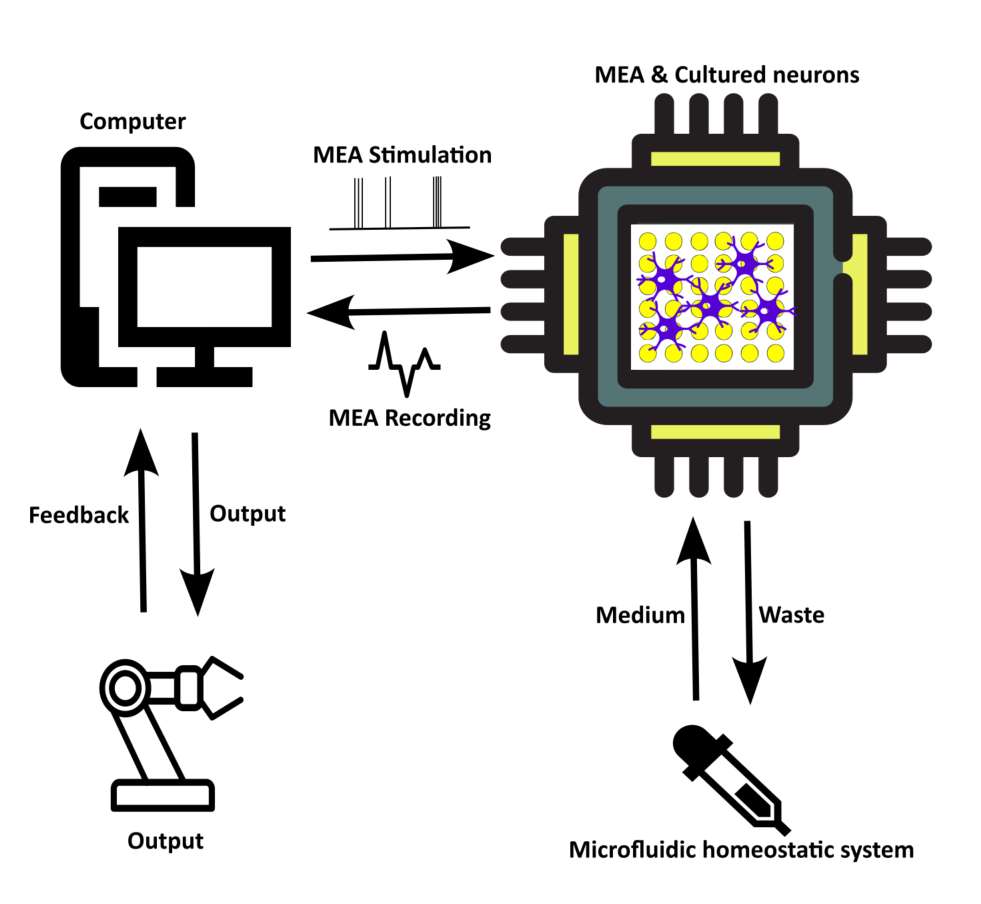
Figure 4: Closed-loop SBI system schematic, highlighting real-time feedback between computer, MEA/neural culture, actuators, and microfluidic life-support.
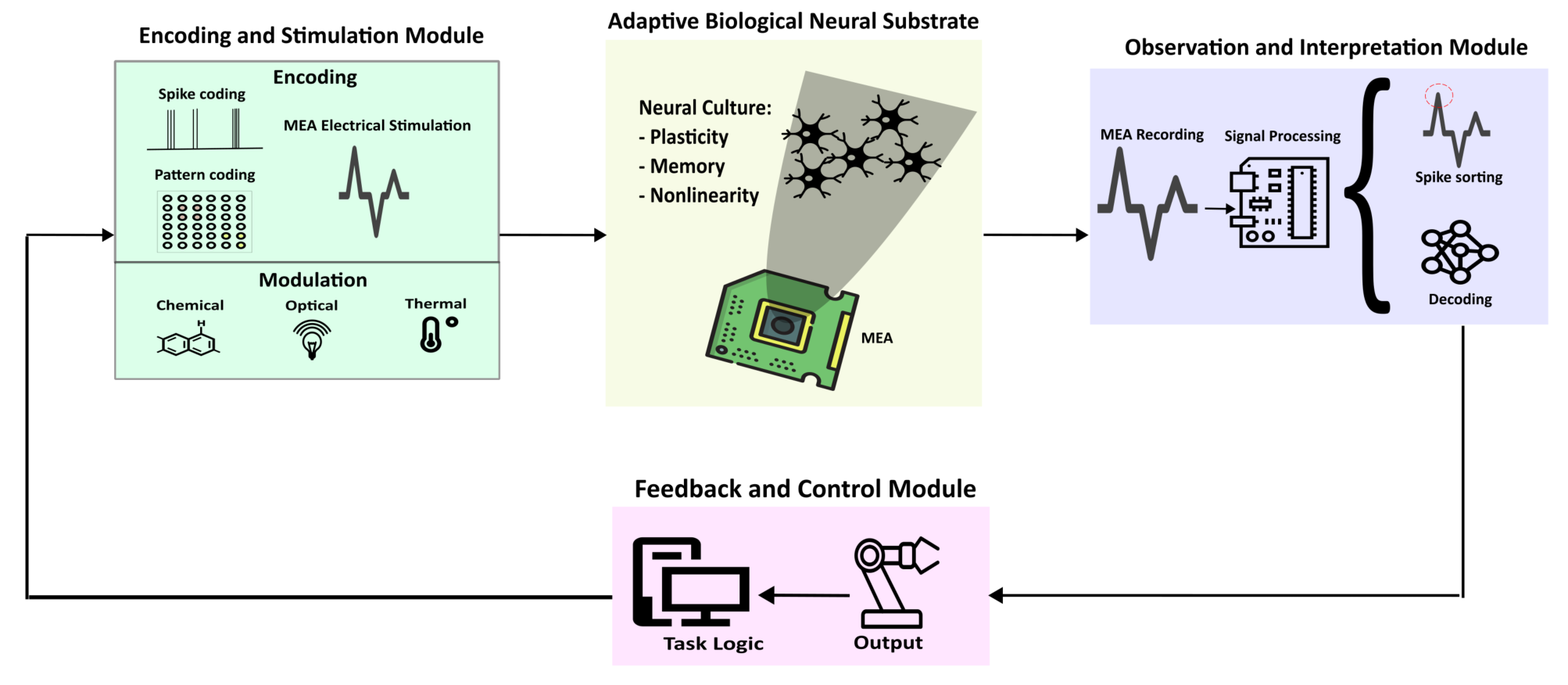
Figure 5: The ABNIA pipeline, emphasizing nonlinear memory-rich processing, multiscale feedback, and adaptive control of the living neural channel.
Encoding Modalities
SBI systems employ a diverse array of encoding schemes tuned to the biophysical constraints and computational capabilities of the neural substrate:
- Spike-based Rate Coding: Information is represented in average firing rates over defined intervals; robust but low-bandwidth [guoNeuralCodingSpiking2021].
- Temporal Coding: Time-to-first-spike, inter-spike intervals, and phase relations encode information with higher temporal resolution, theoretically increasing bandwidth but susceptible to biological noise and jitter.
- Spatial Coding: Utilizes the spatial distribution of stimulation across the MEA to differentiate input classes or task states [kaganVitroNeuronsLearn2022].
- Non-electrical Modulation: Chemical, optical, or thermal inputs to alter plasticity, excitability, or synchronization state, especially relevant for pharmacological and developmental experimentation.
Encoding design must account for the adaptive, non-stationary, and history-dependent responses of the neural substrate, which are shaped by both immediate stimuli and accumulated plasticity.
Decoding and Interpretation
Observation modules implement signal conditioning, automatic thresholding, and advanced spike sorting techniques (including PCA, wavelets, and neural classifier-based approaches) [buccinoSpikeSortingNew2022]. Downstream decoding interprets spike timing, bursts, and firing-rate patterns using both feature-based and classifier-driven (SVM, ANN) methods. Sequence-aware approaches (e.g., Markov models) are essential due to strong inter-symbol interference and network memory.
Adaptive Substrate Properties and Channel Modeling
The biological substrate is fundamentally distinct from classical communication channels:
- Non-linearity and Adaptivity: Synaptic plasticity and long-term drift dictate response characteristics.
- Temporal Memory: SBI substrates integrate information across broad temporal windows; criticality and synchronization states modulate computational efficacy [habibollahiCriticalDynamicsArise2023].
- Noise and Variability: Ionic channel stochasticity, synaptic noise, and population-level bursting necessitate robust coding/decoding and careful system modeling [faisalNoiseNervousSystem2008].
Benchmarks must account for the substrate’s ongoing evolution, high inter-experimental variability, and mortality, limiting direct cross-session and cross-platform comparisons.
Control, Feedback, and Task-Oriented Adaptation
Closed-loop feedback defines SBI’s system-level advantage over open-loop biocomputation and neuromorphic hardware. ABNIA’s feedback module enables:
- Adaptive Signal Correction: Dynamic adjustment of stimulation in response to spontaneous drift or network instability.
- Reinforcement Modulation: Task performance-based reward signals, resulting in supervised neural reorganization for task-oriented learning [kaganVitroNeuronsLearn2022].
- Long-Term Plasticity: Stimulation history-dependent modification of network topology and computational capacity.
SBI’s closed feedback induces state transitions and potentially critical dynamic regimes, which directly influence learning efficiency and robustness.
- Energy Efficiency: The energy cost of SBI systems using living BNNs is orders of magnitude lower than digital supercomputing for comparable computational tasks, as demonstrated by the relative power consumption of human cortical organoids versus exascale supercomputers.
- Sample Efficiency: Studies indicate that SBI substrates (e.g., “DishBrain”) can achieve superior sample efficiency relative to state-of-the-art deep reinforcement learning schemes in real-world time constraints [khajehnejadBiologicalNeuronsCompete2024].
- Robustness and Adaptivity: Multiorganoid ensembles enhance classification accuracy and robustness to noise, with three-organoid SBI systems achieving Braille recognition rates up to 83% in task-specific settings [liuEncodingTactileStimuli2025].
Implications, Limitations, and Future Directions
Practical and Theoretical Implications
SBI, as formalized in ABNIA, represents a new hybrid computing and control substrate combining biological adaptability with digital orchestration. Its applications span neurorobotics, biomedical engineering, drug screening, and low-power AI co-processing [jordanOpenRemotelyAccessible2024, robbinsGoalDirectedLearningCortical2024].
From a theoretical perspective, the field compels reconsideration of computation’s scope beyond Turing models, motivating reconsideration of analog, memory-rich, and multi-scale dynamical systems for AI and network design [maclennanNaturalComputationNonTuring2004, milinkovicBiologicalArtificialConsciousness2026].
Current Limitations
- Reproducibility: Substrate mortality, culture-to-culture variability, and non-stationarity undermine standardized benchmarking and transferability.
- Infrastructure Requirements: Most SBI platforms necessitate stringent lab conditions, though cloud-accessible systems are mitigating this barrier.
- Encoding/Decoding Standardization: The lack of platform-agnostic protocols and benchmarks complicates cumulative progress.
Future Developments
- Standardization: Establishment of transferable, platform-agnostic protocols for encoding, decoding, and benchmarking is needed for field-wide reproducibility and system integration.
- Co-Processor Paradigms: SBI modules could serve as adaptive co-processors in 5G/6G or future hybrid intelligent networks, optimizing energy, flexibility, and robustness for real-time distributed systems [lanWhatSemanticCommunication2021].
- Bioengineering Advances: Multifunctional, high-density 3D MEAs, microfluidic homeostasis, multi-organoid communication (“virtual white matter”) [khantanVirtualWhiteMatter2025], and improved digital-bio interfacing are key technical frontiers.
- Biomedical Applications: SBI holds evident potential for pathophysiological modeling, drug discovery, and in-vitro biomarker benchmarking in neurological and psychiatric disease contexts [ajongboloBrainOrganoidsAssembloids2025, watmuffDrugTreatmentAlters2025].
Conclusion
This survey provides the most comprehensive, system-level abstraction of SBI to date, establishing ABNIA as a robust framework for future research and engineering. By articulating cross-platform protocol unification, detailing substrate-specific channel features, and critically reviewing state-of-the-art platforms, the paper creates the necessary foundation for scalable, reproducible, high-impact SBI development.
The fusion of living BNNs with digital control systems positions SBI at the leading edge of next-generation intelligent and energy-efficient computation, with far-reaching consequences for both AI and neuroscience. Methodological advances in closed-loop feedback, encoding/decoding design, and benchmarking are poised to catalyze SBI’s translation from bespoke laboratory testbeds to integrated, scalable, hybrid bio-digital systems.
Figure 3: In-vitro MEA with organoid culture, the core SBI computational substrate and bi-directional interface.
Figure 4: Schematic of an SBI closed-loop testbed, highlighting the dynamics of signal stimulation, neural response measurement, and automated bio-digital feedback.
Figure 1: Taxonomic relationships among terminology in bio-inspired computing, situating SBI among related paradigms.
Figure 2: Representation of the spatial and organizational scales in biologically-inspired computing, positioning SBI at the network/system level.
Figure 5: The ABNIA closed-loop system: multi-scale encoding, BNN channel, real-time feedback, and adaptive control.